Why Choosing the Right Commercial Roofing System Can Make or Break Your Building
The types of commercial roofing systems available today range from single-ply membranes to spray foam — and picking the wrong one costs Wisconsin property owners thousands in repairs, energy waste, and premature replacement.
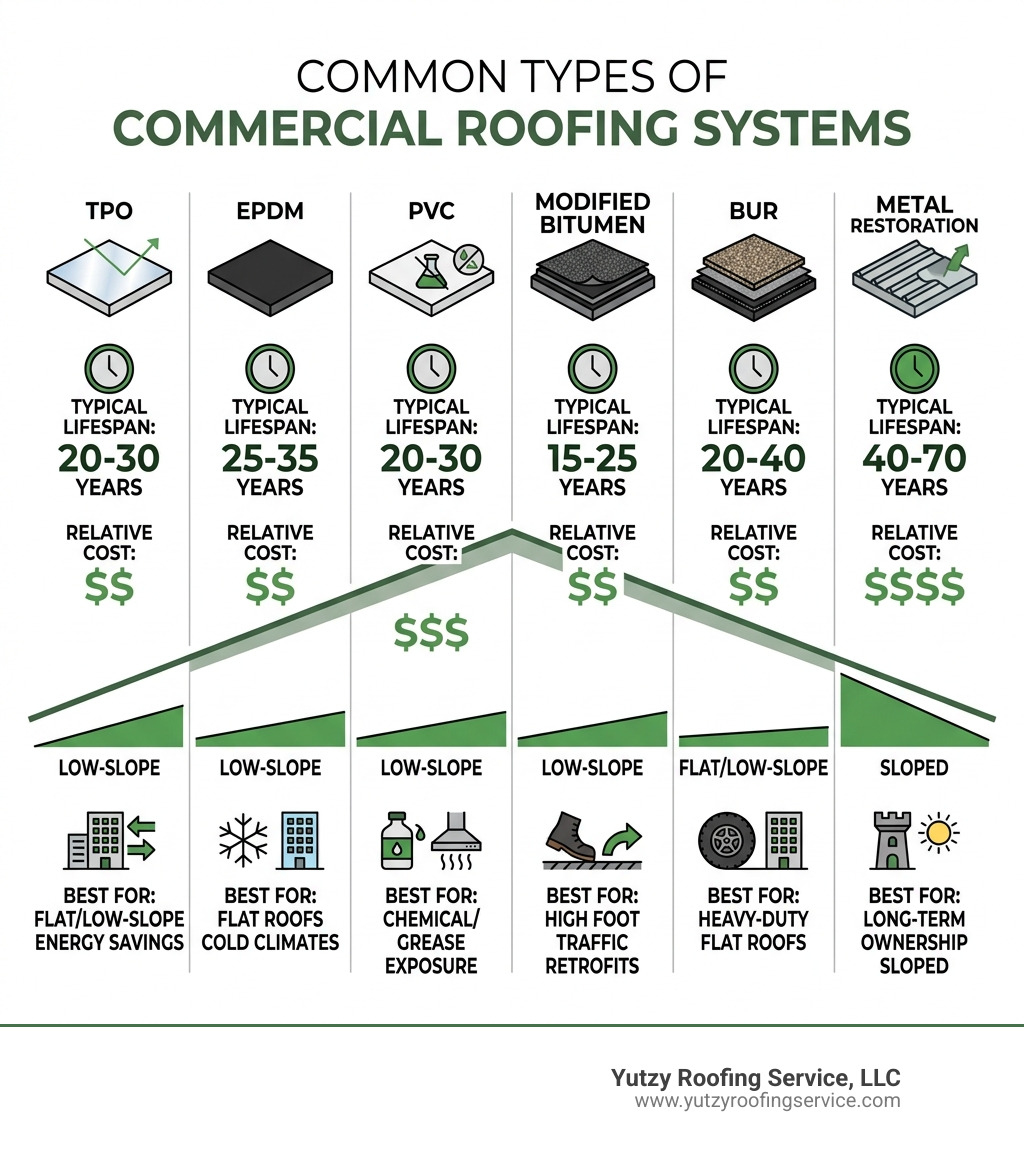
Here’s a quick overview of the most common options:
| Roofing System | Typical Lifespan | Relative Cost | Best For |
|---|---|---|---|
| TPO | 20–30 years | $$ | Flat/low-slope, energy savings |
| EPDM | 25–35 years | $$ | Flat roofs, cold climates |
| PVC | 20–30 years | $$$ | Chemical/grease exposure |
| Modified Bitumen | 15–25 years | $$ | High foot traffic, retrofits |
| Built-Up Roofing (BUR) | 20–40 years | $$ | Heavy-duty flat roofs |
| Spray Foam (SPF) | 15–20+ years (recoatable) | $$$ | Irregular shapes, insulation |
| Metal (restoration) | 40–70 years | $$$$ | Long-term ownership, sloped |
Most commercial buildings in Wisconsin have flat or low-slope roofs. That means your decision usually comes down to a single-ply membrane like TPO or EPDM, a multi-ply system like modified bitumen or BUR, or a restoration solution like spray polyurethane foam.
Single-ply systems alone account for 81% of contractor usage — and for good reason. They’re lightweight, fast to install, and increasingly energy-efficient.
But the “best” system depends on your building, your budget, and your Wisconsin winters. This guide breaks it all down.
I’m Josh Yutzy, and my family business has been installing and restoring commercial roofs across Wisconsin since 1995 — giving me experience with how different types of commercial roofing systems hold up through freeze-thaw cycles, heavy snow loads, and humid summers. That real-world knowledge shapes everything you’ll read here.
Understanding the Most Common Types of Commercial Roofing Systems
When we talk about commercial roofing in April 2026, we aren’t just talking about a “lid” for your building. We are talking about a complex, engineered assembly. In regions like Madison or Eau Claire, a roof has to manage extreme thermal shock—where the surface temperature might drop 40 degrees in an hour during a spring storm.
The market has shifted significantly over the last few decades. While “tar and gravel” used to be the only game in town, single-ply membranes now dominate the landscape. According to industry data, TPO holds a massive 40% share of the new construction low-slope market and 30% of the reroofing market. EPDM follows closely, capturing about 26% of the reroofing sector.
Market Share and Slope Suitability
Most commercial structures are designed with low-slope (less than 2:12 pitch) or flat roofs. These designs are economical for large footprints like warehouses in Marshfield or retail centers in Appleton, but they require specialized materials to prevent “ponding” water. Unlike a sloped roof that sheds water instantly, a flat roof must be a perfectly sealed vessel.
Choosing the right membrane is the first step in protecting your investment. If you are wondering how to navigate these choices, you can learn more about how to choose the right type of roof membrane for your commercial building to ensure your facility stays dry and efficient.
TPO: The Energy-Efficient Leader Among Types of Commercial Roofing Systems
Thermoplastic Polyolefin, or TPO, has become the “golden child” of the industry. It’s a white, highly reflective single-ply membrane that is particularly popular for cool roof initiatives.
In the heat of a Wisconsin summer, a dark roof can reach temperatures over 170°F. A white TPO roof reflecting 80% of sunlight stays approximately 50°F cooler. This isn’t just about comfort; it’s about the bottom line. Research shows that cool roofs can reduce cooling energy consumption by 20–40%. For a large distribution hub in Wausau, those savings add up to thousands of dollars annually.
TPO’s greatest strength lies in its heat-welded seams. Unlike systems that rely on adhesives or tapes, TPO seams are fused together using hot air, creating a physical bond that is often stronger than the membrane itself. This makes it incredibly resistant to leaks and wind uplift.
Comparing Traditional and Modern Types of Commercial Roofing Systems
It’s helpful to look at where we’ve been to understand where we’re going.
- Built-Up Roofing (BUR): Often called “tar and gravel,” BUR has been around for over 100 years. It consists of alternating layers of bitumen (asphalt) and reinforcing fabrics. While it is incredibly tough and offers great redundancy (if one layer fails, you have three more), it is heavy, smelly to install, and increasingly expensive due to labor costs.
- Modified Bitumen (Mod Bit): This is the modern evolution of BUR. It uses asphalt that has been “modified” with polymers like SBS (styrene-butadiene-styrene) for rubber-like flexibility. It’s a great choice for roofs with high foot traffic, such as those with heavy HVAC equipment that requires frequent servicing.
- The Single-Ply Revolution: The shift toward TPO and EPDM was driven by the 1970s energy crisis and a desire for lighter, faster-to-install materials. Today, single-ply systems command 81% of contractor usage because they offer a balanced ROI.
For a deeper dive into these categories, check out a guide to the different types of commercial roofs to see which traditional or modern approach fits your specific structure.
Single-Ply Performance: TPO, EPDM, and PVC

When we install single-ply systems, thickness matters. Membranes are typically measured in “mils” (thousandths of an inch). While 45-mil is the entry-level, we almost always recommend 60-mil or higher for Wisconsin buildings. A thicker membrane provides better puncture resistance against hail and accidental damage from tool-dropping technicians.
The lifespan of these membranes is a major selling point. If you’re curious about the longevity of your current setup, you can read more about roof membranes how long do they last to plan for future capital expenditures.
EPDM Rubber Roofing
Ethylene Propylene Diene Monomer (EPDM) is essentially a high-performance synthetic rubber roof. It has been a staple in the industry since 1962. In cold climates like Green Bay or Rochester, MN, EPDM is a “rockstar” because of its incredible flexibility. It can expand and contract significantly without cracking, which is vital when temperatures swing from -20°F in January to 90°F in July.
- Pros: Highly resistant to UV radiation and thermal shock; relatively easy to repair even 20 years later.
- Cons: Traditionally black (absorbs heat); seams are joined with adhesive tape rather than heat-welding, which can be a weak point if not installed by experts.
EPDM is often a top choice for warehousing and retail. You can find more details on why this material remains a favorite in our look at top flat roof material types you should know about a closer look.
PVC for Chemical and Grease Resistance
Polyvinyl Chloride (PVC) is the “heavy-duty” sibling of TPO. While they look similar, PVC is chemically engineered to withstand much harsher environments.
If you own a restaurant in Madison or a food processing plant in Fond Du Lac, PVC is likely your best bet. It is exceptionally resistant to animal fats, grease, and chemicals that would literally dissolve an EPDM or TPO membrane over time. It also boasts superior fire resistance and puncture strength, though it does come with a higher upfront price tag.
Multi-Ply and Specialized Restoration Systems
Sometimes, the best “new” roof isn’t a replacement at all—it’s a restoration. In Wisconsin, where the cost of a full tear-off can be astronomical due to disposal fees and labor, restoration systems are gaining massive traction.
Spray Polyurethane Foam (SPF) and Coatings
Spray foam is a unique animal. It starts as a liquid and expands 20 to 30 times its volume to form a seamless, monolithic barrier. Because it is “self-flashing,” it seals around every vent, pipe, and HVAC curb without the need for complicated cutting and gluing.
- Insulation Power: SPF offers an incredible R-value of R-6 to R-7 per inch. In a cold climate, this can drastically reduce heating costs.
- Renewability: This is the only “renewable” roofing system. Every 15–20 years, you simply clean the surface and apply a new top coat of silicone. This resets the warranty and prevents the need for a tear-off forever.
However, SPF requires a skilled hand. If applied in wet or windy conditions, it won’t bond properly. That’s why we emphasize working with certified professionals who understand the Wisconsin climate. To learn more about this high-tech option, see what to know about spray polyurethane foam roof system.
The benefits are extensive, ranging from energy efficiency to leak-proofing. We’ve detailed them all in our guide on the benefits of spray polyurethane foam spf for your commercial roof.
Metal Roof Restoration and Maintenance
Let’s get one thing straight: we aren’t talking about installing brand-new metal roofs here. We are talking about saving the one you already have. Many industrial buildings in Mankato or Eau Claire have R-panel or standing seam metal roofs that are structurally sound but leaking at the seams or rusting.
Metal roof restoration involves:
- Power washing to remove oxidation.
- Treating rust with specialized inhibitors.
- Sealing every fastener and seam with reinforced tape or liquid membrane.
- Applying a reflective top coat (like silicone or acrylic).
This process can extend the life of a metal roof by decades at a fraction of the cost of replacement. Plus, metal is highly sustainable and recyclable. For more on why metal is a great candidate for these treatments, read about the top reasons why metal roofs are ideal for commercial buildings.
Selection Factors for Wisconsin Commercial Buildings
Selecting from the various types of commercial roofing systems requires a localized lens. What works in Arizona might fail miserably in Wisconsin. Here are the factors we look at:
- Snow Load: Wisconsin roofs must be engineered to handle heavy, wet snow. A system like BUR or Mod Bit provides the structural “beef” to handle snow removal shovels, while SPF provides the insulation to prevent ice dams.
- Thermal Shock: Our roofs go from freezing nights to sunny days. Flexible membranes like EPDM or SPF are essential to prevent cracking.
- Building Use: Is it a “hot” building (like a laundry facility) or a “cold” building (like a warehouse)? This dictates where your vapor retarder should go.
For a specific breakdown of regional favorites, check out our guide on top options for commercial roofing in Wisconsin.
How do I choose the best system for my budget?
When calculating costs, don’t just look at the quote for installation. Look at the “Lifecycle ROI.”
- Upfront Cost: Shingles or EPDM are often the cheapest initially.
- Energy Savings: TPO and SPF pay for themselves over time through lower utility bills.
- Maintenance: Metal and SPF require less frequent “emergency” repairs if maintained correctly.
We help owners navigate these financial waters in our article on the best roofing system materials for your business.
What are the warranty requirements for commercial roofs?
In the commercial world, an “NDL” (No Dollar Limit) warranty is the gold standard. It means the manufacturer will cover the full cost of repairs (labor and materials) for the duration of the warranty, regardless of the cost.
However, to keep these warranties valid, you must:
- Use a certified installer.
- Document annual inspections.
- Address minor repairs immediately.
At Yutzy Roofing Service, we offer an upfront, 18-year non-prorated renewable warranty on our restoration systems. This gives you peace of mind that your “fix” is actually a long-term solution.
Conclusion
Choosing between the different types of commercial roofing systems doesn’t have to be a headache. Whether you need an EPDM repair in Madison, a spray foam coating in Appleton, or a metal roof restoration in Wausau, the goal is the same: protection and performance.
At Yutzy Roofing Service, LLC, we specialize in making your existing roof work harder for you. We focus on restoration and maintenance because we believe in providing value that lasts. From our home base in Marshfield to our service areas in Green Bay, Fond Du Lac, and beyond, we bring decades of experience to every deck we step on.
Ready to stop worrying about your roof and start saving on your energy bills? Contact Yutzy Roofing Service today for a professional assessment. Let’s build a solution that actually works for your business.
