
Core Criteria for Evaluating Commercial Steel Roof Options
Commercial steel roofs represent some of the sturdiest building envelope components available, routinely engineered to withstand decades of harsh weather. However, the true long-term value of an industrial steel roof hinges on structural gauge, base metal chemistry, and proactive weatherproofing. In high-wind, freeze-thaw, and storm-prone climates across Wisconsin and Minnesota—from Madison and Green Bay to Mankato and Rochester—facility managers seeking to achieve the best steel roof longevity must evaluate existing steel profiles against clear performance benchmarks.
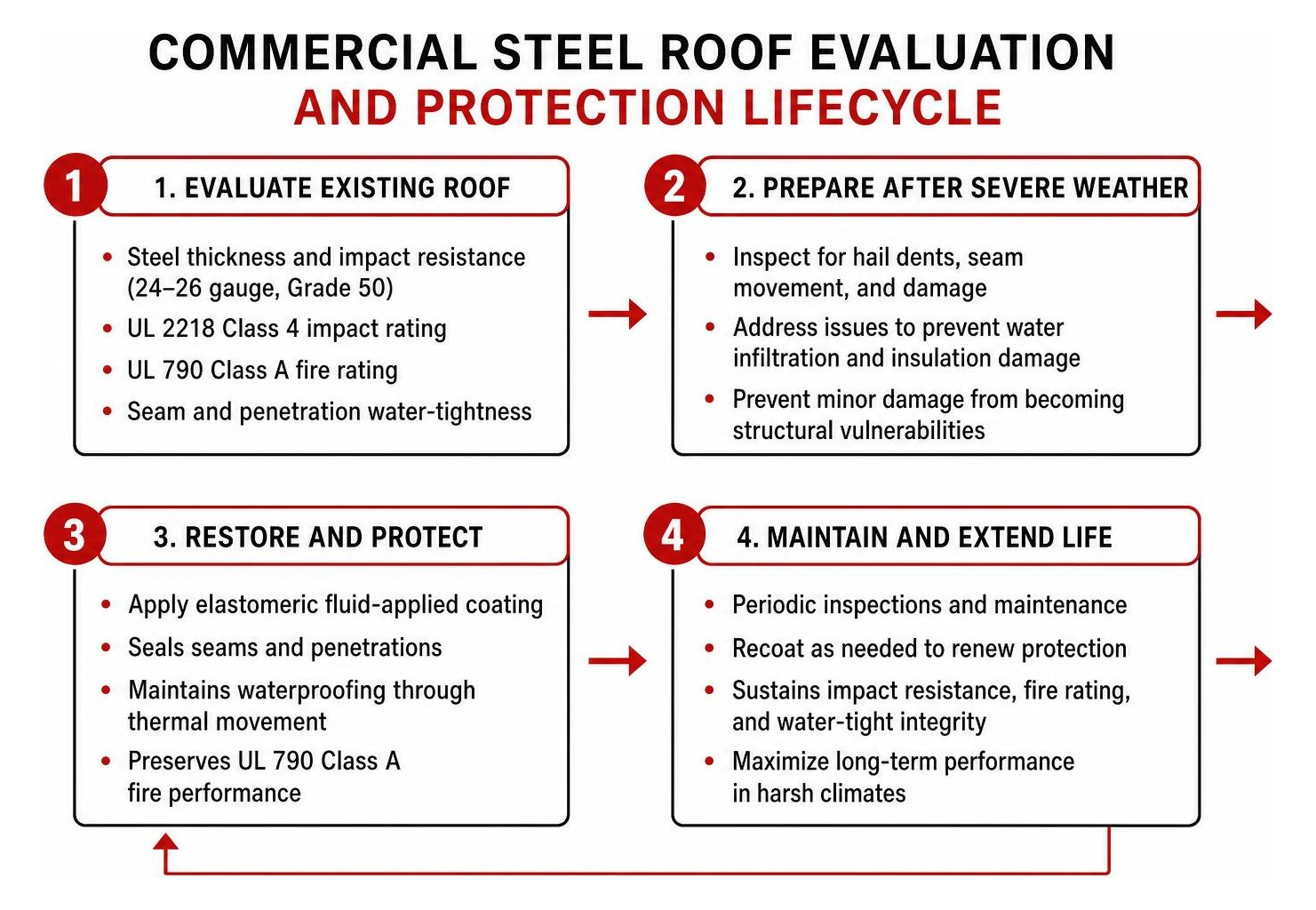
When evaluating an existing commercial steel roof for restoration, we prioritize several critical engineering criteria:
- Steel Thickness and Impact Resistance: Most structural steel roofs utilize 24-gauge or 26-gauge panels. Thicker 24-gauge Grade 50 steel (providing up to 50,000 psi yield strength) offers substantial defense against heavy snow loads and simulated hail strikes. While lighter 29-gauge utility steel is common in basic agricultural buildings, commercial facilities require heavier profiles to prevent structural oil canning and premature flex fatigue under wind uplift pressures (tested under ASTM E1592 standards).
- UL 2218 Class 4 Impact Ratings: A Class 4 rating is the highest impact benchmark achievable under UL 2218 testing, simulating severe hail strikes using dropped steel spheres. Maintaining panel integrity without surface puncture prevents water infiltration that could destroy insulation layers. Knowing how to prep your roof after severe weather ensures that minor hail dents do not turn into structural vulnerabilities.
- UL 790 Class A Fire Ratings: Commercial steel roofs provide non-combustible protection. Applying an elastomeric fluid-applied coating preserves this Class A external fire performance while sealing compromised points.
- Seam and Penetration Water-Tightness: Thermal cycling causes expansion and contraction across wide roof spans. Laps, ridge caps, curb flashings, and skylight transitions must maintain elastic waterproofing membranes to handle this movement without splitting.
Restoration Options for Standing Seam vs Exposed Fastener Steel Roofs
Commercial facilities generally feature one of two steel roof configurations: architectural/structural standing seam panels or exposed-fastener ribbed panels (such as PBR or R-panel profiles). Each design handles weather and thermal stress differently, dictating specific restoration protocols.
Standing seam systems use raised vertical interlocking ribs (often 1-inch to 2-inch rib heights) secured to the roof deck or purlins via concealed clips. Because these clips hide beneath the seam, fasteners are shielded from direct UV exposure, moisture, and wind-driven rain. High-grade standing seam clips allow the steel panels to “float” as the building warms and cools across seasonal swings. Restoration on standing seam profiles focuses primarily on sealing panel end-laps, flashings around HVAC curbs, wall terminations, and applying fluid-applied elastomeric topcoats to reverse surface UV chalking.
Exposed-fastener systems—frequently utilizing PBR (Purlin Bearing Rib) panels spanning open purlins up to 60 inches—rely on thousands of hex-head screws driven directly through the metal skin. Over 10 to 20 years of continuous seasonal thermal movement, the metal expands against the fixed screws. This leads to fastener back-out, stripped threads, and severe degradation of the neoprene rubber sealing washers under intense solar UV exposure.
Restoring an exposed-fastener steel roof requires systematically retorquing or replacing backed-out screws with oversized fasteners, encapsulating every screw head in a fiber-reinforced elastomeric mastic, and embedding fabric across every longitudinal overlap seam before laying down monolithic protective coatings.
Addressing Steel Substrates: Galvalume and Galvanized Roof Preservation
The chemical substrate of your commercial steel determines how corrosion starts and how it must be treated during restoration:
- Galvalume Steel (AZ50 / AZ55): Galvalume features an alloy coating composed of roughly 55% aluminum, 43.4% zinc, and 1.6% silicone. The aluminum acts as an impermeable physical barrier against oxidation, while the zinc provides galvanic sacrificial protection. While Galvalume offers up to four times the atmospheric corrosion resistance of traditional galvanized coatings, it remains susceptible to “cut-edge corrosion” where raw steel is exposed at panel eave edges, panel laps, and fastener penetrations.
- Galvanized Steel (G90): Galvanized steel utilizes a pure zinc protective layer (typically 0.90 ounces of zinc per square foot for G90). As the zinc sacrificial layer slowly depletes under industrial acid rain and environmental pollutants, base carbon steel oxidizes into active red rust.
Restoration halts substrate deterioration before structural panel loss occurs. Our process involves treating active corrosion with specialized rust-inhibitive chemical primers that convert iron oxide into a stable, non-corrosive complex, followed by applying seamless fluid-applied barrier coatings that permanently isolate the substrate from ambient moisture and oxygen.
Comparing Commercial Steel Roof Coating and Restoration Systems
When restoring an existing commercial steel roof, selecting the correct fluid-applied coating chemistry ensures long-term elasticity, ponding water resistance, and solar reflectivity. The table below details how the primary commercial restoration chemistries perform across structural steel substrates.
| Coating System Property | High-Solids Acrylic Systems | High-Solids Silicone Systems | Polyurethane / Elastomeric Hybrid |
|---|---|---|---|
| Tensile Strength | High (250–400 psi) | Moderate (150–250 psi) | Very High (500–1200+ psi) |
| Elongation Flexibility | 250% – 350% | 200% – 300% | 400% – 600%+ |
| UV Resistance & Color Stability | Excellent (Minimal chalking) | Superior (Unaffected by UV) | Excellent |
| Thermal Movement Accommodation | High | Moderate to High | Superior (Ideal for high-movement steel) |
| Resistance to Ponding Water | Fair (Requires positive slope) | Superior (Withstands standing water) | High to Superior |
| Solar Reflectance Index (SRI) | 100–110+ (Initial) | 100–110+ (Initial) | 100–108+ (Initial) |
| Adhesion to Galvalume & Primed Steel | Excellent with acrylic primer | Requires dedicated silicone primer | Excellent with base primer |
| Relative Lifecycle Cost | Most economical upfront | Moderate | Premium performance / High durability |
For facilities with complex structural layouts, integrating complementary commercial solutions—such as knowing where spray-foam roofing is an excellent choice for self-flashing monolithic insulation over transitions—further optimizes overall thermal envelope performance alongside elastomeric coatings. In multi-roof facilities combining flat membranes with pitched metal sections, understanding the top benefits of EPDM roof restoration allows property owners to align warranties across their entire building portfolio.
Maximizing ROI: Long-Term Performance and Protective Restoration
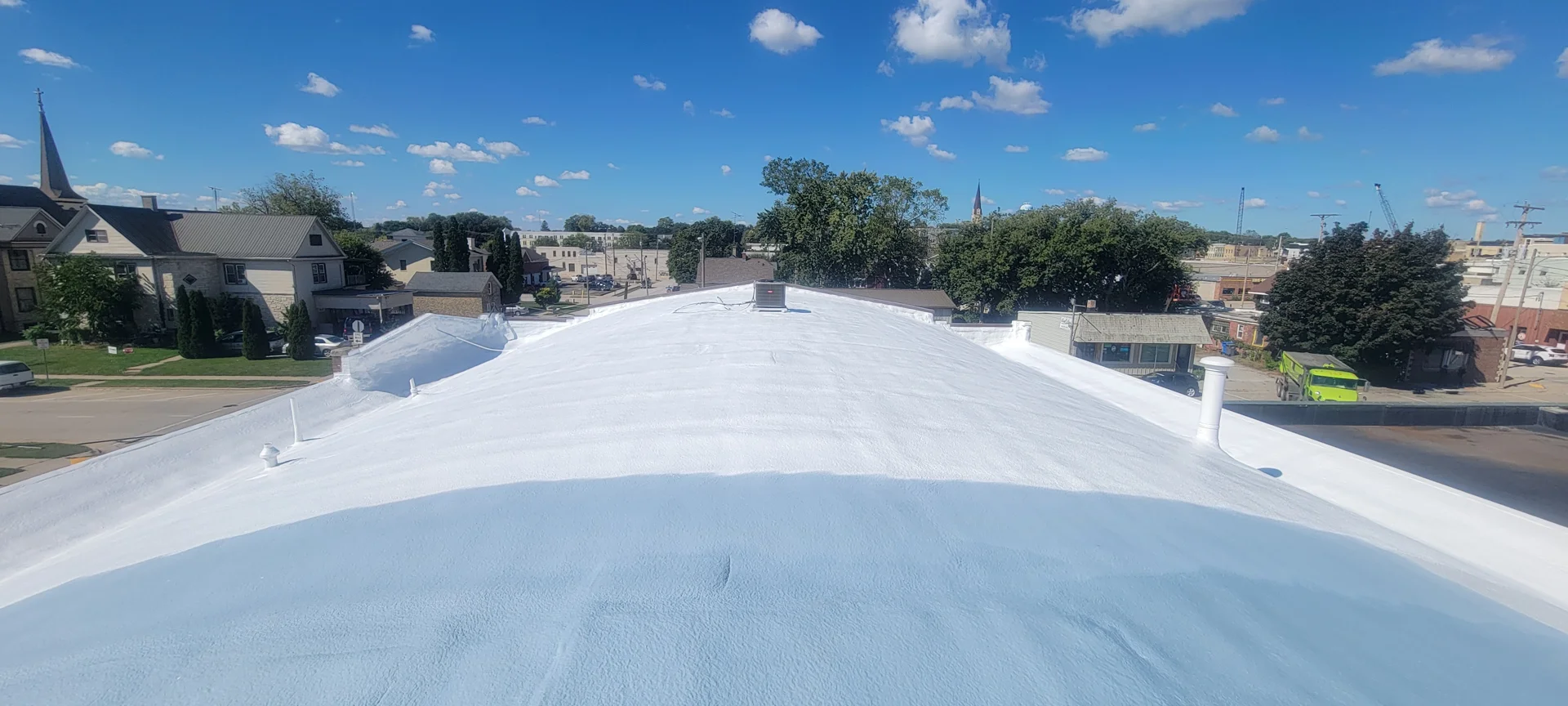
A commercial steel roof is an engineered asset designed to last between 40 and 70 years when properly maintained. Tearing off a structurally sound steel roof simply because of leaking fasteners, failing lap seams, or surface chalking is one of the costliest oversights a property owner can make. Complete replacements incur severe landfill disposal fees, business downtime, structural disruption, and significant capital expenditures.
Commercial fluid-applied roof restoration delivers an immediate return on investment by extending the usable service life of an aging steel roof by 15 to 20+ years at roughly one-third to one-half the cost of a full replacement. Exploring the benefits of metal roof restoration reveals that restoration expenses can often be 100% tax-deductible in the year they are incurred as an operating maintenance expense, rather than amortized over 39 years as a capital replacement.
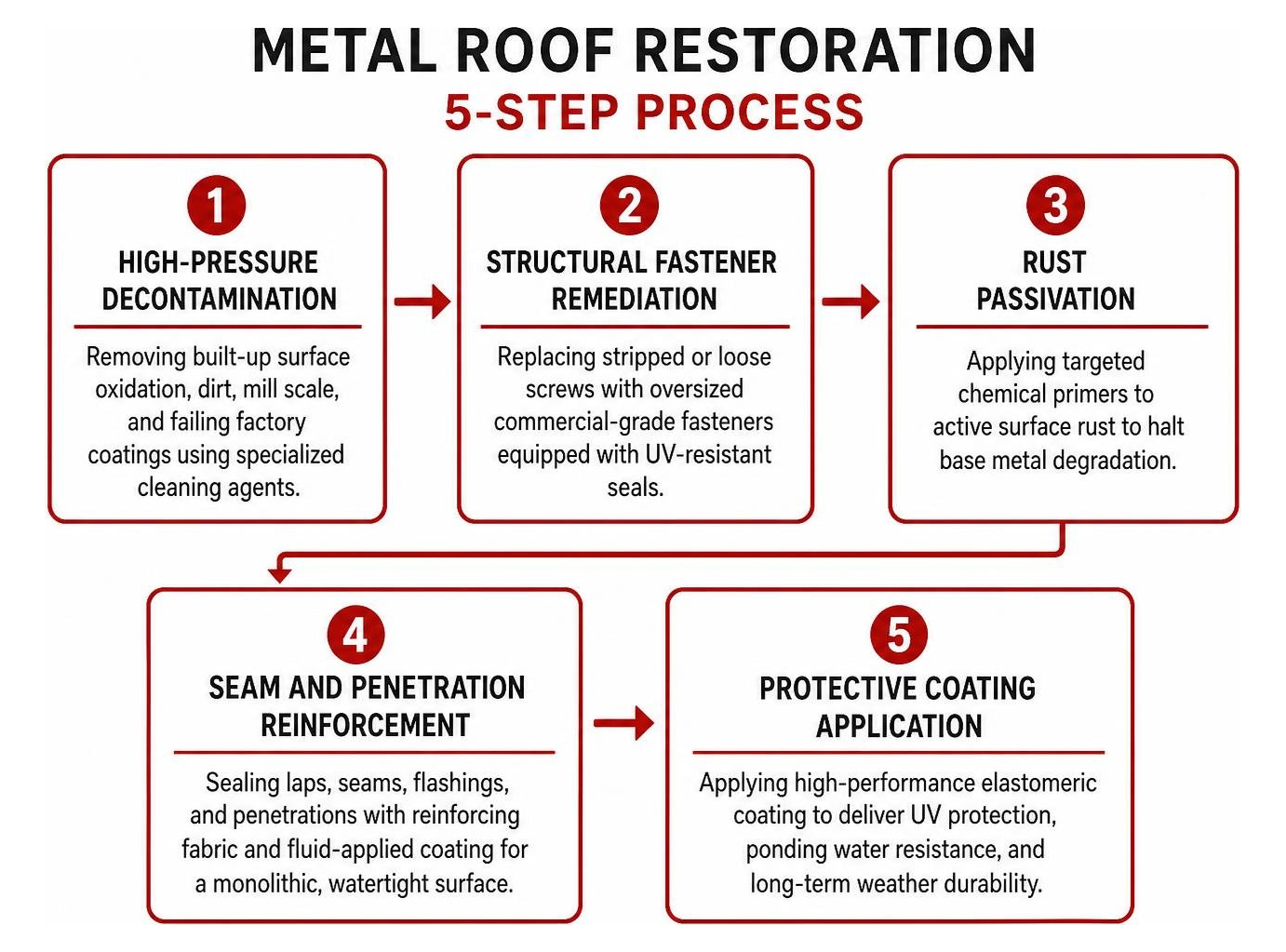
Our standard metal roof restoration framework systematically targets the mechanical weak points of industrial steel panels:
- High-Pressure Decontamination: Removing built-up surface oxidation, dirt, mill scale, and failing factory coatings using specialized cleaning agents.
- Structural Fastener Remediation: Replacing stripped or loose screws with oversized commercial-grade fasteners equipped with UV-resistant seals.
- Rust Passivation: Applying targeted chemical primers to active surface rust to halt base metal degradation.
- Seam and Penetration Reinforcement: Encapsulating horizontal overlaps, vertical seams, ridge caps, and roof penetration flashing boots with elastomeric compound and high-tensile polyester fabric.
- Monolithic Cool Roof Coating Application: Applying fluid-applied elastomeric topcoats that cure into a joint-free, highly reflective membrane.
By reflecting up to 85% of solar radiation away from the building, highly reflective coatings significantly lower roof surface temperatures during summer months. This reduces HVAC runtime, minimizes thermal expansion fatigue across steel panels, and cuts peak facility cooling loads. Building owners can review the ultimate guide to metal roof restoration for detailed maintenance schedules and coating application protocols.
Frequently Asked Questions About Commercial Steel Roofing
How do roof coatings protect commercial steel roofs from severe weather and rust?
Fluid-applied elastomeric roof coatings cure into a seamless, flexible rubberized membrane that adheres directly to the steel panels. This monolithic layer eliminates vulnerable penetration points and open seams, preventing wind-driven rain and snowmelt from reaching the metal substrate.
The coating acts as a physical barrier against oxygen and moisture, effectively stopping galvanic corrosion and surface rust. Additionally, high-tensile elastomeric coatings absorb minor hail impacts and accommodate the continuous thermal expansion and contraction of structural steel panels across extreme seasonal temperature shifts without cracking or peeling.
How are Galvalume and galvanized steel roofs prepared for restoration?
Proper preparation involves high-pressure power washing (typically 3,000 to 4,000 PSI) with specialized biodegradable degreasers to remove oil, atmospheric pollutants, and loose chalking paint.
For galvanized steel showing active iron oxide (red rust), a chemical rust-inhibiting primer is applied to stop further oxidation and convert the rust into an inert protective barrier.
For Galvalume roofs, cut edges, eave overhangs, and surface abrasions are spot-primed to prevent galvanic cut-edge corrosion. Once primed, an adhesion promoter or base coat is applied to guarantee maximum chemical and mechanical bonding between the steel substrate and the fluid-applied topcoat.
Why do exposed fastener steel roofs require frequent maintenance and seam sealing?
Exposed-fastener steel roofs (such as PBR and corrugated panels) are secured with thousands of structural screws driven through the face of the panels directly into purlins. As daily temperatures fluctuate, the steel panels constantly expand and contract, placing severe shear stress on these rigid screw shafts.
Over time, this mechanical cycling widens screw holes, backs fasteners out, and deteriorates the underlying neoprene rubber washers under harsh solar UV exposure. Furthermore, horizontal overlaps and vertical seams can shift slightly, breaking initial factory tape seals and creating leak paths. Regular maintenance, fastener replacement, and elastomeric seam reinforcement are necessary to keep exposed-fastener profiles watertight.
Conclusion
Protecting your commercial building envelope does not require costly, disruptive roof replacements when your existing steel substrate remains structurally sound. By addressing loose fasteners, reinforcing seam transitions, and applying advanced fluid-applied elastomeric coatings, you can extend your commercial steel roof’s working lifespan by decades while drastically lowering cooling costs and maintenance downtime.
At Yutzy Roofing Service, LLC, we specialize in high-performance commercial roof restoration, metal roof repair, and spray foam coating systems across Wisconsin and Minnesota—including Marshfield, Madison, Appleton, Green Bay, Wausau, Eau Claire, Fond Du Lac, Mankato, and Rochester. We back our commercial restoration projects with renewable, non-prorated warranties up to 18 years, giving building owners complete peace of mind.
To learn more about maximizing the value of your commercial facility, explore why metal roofs are ideal for commercial buildings and schedule a comprehensive roof assessment with our experienced commercial team today.
