

What Does a Spray Foam Roof Actually Cost in 2026?
The cost of spray foam roofing typically falls between $5 and $10 per square foot for most commercial projects, with the total depending on roof size, foam thickness, coating type, and prep work required.
Here’s a quick-reference snapshot for commercial flat roofs:
| Roof Size | Estimated Total Cost |
|---|---|
| 1,000 sq ft | $5,000 – $12,000 |
| 2,500 sq ft | $12,500 – $25,000 |
| 5,000 sq ft | $25,000 – $50,000 |
| 10,000 sq ft | $50,000 – $87,500 |
| 25,000 sq ft | $125,000 – $250,000+ |
Note: Larger roofs generally cost less per square foot due to economies of scale.
These numbers include materials, labor, and a protective topcoat — the three core components of any spray polyurethane foam (SPF) roofing system.
If you’re a commercial property owner in Wisconsin dealing with winter damage, chronic leaks, or an aging flat roof, spray foam is worth a serious look. It’s one of the few systems that insulates, waterproofs, and restores — often without tearing off your existing roof.
I’m Josh Yutzy, and our family business has been installing commercial roofing systems across Wisconsin since 1995. Over the decades, we’ve seen how the cost of spray foam roofing compares to alternatives — and why it often delivers the best long-term value for flat and low-slope commercial buildings. Keep reading for a full breakdown of every cost factor you need to know before getting a quote.
Breaking Down the Cost of Spray Foam Roofing
When you start researching the cost of spray foam roofing, you’ll notice that pricing is often quoted in two ways: per square foot or “per square.” In the roofing industry, a “square” is simply a 100-square-foot area. As of May 2026, the general market rate for a fully installed SPF system ranges from $500 to $1,000 per square.
While that might seem like a wide range, it reflects the custom nature of the product. Unlike a membrane roof that comes in rolls, a spray foam roof is actually manufactured right on your rooftop. Two liquid components are mixed at the spray gun tip to create a solid, seamless surface. According to data from Angi, the national average for installation sits around $11,500, but for the large industrial and commercial buildings we service in cities like Madison and Green Bay, projects frequently range between $40,000 and $200,000 depending on the footprint.
To understand how much it will cost for your roof, you have to look at the three main pillars of the quote: the size of the building, the materials used, and the labor required to apply it correctly.
How Roof Size Impacts the Cost of Spray Foam Roofing
It might sound counterintuitive, but a larger roof often has a lower cost per square foot. This is due to “economies of scale.” Every project we take on in Wisconsin or Minnesota requires a certain amount of fixed overhead. This includes:
- Mobilization: Getting our specialized spray trucks, equipment, and crew to your site.
- Setup and Safety: Installing safety flags, fall protection, and masking off HVAC units or nearby vehicles to prevent overspray.
- Equipment Maintenance: SPF equipment is high-tech and requires significant cleaning and prep for every job.
On a small 1,000-square-foot roof, these fixed costs are spread over a tiny area, which might push the price toward $12 or $13 per square foot. On a 50,000-square-foot warehouse, those same setup costs are a drop in the bucket, allowing the price to settle closer to the $5 or $6 range. As noted in HomeAdvisor’s 2025 data, the larger the project, the more efficiently a crew can operate, often completing 2,500 to 3,500 square feet per day.
Material and Labor: The Cost of Spray Foam Roofing Components
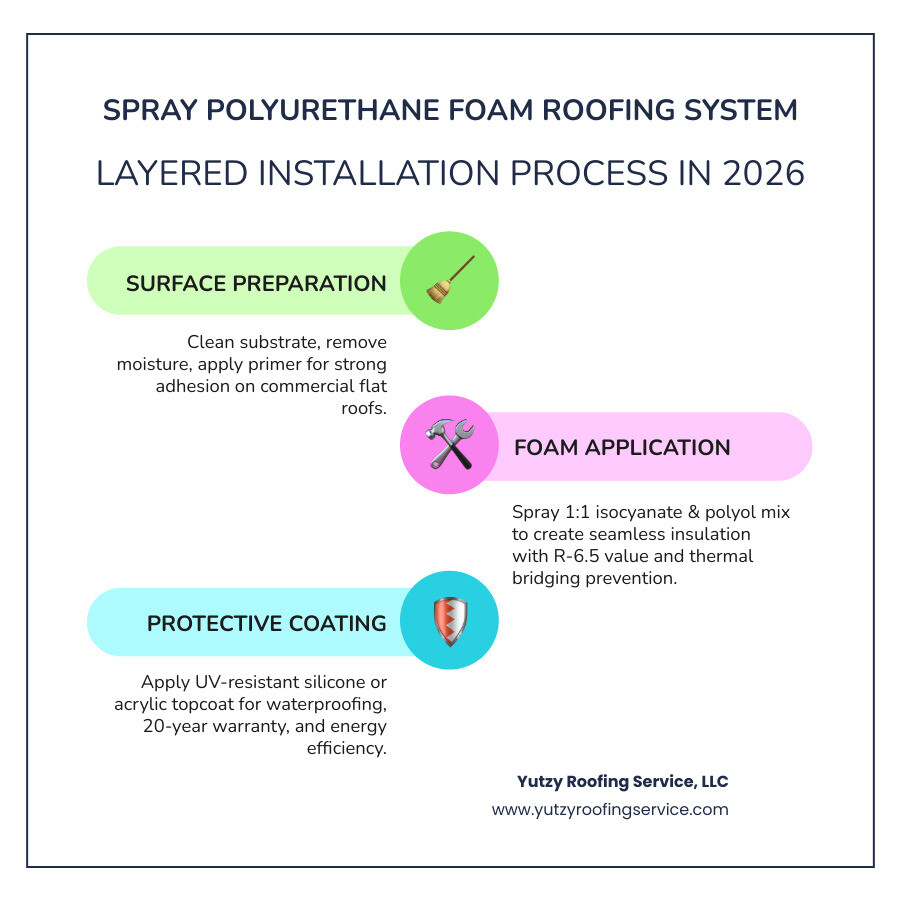
The liquid “magic” that creates your roof consists of two parts: A-side (Isocyanate) and B-side (Polyol resin). These are heated and pumped through a dual-hose system at a 1:1 ratio.
The material cost for the foam itself usually starts around $1.50 to $3.00 per square foot for the first inch of thickness. However, the foam is only half the battle. Because SPF is sensitive to UV rays, it must be shielded by an elastomeric coating.
Labor is the other significant piece of the puzzle. Applying SPF isn’t like painting a wall; it requires a highly trained applicator who understands chemistry, wind speeds, and temperature. In 2026, labor costs typically range from $2.00 to $4.00 per square foot. You aren’t just paying for someone to hold a gun; you’re paying for the expertise to ensure the foam cures with the correct density and slope to prevent ponding water.
Key Factors Influencing Your SPF Investment
Beyond the size of your building, several technical factors will dictate where your quote lands on the pricing spectrum.
Impact of Foam Density and Cell Type
For roofing, we exclusively use closed-cell, high-density polyurethane foam. You might hear about open-cell foam used in attics or walls, but it has no place on a roof. Open-cell foam is cheaper ($0.30–$0.65 per sq ft) but acts like a sponge.
High-density closed-cell foam ($1.00–$1.50 per sq ft for materials) is a different beast entirely. It has a compression strength of 50–60 PSI, which is strong enough to support heavy foot traffic and HVAC equipment. It also provides an incredible R-value of approximately 6.5 per inch of thickness, making it the most efficient insulation available.
Protective Coatings and Surface Preparation
Because foam degrades under the sun, we apply a protective topcoat. You generally have two choices:
- Acrylic Coatings: These are budget-friendly ($0.15–$0.75 per sq ft) and work well in dry climates, but they don’t hold up as well to the ponding water often found on flat Wisconsin roofs.
- Silicone Coatings: This is our preferred choice. While more expensive ($1.50–$2.50 per sq ft), silicone is moisture-cured and won’t degrade under standing water.
Before a single drop of foam is sprayed, the substrate must be pristine. We spend a significant portion of the budget on cleaning, power washing, and priming. If the roof isn’t clean, the foam won’t stick, and the system will fail. We also address common warranty questions by ensuring the coating thickness matches the warranty length—typically 20 to 30 mils for a 10- to 20-year protection plan.
Roof Tear-Off vs. Restoration Costs
One of the biggest ways to save on the cost of spray foam roofing is by avoiding a total tear-off. In Wisconsin, building codes often allow for two roof layers. If your current roof is structurally sound and well-adhered, we can often apply the foam directly over it after some basic repairs.
However, we cannot spray over wet insulation. We use infrared thermography or core samples to find “hot spots” of moisture. Removing these small sections is much cheaper than a full tear-off, which can add $1.00 to $3.00 per square foot in labor and disposal fees. By restoring rather than replacing, you save money and keep tons of roofing waste out of our local landfills.
Long-Term Value: Maintenance and Recoating Costs
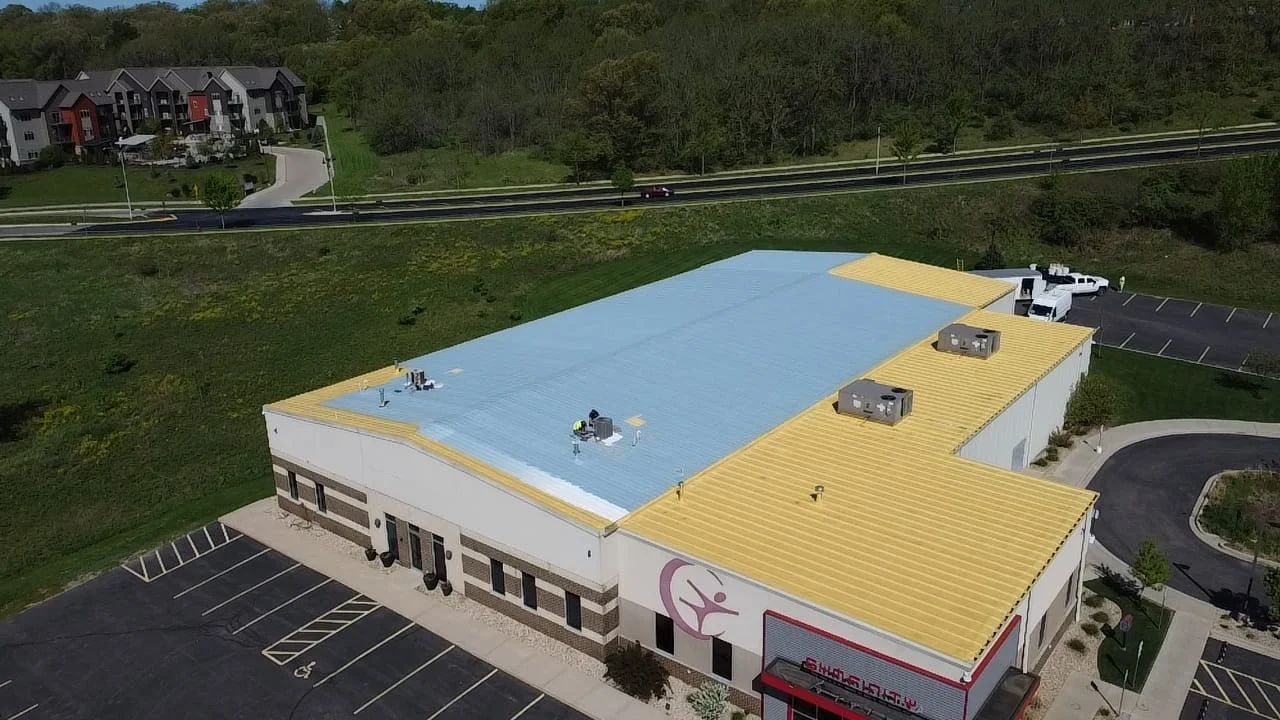
A spray foam roof is often called the “last roof you’ll ever need” because it is renewable. Unlike a TPO or EPDM roof that must be torn off when it reaches the end of its life, an SPF roof just needs a “haircut and a shave.”
Scheduled Inspections and Minor Repairs
We recommend bi-annual inspections (Spring and Fall). Because the foam is closed-cell, even if a stray branch or a dropped tool punctures the top layer, the roof won’t leak. Water cannot travel through the foam. Repairs are simple: we cut out the damaged area, dry it, and fill it with a silicone sealant or caulk.
The real “renewal” happens every 10 to 20 years. The top coating is sacrificial—it slowly wears away to protect the foam. Before the foam is exposed, we power wash the roof and apply a fresh topcoat. This “recoat” costs about 1/3 to 1/2 of the original installation price and resets your warranty for another 10 to 20 years. This cycle makes SPF the lowest lifecycle cost option for commercial buildings.
Comparing SPF to Other Commercial Roofing Systems
When building owners in Wausau or Eau Claire ask us why they should choose foam over traditional membranes like TPO or EPDM, it usually comes down to the seams.
Most roof leaks occur at the seams, fasteners, or flashing. SPF is “self-flashing,” meaning it climbs up pipes, parapet walls, and HVAC curbs to create a single, monolithic glove over your building. There are no seams to fail. According to West Roofing Systems, this seamless nature eliminates the most common points of failure found in single-ply systems.
Energy Savings and ROI
The cost of spray foam roofing is often offset by the massive reduction in utility bills. With an R-value of 6.5 per inch, SPF provides superior thermal resistance. In our Wisconsin winters, this keeps the heat inside; in the summer, the white reflective coating bounces solar heat away.
Property owners often report energy savings of up to 30-40% after switching to SPF. When you factor in these savings plus the avoidance of future tear-off costs, the “expensive” initial investment often pays for itself in 5 to 10 years.
Frequently Asked Questions about SPF Costs
Can spray foam be installed over an existing commercial roof?
Yes! As long as the existing roof is fully adhered and the insulation underneath is dry, SPF can be applied over metal, TPO, EPDM, and built-up roofs. This is a major cost-saver as it eliminates the need for a full tear-off and disposal.
How long does a spray foam roof last before needing a recoat?
Typically, a spray foam roof needs a recoat every 10 to 15 years. The exact timing depends on the initial thickness of the coating and the local weather conditions. Regular maintenance helps extend this window.
Does the R-value of spray foam justify the initial installation cost?
Absolutely. For commercial buildings with high heating or cooling demands (like cold storage or large retail spaces), the insulation value of SPF is a game-changer. It reduces the load on your HVAC systems, extending their lifespan and lowering monthly overhead.
Conclusion
Understanding the cost of spray foam roofing is about more than just looking at the price per square foot today. It’s about looking at the next 30 or 40 years of your building’s life. While the initial investment might be higher than some “quick-fix” options, the combination of energy efficiency, leak-proof performance, and the ability to renew the roof without a tear-off makes it an unbeatable value.
At Yutzy Roofing Service, LLC, we specialize in helping Wisconsin and Minnesota building owners protect their investments. We offer an up to 18-year non-prorated renewable warranty on our systems, serving areas from Madison and Milwaukee to Rochester and Mankato.
Ready to see what a spray foam system would cost for your specific building? Get more info about our spray foam roofing services and let our family help yours secure a roof that lasts a lifetime.
