What Is EPDM Roof Maintenance — and Why It Matters for Your Building
EPDM roof maintenance is the routine care that keeps your rubber roofing system watertight, energy-efficient, and performing at its best for decades. Here’s a quick overview of what it involves:
Core EPDM roof maintenance tasks:
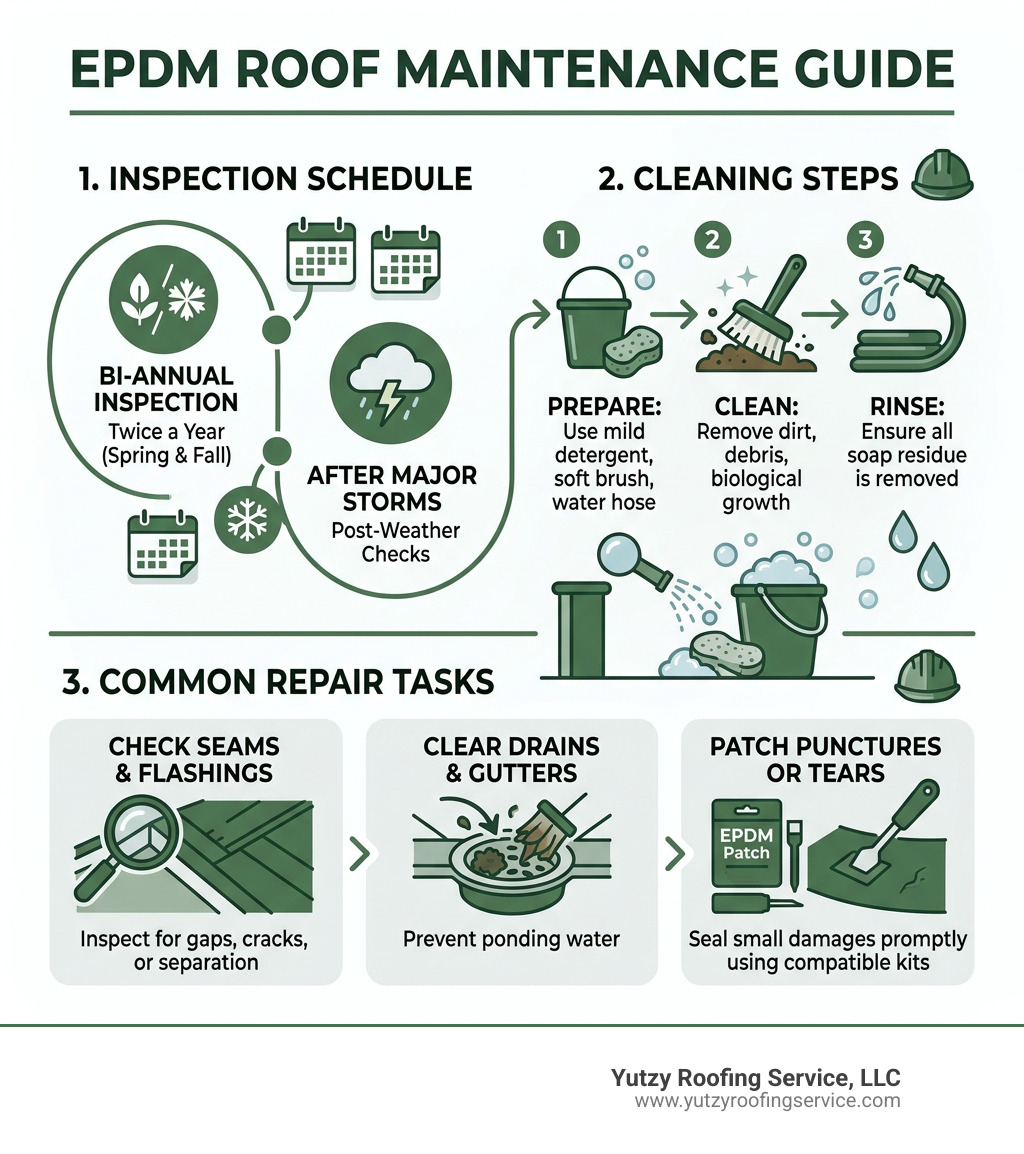
- Inspect twice a year (spring and fall) and after major storms
- Clean 3-4 times per year using mild detergent and a soft-bristle brush
- Check seams and flashings for gaps, cracks, or separation
- Clear drains and gutters to prevent ponding water
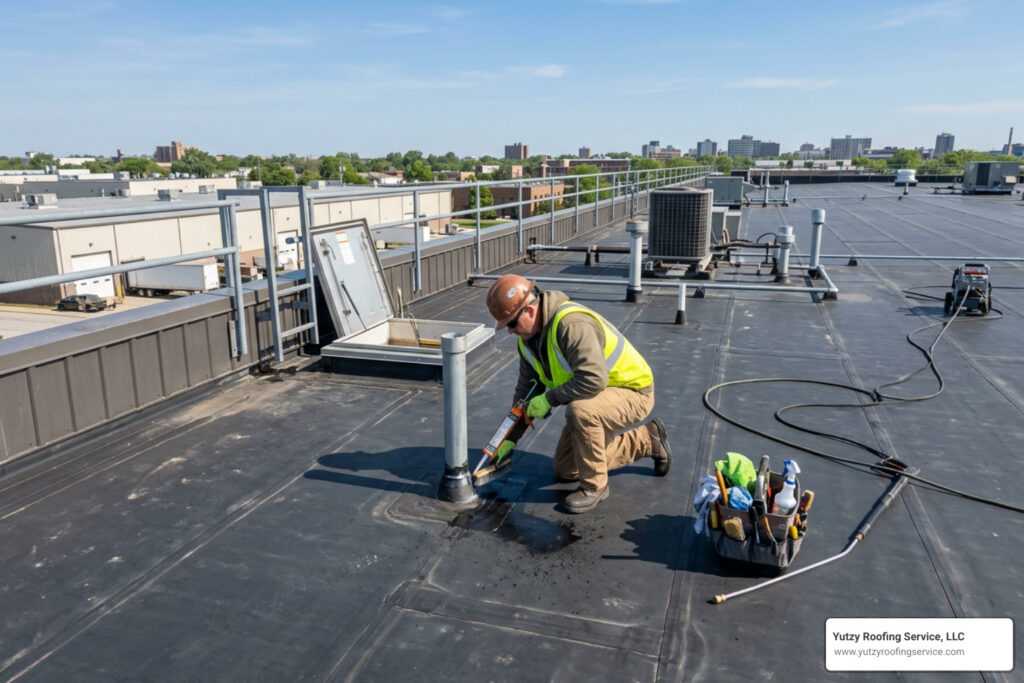
- Patch small punctures or tears promptly using EPDM-compatible repair kits
- Recoat periodically to protect against UV damage and restore reflectivity
With proper care, an EPDM roof can last anywhere from 25 to 50 years — making it one of the most cost-effective roofing investments available for commercial buildings.
EPDM (ethylene propylene diene monomer) is a synthetic rubber membrane widely used on flat and low-slope commercial roofs. It’s tough. It handles Wisconsin’s brutal freeze-thaw winters, scorching summers, and heavy rains better than many alternatives. But even the most durable roofing material won’t last without some upkeep. Small problems — a minor seam gap, a slow-draining corner — turn into expensive headaches when left alone.
This guide walks you through everything you need to know to protect your roof and your bottom line.
I’m Josh Yutzy, and my family’s roofing company has been installing and maintaining commercial roofing systems across Wisconsin, Missouri, and Kansas since 1995 — including extensive work in EPDM roof maintenance and restoration. We’ve seen what separates a 50-year roof from one that fails in 15.
The Fundamentals of EPDM Roof Maintenance
When we talk about the fundamentals of keeping your rubber roof in top shape, we are really talking about asset management. An EPDM roof is a significant investment, typically ranging from $4 to $12 per square foot for installation. Because these systems are engineered to be incredibly resilient, it is easy to fall into the trap of “out of sight, out of mind.” However, the difference between a roof that lasts 25 years and one that pushes past the 50-year mark is almost always the quality of its preventative care.
EPDM is prized for its flexibility and its ability to remain stable under extreme ultraviolet (UV) exposure. In places like Marshfield, Wausau, and Madison, our roofs have to deal with massive temperature swings. This causes the building and the membrane to expand and contract. Without a solid How to Maintain a Rubber Roof Membrane A Guide, these natural movements can eventually stress the weakest points of the system: the seams and the flashings.
Why regular epdm roof maintenance matters
You might wonder why you should spend time or money on a roof that isn’t currently leaking. The answer lies in three main areas: warranty, efficiency, and longevity.
First, let’s talk about warranties. Many manufacturers, such as Carlisle SynTec Systems, offer robust warranties (like a 12-year material warranty), but these often require proof of regular maintenance. If a leak occurs because a drain was clogged for six months, the manufacturer may not cover the damage.
Second, there is the cool roof effect. While standard EPDM is black and absorbs heat, maintaining a clean surface—or better yet, applying a reflective coating—can significantly lower your cooling costs during those humid Wisconsin summers.
Finally, regular epdm roof maintenance is simply the best way to preserve your asset. It is much cheaper to reseal a ten-foot section of seam today than it is to replace water-damaged insulation and a collapsed roof deck five years from now.
Establishing a biannual inspection schedule
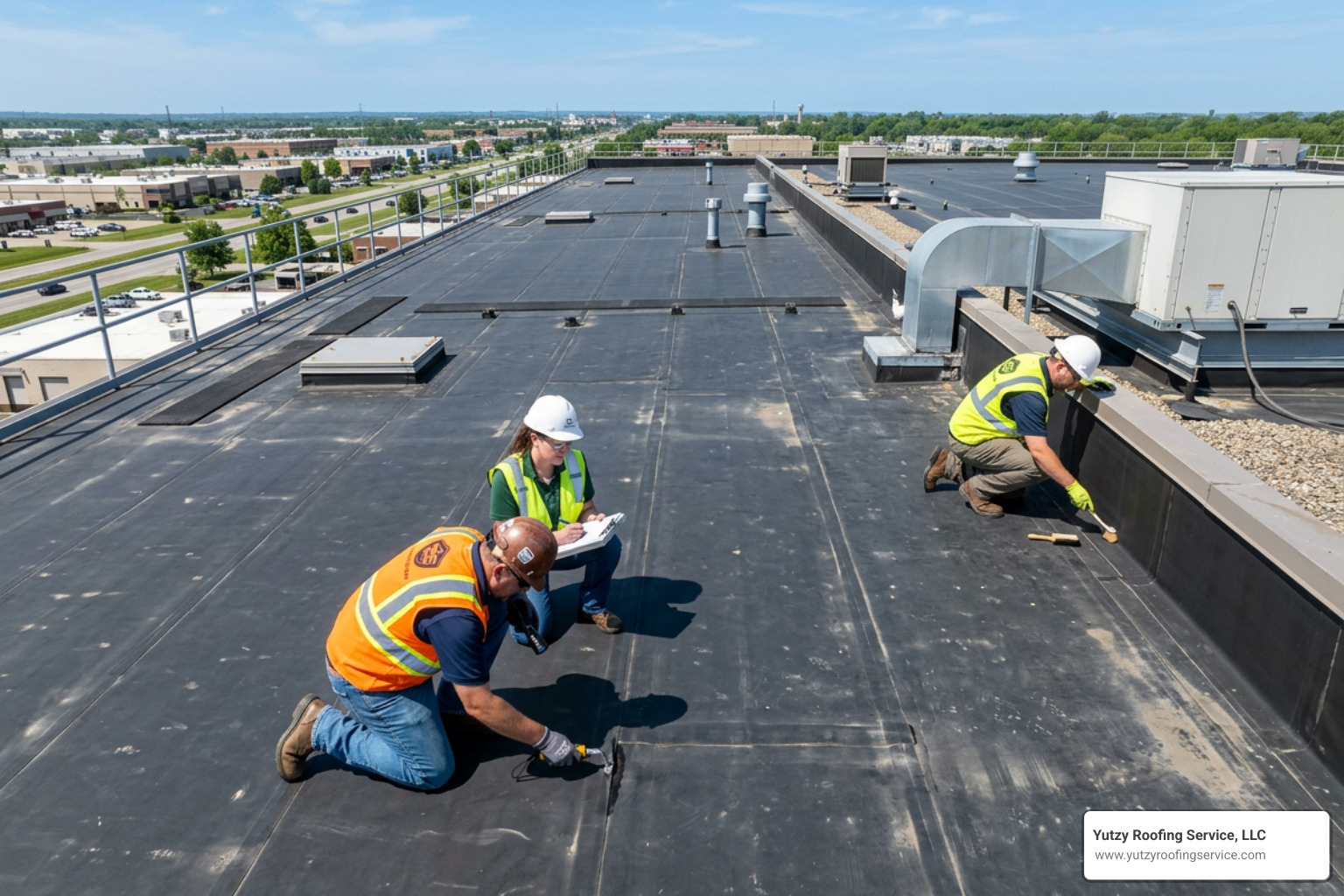
We recommend that every building owner in the Midwest follows a “Spring and Fall” inspection rule.
- Spring Inspection: After the snow melts, you need to check for damage caused by ice dams, snow shovels, or the harsh freeze-thaw cycles that can pull flashings away from walls.
- Fall Inspection: Before the first freeze, ensure your roof is clear of leaves and debris. This is the time to make sure your drainage system is wide open so that water doesn’t freeze on the membrane and cause “scouring” or physical damage.
Beyond these scheduled checks, you should always perform a “post-storm” walk-through. High winds can toss debris onto the roof, and heavy hail can occasionally cause small punctures that aren’t visible from the ground. During these inspections, we pay close attention to drainage. If you see large circles of dirt or “tide marks” on the membrane, that’s a sign that water is sitting there too long.
Best Practices for Cleaning and Debris Removal
Cleaning your roof isn’t just about aesthetics; it’s about removing “surface parasites” like mold, mildew, and atmospheric dirt that can trap heat and moisture. We recommend a gentle wash once or twice a year.
| Feature | Safe for EPDM | Unsafe / Avoid |
|---|---|---|
| Cleaning Agent | Mild dish soap (e.g., Dawn), specialized EPDM cleaners | Petroleum-based solvents, citrus-based cleaners |
| Tools | Soft-to-medium bristle brush, leaf blower, low-pressure hose | High-pressure power washers, wire brushes, metal scrapers |
| Frequency | 3-4 times annually for debris; 1-2 times for washing | Neglecting for years at a time |
When cleaning, the goal is to remove the “chalking” or carbon runoff that naturally occurs as EPDM ages. This runoff is normal, but if it’s allowed to build up, it can stain the sides of your building. For more stubborn stains or mold, products like Tilex can be used on small areas, provided they are rinsed off immediately and thoroughly. For a deeper look at how cleaning fits into the bigger picture, check out our guide on Rubber Roofing Repair Renewing and Reinforcing Your EPDM Roofing System.
Chemicals and tools to avoid during epdm roof maintenance
This is perhaps the most critical part of the guide. EPDM is a rubber product, and rubber reacts poorly to certain chemicals. Never use petroleum-based products. This includes certain types of roof cements (mastic) that are meant for asphalt roofs. Petroleum will cause the EPDM to swell, soften, and eventually dissolve.
Similarly, avoid citrus-based cleaners. While they smell nice and seem “natural,” the oils in citrus can degrade the molecular bonds of the synthetic rubber. Finally, put away the power washer. High-pressure water can easily find a tiny gap in a seam and blast it wide open, forcing water directly under your membrane and into the insulation.
Safe debris management and foot traffic
Most EPDM damage isn’t caused by the weather—it’s caused by people. Whether it’s an HVAC technician dropping a tool or a maintenance worker wearing heavy work boots, foot traffic is a major risk factor.
To prevent punctures, we recommend:
- Walkway Pads: Install yellow or black rubber walkway pads in high-traffic areas, especially around roof hatches and HVAC units.
- Soft Shoes: If you must walk on the roof, wear soft-soled shoes.
- Clear Branches: Trim any overhanging tree branches. In a storm, a falling branch acts like a spear against a rubber membrane.
- Leaf Blowers: Use a leaf blower to clear light debris. It’s much safer for the membrane than using a rake or a stiff broom.
Identifying and Repairing Common EPDM Issues
Even with the best epdm roof maintenance plan, issues can arise. The key is catching them while they are “minor repairs” rather than “major disasters.”
If you find a puncture or a small tear, don’t panic. One of the best things about EPDM is its “repairability.” Unlike other materials that become brittle with age, EPDM stays flexible, meaning we can often patch a 20-year-old roof with great success. For a deep dive into the restoration process, see our page on EPDM Membrane Roof Restoration in Marshfield WI.
Managing ponding water and seam integrity in epdm roof maintenance
Ponding water is defined as water that remains on the roof for more than 48 hours after a rain. While EPDM is waterproof, standing water puts constant hydraulic pressure on the seams. Over time, this can cause the adhesives to “creep” or fail.
If you have consistent ponding, you might need to look at:
- Tapered Insulation: This creates a slight slope to guide water toward the drains.
- Seam Tape and Sealants: If you notice seams beginning to “fish-mouth” (opening up like a fish’s mouth), they need to be cleaned with a specific EPDM primer and resealed with heavy-duty seam tape.
- Drain Cleaning: Often, “ponding” is just a result of a $5 plastic drain cover being clogged with leaves.
Addressing blisters and shrinkage
Blisters usually happen when moisture gets trapped under the membrane during installation. When the sun hits the roof, that moisture turns to vapor, expands, and lifts the rubber. Small blisters are usually fine if they aren’t in a high-traffic area, but large ones should be professionally deflated and patched.
Shrinkage is another common issue, especially on older “ballasted” roofs (those covered in rocks). As the membrane ages, it can pull away from the edges of the building. This is often called “bridging.” If you see the membrane pulling tight at the corners like a drumhead, it’s time to call in the pros to install reinforcement strips and secure the perimeter. Learn more about whether your system is a candidate for a full refresh on our page: Does Your Commercial Roof Need an EPDM Restoration System.
Extending Lifespan with Protective Coatings
If your EPDM roof is reaching the 15-to-20-year mark, you don’t necessarily need to replace it. This is where roof restoration comes in. By applying a high-quality coating, you can essentially “reset the clock” on your roof’s lifespan.
We often recommend silicone coatings for EPDM. Silicone is highly resistant to ponding water and provides incredible UV protection. It also creates that cool roof effect we mentioned earlier, reflecting up to 85% of the sun’s rays. This can lower roof surface temperatures by as much as 50 or 60 degrees on a hot July afternoon in Appleton or Green Bay.
The benefits of professional recoating
Why choose a coating over a replacement?
- Cost: Restoration is typically half the cost of a full “tear-off” and replacement.
- Minimal Disruption: We don’t have to tear into your building, meaning your business stays open.
- Renewable Warranties: At Yutzy Roofing Service, we offer an up to 18-year non-prorated renewable warranty on our restoration systems. When that warranty is up, we can simply clean the roof and apply a “refresh” coat to extend it again.
- Sustainability: You keep thousands of pounds of old rubber and wet insulation out of Wisconsin landfills.
If you are in the Madison area, you can learn more about this specific service here: EPDM Roof Restoration Near Madison WI.
Frequently Asked Questions about EPDM Care
Can I perform DIY repairs on my rubber roof?
For very small punctures—say, from a fallen branch—a DIY repair kit can work. These kits usually include a piece of EPDM, a primer, and a scrub pad. However, for anything involving seams, flashings, or large tears, we strongly recommend professional help. If you use the wrong primer or fail to clean the aged membrane properly, the patch will fail, potentially voiding your warranty and leading to much more expensive water damage.
What causes blisters on a flat rubber roof?
Blisters are almost always caused by trapped air or moisture. In our Midwest climate, if a roof is installed on a humid day or over slightly damp insulation, that moisture has nowhere to go. When the dark EPDM membrane heats up in the sun, the moisture expands into water vapor. Early detection is key; as long as the blister isn’t leaking or being stepped on, it can often be monitored during your biannual epdm roof maintenance checks.
How often should a rubber roof be recoated?
There is no “one size fits all” answer, but generally, you should look at recoating every 10 to 15 years. If you notice “alligatoring” (fine cracks in the surface), excessive chalking, or if the membrane is starting to feel brittle rather than rubbery, it’s time for a coating. Silicone is much more durable than acrylic in our climate because it handles the weight of snow and the stress of ponding water much more effectively.
Conclusion
Taking care of your EPDM roof doesn’t have to be a daunting task. By sticking to a simple schedule of biannual inspections, gentle cleaning, and prompt repairs, you can ensure your building stays dry and your energy bills stay low. Epdm roof maintenance is an investment that pays for itself by delaying—or even eliminating—the need for a costly roof replacement.
At Yutzy Roofing Service, LLC, we specialize in helping Wisconsin business owners get the most out of their commercial roofs. From Marshfield to Madison, and Eau Claire to Fond Du Lac, we provide expert EPDM repairs and restoration systems backed by our industry-leading 18-year non-prorated warranty.
Don’t wait for a drip to turn into a flood. Whether you need a simple inspection or a full EPDM Roof Restoration Near Madison WI, our team is here to help keep your roof happy and healthy for decades to come. Give us a call today to schedule your professional roof assessment!
