What Is EPDM Rubber Roofing For Sale — and Is It Right for Your Building?
EPDM rubber roofing for sale is one of the most practical and cost-effective options for flat and low-slope commercial roofs — and if you’re dealing with leaks or wear after a brutal Wisconsin winter, it deserves a serious look.
Here’s a quick snapshot of what you need to know:
| Feature | Details |
|---|---|
| What it is | Synthetic rubber membrane (Ethylene Propylene Diene Monomer) |
| Best for | Flat or low-slope roofs (3/12 pitch or less) |
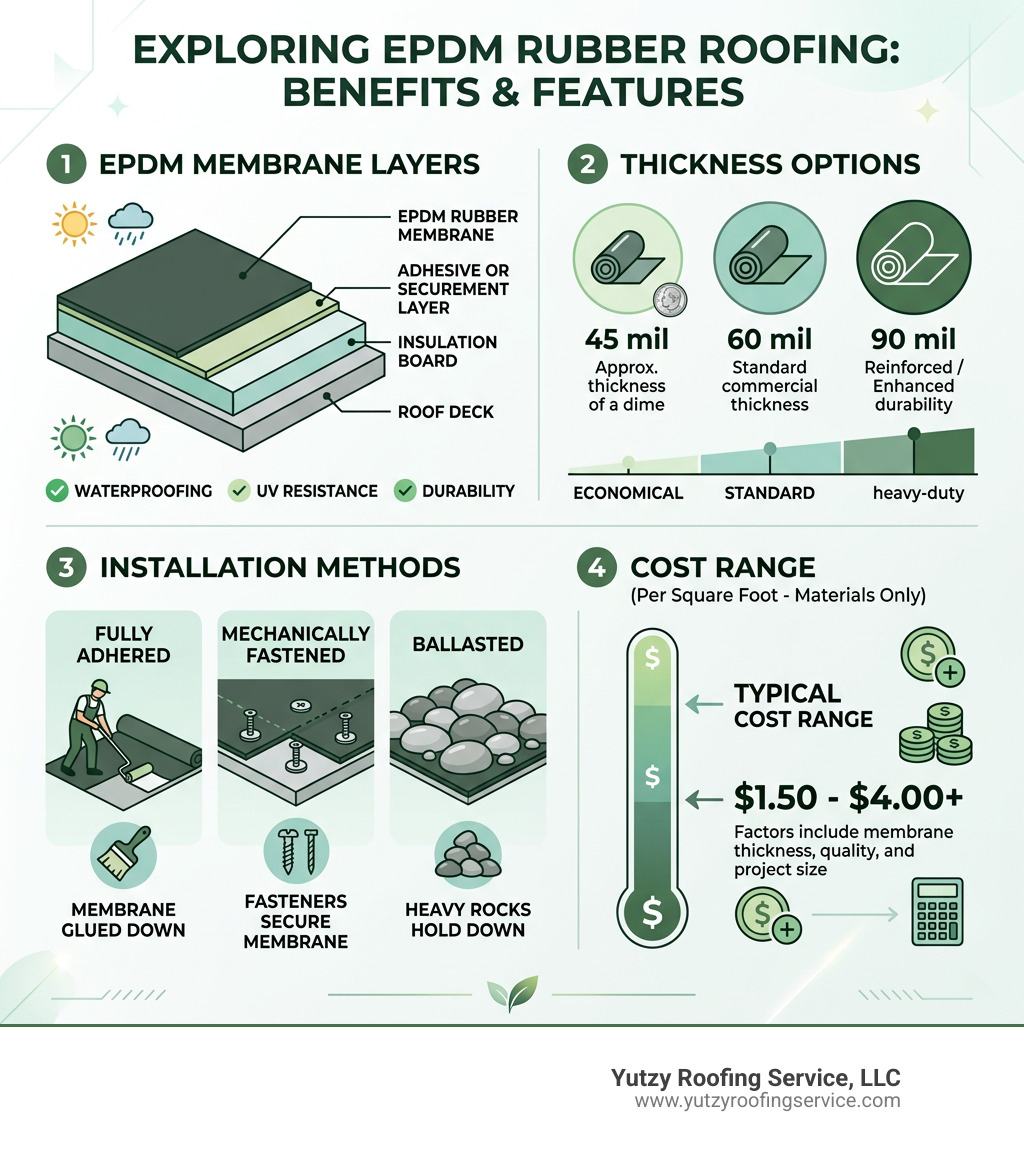
| Common thickness | 45 mil (about the thickness of a dime) |
| Available sizes | Up to 50′ wide and 100′ long — often seamless |
| Typical cost | Roughly $1.50–$4.00 per square foot for materials |
| Installation methods | Fully adhered, mechanically fastened, or ballasted |
| Warranty | 10–20 years depending on product and installer |
| Key strengths | UV resistance, ozone protection, extreme temperature flexibility |
EPDM has been used on commercial rooftops for decades. It holds up against heat, cold, ozone, and UV — which makes it especially valuable in climates like Wisconsin’s, where your roof takes a beating year-round. It’s also recyclable and can improve your building’s thermal performance, which means lower energy bills over time.
I’m Josh Yutzy of Yutzy Roofing Service, LLC — a family roofing business serving Wisconsin since 1995 — and we’ve installed and restored countless commercial roofs using epdm rubber roofing for sale from trusted manufacturers. In this guide, I’ll walk you through everything you need to know to make a smart buying and installation decision.
Understanding EPDM Rubber Roofing
When we talk about epdm rubber roofing for sale, we are referring to a high-performance synthetic rubber compound. The acronym stands for Ethylene Propylene Diene Monomer. While that sounds like a mouthful from a high school chemistry textbook, all you really need to know is that these ingredients create a remarkably durable, flexible membrane that acts like a waterproof “skin” for your building.
EPDM is engineered to meet strict ASTM International standards, ensuring it can handle the physical stresses of a commercial environment. One of its most famous traits is its “memory”—if it gets stretched by heavy snow loads or building movement, it wants to return to its original shape.
Black vs. White EPDM
Most epdm rubber roofing for sale comes in black. Black EPDM is excellent for colder climates like Wisconsin and Minnesota because it absorbs heat from the sun, helping to melt snow and ice faster in the winter. However, white EPDM (which is often a black membrane with a white top layer) is also available for those looking to reflect sunlight and reduce cooling costs in the summer.
Common EPDM Membrane Specifications
Choosing the right material involves understanding the “mil” system. In the roofing world, a “mil” is one-thousandth of an inch.
- 45 Mil Thickness: This is the industry standard for many residential and light commercial applications. To give you a visual, 45 mil is about the thickness of a dime. It’s lightweight, easy to handle, and very budget-friendly.
- 60 Mil Membrane: This is the “heavy-duty” choice. It offers superior puncture resistance and is often the go-to for commercial buildings in areas prone to hail or where technicians frequently walk on the roof to service HVAC units.
- 90 Mil Options: For the ultimate protection, 90 mil membranes provide maximum durability and longevity, though they are heavier and more expensive.
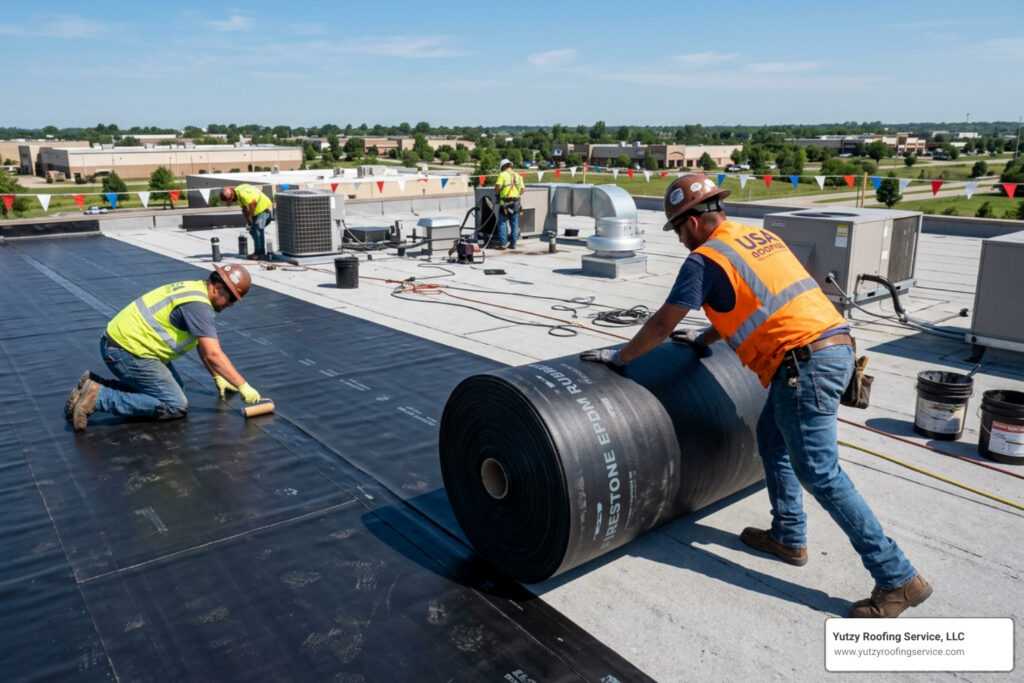
One of the biggest advantages when looking at epdm rubber roofing for sale is the size of the sheets. You can find rolls that are 10′, 20′, or even 50′ wide and up to 100′ long. Why does this matter? Because fewer pieces mean fewer seams. On a standard 2,000-square-foot flat roof, you could potentially have a completely seamless application, which significantly reduces the risk of leaks over time.
Performance Benefits and Material Comparisons
Why do so many building owners choose EPDM over other single-ply membranes? It boils down to a track record of performance. Industry leaders have installed billions of square feet of these systems globally over the last 30 years.
Unmatched Durability
EPDM is essentially immune to the “aging” effects of the sun. It features outstanding resistance to UV radiation and ozone. While other materials might become brittle and crack after a decade of sun exposure, EPDM remains flexible. It also performs exceptionally well in extreme temperatures, remaining pliable even when the Wisconsin thermometer dips well below zero.
Environmental Impact
If you’re looking for a “green” roofing option, EPDM is a strong contender. It is recyclable in many situations at the end of its lifespan. Furthermore, its thermal performance can help reduce overall energy consumption. Because it lasts so long (often 20–30 years or more), you aren’t filling up landfills with roofing waste every decade.
EPDM vs. TPO vs. PVC
When shopping for epdm rubber roofing for sale, you’ll likely see TPO and PVC mentioned. Here is how they stack up:
| Feature | EPDM | TPO | PVC |
|---|---|---|---|
| Material Base | Synthetic Rubber | Thermoplastic Polyolefin | Polyvinyl Chloride |
| Seam Method | Adhesive/Tape | Heat-Welded | Heat-Welded |
| Flexibility | Extremely High | Moderate | Moderate |
| Cost | Lowest | Moderate | Highest |
| Lifespan | 25+ Years | 15–20 Years | 20+ Years |
While TPO and PVC have heat-welded seams, EPDM’s flexibility and lower price point make it a favorite for those who need a reliable roof without the premium price tag. If your current roof is starting to show its age but doesn’t need a full replacement yet, you might consider if does-your-commercial-roof-need-an-epdm-restoration-system is a better path forward. Restoration can often extend the life of your rubber roof for a fraction of the cost of a new install.
Installation Methods and Ideal Applications
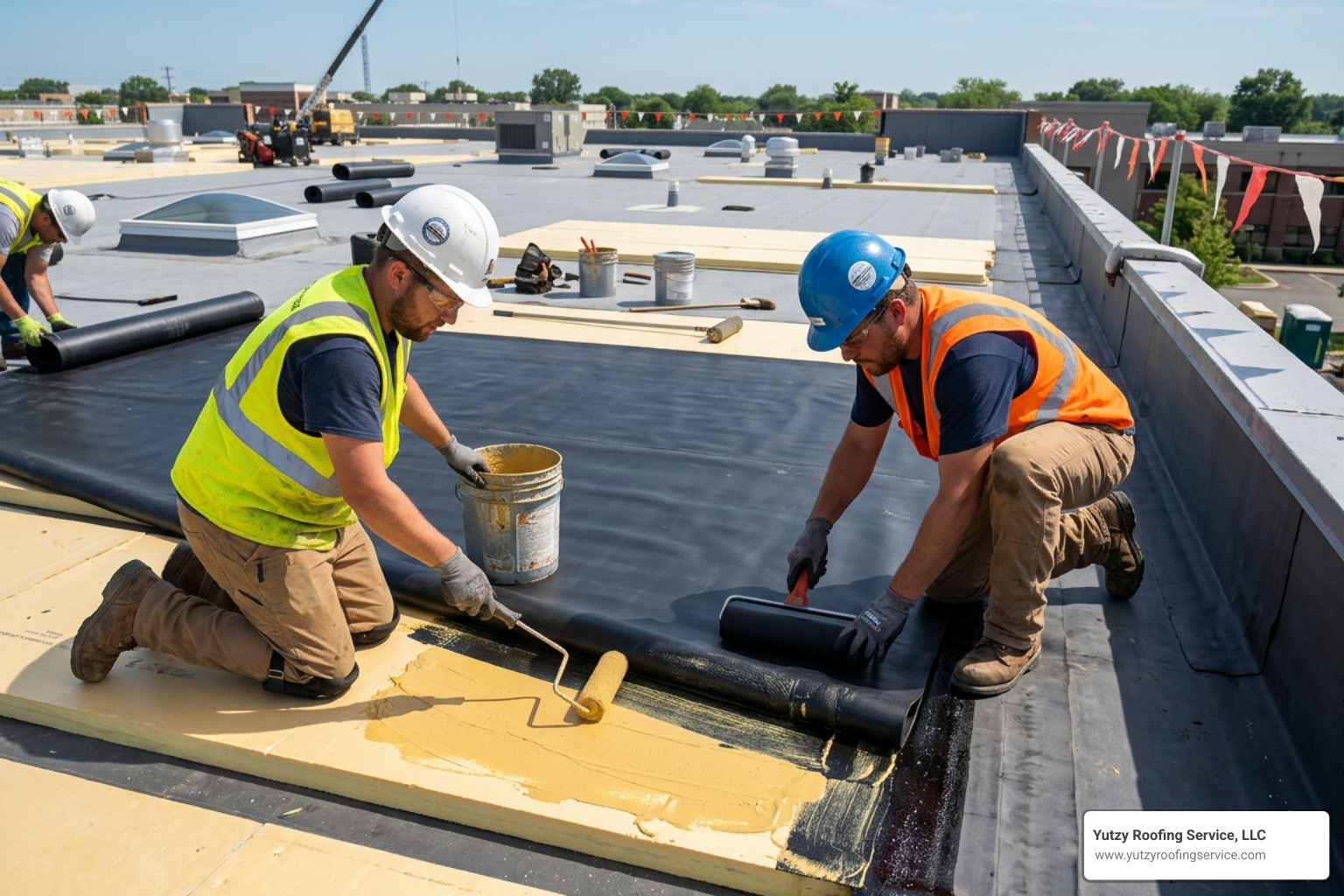
How you install your epdm rubber roofing for sale depends on your building’s structure and your budget. There are three primary methods:
- Fully Adhered: The membrane is glued directly to the insulation or substrate using a powerful bonding adhesive. This is the most popular method because it is highly resistant to wind uplift and looks very “clean.”
- Mechanically Fastened: The rubber is secured to the roof deck using specialized screws and plates. This is often a fast and economical way to cover large commercial spaces.
- Ballasted: The membrane is laid down loose and then held in place by a heavy layer of smooth river stone or concrete pavers. This is great for large flat roofs where the structure can handle the extra weight.
Ideal Applications
While we primarily see EPDM on commercial buildings, its versatility makes it perfect for:
- Flat and Low-Slope Roofs: Any roof with a pitch of 3/12 or less.
- Additions & Carports: Great for DIY-friendly projects like room additions or storage buildings.
- RV and Mobile Home Roofing: Because it is lightweight and flexible, it is the gold standard for keeping trailers and motorhomes dry.
If you already have a rubber roof, knowing how-to-maintain-a-rubber-roof-membrane-a-guide can save you thousands in premature replacement costs.
Preparation and Necessary Accessories
You can’t just throw a rubber sheet over an old roof and call it a day. Proper preparation is the difference between a roof that lasts 30 years and one that leaks in three.
- Surface Cleaning: The substrate must be bone-dry and free of dust, oils, or loose debris.
- Substrate Prep: Often, a cover board or insulation layer is installed first to provide a smooth, flat surface for the rubber.
- Bonding Adhesive: This is the “glue” that keeps the roof in place.
- Seam Tape & Lap Sealant: Even with wide rolls, you’ll have seams at the edges or around corners. These require specialized EPDM tape and a bead of sealant to ensure they are watertight.
- Pipe Boots & Termination Bars: These accessories seal the “holes” in your roof, like plumbing vents or where the roof meets a vertical wall.
For those dealing with existing damage, rubber-roofing-repair-renewing-and-reinforcing-your-epdm-roofing-system provides a roadmap for fixing leaks and reinforcing weak points like corners and drains.
Frequently Asked Questions about EPDM
What warranties are typically offered on EPDM products?
When you browse epdm rubber roofing for sale, you’ll see a variety of warranties. Many retail products come with a limited 10-year warranty against manufacturer defects. However, when you work with a professional commercial contractor, you can often access 20-year or even longer system warranties.
At Yutzy Roofing Service, we take it a step further. We offer up to 18-year non-prorated renewable warranties on our restoration systems. This means if there’s an issue, you’re covered for the full value of the repair, not a “depreciated” amount based on the age of the roof.
How much does EPDM roofing cost per square foot?
Material pricing for epdm rubber roofing for sale generally ranges from $1.50 to $4.00 per square foot.
- A 20′ x 100′ roll of 45 mil EPDM might retail for around $1,500 to $1,700.
- Smaller rolls (like 10′ x 25′) are available for around $250 to $350 for DIY projects.
- Pro Tip: Shipping can be a major factor. Large rolls can weigh over 600 lbs and must be shipped via freight truck. Many suppliers offer free freight on orders over $1,000, which can save you a significant amount of money.
What do customer reviews say about real-world performance?
Generally, customers rave about EPDM’s flexibility in cold weather. Unlike asphalt shingles that can become brittle and crack, EPDM stays rubbery even in a Wisconsin deep freeze. Users also appreciate its puncture resistance against falling branches or hail. The most common “complaint” usually stems from poor installation—specifically at the seams—emphasizing why professional help or very careful DIY prep is vital.
Conclusion
Finding epdm rubber roofing for sale is the first step toward a secure, dry, and energy-efficient building. Whether you are looking to cover a small garage or a massive industrial warehouse, EPDM offers a “stretch” for your budget that few other materials can match. Its decades-long track record of fighting off UV rays and surviving extreme temperature swings makes it a top-tier choice for our climate in the Midwest.
At Yutzy Roofing Service, LLC, we specialize in making sure your investment lasts. From Marshfield and Wausau to Madison and Appleton, we help building owners avoid the massive expense of a full tear-off by providing expert EPDM repairs and commercial restoration systems. Our non-prorated, renewable warranties ensure that your roof stays our responsibility, not your headache.
If you’re ready to stop the leaks and start protecting your bottom line, we’re here to help. Visit us at https://www.yutzyroofingservice.com/ or give us a call to discuss your roofing needs. Let’s make sure your next roof is the last one you’ll have to worry about for a long, long time.
