What Are Non-Renewable Warranty Alternatives (And Which One Is Right for You)?
Non-renewable warranty alternatives are protection options you can turn to once a standard roofing warranty expires — without simply buying a new policy that starts the clock over.
Here are the most common options at a glance:
| Alternative | What It Does | Best For |
|---|---|---|
| Extended Service Agreement | Covers repairs for a set period after expiry | Roofs in good condition needing continued coverage |
| Maintenance Contract | Scheduled inspections and repairs for a flat fee | Proactive owners wanting predictable costs |
| Performance Guarantee | Contractor guarantees outcomes, not just parts | Restoration and coating projects |
| Renewable Warranty | Warranty that resets or extends on renewal | Long-term asset protection without tear-off |
| Mechanical Breakdown Insurance (MBI) | Insurance-backed repair coverage | When traditional service contracts aren’t available |
When a roofing warranty expires on a commercial building in Wisconsin, the stakes are high. Harsh winters, freeze-thaw cycles, and summer UV exposure don’t pause while you sort out your coverage gap.
The reality is that most commercial property owners don’t discover their warranty has lapsed until something goes wrong — a leak during a spring thaw, a seam failure after a brutal cold snap. At that point, the question isn’t just “what went wrong?” It’s “who’s paying for it?”
That’s exactly why understanding your options before expiration matters.
I’m Josh Yutzy of Yutzy Roofing Service, LLC — a family-owned Wisconsin roofing company that has been helping commercial property owners navigate non-renewable warranty alternatives and long-term roof protection since 1995. With decades of hands-on experience installing and restoring commercial roofing systems across Wisconsin, I’ve seen what happens when property owners are left exposed — and how the right coverage alternative can make all the difference.
Evaluating the Cost and Structure of Non-Renewable Warranty Alternatives
As we move into April 2026, the landscape of commercial protection has shifted. In the past, you either had a manufacturer’s warranty or you had nothing. Today, savvy facility managers in Madison and Wausau are looking at a broader spectrum of non-renewable warranty alternatives. Understanding the technical differences between these can save your budget from a $50,000 “surprise” repair bill.
Extended Service Agreements vs. Maintenance Contracts
An Extended Service Agreement (ESA) functions similarly to the “extended warranties” you see in the automotive world. You pay a premium to extend the period during which specific mechanical failures or material defects are covered. In the roofing industry, these are often third-party vehicle service contracts (VSCs) adapted for industrial equipment or structural components.
Conversely, a Maintenance Contract is a proactive service-type agreement. Instead of waiting for a leak (a “break-fix” model), you pay for scheduled inspections and minor upkeep. Research shows that while an ESA might cost between $900 and $2,400 per year for smaller systems, a dedicated maintenance plan often pays for itself by preventing the “continued operations” damage that often voids standard warranties.
Assurance-type vs. Service-type Warranties
From an accounting perspective, it is helpful to distinguish between these two. Under ASC 606 standards, an assurance-type warranty is a guarantee that the product will work as promised at the time of sale. You don’t usually pay extra for this; it’s a contingency.
A service-type warranty, however, provides a distinct service beyond just fixing a defect. This is where most non-renewable warranty alternatives live. They are “performance obligations” where the provider (like us) commits to keeping the roof functional over a specific term.
Comparing Commercial Roofing Service Agreements
To help you decide which path to take for your facility in Green Bay or Rochester, consider this breakdown:
| Feature | Extended Service Agreement | Maintenance Contract | Performance Guarantee |
|---|---|---|---|
| Primary Goal | Risk Transfer | Preventive Care | Quality Assurance |
| Typical Cost | Moderate Annual Fee | Fixed Monthly/Quarterly | Included in Project Cost |
| Covers Leaks? | Yes (if not wear & tear) | Yes (minor repairs) | Yes (system failure) |
| Inspections | Usually not included | Required & Included | Post-installation check |
Key Protections: Backup Insurance, Claims, and Avoiding Scams
When looking for non-renewable warranty alternatives, you must look under the hood of the company offering the contract. In Vehicle Service Contracts and similar repair agreements, the “Obligor” is the entity legally responsible for paying your claim.
The Role of Backup Insurance
One of the most critical things we’ve learned is that a service contract is only as strong as the money backing it. In states with strict regulations like California, Vehicle Service Contract Providers (VSCPs) must be guaranteed by backup insurance unless they have at least $100,000,000 in net assets. While Wisconsin and Minnesota have different specific statutes, the principle remains: if the provider goes bust, who pays for your roof repair?
Always ask if the provider is “reinsured.” This ensures that even if the local contractor faces financial hardship, a larger insurance entity is on the hook for the Longevity Warranty → Term .
Navigating Claims and Denials
Filing a claim shouldn’t feel like a root canal. However, many third-party providers are notorious for denials based on “wear and tear,” “pre-existing conditions,” or “seals and gaskets” exclusions.
Common red flags for scams or unreliable providers include:
- High-Pressure Sales: Robocalls or mailers warning that your “warranty is about to expire” (even if it expired years ago).
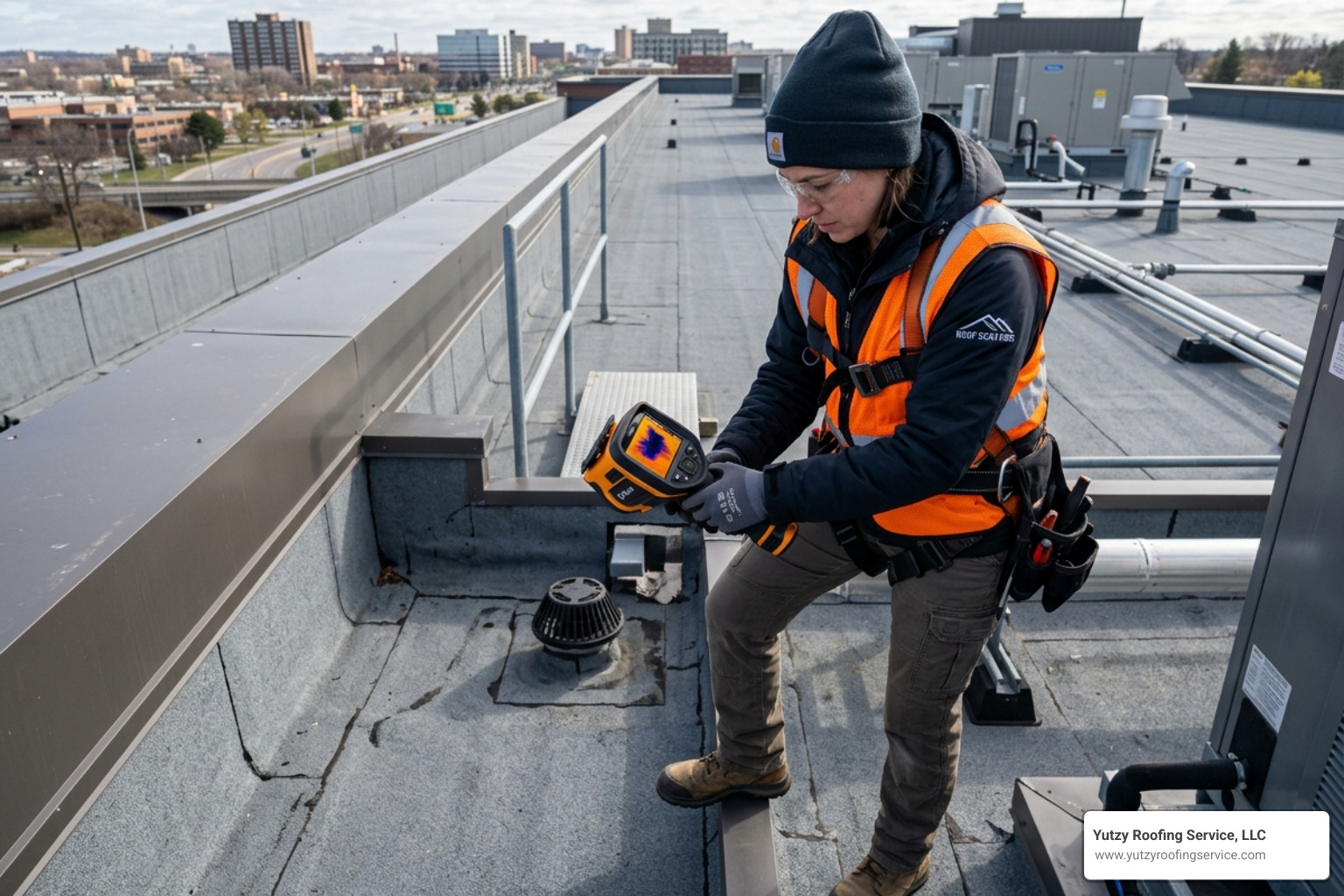
- Lack of Physical Inspection: A legitimate provider will rarely offer a contract on a commercial roof without seeing it first.
- Vague Exclusions: If the contract excludes “damage from environmental factors,” and you live in Wausau, that could mean almost anything.
If a claim is denied, your first step is to gather documentation. We always recommend keeping a “Roof Log” of every inspection and minor repair. If a provider claims “negligence,” your maintenance records are your best defense.
Restoration vs. Replacement: The Sustainability of Renewable Warranties
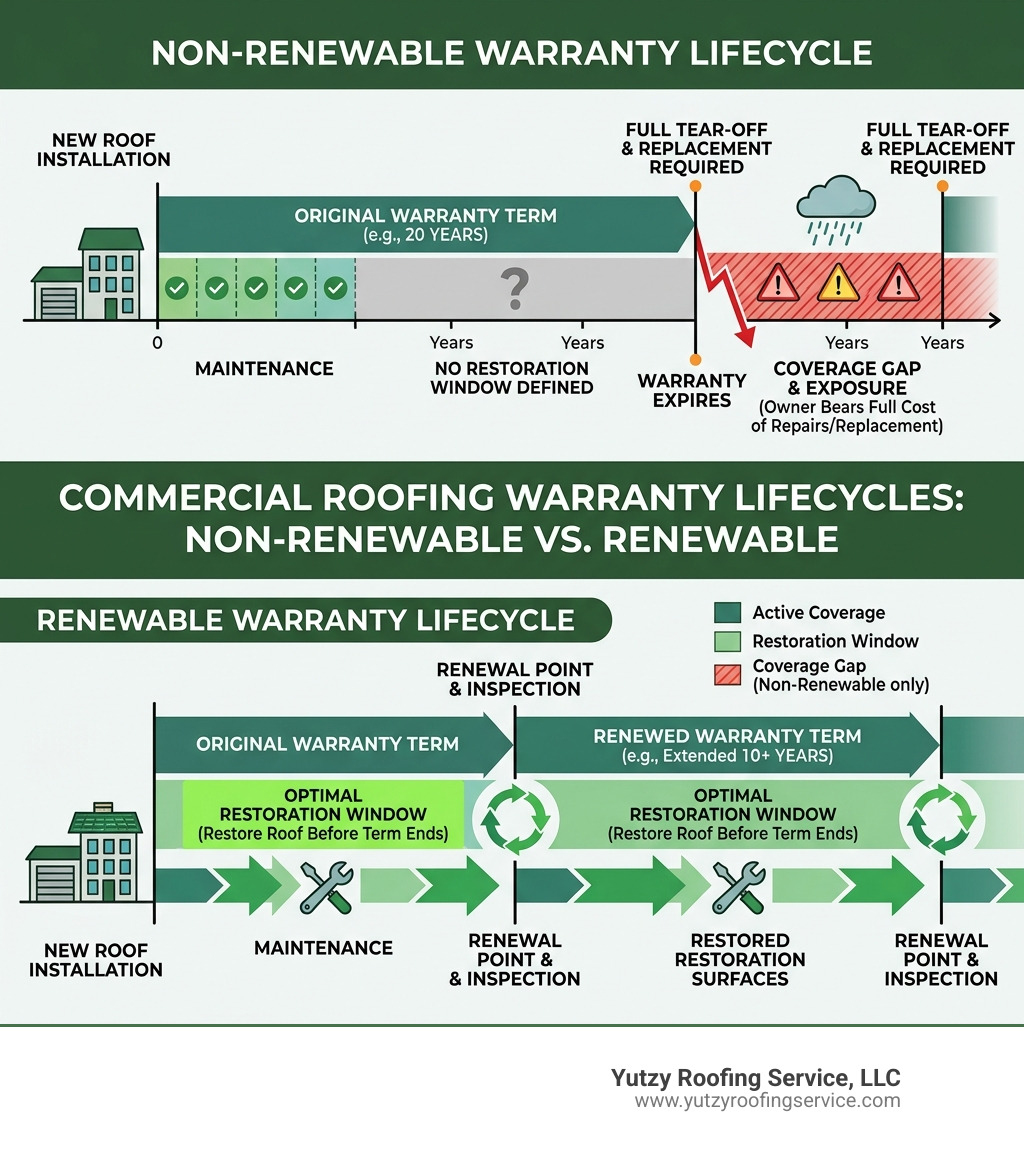
Many property owners think that once a warranty expires, their only choice is a total tear-off and replacement. This is a “linear” way of thinking—install, use, fail, landfill. But in April 2026, we are firmly in the era of the circular economy.
At Yutzy Roofing Service, we specialize in a different kind of alternative: Roof Restoration. Instead of a non-renewable contract that simply expires and leaves you hanging, we offer a renewable warranty system.
The 18-Year Non-Prorated Advantage
Most standard warranties are “prorated,” meaning they lose value every year. If your roof fails in year nine of a ten-year warranty, the manufacturer might only cover 10% of the cost.
Our approach is different. We provide up to an 18-year non-prorated renewable warranty. This means if a problem occurs in year 17, you are just as covered as you were in year one. Even better, at the end of that term, the roof can often be cleaned and recoated, “renewing” the warranty for another full term. This is one of the most cost-effective non-renewable warranty alternatives because it avoids the massive capital expenditure of a replacement.
Learn more about how this impacts your bottom line here: How Commercial Roof Restoration Can Save You Money In The Long Run.
Non-renewable warranty alternatives for EPDM Systems
EPDM (rubber) roofs are common across Appleton and Fond Du Lac, but they are prone to seam failures as they age. When an EPDM warranty expires, you don’t have to wait for the rubber to shrink and pull away from the walls.
Restoration coatings can be applied directly over old EPDM. These coatings create a seamless, “liquid-applied” membrane that eliminates the very seams that cause leaks. It’s a way to bypass the expiration of your original contract while upgrading the roof’s performance.
For a deeper dive into these systems, check out Epdm Restorations What To Know.
Non-renewable warranty alternatives for Metal Roof Restoration
Metal roofs are durable, but the fasteners and seams eventually succumb to the “thermal shock” of Wisconsin winters. Once the factory finish wears off and the warranty ends, rust begins its work.
Instead of a costly metal replacement, we use high-performance coatings and spray foam to seal the entire structure. This not only stops leaks but adds significant R-value (insulation), lowering your energy bills. This is a prime example of a Metal Roof Restoration Extend Your Roof Life strategy.
Find out why many owners are choosing this path: Why Replace When You Can Restore Your Commercial Metal Roof.
Frequently Asked Questions about Non-Renewable Warranty Alternatives
How do extended service agreements differ from manufacturer warranties for commercial roofs?
A manufacturer’s warranty is typically limited to material defects—essentially promising that the “recipe” for the roofing membrane was correct. An extended service agreement or a vehicle service contract (VSC) for building systems often covers labor and a wider range of failure points, including those caused by normal wear and tear, which manufacturers almost always exclude.
Are pre-existing conditions covered by these alternatives?
Almost never. Whether it’s a car warranty from a company like Endurance or a roofing agreement, the system must be in good working order at the time the contract is signed. This is why we perform a thorough inspection and often require minor repairs or a restoration coating before we can issue our 18-year renewable warranty.
Can I cancel a non-renewable warranty alternative for a refund?
In many cases, yes. Most legitimate service contracts offer a “free look” period (usually 30 to 60 days) where you can cancel for a full refund. After that, refunds are typically prorated based on the remaining time or mileage/usage on the contract. Always check the “cancellation clause” in your agreement before signing.
Conclusion
Navigating life after a warranty expires doesn’t have to be a gamble. Whether you are managing a warehouse in Madison, a retail center in Appleton, or an industrial plant in Wausau, you have options that extend beyond “hope it doesn’t leak.”
From extended service agreements to our specialized renewable warranty restoration programs, the key is to be proactive. Don’t wait for the “out of warranty” status to become a financial crisis. By choosing a non-prorated, long-term solution, you can protect your assets, improve your building’s energy efficiency, and sleep better when the Wisconsin snow starts to fall.
At Yutzy Roofing Service, LLC, we’ve spent over 25 years proving that a roof doesn’t have to be replaced just because a piece of paper expired. We serve Marshfield, Green Bay, Eau Claire, and beyond with honesty and high-performance solutions.
Contact us for commercial roofing solutions today to schedule an inspection and see if your roof is a candidate for a renewable future.
