
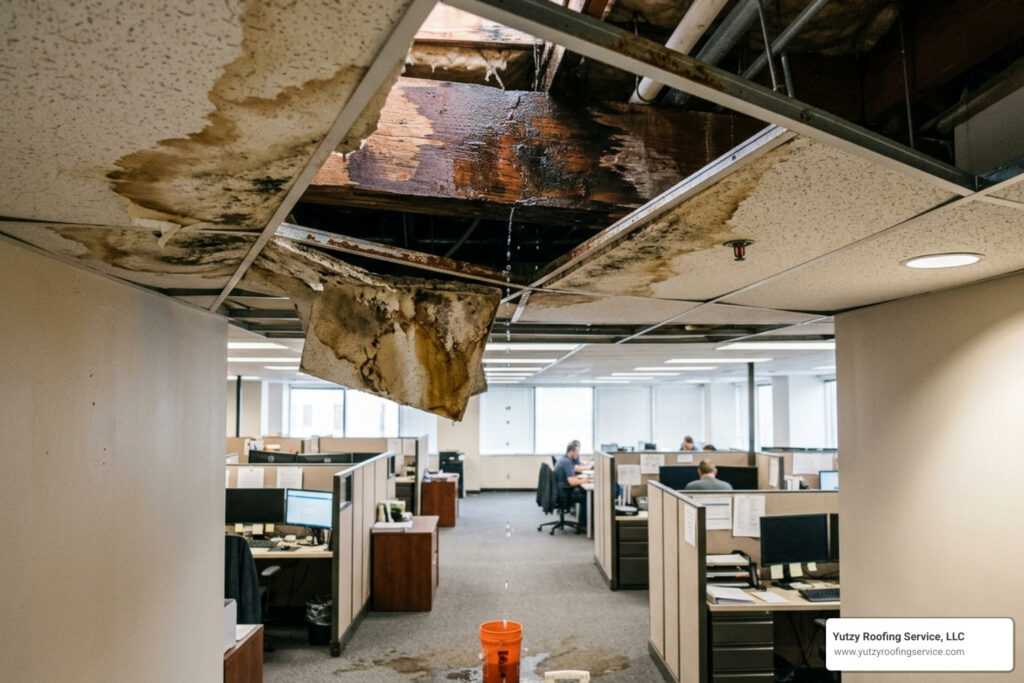
What to Do When Your Commercial Roof Is Leaking From the Inside
How to fix a leaking roof from the inside is something every commercial property owner in Wisconsin should know — especially when a storm hits mid-winter and you can’t safely access the roof.
Here’s the short answer:
- Contain the water — Place buckets under drips and protect equipment immediately
- Turn off electricity in any area where water is near wiring or light fixtures
- Relieve ceiling pressure — If you see a bulge, carefully poke a small hole at the lowest point to drain pooled water
- Get to the attic or plenum — Use a flashlight to trace water trails back toward the source
- Apply a temporary patch — Use roofing tar, rubberized sealant, or roofing tape over the leak point on the inside of the roof deck
- Document everything — Photos, videos, and receipts for your insurance claim
- Call a professional roofer — Interior fixes are always temporary; the exterior source must be repaired
Important: Interior repairs stop the drip — they do not fix the roof. A permanent repair requires addressing the external source.
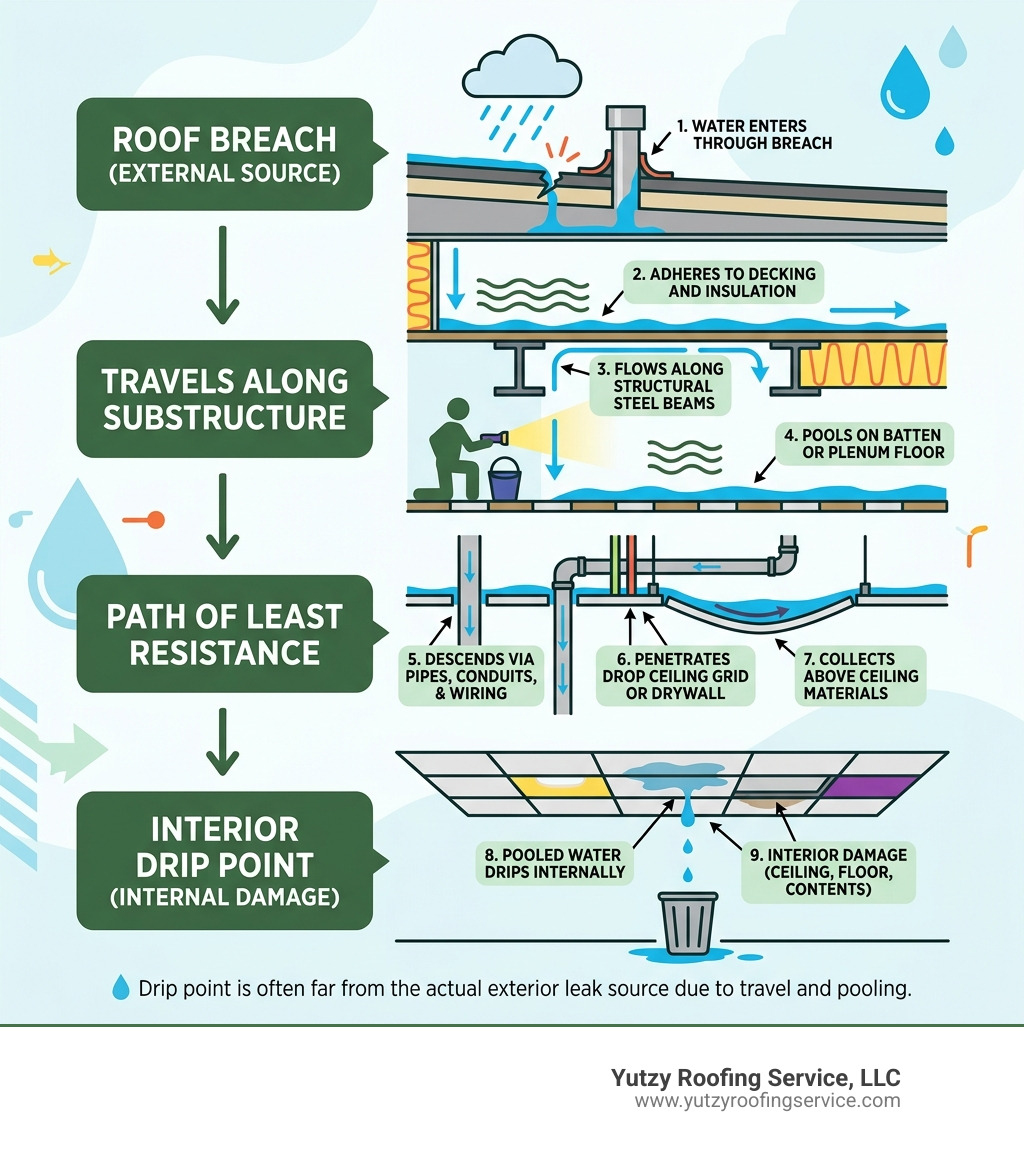
Water is sneaky. It enters the roof at one point, then travels along rafters and decking before dripping somewhere completely different. That means the wet spot on your ceiling is rarely directly below the actual damage. Putting off a real repair can push your costs past $5,000 — and that’s before accounting for mold, rot, or inventory loss.
I’m Josh Yutzy, and my family has been repairing and restoring commercial roofs across Wisconsin since 1995 — including plenty of emergency calls from property owners who needed to know exactly how to fix a leaking roof from the inside while waiting for conditions to allow a proper exterior repair. In this guide, I’ll walk you through every step, from immediate containment to knowing when it’s time to call in the crew.
Immediate Safety and Containment Steps
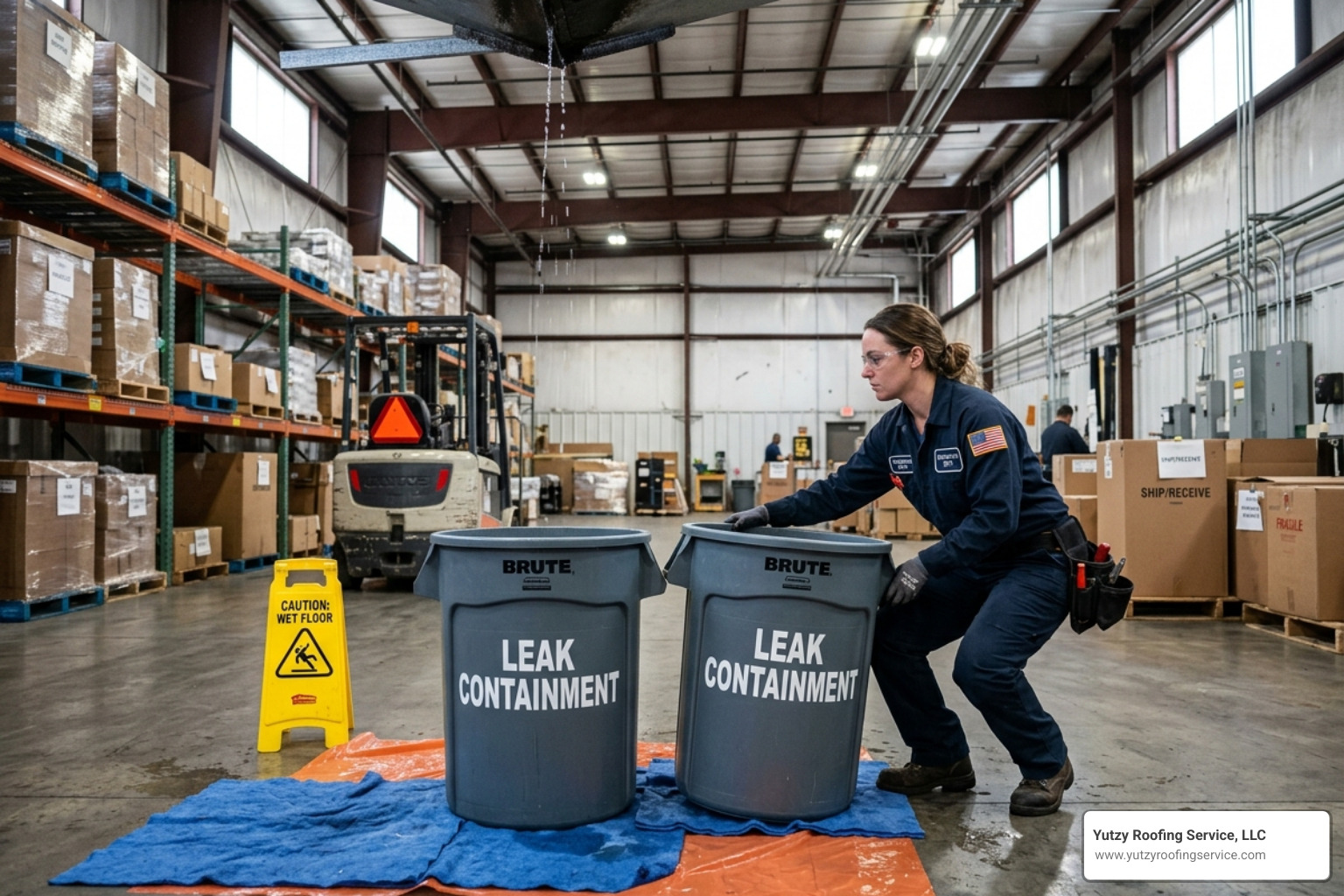
When you first spot a leak in your warehouse or facility, your brain might go straight to the repair, but your first priority must be safety and containment. In a commercial setting, water doesn’t just damage the structure; it threatens expensive inventory, machinery, and the safety of your team.
Start by placing industrial-grade buckets or trash cans under the active drip. If the water is splashing, line the area with towels or heavy plastic sheeting to prevent slip hazards. What To Do If Your Commercial Roof Is Leaking starts with protecting your assets. Move any pallets, electronics, or paperwork away from the splash zone.
Safety is paramount. If water is dripping near light fixtures, electrical panels, or conduit, shut off the power to that section of the building immediately. Water and electricity are a deadly combination, and commercial voltages are no joke.
Managing Ceiling Pressure
If you notice a section of your drywall or ceiling tiles bulging downward, it means water is pooling on top of the material. This is a “ticking time bomb” for a ceiling collapse.
To prevent a sudden, messy failure, you need to perform a controlled drain. Take a long screwdriver or a drill and carefully poke a small hole in the very center of the bulge (the lowest point). Have a bucket ready! This releases the weight and pressure, protecting the structural integrity of the rest of the ceiling grid. By diverting the water into a container, you stop it from spreading horizontally and ruining more of your interior.
How to Safely Locate the Source from the Inside
Once the immediate “flood” is under control, you need to find where the water is actually coming in. Remember: where the water drips is rarely where the roof is broken. Gravity is a trickster. Water hits the roof deck, runs down a steel rafter, hops onto a piece of insulation, and finally drops onto your head ten feet away from the original hole.
If you have a crawl space, attic, or plenum, grab a high-powered flashlight and head up there. Look for “water trails”—shiny streaks on rafters or dark stains on the underside of the roof deck. Your Guide To Roof Leak Repairs How To Spot A Leaking Roof emphasizes that you should always trace these trails upward to the highest point of moisture.
Tracing Leaks in Commercial Plenums
In large commercial buildings, tracing a leak requires a bit of detective work. Look closely at roof penetrations like HVAC units, vents, and skylights. These are common culprits.
- Check the insulation: Wet fiberglass insulation is a clear marker. If it’s soaked, pull it back to see the deck underneath.
- Follow the rafters: Water often clings to the bottom flange of a steel I-beam or C-channel.
- Look for light: On a bright day, you might actually see pinpricks of daylight through the deck, though this is less common with modern membrane roofs.
For more detailed troubleshooting, How to Troubleshoot and Repair a Leaking Ceiling provides excellent insights into identifying non-obvious moisture sources.
How to Fix a Leaking Roof From the Inside: Step-by-Step
You’ve found the spot. Now, how do you stop the flow? We want to be clear: this is a “Band-Aid” fix. It buys you time until we can get a crew out to Appleton or Madison to fix the exterior membrane or metal panels.
Essential Tools for how to fix a leaking roof from the inside
Before you climb back up, make sure you have your “emergency kit” ready. You don’t want to be hunting for tools while water is actively damaging your facility.
- Roofing tar or bitumen: This is a thick, waterproof adhesive.
- Putty knife: For spreading the tar.
- Rubberized sealant or roofing tape: Products like Gorilla Waterproof Patch or Flex Tape are great for small cracks.
- Plywood scraps: Small 6×12 inch pieces to reinforce the patch.
- Utility knife: To cut materials to size.
- Rags and a fan: To dry the surface as much as possible before applying adhesive.
Applying the Temporary Interior Patch
- Dry the Surface: Adhesives hate water. Use a rag or a battery-operated fan to dry the underside of the roof deck around the leak as much as possible.
- Apply the Sealant: Using your putty knife, spread a liberal amount of roofing tar or bitumen directly over the hole or crack. Make sure the coverage extends at least 3-4 inches beyond the edges of the leak.
- Reinforce: Press a piece of plywood or a spare shingle into the wet tar. This provides a physical barrier and helps the tar stay in place against gravity.
- Seal the Edges: Apply another layer of tar around the edges of the plywood to ensure no water can “creep” around the patch.
If the leak is too large for tar, you can use a heavy-duty plastic tarp. Staple the tarp to the rafters above the leak and direct the bottom of the tarp into a bucket. This is called a “drainage bypass.” It doesn’t stop the leak, but it keeps your floor dry. For specific advice on flat roofs, see our guide on Flat Roof Leak Repair In Appleton Wi.
Why Interior Patches are Only Temporary Solutions
It is tempting to see the dripping stop and think the job is done. In April 2026, we see many business owners make this mistake, only to face a $10,000 mold remediation bill six months later.
How to fix a leaking roof from the inside is a mitigation strategy, not a repair. When you patch from the inside, the water is still getting past your exterior membrane or metal. It is now trapped inside your roof assembly.
Limitations of how to fix a leaking roof from the inside
- Moisture Entrapment: Water trapped between the interior patch and the exterior roof deck will rot the wood or rust the steel deck from the inside out.
- Insulation Damage: Wet insulation loses nearly all its R-value. It also becomes a breeding ground for mold. Commercial Roof Repair Faq About Warehouse Roof Leaks explains how trapped moisture can quickly ruin a building’s energy efficiency.
- Structural Rot: Constant moisture leads to wood rot in rafters or corrosion in metal supports, which can eventually lead to a full roof collapse.
- The “Balloon” Effect: If you seal a leak from the inside, the water will simply find the next path of least resistance, often popping up as a new leak a few feet away.
For more on why quick action is vital for business owners, check out Roof Leaks A Guide For Business Owners In Marshfield Wi.
When to Call a Professional for Commercial Roof Repair
While a DIY patch might cost you $50 in materials, ignoring the root cause could lead to a full roof replacement costing tens of thousands. You should call us immediately if:
- The patch doesn’t stop the drip: This means the water volume is too high for a temporary fix.
- The roof is sagging: This is a structural emergency. Evacuate the area and call a pro.
- There are multiple leaks: This usually indicates a systemic failure of the roof membrane or aging materials.
- The leak is near electrical systems: Don’t risk a fire or electrocution.
Signs of Serious Commercial Roof Failure
Keep an ear out for electrical buzzing or popping sounds near the leak. Look for large-scale mold colonies (black or green fuzzy spots) on the underside of the deck. If your roof is over 20 years old, these leaks are likely the “canary in the coal mine” for a total failure. Flat Roof Leak When To Call The Professionals In Madison Wi offers a checklist for when the situation has moved beyond DIY.
Frequently Asked Questions about Interior Roof Repairs
Can I fix a roof leak from the inside permanently?
No. There is no such thing as a permanent interior roof repair. Roofs are designed to shed water from the outside. Any fix applied to the inside allows water to remain within the roof’s structure, which will eventually cause rot, mold, and structural failure. You must seal the external breach to solve the problem.
Is it safe to enter a commercial attic or plenum during a leak?
Generally, yes, but use extreme caution. Wear gloves and non-slip shoes. Always use a stable ladder and have a spotter if possible. Avoid stepping on any part of the ceiling that looks wet or sagging, as it may not support your weight. If you smell gas or hear electrical arcing, exit the area immediately.
How long will an interior patch hold?
A well-applied interior patch might hold for a few days to a couple of weeks. However, temperature swings (common in Wisconsin and Minnesota) and heavy rain will quickly degrade the adhesive. It is a stop-gap measure meant to buy you enough time to schedule a professional inspection.
Conclusion
Knowing how to fix a leaking roof from the inside is a vital skill for any facility manager or business owner. It allows you to take control of an emergency, protect your assets, and minimize downtime. But remember, the “drip” is just a symptom; the “hole” is the disease.
At Yutzy Roofing Service, LLC, we specialize in long-term commercial solutions that go far beyond a temporary patch. Whether you need a spray foam coating to seal an entire warehouse or EPDM repairs for a flat industrial roof, we bring decades of experience to every job. We are proud to offer an up to 18-year non-prorated renewable warranty on our restoration services, serving Madison, Appleton, Wausau, and throughout Wisconsin and Southern Minnesota.
Don’t let a small drip turn into a structural disaster. If you’ve applied your temporary patch and are ready for a permanent solution, check out our flat roof services or give us a call today to schedule a professional inspection. We’ll help you stop the drip for good.
