Choose a Commercial Roofer Company That Protects Your Facility
A qualified commercial roofer company should inspect the full roof system, identify the source of leaks or moisture, explain whether repair, restoration, or replacement makes financial sense, and provide a clear written scope of work.
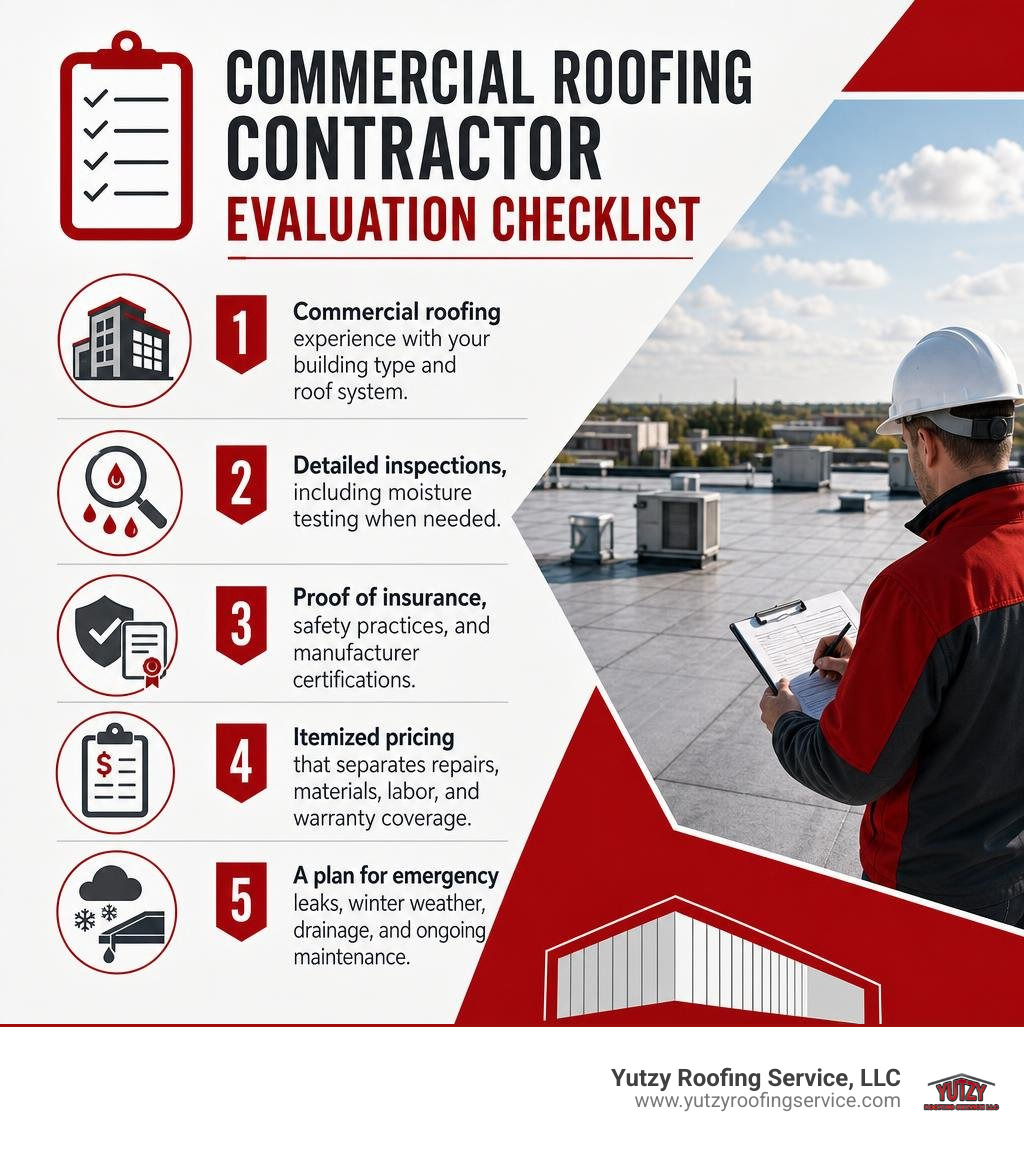
Before hiring, look for:
- Commercial roofing experience with your building type and roof system.
- Detailed inspections, including moisture testing when needed.
- Proof of insurance, safety practices, and manufacturer certifications.
- Itemized pricing that separates repairs, materials, labor, and warranty coverage.
- A plan for emergency leaks, winter weather, drainage, and ongoing maintenance.
For Wisconsin commercial property owners, the right choice is rarely the contractor with the fastest guess or lowest starting price. Extreme cold, summer heat, standing water, and repeated freeze-thaw cycles can turn a small membrane failure into wet insulation, interior damage, and an expensive tear-off. A thorough contractor helps you understand the condition of the roof before recommending a major capital expense.
I am Josh Yutzy of Yutzy Roofing Service, LLC, a family-owned roofing business serving Wisconsin since 1995. Our experience as a commercial roofer company is built on helping property owners choose durable, cost-conscious solutions without compromising material or installation quality.
Learn more about commercial roofer company:
Key Services Offered by a Qualified Commercial Roofer Company
Selecting a partner to manage your building envelope requires understanding the full scope of what an enterprise-grade crew delivers. Commercial facilities—such as manufacturing facilities, distribution centers, warehouses, and cold storage units—present unique architectural demands. A professional crew does far more than patch visible holes; they manage structural loads, optimize energy performance, and protect your operations from unplanned downtime. Understanding how commercial roofer services protect you begins with evaluating the core capabilities a contractor brings to the job site.
Standard service offerings from seasoned contractors typically include:
- Comprehensive diagnostic evaluations: Evaluating membrane integrity, structural substrate health, thermal resistance, and internal drainage networks.
- Targeted leak mitigation and emergency patching: Rapid isolation of active water intrusion to halt damage to inventory, plant machinery, and finished interiors.
- Scheduled preventative maintenance: Bi-annual inspections, cleaning scuppers and drains, resealing flashing details, and checking rooftop mechanical penetrations.
- Fluid-applied roof restorations: Installing seamless silicone or acrylic elastomeric systems over aged membranes to renew weatherproofing without a full tear-off.
- Retrofit (recover) installations: Adding an approved insulation layer and a single-ply membrane over an existing substrate where building codes allow.
- Full roof tear-offs and structural replacements: Total removal of failed substrates down to the structural decking, followed by new vapor barriers, high-density polyiso insulation, and premium membrane installation.
Advanced Diagnostic Inspections and Maintenance
Modern roofing diagnostics eliminate guesswork. Instead of walking a roof and poking at random seams, specialized contractors employ non-destructive evaluation tools to analyze what is happening beneath the visible membrane.
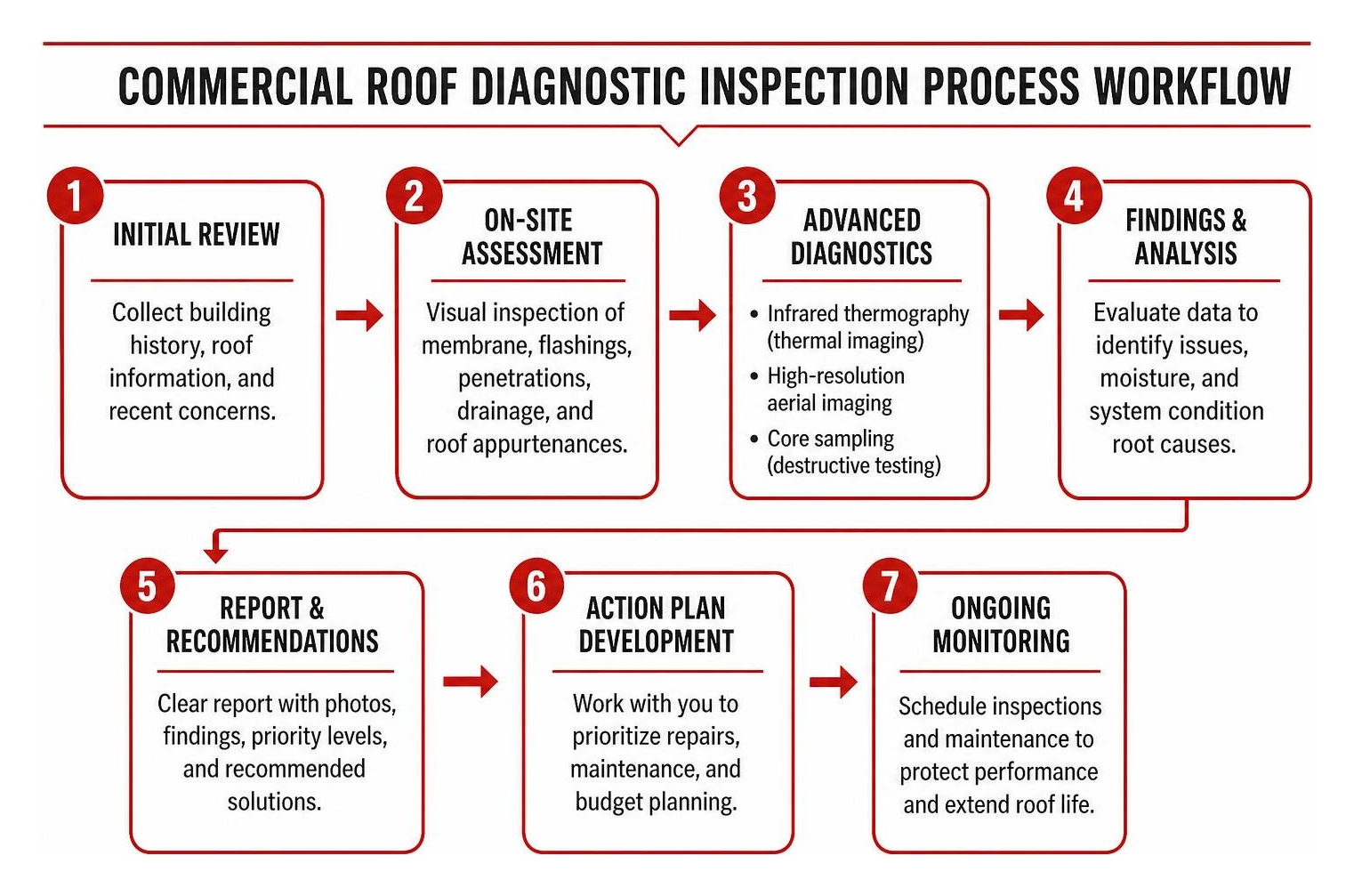
Key diagnostic methods include:
- Infrared thermography (thermal imaging): Performed after sunset as the building cools down, infrared scans detect temperature differentials. Because moisture-saturated insulation retains heat longer than dry insulation, wet areas glow brightly on the camera screen.
- High-resolution aerial imaging: Drone surveys capture millimeter-accurate overhead views of massive industrial decks, highlighting ponding water, open seams, and puncture points around rooftop HVAC units without putting excess foot traffic on fragile surfaces.
- Core sampling (destructive cut testing): Taking small, cylindrical cutouts through all layers down to the deck confirms exact insulation thickness, identifies trapped moisture layers, and reveals the original deck composition (metal, wood, or concrete).
- Drainage line verification and drain markers: In northern climates subject to deep snow and freeze-thaw cycles, installing elevated drain markers ensures maintenance teams can instantly find and clear roof drains during blizzards, preventing severe structural overloading from meltwater pooling.
What Sets a Dedicated Commercial Roofer Company Apart
Industrial buildings cannot be treated like standard residential structures. Understanding why hire a commercial roofing company rather than a general contractor comes down to engineering standards, specialized equipment, and operational sequencing.
Commercial roofs are primarily low-slope or flat platforms that rely on internal drainage, crickets, and positive slope-to-drain designs rather than gravity-driven pitch. Managing hundreds of thousands of square feet requires heavy-duty staging equipment, specialized cranes, robotic seam welders, and industrial tear-off machines.
Furthermore, industrial contractors know how to sequence production hours. If you operate an active food processing plant, pharmaceutical lab, or data center, we sequence the roofing work around your operational shifts to minimize noise, eliminate odor intake into HVAC make-up air units, and avoid any halt to your daily revenue generation.
Commercial Roofing Systems: Material and Installation Comparison
Choosing the proper roofing system requires balancing building use, structural deck capacity, chemical exposure, and budget. Below is an objective comparison of primary low-slope and flat roof commercial systems:
| Roofing System | Typical Material Lifespan | Estimated Installation / Restoration Cost (Per Sq. Ft.) | Primary Strengths | Best Facility Applications |
|---|---|---|---|---|
| TPO (Thermoplastic Polyolefin) | 20–30 Years | $8.00 – $14.00 | High solar reflectivity, heat-welded seams, resistant to tears and ozone | Warehouses, distribution centers, big-box retail |
| EPDM (Ethylene Propylene Diene Monomer) | 25–35+ Years | $8.00 – $13.00 | Superior cold-weather flexibility, excellent hail and puncture resistance | Cold storage facilities, manufacturing plants, northern climates |
| Modified Bitumen (Multi-Ply) | 15–25 Years | $9.00 – $16.00 | Heavy foot-traffic tolerance, multiple protective plies, puncture toughness | Buildings with heavy rooftop equipment, schools, hospitals |
| Fluid-Applied Silicone / Acrylic Coatings | 10–18+ Years (Renewable) | $2.50 – $5.00 | Completely seamless, zero tear-off disruption, highly reflective, cost-effective | Aging metal roofs, weathered EPDM, TPO, and modified bitumen |
Single-Ply Membranes: TPO and EPDM Performance
Single-ply sheets remain among the most popular choices for low-slope commercial facilities.
TPO (Thermoplastic Polyolefin) is a reflective white membrane that features hot-air welded seams. When welded with robotic equipment, the seams fuse at the molecular level, creating a continuous bond stronger than the sheet itself. Its bright white surface deflects UV rays, helping keep interior temperatures lower during hot summer months.
EPDM (Ethylene Propylene Diene Monomer) is a synthetic vulcanized rubber membrane known for durability. Black EPDM absorbs solar heat, which can be an advantage during freezing northern winters by accelerating snowmelt. It maintains its flexibility even when temperatures drop well below zero, avoiding the thermal shock cracking that can affect rigid materials. For business owners evaluating single-ply systems across our service regions in Wisconsin, choosing between TPO and EPDM often comes down to internal building humidity, local freeze-thaw severity, and energy priorities.
Multi-Ply Modified Bitumen and Fluid-Applied Coatings
For facilities with heavy rooftop maintenance traffic, Modified Bitumen delivers multi-ply security. Using sheets factory-infused with SBS (styrene-butadiene-styrene) rubber or APP (atactic polypropylene) plastic, these systems are installed in multiple layers using cold adhesives, hot asphalt, or self-adhering plies. The multi-layer structure provides a durable barrier against punctures from dropped tools or service technicians servicing HVAC units.
Fluid-Applied Elastomeric Restoration (Silicone and Acrylic Coatings) is one of the most effective ways to restore an aging roof. Rather than spending capital on a complete tear-off, high-solids silicone or acrylic elastomeric systems are applied directly over cleaned, sound substrates.
The coating cures into a monolithic, seamless membrane that seals all existing fasteners, flashing details, and seams. Silicone formulations resist ponding water indefinitely, making them ideal for flat commercial profiles. Because a fluid restoration eliminates the labor and landfill disposal fees of a complete tear-off, facility managers can save substantially while securing warranties up to 18 years that are fully renewable with a maintenance re-coat.
Commercial Roof Decision Framework: Repair, Restore, or Replace
One of the most important aspects of hiring a commercial contractor is ensuring their recommendations match the true condition of your roof. Installing a new roof when a restorative coating would suffice drains capital; conversely, repeatedly patching a saturated substrate simply wastes maintenance funds.

Commercial roofing specialists rely on a straightforward threshold: the 25% rule. If non-destructive moisture scans reveal that more than 25% of the subsurface insulation is wet and degraded, a full tear-off is generally necessary. Wet insulation cannot insulate, creates structural dead-load weight, and accelerates deck corrosion.
However, if insulation core tests show the insulation is dry and recurring leaks are limited to aged flashings or weathered seams, a fluid-applied restoration coating provides a durable, leak-free system at a fraction of the cost of replacement. If you are comparing contractors in the region, check out our guide on how to choose the best commercial roofing company for your needs to make an informed choice.
Core Cuts, Moisture Scans, and Recover Rules
Before deciding to tear off a roof, a commercial roofer evaluates local building codes regarding recover systems. Most building codes permit a maximum of two roofing layers on a commercial structure.
- If the building has one existing roof layer: If core cuts and thermal imaging confirm the underlying insulation and structural deck are dry and structurally sound, a recover board and new single-ply membrane or elastomeric coating can be installed directly over the existing roof. This eliminates tear-off labor and dumpster fees, saving building owners between 20% and 35% compared to total replacement.
- If the building already has two roof layers: Building codes generally require a complete tear-off down to the deck before any new roofing membrane can be installed.
- If structural load limits are reached: Even if a second layer is code-permissible, a contractor must verify that the building’s structural trusses can support the added dead load of an extra membrane layer.
Cost Drivers, Timelines, and Warranty Coverage
Understanding the primary cost drivers helps you evaluate estimates accurately. Before signing a contract, reviewing what you need to know before hiring commercial roofers can help you avoid surprise change orders down the line.
Key commercial cost drivers include:
- Substrate condition: Dry decking requires basic preparation; saturated decking requires sheet replacement, structural re-fastening, and new polyisocyanurate insulation boards.
- Access and height: A low, single-story warehouse deck with open perimeter access costs less to service than a multi-story building requiring heavy staging, street closures, and specialized crane logistics.
- Penetrations and flashing details: Flat expanses of open deck install quickly; roofs crowded with exhaust stacks, skylights, RTUs, and parapet walls require intensive hand-labor and detail sealing.
- System type: Liquid coating restorations typically range from $2.50 to $5.00 per sq. ft., standard TPO flat roof replacements range from $8.00 to $14.00 per sq. ft., and complex multi-ply installations run higher. Routine spot leak repairs generally fall between $1,500 and $15,000, depending on the extent of the damage.
Project timelines scale with square footage, weather conditions, and system complexity. A 50,000-square-foot membrane recover might take 7 to 12 working days, whereas a complete tear-off of the same size with extensive insulation replacement could take several weeks.
When reviewing proposals, look closely at warranty structures. Many property owners look for NDL (No Dollar Limit) manufacturer warranties, which cover 100% of the labor and material costs required to correct warrantable leaks without a dollar cap over 10 to 30 years. At Yutzy Roofing Service, we back our commercial restoration and coating work with up to 18-year non-prorated renewable warranties, providing lasting protection that can be extended with simple re-coats down the road.
Essential Vetting Criteria for Commercial Contractors
Commercial installations involve high-value property, active indoor machinery, and heavy equipment. You must verify that any contractor you consider has the operational stability and safety record to work on your facility.

How to Choose the Right Commercial Roofer Company
When reviewing contractor proposals, use this practical evaluation checklist:
- Dedicated commercial expertise: Ensure the contractor specializes in low-slope and flat commercial installations rather than shifting between small residential jobs and enterprise projects.
- Itemized, line-item bid transparency: Avoid single-number estimates. Demands bids that clearly itemize teardown, insulation R-value, membrane mil-thickness, flashing specifications, disposal fees, and permit costs.
- Local references and regional track record: Ask for references from similar industrial facilities in your geographic area. A reputable contractor will readily supply client contacts and case studies.
- Established supplier relationships: Verify that the contractor is an authorized, certified applicator for major commercial roofing manufacturers.
Safety Compliance, Manufacturer Certifications, and Bonding
Safety is critical on an active industrial job site. A quality commercial roofer company prioritizes strict compliance to protect everyone involved:
- OSHA 29 CFR 1910.28 compliance: The contractor must demonstrate strict adherence to federal and state safety standards, including perimeter warning lines, safety net systems, harness tie-offs, and secure ladder/hatch access points. Understanding the role of commercial roofers in ensuring safety and compliance will show you how strict adherence protects building owners from liability.
- Comprehensive insurance coverage: The contractor must carry active Commercial General Liability insurance, along with full statutory Worker’s Compensation for every crew member on site.
- Surety project bonding: For large-scale industrial projects, evaluate whether the contractor can secure single-project bonding. This provides third-party financial backing guaranteeing project completion according to the contract.
- Factory-certified master contractor status: Manufacturers only grant their top-tier warranties (such as 20- or 30-year NDL terms) when the roof is installed by an authorized, factory-trained installer.
Frequently Asked Questions About Commercial Roofing Contractors
How do commercial roofers handle storm emergencies and active leaks?
When a severe storm damages a commercial roof, reputable commercial roofers provide rapid emergency dispatch. The initial priority is active leak containment—using heavy-duty reinforced tarps, mechanical drain clears, and temporary sealants to stop water from reaching inventory and electrical equipment. Once conditions stabilize, technicians perform non-destructive moisture scans, document all damaged areas with photos, and provide adjuster-ready documentation to streamline your commercial insurance claim.
What warranty coverage should I expect from a commercial installation?
Commercial projects typically involve two distinct warranties:
- Contractor workmanship warranty: Covers installation craftsmanship, flashing details, and contractor labor for a designated period (often 2 to 10 years).
- Manufacturer material / NDL warranty: Offered directly by the chemical or membrane manufacturer, covering membrane defects and weatherproofing integrity for 10 to 30 years. Premium NDL (No Dollar Limit) warranties cover full labor and material replacement costs if the membrane fails. High-performance restoration coatings often include 10- to 18-year non-prorated warranties that can be renewed with subsequent topcoats.
How much does a commercial roof installation or repair cost?
Commercial roofing costs depend on the scope of work and chosen approach:
- Spot leak repairs: Typically run between $1,500 and $15,000, depending on access, membrane condition, and underlying moisture.
- Fluid-applied roof restorations: Average $2.50 to $5.00 per sq. ft., delivering a renewed, seamless surface without tear-off costs.
- Single-ply membrane replacements (TPO/EPDM): Generally range from $8.00 to $14.00 per sq. ft., depending on insulation thickness, fastener specifications, and tear-off requirements.
- Multi-ply modified bitumen installations: Typically range from $9.00 to $16.00 per sq. ft., based on system design and deck complexity.
Conclusion
Your commercial roof is a major structural investment that protects your employees, inventory, and operations every day. Choosing the right contractor means partnering with a team that uses proven diagnostic tools, understands commercial flat-roof engineering, follows strict job site safety standards, and offers honest recommendations on whether to repair, restore, or replace.
Rather than settling for generic estimates or rushed full-replacement quotes, take the time to inspect your roof’s underlying insulation, explore fluid-applied restoration options, and verify manufacturer certifications. If your facility is located in Marshfield, Appleton, Eau Claire, Fond Du Lac, Green Bay, Madison, Wausau, or nearby regions, our team at Yutzy Roofing Service is ready to help. Contact us today to schedule a comprehensive commercial roof evaluation and secure long-term protection for your building.
