Why Roof Leak Detection Can Save Your Commercial Property From Costly Damage
Roof leak detection is the process of locating where water enters a building through the roof — before it causes serious structural damage, mold growth, or costly interior repairs.
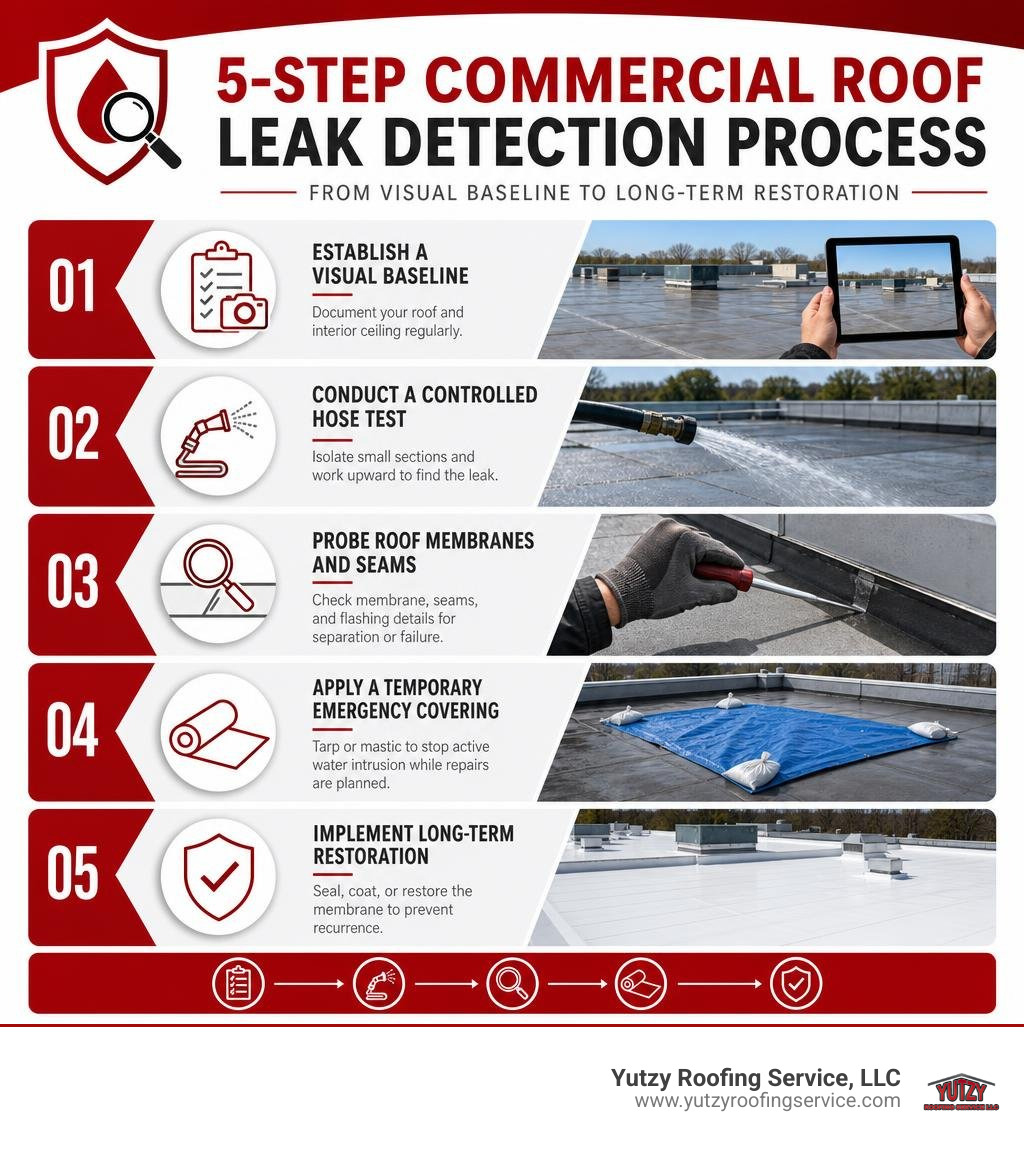
Quick answer — how to find a roof leak in 5 steps:
- Establish a visual baseline — document your roof and interior ceiling regularly so new damage stands out immediately
- Conduct a controlled hose test — isolate small sections and work upward to pinpoint the entry point
- Probe flat roof membranes and seams — check EPDM, TPO, and flashing details for separation or failure
- Apply a temporary emergency covering — tarp or mastic to stop active water intrusion while repairs are planned
- Implement long-term restoration — seal, coat, or restore the membrane to prevent recurrence
Here’s the problem most commercial property owners face: by the time a water stain appears on a ceiling tile, the damage to your roof deck, insulation, and structural steel has already begun. Water rarely drips straight down. It travels along beams, decking, and framing — sometimes several feet — before showing up where you can see it.
Wisconsin’s extreme winters and hot summers make this worse. Freeze-thaw cycles stress seams and flashings. Summer heat bakes membranes. And a small, undetected breach can quietly saturate insulation for months before anyone notices the heating bill creeping up.
I’m Josh Yutzy, and with over 30 years of commercial roofing experience across Wisconsin, I’ve seen how early roof leak detection prevents small problems from turning into full roof replacements. In this guide, I’ll walk you through exactly how to find and fix a commercial roof leak — step by step.
Roof leak detection terms made easy:
Early Warning Signs of Commercial Roof Damage
Catching a leak before it triggers a crisis requires understanding how water interacts with commercial roofing systems. Unlike sloped residential structures, flat or low-slope commercial roofs rely on complex drainage systems, heavy-duty membranes, and specialized flashings.
If you wait for a major downpour to check on your building, you are playing catch-up. To keep your facility dry and operational, it is crucial to understand the differences between trying to handle this yourself versus bringing in specialized professionals.
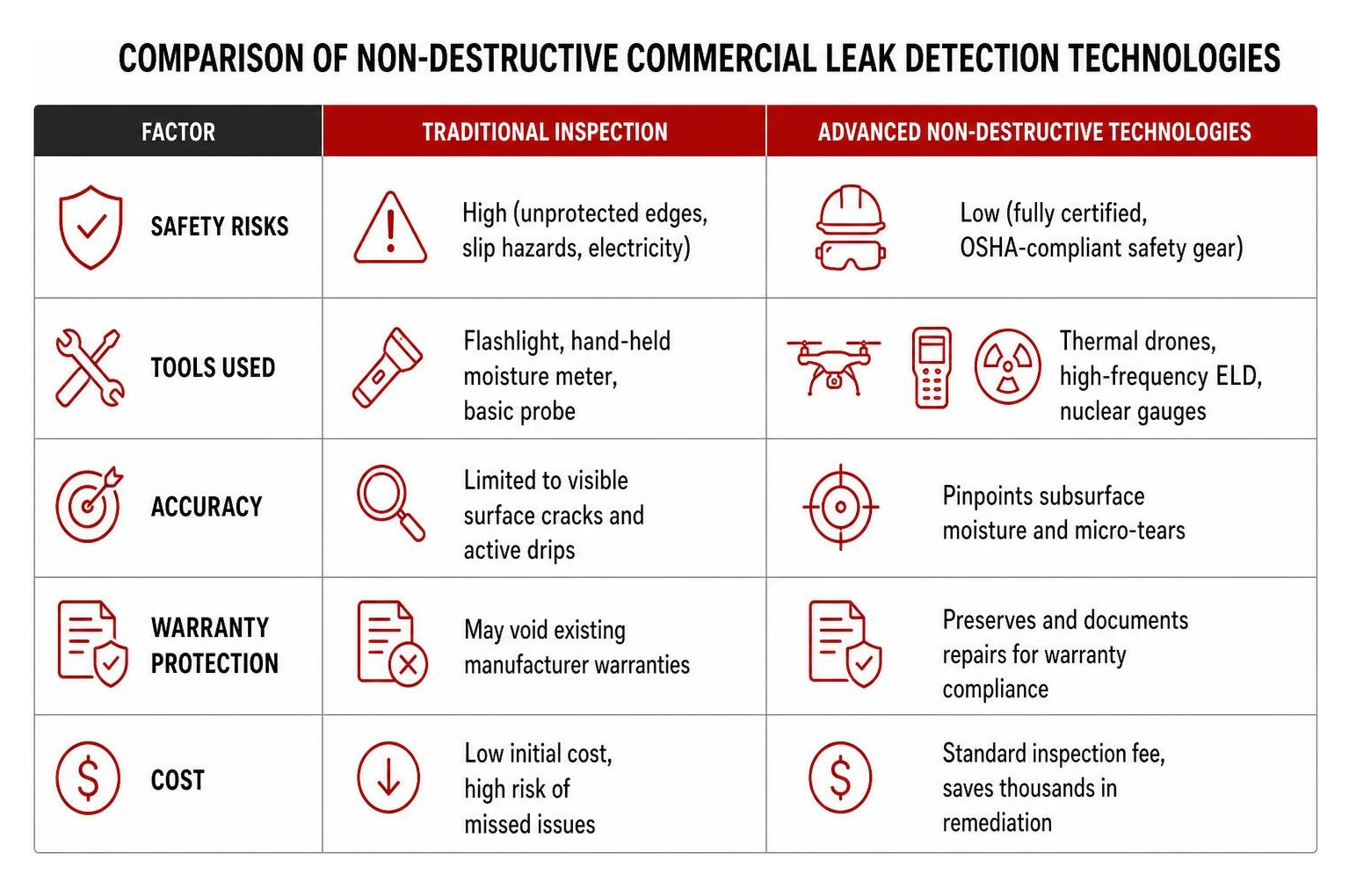
| Feature | DIY Commercial Leak Detection | Professional Commercial Leak Detection |
|---|---|---|
| Safety Risks | High (unprotected edges, slip hazards, electricity) | Low (fully certified, OSHA-compliant safety gear) |
| Tools Used | Flashlight, hand-held moisture meter, basic probe | Thermal drones, high-frequency ELD, nuclear gauges |
| Accuracy | Limited to visible surface cracks and active drips | Pinpoints subsurface moisture and micro-tears |
| Warranty Protection | May void existing manufacturer warranties | Preserves and documents repairs for warranty compliance |
| Cost | Low initial cost, high risk of missed issues | Standard inspection fee, saves thousands in remediation |
When performing any preliminary assessment, safety must be your absolute priority. Commercial roofs present unique hazards, including open perimeters, skylights that cannot support a person’s weight, wet membranes that become slick as ice, and proximity to high-voltage HVAC equipment. Always wear non-slip boots, establish safety lines near edges, and never step onto a roof alone or during active lightning storms.
During your walkarounds, look closely for three primary indicators of membrane distress:
- Water pooling (ponding water): Water that remains on the membrane for more than 48 hours after rain indicates a drainage failure. Ponding water acts like a magnifying glass under the hot summer sun, accelerating UV degradation, while its sheer weight stresses the structural deck.
- Membrane blistering: These are raised bubbles caused by trapped air or moisture heating up and expanding between the membrane layers. If a blister is punctured, it creates a direct conduit for water.
- Structural degradation: Look for sagging deck sections, rusted steel joists, or crumbling masonry parapet walls. These physical failures are often the result of long-term, slow moisture infiltration.
Spotting the Warning Signs Early
The primary culprits behind flat roof failures are surprisingly consistent. Clogged roof drains and scuppers cause water to back up, creating massive artificial ponds that find even the microscopic imperfections in your roof. Flashing failures—where the protective metal edging meets the membrane at walls, chimneys, or HVAC curbs—account for a massive percentage of active leaks.
Furthermore, seam separation occurs as EPDM or TPO membranes age and shrink, tearing open the heat-welded or taped joints. To protect your property, we recommend reading our detailed guide on how to Stop The Drip By Checking Roof For Leaks Early to identify these weak points before they fail.
Tracing Water Paths Indoors
If water has already entered your facility, finding the physical source requires a bit of detective work. Start by looking up into the ceiling plenum (the space between the structural ceiling and your drop-ceiling tiles).
Water stains on tiles are rarely directly below the roof leak because gravity pulls water along the slope of the metal deck, conduits, and structural steel beams until it finds a low point to drip. Look for mold growth on drywall, bubbling paint, or persistent musty odors. If you spot these internal indicators, consult our guide, Stop The Drip A Guide To Interior Roof Repairs, to learn how to mitigate interior damage while tracing the water uphill.
Advanced Technologies for Commercial Roof Leak Detection
When a visual inspection is not enough to find a hidden leak, modern commercial roofers rely on scientific instruments. These non-destructive testing technologies allow us to map moisture without cutting into your functional roof.
Infrared Thermography and Drone Scans
Infrared thermography takes advantage of a simple physical property: water has a much higher heat capacity than dry roofing materials. During a hot summer day in Wisconsin, the sun heats up the entire roof. After sunset, the dry insulation cools down rapidly. However, wet insulation holds onto that thermal energy far longer.
By scanning the roof at night with long-wave infrared cameras (typically operating in the 8 to 14 micrometer range), we can see “hot spots” that represent saturated insulation beneath an intact membrane.
Using drones equipped with radiometric sensors allows our team to rapidly map massive facilities in places like Madison or Green Bay without disruptive foot traffic. If you want to learn more about this process, you can read about how we Detect roof leaks with thermography – Expert inspection [FREE] Quote within 24 hours. to see how thermal imaging pinpoints exact moisture paths.
Electronic Leak Detection (ELD) for Flat Membranes
For non-conductive membranes like PVC, TPO, and EPDM, Electronic Leak Detection (ELD) is the gold standard for quality control. This process is governed by the active industry standard D7877 Standard Guide for Electronic Methods for Detecting and Locating Leaks in Roofing and Waterproofing Membranes .
ELD works by applying a low-voltage electrical current across the roof surface. Because dry roofing membranes are excellent electrical insulators, the current cannot pass through them. However, if there is a pinhole leak or micro-perforation, water inside that breach will create a conductive path to the grounded structural deck below.
By tracing the ground return path of the electrical current, we can pinpoint breaches accurate to within millimeters—even on membranes buried under gravel ballast or green roof overburden.
The 5-Step Guide to Locating and Fixing Commercial Roof Leaks
If you suspect your commercial facility has a leak, follow this systematic five-step process to find the source and address it permanently.
Step 1: Establish a Visual Baseline for Roof Leak Detection
You cannot easily identify what is broken if you do not know what “normal” looks like. Establishing a visual baseline involves creating a comprehensive facility maintenance file. Take high-resolution photographs of your entire roof surface, noting the condition of every HVAC curb, drain, expansion joint, and flashing detail.
Keep a detailed log of when equipment was serviced, as HVAC technicians dropping heavy tools or panels is a common cause of membrane punctures. For tips on managing this process without getting overwhelmed, check out our guide on Finding Your Roof Leak Without Losing Your Mind.
Step 2: Conduct a Controlled Hose Test for Roof Leak Detection
When a visual inspection fails to reveal the breach, a controlled water test is the most reliable way to replicate the leak.
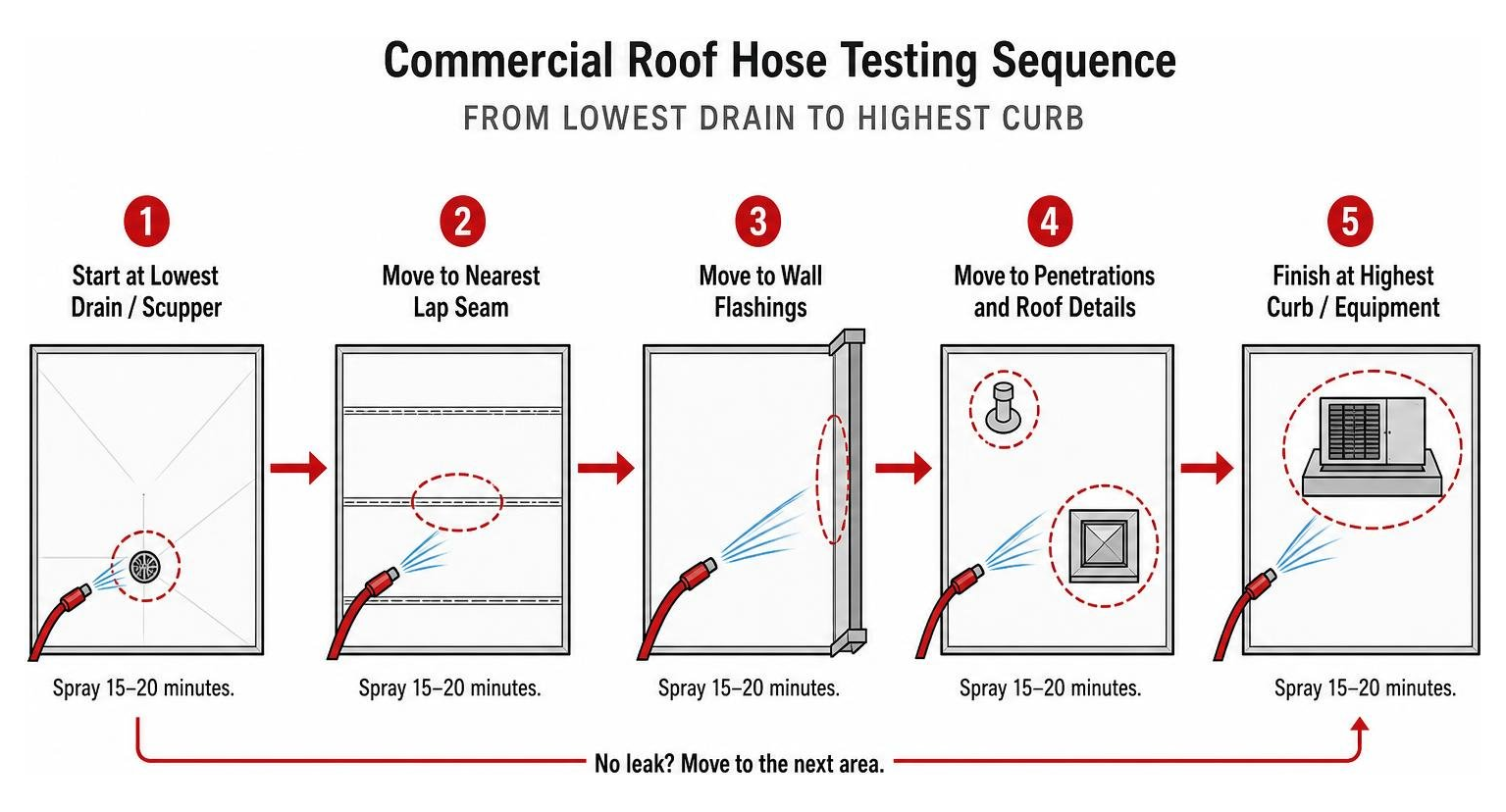
To perform this test correctly, you must isolate specific zones and work slowly from the lowest point of the roof upward. If you spray the entire roof at once, you will learn nothing because water will run down over multiple potential entry points, making isolation impossible.
- Establish Communication: Have one technician inside the building with a radio and flashlight watching the ceiling plenum, while another is on the roof with a garden hose.
- Start Low: Begin by spraying the lowest drain or scupper area for 15 to 20 minutes.
- Move Upward Methodically: If no leak appears indoors, move the hose slowly up to the nearest lap seam, then to the wall flashings, and finally to the HVAC curbs.
- Document: Once the indoor observer spots water dripping, stop spraying immediately and mark that exact outdoor zone.
Step 3: Probe Flat Roof Membranes and Seams
On EPDM and TPO roofs, seams are the most vulnerable points. Over time, thermal expansion and contraction pull at these joints, causing the adhesive tape or heat-welds to fail. To find these micro-separations, we use a specialized metal seam probe.
By gently running the dull tip of the probe along the edge of the seam with light pressure, we can feel when the tool slips into an unbonded pocket. If you find a separation, it must be cleaned, primed, and sealed with a high-quality lap sealant or cover tape. For a deep dive into this technique, read our article on Probing For Problems The Best Way To Find A Leak On A Flat Roof.
Step 4: Apply Temporary Emergency Coverings
If a storm is actively rolling through Wausau or Eau Claire, you cannot perform a permanent restoration. Your immediate goal is water containment.
Use heavy-duty plastic tarps weighted down with sandbags (never concrete blocks, which can tear the membrane) to cover the suspected area. Alternatively, apply an emergency wet-surface mastic or roofing cement directly over the puncture. This mastic can be applied even in standing water to temporarily block the flow.
To prepare your maintenance team for these high-stress situations, review our guide on Dont Let The Rain In With These Emergency Roof Covering Tips.
Step 5: Implement Long-Term Restoration and Maintenance
Temporary patches are just band-aids. To prevent recurring water damage, you must implement a long-term commercial restoration strategy.
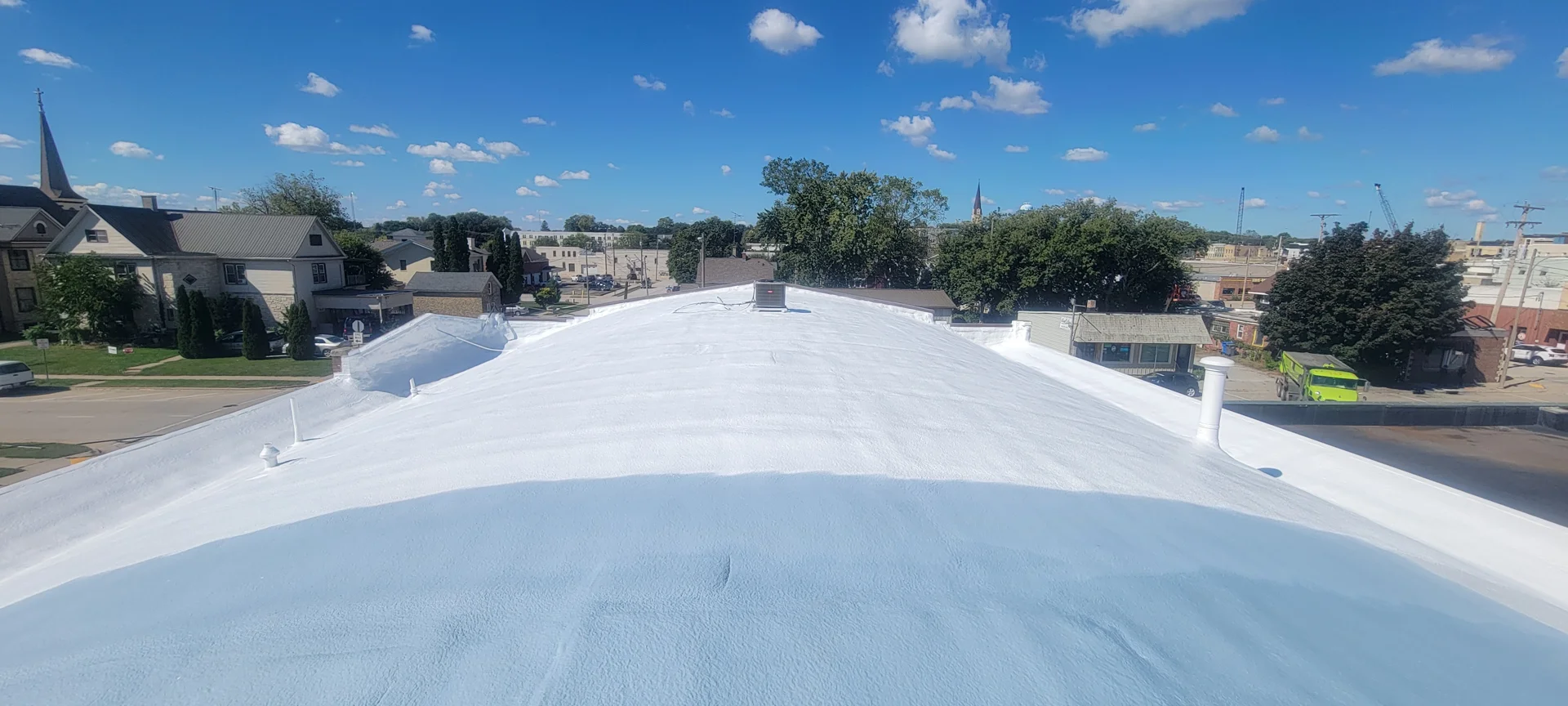
For aging flat roofs, full tear-offs are incredibly expensive and disruptive to your operations. Instead, we specialize in advanced commercial roofing restoration, such as applying seamless fluid-applied silicone or acrylic coatings. These coatings create a monolithic, joint-free membrane directly over your existing roof, sealing all seams, flashings, and penetrations.
If your building has a metal roof, we offer specialized metal roof restoration systems that stop rust, seal fasteners, and eliminate leaks without the cost of new metal roofing panels. To understand the mechanics of metal roof issues, check out Drip Drip Drip How To Identify And Fix A Metal Roof Leak.
For highly sensitive environments, spray polyurethane foam (SPF) coatings provide both seamless waterproofing and added R-value insulation. Best of all, our restoration systems come with up to an 18-year non-prorated renewable warranty, giving you long-term peace of mind.
To ensure you are fully prepared for any roof issue, we also recommend checking out these helpful resources:
- Your Guide To Roof Leak Repairs How To Spot A Leaking Roof
- Staying Dry How To Fix A Roof Leak And Mistakes To Avoid
- How To Find Reliable Roof Leak Repair Services
- Dont Wait For Spring Quick Fixes To Stop Roof Leaks Now
- Non-destructive dormer leak detection – Expert inspection [FREE] Quote within 24 hours.
- Roof leak detection – Expert inspection [FREE] Quote within 24 hours.
Frequently Asked Questions about Commercial Roof Leaks
How much does a professional commercial roof inspection cost?
The cost of a commercial inspection depends on the size of your facility, its height, and the technology required:
- Standard Visual Inspection: Typically ranges from $250 to $350 for a thorough physical walk-through, drain check, and seam probing.
- Infrared Drone Inspection: Averages around $550 to rapidly map subsurface moisture across larger facilities.
- Specialty Roofs / Large Facilities: Complex architectural designs or massive industrial plants can range from $800+ depending on the scope of the diagnostic testing.
How does thermal imaging help find roof leaks?
Thermal imaging does not actually “see” water. Instead, it measures surface temperature differentials. Because wet insulation has a much higher heat capacity than dry insulation, it acts like a thermal battery.
As the sun sets and the roof cools down, the wet areas remain warm much longer. The infrared camera captures these subtle temperature variations, allowing us to draw a precise map of the wet insulation trapped beneath the membrane without drilling a single hole.
Can a roof leak be far from the water stain on the ceiling?
Yes, absolutely. Water is lazy—it follows the path of least resistance. On a commercial flat roof, water will penetrate a seam, run down through the insulation, hit the metal or concrete deck, and then travel along the deck’s flutes or structural steel beams.
It may run 10, 20, or even 30 feet horizontally before finding a joint in the deck or a ceiling tile opening to drip through. This is why professional roof leak detection is so critical; patching the roof directly above the ceiling drip rarely solves the actual problem.
Conclusion
A leaking commercial roof is a ticking clock. If ignored, a minor seam separation can quietly destroy your insulation, decay your structural deck, and lead to thousands of dollars in mold remediation and facility downtime.
At Yutzy Roofing Service, LLC, we believe in solving commercial roofing problems before they require a costly, disruptive replacement. Serving Wisconsin communities like Madison, Appleton, Wausau, Marshfield, Eau Claire, Fond Du Lac, and Green Bay, as well as Rochester and Mankato, MN, we bring advanced diagnostics and over three decades of local expertise directly to your facility.
Whether you need a seamless spray foam coating, a high-performance silicone restoration, or targeted EPDM repairs, our work is backed by our industry-leading, up to 18-year non-prorated renewable warranty.
Don’t let a slow drip turn into a major business interruption. Contact us today to schedule a professional inspection, or visit our dedicated service page to learn more about how our flat roof leak repair services can protect your investment for decades to come.
