
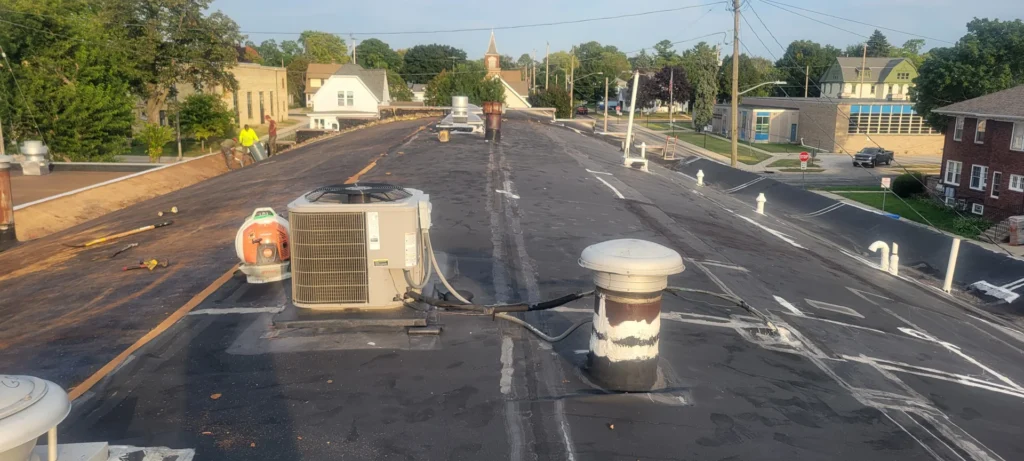
What Does Hot Tar Roofing Actually Cost? (Quick Answer)
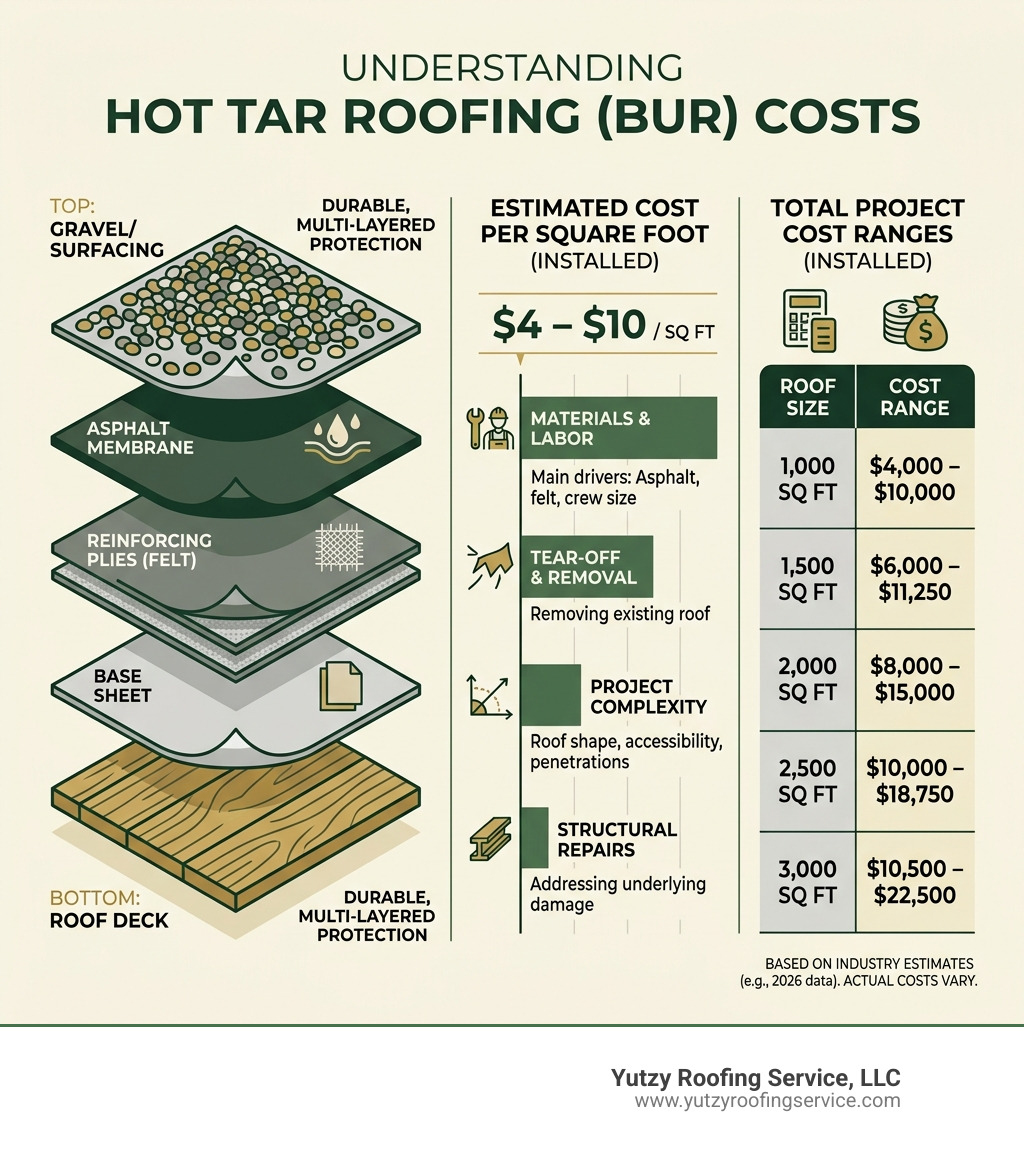
Hot tar roofing cost runs between $4 and $10 per square foot installed, with most commercial property owners paying $8,000 to $12,000 for a standard project. Here’s a fast breakdown:
| Roof Size | Estimated Cost Range |
|---|---|
| 1,000 sq ft | $4,000 – $10,000 |
| 1,500 sq ft | $6,000 – $11,250 |
| 2,000 sq ft | $8,000 – $15,000 |
| 2,500 sq ft | $10,000 – $18,750 |
| 3,000 sq ft | $10,500 – $22,500 |
These figures include materials, labor, and basic removal of an existing roof. Your actual number depends on roof condition, location, number of layers, and whether structural repairs are needed.
Your flat roof is easy to ignore — until it leaks mid-January in a Wisconsin winter. By then, a small problem has often become a costly one. Hot tar roofing, also called built-up roofing (BUR), has protected commercial buildings for over 100 years. It’s proven, durable, and cost-effective — but understanding what drives the price is what separates a smart investment from an expensive surprise.
Material costs alone have jumped roughly 15% since 2022, and labor typically makes up 50% to 70% of the total project cost. That means the quotes you see can vary widely — and knowing what goes into them matters.
I’m Josh Yutzy, and my family has been installing and restoring commercial roofing systems across Wisconsin since 1995 — including countless hot tar and BUR systems where we’ve seen what drives hot tar roofing cost up or down. That experience is exactly what this guide draws on to help you budget confidently and avoid costly mistakes.
Understanding Built-Up Roofing (BUR) and Installation
When people talk about “hot tar,” they are usually referring to a Built-Up Roofing (BUR) system. This isn’t just a bucket of tar slapped onto a deck; it is a sophisticated, multi-layered “sandwich” of protection.
The process begins with a base sheet, followed by alternating layers of heavy-duty roofing felt (reinforcing fabrics) and hot liquid bitumen (asphalt). We typically apply three to five layers of this combination. The “hot” part of the name comes from the asphalt, which must be heated in a specialized kettle to roughly 400 degrees Fahrenheit before application. This high heat allows the asphalt to fuse the felt layers into a single, seamless, waterproof membrane.
To finish it off, we add a top layer of aggregate, usually gravel or slag. This isn’t just for looks—it protects the underlying bitumen from UV rays, provides fire resistance, and makes the surface safe to walk on. If you want to dive deeper into how this compares to other systems, check out our guide on Top Flat Roof Material Types You Should Know About: A Closer Look.
Average Hot Tar Roofing Cost in 2026
As we move through April 2026, the economic landscape for roofing has shifted. While tar and gravel remain a “budget-friendly” option compared to some premium systems, the hot tar roofing cost has seen steady pressure from rising raw material prices.
Currently, for a standard commercial flat roof, you should expect to pay an average of $6.00 per square foot. However, the range is wide. A basic “band-aid” coating might only cost $1.50 to $2.50 per square foot, but these only last 2-3 years and are rarely the best long-term move for a commercial asset. For a full, professional installation that will last decades, the 2026 Tar and Gravel Roof Cost | Angi report suggests a normal range of $8,000 to $12,000 for mid-sized projects.
| System Type | Cost Per Sq. Ft. | Expected Lifespan |
|---|---|---|
| 3-Ply BUR (Standard) | $4.00 – $6.50 | 15–20 Years |
| 5-Ply BUR (Premium) | $7.00 – $10.00 | 25–30+ Years |
| Tar Coating (Maintenance) | $1.50 – $2.50 | 2–3 Years |
| Ballasted System | $3.50 – $5.50 | 15–25 Years |
Key Factors Influencing Your Hot Tar Roofing Cost
Why does one 2,000-square-foot roof cost $8,000 while another costs $14,000? It rarely comes down to just the materials. Several invisible factors weigh heavily on the final invoice.
- Roof Size and Complexity: Larger roofs often benefit from “economies of scale,” but complexity—like numerous vents, HVAC units, or skylights—requires detailed hand-work that drives up labor hours.
- Structural Weight: Hot tar roofs are heavy. A 4-ply system with gravel can weigh several pounds per square foot. In some cases, a structural engineer (costing $2,000 to $5,000) is needed to ensure your building can handle the load.
- Labor Intensity: This is a labor-heavy job. Unlike rolling out a single-ply membrane, BUR requires a crew to manage a hot kettle, carry heavy buckets, and mop down multiple layers. Labor typically accounts for 60% to 70% of your total hot tar roofing cost.
- Removal and Disposal: Tearing off an old, saturated multi-ply roof is back-breaking work. Expect to pay $1,000 to $1,500 just for removal and disposal of the old materials.
- Drainage Systems: Flat roofs don’t have the luxury of gravity. If your roof has “ponding” issues, adding or repairing drains can cost $800 to $1,500 per drain.
For a deeper dive into these variables, see our article on Factors Influence Commercial Roofing Cost.
Regional Variations and Hot Tar Roofing Cost in Wisconsin
If you are in Madison, Appleton, or Wausau, your costs will look different than someone in Queens, NY or Los Angeles. In the Midwest, our labor rates are often more competitive than the coasts, but our climate adds unique challenges.
We have to deal with extreme “freeze-thaw” cycles. This means we often recommend higher-grade underlayments or vapor barriers (adding $1,000 to $4,000 to the project) to prevent moisture from getting trapped between layers during our humid summers and frigid winters. Furthermore, installation timing is key—hot asphalt cannot be applied in the rain or when temperatures drop below 45°F, which limits our “prime” installation window in Wisconsin.
Material and Labor Breakdown for Hot Tar Roofing Cost
To give you a peek behind the curtain, here is where your money actually goes:
- Materials ($1.50 – $2.70 per sq. ft.): This includes the asphalt bitumen, rolls of fiberglass or organic felt, and the top-layer gravel.
- Labor ($2.00 – $4.80 per sq. ft.): This covers the crew’s time, safety monitoring (essential when working with 400-degree liquids), and the specialized skill of “mopping” the layers evenly.
- Equipment & Fees: Specialized kettle rentals can run $200-$300 per day. Permits in Wisconsin cities like Green Bay or Eau Claire typically range from $150 to $550.
Pros, Cons, and Long-Term Value of Tar and Gravel
Is a hot tar roof worth the investment? Let’s look at the trade-offs.
The Pros:
- Durability: Multiple layers mean if the top layer is punctured, you still have several backup layers of protection.
- Fire Resistance: The gravel top layer provides an excellent Class A fire rating.
- UV Protection: The aggregate reflects sunlight, preventing the asphalt from becoming brittle.
- Soundproofing: The sheer mass of the roof is great at dampening the sound of rain or machinery.
The Cons:
- Weight: As mentioned, it’s a heavy system.
- The Smell: During installation, the fumes are strong. While safe when handled correctly, it’s not ideal for buildings that need to remain open to the public during the job.
- Leak Detection: If a leak does happen, finding the exact entry point under a layer of gravel can be like finding a needle in a haystack.
To see how these stack up against other options, read The Pros and Cons of Having a Flat Roof.
Maintenance and Repair vs. Hot Tar Roofing Cost
The secret to maximizing your hot tar roofing cost investment is simple: don’t ignore it. A well-maintained BUR system can last 30 to 40 years, but a neglected one might fail in 15.
Minor repairs, like patching small cracks or redistributing gravel that has blown away, usually cost between $300 and $600. However, if you wait until 25% of the roof is damaged, you’re looking at a major repair bill of $1,000 to $2,500 or a full replacement. We often recommend commercial roof restoration or spray foam coatings as a way to extend the life of an aging tar roof without the cost of a full tear-off. You can learn more about these Preventive Strategies: How to Minimize Your Roof Maintenance Cost on our blog.
Frequently Asked Questions about Hot Tar Roofing
How long does a hot tar roofing cost investment last?
On average, a professionally installed hot tar roof lasts 20 to 30 years. With annual inspections and prompt repairs, many of the systems we see in Marshfield and Wausau reach the 35- or 40-year mark. The key is keeping the drains clear and ensuring the gravel cover remains even.
Can you walk on a tar and gravel roof?
Yes! In fact, BUR is one of the best flat roof systems for foot traffic. The gravel layer acts as a protective shield, preventing your boots from tearing the waterproof membrane. This makes it a great choice for buildings with heavy HVAC maintenance needs.
Is hot tar roofing the best choice for commercial buildings?
It is a fantastic choice for buildings that prioritize durability and fire resistance over “curb appeal.” While it doesn’t have the modern look of a white TPO roof, its track record of lasting 30+ years in the harsh Wisconsin climate makes it a top-tier value play for long-term property owners.
Conclusion
Investing in a new roof is one of the biggest decisions you’ll make for your commercial property. While the hot tar roofing cost might seem significant upfront, the multi-ply protection and 30-year lifespan offer a level of security that few other systems can match.
At Yutzy Roofing Service, we specialize in helping commercial owners in Madison, Appleton, Green Bay, and beyond find the right balance between protection and price. Whether you need a full BUR replacement, a spray foam coating to revive an old roof, or a metal roof restoration, we’ve got you covered with our industry-leading, up to 18-year non-prorated renewable warranty.
Don’t wait for the next Wisconsin storm to test your roof. If you’re noticing ponding water or minor leaks, it’s time to act. Check out our guide on How to Maintain a Tar and Gravel Roof or reach out to us today for a professional evaluation. We’re here to ensure your investment stays high and dry for decades to come.
