Why EPDM Restoration Is the Smarter Choice for Your Commercial Roof
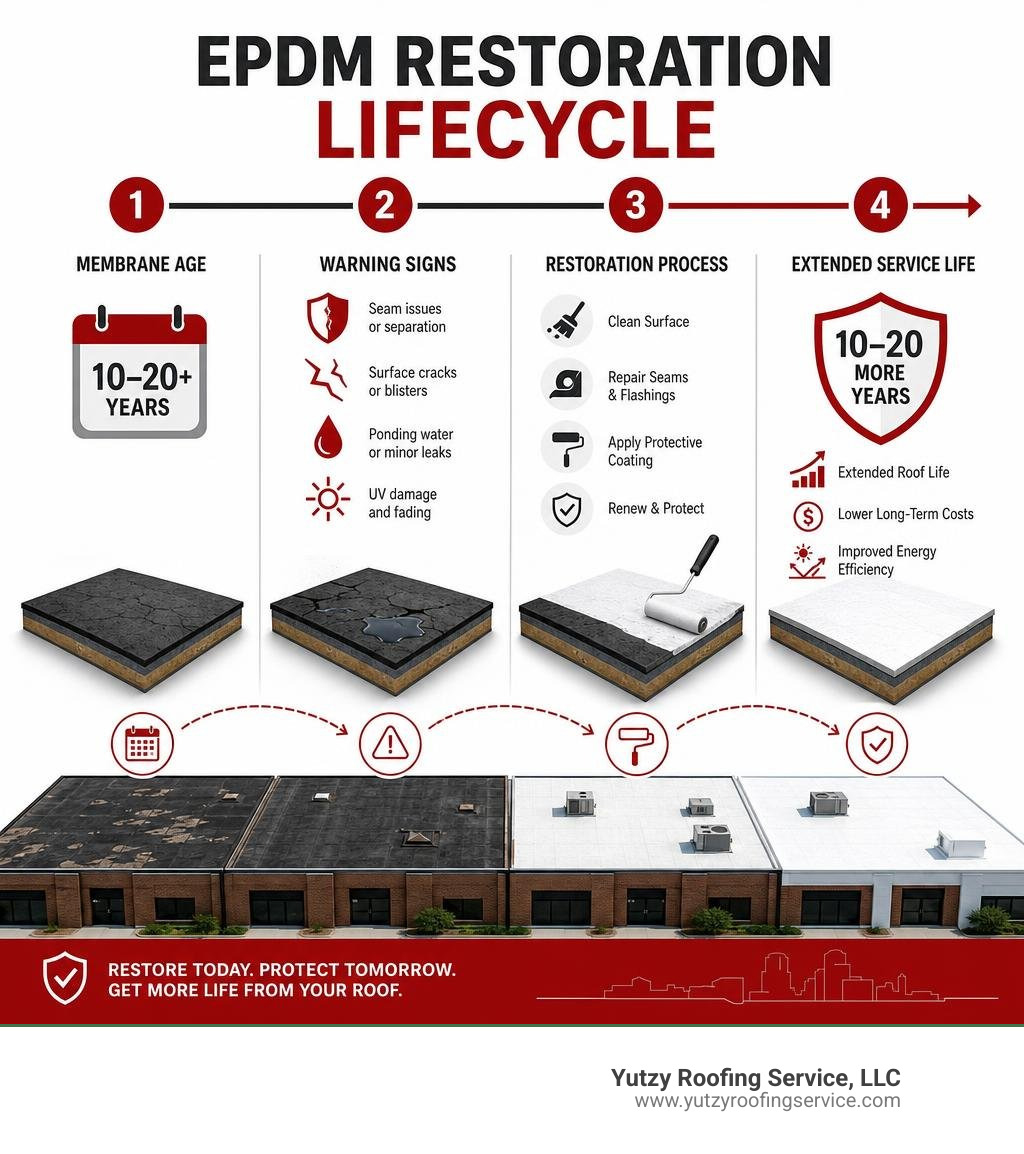
EPDM restoration is the process of renewing an aging rubber roof membrane — without tearing it off and starting over. Instead of a costly full replacement, a qualified contractor cleans the existing surface, repairs seams and flashings, and applies a protective coating system that extends the roof’s life by 10–20 years.
Here’s a quick summary of what you need to know:
- What it is: Cleaning, repairing, and coating an existing EPDM rubber roof
- Cost savings: Typically 50–70% less than full replacement
- Lifespan added: 10–20 years of additional service life
- Energy savings: White reflective coatings can cut cooling costs by 15–30%
- Best for: Structurally sound roofs with seam issues, surface cracking, or minor leaks
- Not ideal when: Insulation is saturated or the deck structure is compromised
Most commercial property owners assume a leaking roof means a full replacement. In reality, 65% of roof replacements happen because of leaks — many of which could have been resolved through restoration at a fraction of the cost.
If your EPDM roof is showing wear but the underlying structure is still solid, restoration is almost always the more practical path.
I’m Josh Yutzy, and our team at Yutzy Roofing Service has been installing and restoring commercial roofing systems across Wisconsin since 1995, including countless EPDM restoration projects on flat and low-slope commercial buildings. In this guide, I’ll walk you through everything you need to know — from spotting early warning signs to choosing the right materials and understanding your financial options.
What is EPDM Restoration vs. Replacement?
When your commercial building’s rubber roof starts showing its age, you generally face a fork in the road: do you tear the whole thing off and replace it, or do you opt for a professional restoration?

A full roof replacement is exactly what it sounds like. We tear off the existing EPDM membrane, pull up the insulation board (often disposing of perfectly dry materials in a landfill), and install a brand-new system from the deck up. It is noisy, highly disruptive to your daily operations, and incredibly expensive.
An EPDM restoration, on the other hand, works with your existing roof. Instead of throwing away a structurally sound roof, we clean the membrane, reinforce all the vulnerable seams and flashings, and apply a high-performance fluid-applied coating. This chemical or physical bond transforms your tired, weathered black rubber into a seamless, watertight, highly reflective membrane.
To help you determine which path is right for your building, we have put together a guide on Does Your Commercial Roof Need An Epdm Restoration System to outline the diagnostic process.
EPDM Restoration vs. Full Replacement Comparison
| Feature | EPDM Restoration System | Full Roof Replacement |
|---|---|---|
| Average Cost | $3.00 – $6.00 per sq. ft. | $10.00 – $18.00+ per sq. ft. |
| Typical Cost Savings | 50% to 70% less than replacement | Baseline cost |
| Installation Time | 1 to 3 days (minimal disruption) | Weeks (highly disruptive) |
| Waste & Landfill Impact | Zero tear-off waste | Tons of roofing debris |
| Life Extension | 10 to 20 years (renewable) | 20 to 25 years |
| Tax Treatment | Immediate deduction (Maintenance) | Capitalized asset (39-year depreciation) |
| Solar Reflectivity | 80% to 90% (with white topcoat) | 5% to 10% (standard black EPDM) |
The Core Benefits of EPDM Restoration
Opting to restore rather than replace your commercial roof comes with a massive list of operational and financial perks. First and foremost is the financial savings. Because we do not have to pay for a massive crew to rip off materials, rent multiple dumpsters, or purchase entirely new insulation packages, restoration typically costs 50% to 70% less than a complete replacement.
Second, the longevity benefits are outstanding. Our restoration systems add 10 to 20 years to your EPDM roof’s service life, often exceeding the weatherproofing performance of the original installation.
Additionally, we cannot ignore the environmental and energy-efficiency advantages. Keeping old rubber and insulation out of local landfills in Wisconsin and Minnesota is a huge win for green building initiatives. Furthermore, transitioning from a dark heat-absorbing surface to a white reflective system radically changes your building’s thermal performance.
You can read more about these advantages in our detailed breakdown of the Top Benefits Of Epdm Roof Restoration. If your building is located in southern Minnesota, you can also explore local options for Rubber Roofing (EPDM) Near Mankato, MN | 56001 to see how regional commercial properties utilize these systems.
When to Restore vs. Replace
Restoration is an incredible tool, but it is not a magic wand. For an EPDM roof to be a candidate for restoration, the underlying structure must be sound.
The most critical step in our assessment is checking for wet insulation. If your roof has suffered from long-term, unaddressed leaks, water may have saturated the polyisocyanurate insulation boards beneath the rubber membrane. Saturated insulation loses its R-value, can rot your roof deck, and will trap moisture that ruins any new coating applied over it.
Before we recommend any project, we perform a thorough physical evaluation and, when necessary, a thermal moisture scan. If only a few small areas of insulation are damp, we can cut those sections out, replace them with dry insulation, patch the membrane, and proceed with the restoration. However, if more than 20% to 25% of your roof’s insulation is waterlogged, a full replacement is usually the only responsible option.
To learn more about what makes a roof eligible for this process, check out our resource on Epdm Restorations What To Know.
Key Indicators Your Commercial Roof Needs Help
As EPDM rubber roofs age, they degrade in highly predictable ways. Catching these signs early is the difference between a simple, low-cost restoration and an expensive, emergency replacement.
If you notice any of these indicators during a routine walk-through, it is time to call in the professionals:
- Seam Separation: EPDM is installed in large sheets that are glued or taped together. Over time, the adhesives fail. If you see seams fish-mouthing, lifting, or peeling apart, water is likely getting underneath.
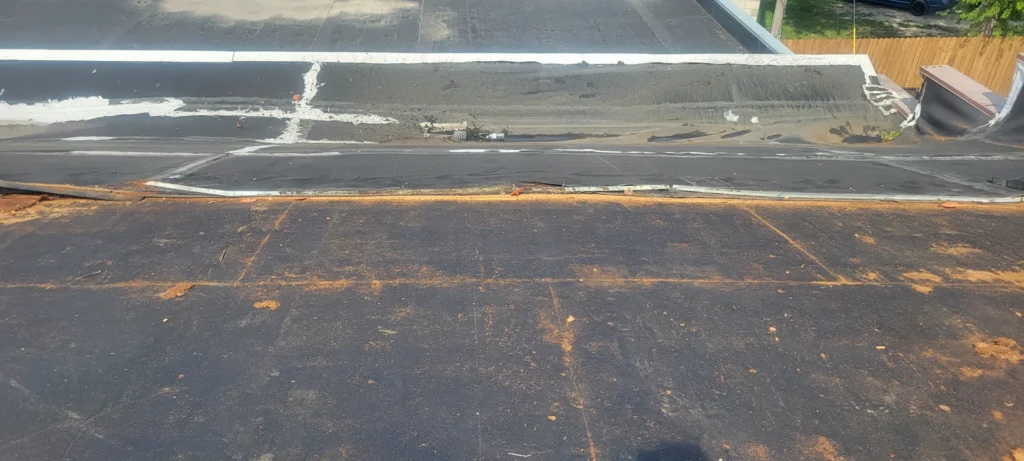
- Membrane Shrinkage: EPDM is synthetic rubber, and as it ages and loses its plasticizers under constant UV exposure, it naturally shrinks. This shrinkage puts immense tension on the perimeter flashings, pulling the membrane away from the edges of the roof.
- Ponding Water: If your flat roof has developed low spots where water sits for more than 48 hours after a rainstorm, it accelerates the breakdown of the membrane and adhesives.
- UV Cracking & Alligatoring: Fine cracks that look like alligator skin on the surface of the rubber indicate that the EPDM is drying out and losing its natural elasticity.
- Blistering: Trapped moisture or air beneath the membrane expands when heated by the sun, creating bubbles or blisters that can easily puncture.
To protect your investment and catch these issues before they turn into costly disasters, we highly recommend reading our guide on how to Keep Your Cool With Expert Epdm Roof Inspection And Maintenance Services.
Common EPDM Failure Points
While the flat field of an EPDM roof can last for 30 years, the detail work rarely does. The adhesives, sealants, and flashings around the edges and penetrations are almost always the first things to fail.
One of the most common failure modes is perimeter pull-away, caused by the membrane shrinkage mentioned above. When the rubber pulls tight like a drum head, it tears away from the parapet walls and gravel stops, leaving open pathways for water.
Another weak spot is brittle flashings around pipes, HVAC units, and drains. These areas undergo constant thermal expansion and contraction. As the sealant dries out, it cracks and splits.
Finally, in mechanically fastened EPDM systems, fastener back-out can occur. The screws holding the insulation and membrane plates in place can back out over time due to building movement, creating sharp metal points that puncture the rubber from the inside out.
For a deeper dive into managing these critical detail areas, check out Patching Things Up A Guide To Epdm Flashing And Seam Repair.
The Step-by-Step Restoration Process
Restoring a commercial rubber roof is a highly technical, multi-step process. You cannot simply buy some coating, roll it on like wall paint, and hope for the best. Proper adhesion requires meticulous preparation.
Here is how our professional crew tackles a standard restoration project:
- Inspection and Mapping: We thoroughly inspect the entire roof, identifying wet insulation, backing-out fasteners, and damaged areas.
- Surface Preparation & Power Washing: We clean the membrane using specialized, heavy-duty rinseable cleaners (like P-120) and high-pressure power washers (up to 3,000 psi) to remove years of dirt, chalking, and environmental grease.
- Adhesion Testing: Because EPDM rubber chemistry naturally resists adhesion, we perform field pull-tests to ensure our primers and coatings will bond permanently to your specific membrane.
- Making Structural Repairs: We cut out any wet insulation, replace it with new, dry boards, and patch those areas with matching EPDM membrane.
- Seam and Detail Reinforcement: Every single seam, flashing, pipe penetration, and T-joint is reinforced with heavy-duty detail sealants or fabric-embedded coatings.
- Applying the Coatings: We apply the specified primer and protective topcoats to the entire roof surface, creating a monolithic, seamless barrier.
For a comprehensive look at how we execute these repairs in our service areas, read The Ultimate Guide To Epdm Repair From Madison To Mankato.
Choosing the Right EPDM Restoration Materials
The success of your epdm restoration depends heavily on the materials used. Different coatings offer distinct chemical properties, strengths, and lifespans:
- Liquid Butyl Rubber: This is a solvent-based coating that chemically cross-links with the existing EPDM rubber, essentially becoming a single, thick, cohesive material. Liquid Butyl Rubber is highly durable, has a massive 500% elongation capacity, and boasts over 1,520 psi tensile strength. It has proven to outlast acrylic, urethane, and elastomeric coatings by a factor of three, and can withstand extreme temperatures from -40°F to 250°F.
- High-Solids Silicone Coatings: Silicone is highly valued for its exceptional ponding water resistance. Unlike water-based acrylics, silicone will not break down under standing water. It offers incredible UV stability and reflects up to 80% to 90% of the sun’s heat.
- EPDM Bleed-Block Primers: Because aged EPDM contains oils that can bleed through white coatings—causing them to turn yellow and lose their reflective properties—we often apply a specialized bleed-block primer (like P-110) before the topcoat.
For official industry guidelines on preparing and restoring these unique rubber membranes, you can review the Technical Bulletin on Repair and Restoration of EPDM Systems – EPDM Roofing Association .
Application and Curing
Once the prep work is complete, we get to work on the detail reinforcement. We seal separated seams with heavy-duty butyl fleece tape or a “three-course” detail repair (applying a layer of coating, embedding a reinforcing polyester fabric, and applying another layer of coating over the top).
Liquid flashings are applied around complex penetrations like HVAC curbs, pipes, and drains to ensure a watertight seal where traditional boots might struggle.
Next comes the main coating application. Depending on the system, we apply the coating using professional airless spray rigs or medium-nap rollers. For example, a standard silicone system might require a base coat of 1.5 gallons per 100 square feet, followed by a perpendicular top coat of another 1.5 gallons per 100 square feet, achieving a total dry film thickness (DFT) of around 36 to 48 mils.
Curing times depend on temperature and humidity. While some high-performance coatings are rain-safe in as little as 15 to 30 minutes, most systems require at least 24 to 48 hours of temperatures above 40°F (ideally 50°F to 100°F) to fully cure before allowing foot traffic.
To keep your newly restored roof in prime condition for the long haul, check out our practical tips on How To Keep Your Epdm Roof Happy And Healthy.
Frequently Asked Questions about EPDM Restoration
If you are a building owner in Wisconsin or Minnesota, you probably have a few practical questions about how these systems perform in the real world. For a localized overview of how we assist commercial clients, you can read our Epdm Roof Restoration Guide Madison Wi We Help.
Here are the answers to the questions we hear most often:
How long does a restored EPDM roof last?
A professionally applied epdm restoration system typically adds 10 to 20 years of reliable service life to your roof, depending on the thickness of the coating applied and the specific system chosen.
What makes these systems incredibly smart is that they are renewable. At the end of your 10- or 15-year warranty term, the membrane does not need to be torn off. As long as the system has been properly maintained, we can simply clean the roof and apply a thin topcoat to extend the warranty for another full term.
To see how we design these systems for long-term performance in our region, check out our regional guide on Epdm Roof Restoration Near Madison Wi.
Can restoration be performed in cold climates like Minnesota or Wisconsin?
Yes, but timing is everything. Our service areas—including Madison, Wausau, Appleton, Eau Claire, and Rochester, MN—experience brutal winters, heavy snow loads, and intense freeze-thaw cycles.
While emergency repairs can be performed in colder weather using specialized sealants, a full epdm restoration project requires dry conditions and consistent temperatures. Most professional coatings require application temperatures of at least 40°F and rising (and often 50°F or higher for ideal curing). Therefore, we schedule our restoration projects from late spring through mid-autumn.
The freeze-thaw cycles of the Upper Midwest are actually a primary reason to restore your roof. The extreme elasticity of liquid butyl rubber (500% elongation) and silicone allows the restored membrane to stretch and contract during rapid temperature swings without cracking or splitting.
To learn more about the unique challenges of maintaining rubber roofs in our northern climate, read our expert advice under Tag/Epdm Rubber Roofing.
What are the tax and financial incentives for roof restoration?
From a financial standpoint, restoration offers massive tax advantages over replacement:
- Section 179 Deductions: Under IRS guidelines, a full roof replacement is classified as a capital improvement, which must be depreciated over a long 39-year period. However, a roof restoration over an existing substrate is classified as a repair expense. This means you can typically write off the entire cost of the project in the very first year under Section 179, saving your business thousands of dollars in taxes immediately.
- Operational Energy Savings: Traditional black EPDM has a solar reflectance of only 6% to 10%, meaning it absorbs up to 90% of the sun’s heat and transfers it directly into your building. By converting to a white reflective coating (which boasts 80% to 90% solar reflectance), you can reduce rooftop surface temperatures by 50 to 80°F. This drop translates directly into a 15% to 30% reduction in cooling energy costs during our hot Midwestern summers.
Conclusion
If your commercial building’s rubber roof is showing signs of aging, do not rush into an expensive, disruptive, and unnecessary tear-off. For structurally sound roofs, epdm restoration is a highly effective, budget-friendly, and energy-efficient alternative that can extend your roof’s life by up to 20 years.
At Yutzy Roofing Service, LLC, we specialize in high-quality commercial roof restorations. We are proud to offer an up to 18-year non-prorated renewable warranty on our systems, giving you ultimate peace of mind. We serve commercial property owners across Wisconsin and southern Minnesota, including Marshfield, Madison, Appleton, Wausau, Green Bay, Fond Du Lac, Eau Claire, Mankato, and Rochester.
Ready to see if your roof is a candidate for restoration? Contact us today to schedule your comprehensive roof assessment, and let’s discuss how we can protect your building while saving your budget. To explore why so many local businesses trust us with their flat roofs, read our full article on Epdm Restorations Smart Investment For Your Business.
