What You Need to Know Before Starting a Commercial New Roof Installation
A commercial new roof installation is one of the largest capital investments a property owner will make — and the decisions made before a single crew member steps onto your roof will determine whether that investment holds up for 20 years or fails in five.
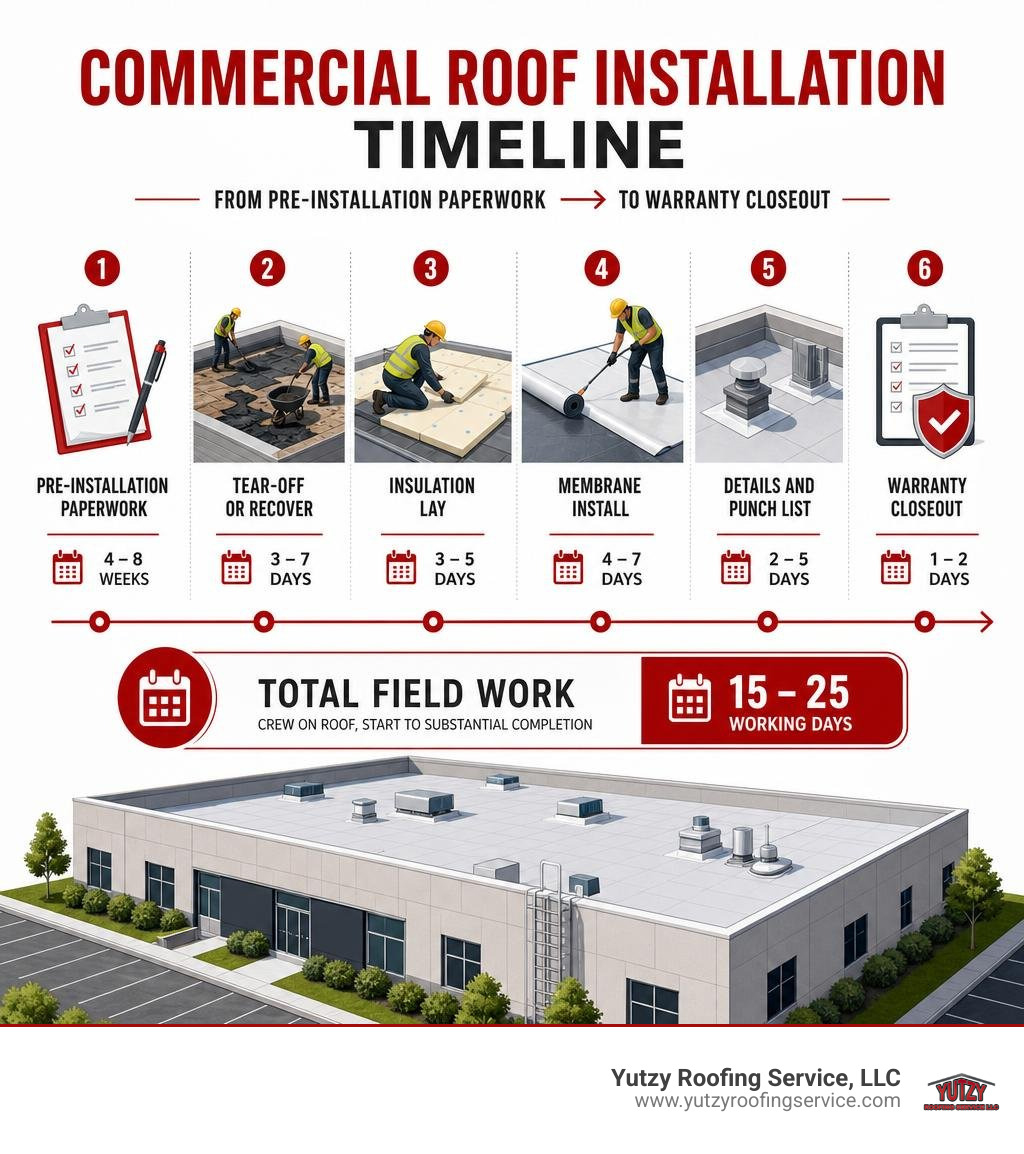
Here is a quick overview of what’s involved:
| Phase | What Happens | Typical Timeframe |
|---|---|---|
| Pre-installation | Submittals, certifications, deck review | 4 to 8 weeks |
| Tear-off or recover | Remove or overlay existing roof | 3 to 7 days (50,000 sq ft) |
| Insulation lay | ISO board, tapered or flat | 3 to 5 days |
| Membrane install | TPO, PVC, or modified bitumen | 4 to 7 days |
| Details and punch list | Flashings, parapets, manufacturer sign-off | 2 to 5 days |
| Total (field work) | Crew on roof, start to substantial completion | 15 to 25 working days |
Most Wisconsin commercial property owners are surprised to learn that the paperwork phase alone — submittals, manufacturer pre-job conferences, architect approvals — takes longer than the actual installation. And skipping or rushing any of it can void your manufacturer warranty entirely.
This guide walks you through every phase: planning, system selection, cost factors, warranties, and how to keep your business running while the work happens overhead.
I’m Josh Yutzy, and since 1995 our family business has been handling commercial new roof installation across Wisconsin, with a strict commitment to quality materials and full labor and material warranties up to 20 years. I’ve seen how the right preparation — and the right system — makes the difference between a roof that lasts and one that becomes a recurring problem.
Commercial new roof installation word list:
Planning Your Commercial New Roof Installation: Timelines and Pre-Installation Logistics

When it comes to a commercial new roof installation, the physical labor is only half the battle. In fact, if a contractor shows up with a truck full of membrane and starts tearing off your roof without a massive stack of pre-approved paperwork, you should probably run.
Properly planning your installation prevents expensive delays, ensures the structural integrity of your building, and guarantees that your manufacturer’s warranty remains completely valid. Let’s look at what needs to happen before the first nail is driven or the first seam is welded.
For a deeper dive into the overall process, you can read A Practical Guide to Commercial Roof Installation.
The Pre-Installation Phase: Submittals, Certifications, and Deck Verification
The pre-installation phase is where the success or failure of your roof is decided. Before any physical work begins, a massive technical package must be compiled. For a typical 60,000 square foot commercial building, this submittal package often ranges from 60 to 120 pages. It contains MasterFormat specifications, material safety data sheets (MSDS), wind-uplift calculations, tapered insulation layouts, and detailed drawings of every single perimeter and penetration.
This package must be reviewed and approved by architects, structural engineers, and the roofing manufacturer. Starting work before these submittals are officially approved can void the manufacturer’s warranty and leave you with substantial contract liabilities.
Once the paperwork is signed off, the focus shifts to the physical deck verification. You cannot build a great roof on a failing foundation. During this phase, we look for several critical issues:
- Steel Deck Corrosion: Metal decks often rust from the underside due to interior humidity. A simple visual inspection from above is never enough. We look for signs of structural weakness, rust flaking, or “soft” spots.
- Concrete Deck Spalling: Concrete decks must be checked for cracking, moisture retention, and spalling. If the concrete is degrading, fasteners will not hold.
- Wood Plank Rot: On older commercial buildings in historic areas like Madison or Appleton, wood plank decks are common. We inspect these for water damage, rot, and structural deflection.
- Lightweight Concrete Limitations: Lightweight insulating concrete (LWIC) cannot reliably hold standard mechanical fasteners. If your building has an LWIC deck, we must pivot to a fully adhered system or specialized fasteners, which completely changes the labor and material requirements.
For a comprehensive breakdown of these technical phases, check out the Commercial Roof Installation 2026: System & Phase Guide | TRB.
How Long Does a Commercial New Roof Installation Take?
“How long is this going to take?” is the first question every facility manager asks. The answer depends heavily on “crew-day math” and project size.
A typical 50,000 square foot single-ply commercial roof installation runs between 15 and 25 working days from the moment the crew arrives to substantial completion. However, this timeline scales based on the size of the building and the size of the crew:
- Small to Mid-Sized Projects (Up to 50,000 sq ft): Typically requires a crew of 8 to 12 workers.
- Large Industrial Projects (200,000+ sq ft): Requires a scaled crew of 18 to 30 workers to maintain efficiency.
In Wisconsin and Minnesota, weather is the ultimate wildcard. Rain, high winds, snow, and extreme cold can halt progress. When planning, we always add a “weather day buffer” of 15 to 30 percent to the schedule, depending on the season.
Once the physical installation is complete, we enter the substantial completion phase. This is when the manufacturer’s technical representative inspects the roof, generates a “punch list” of minor corrections, and, once those are resolved, officially begins the warranty period.
Choosing the Right Commercial Roofing System and Installation Method
Every commercial property has unique structural demands, chemical exposures, and budget constraints. Selecting the wrong membrane can lead to premature failure, while selecting the right one ensures decades of worry-free protection.
To help you choose, read our guide on Choosing a Commercial Roof That Actually Works.
Comparing TPO, PVC, and Modified Bitumen Systems
The three most common systems installed on modern commercial buildings are Thermoplastic Polyolefin (TPO), Polyvinyl Chloride (PVC), and Modified Bitumen (Mod-Bit).
- TPO (Thermoplastic Polyolefin): This is a highly popular single-ply membrane. It is highly reflective (which lowers energy bills), naturally resistant to ultraviolet light, and relatively cost-effective. TPO is typically mechanically attached or fully adhered over polyisocyanurate (ISO) insulation boards.
- PVC (Polyvinyl Chloride): Similar in appearance to TPO, PVC is a premium single-ply membrane designed for harsh environments. It is highly resistant to chemicals, greases, and oils, making it the absolute best choice for restaurants, food processing plants, and manufacturing facilities.
- Modified Bitumen: This is a traditional, multi-ply asphalt system. Instead of a single sheet of rubber or plastic, it uses a two-ply layered approach. It is incredibly tough, highly puncture-resistant, and ideal for roofs that expect heavy foot traffic or frequent maintenance of HVAC equipment.
| Roofing System | Primary Advantage | Best Suited For | Installation Speed (Sq Ft / Day) |
|---|---|---|---|
| TPO (Single-Ply) | High reflectivity, cost-effective | Warehouses, retail, offices | 10,000 – 15,000 (Mechanically Attached) |
| PVC (Single-Ply) | Chemical and grease resistance | Restaurants, manufacturing | 6,000 – 9,000 (Fully Adhered) |
| Modified Bitumen | Extreme puncture resistance | High foot-traffic roofs | 4,000 – 8,000 (Two-Ply Lay) |
Tear-Off vs. Recover: Deciding the Best Route for Your Building
One of the biggest financial decisions you will make during a commercial new roof installation is whether to completely tear off the old roof or perform a “recover” (installing a new membrane directly over the existing one).
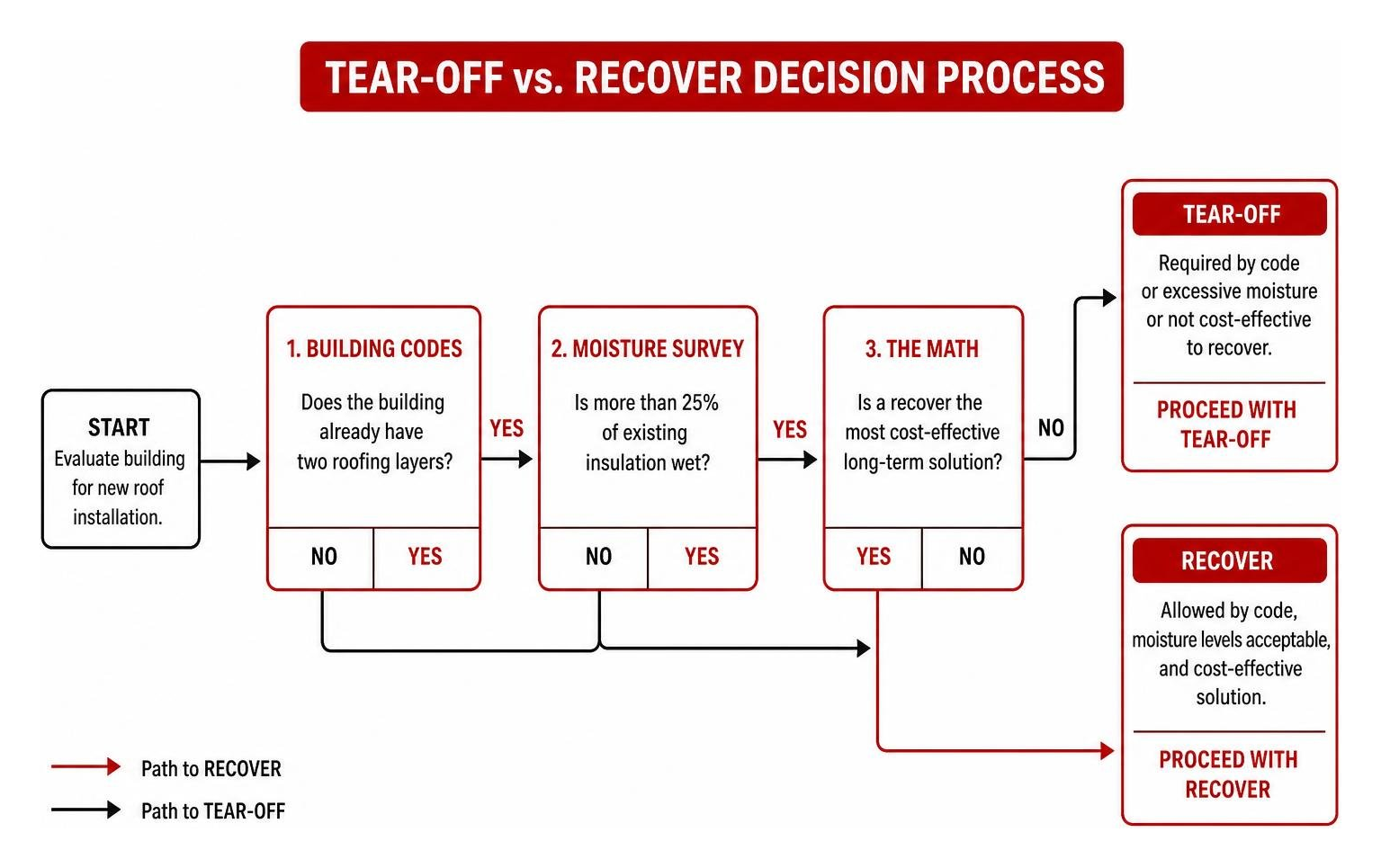
To make this decision, we look at three critical factors:
- Building Codes: The International Energy Conservation Code (IECC) and most state building codes limit commercial buildings to a maximum of two roofing layers. If your building already has two roofs, a complete tear-off is legally required.
- Moisture Surveys: We perform a nuclear or infrared moisture survey. If more than 25% of the existing insulation is wet, a recover is not an option. Trapping moisture under a new roof will rot the deck and ruin the new system.
- The Math on Each:
- Tear-Off: A standard crew can tear off an existing roof at a rate of 8,000 to 15,000 square feet per day. While it is more expensive due to labor and landfill disposal fees (which run $40 to $90 per ton plus hauling), it gives you a clean slate, a brand-new deck inspection, and maximum R-value insulation.
- Recover: This runs much faster, at 12,000 to 25,000 square feet per day. It saves money on labor and disposal, but you are relying on the integrity of the old roof structure underneath.
For more details on planning a new build or a major renovation, see New Construction Roofing – Stone Roofing – Rock Solid Since 1934 .
Above-Code Standards and Mitigating Common Failure Points
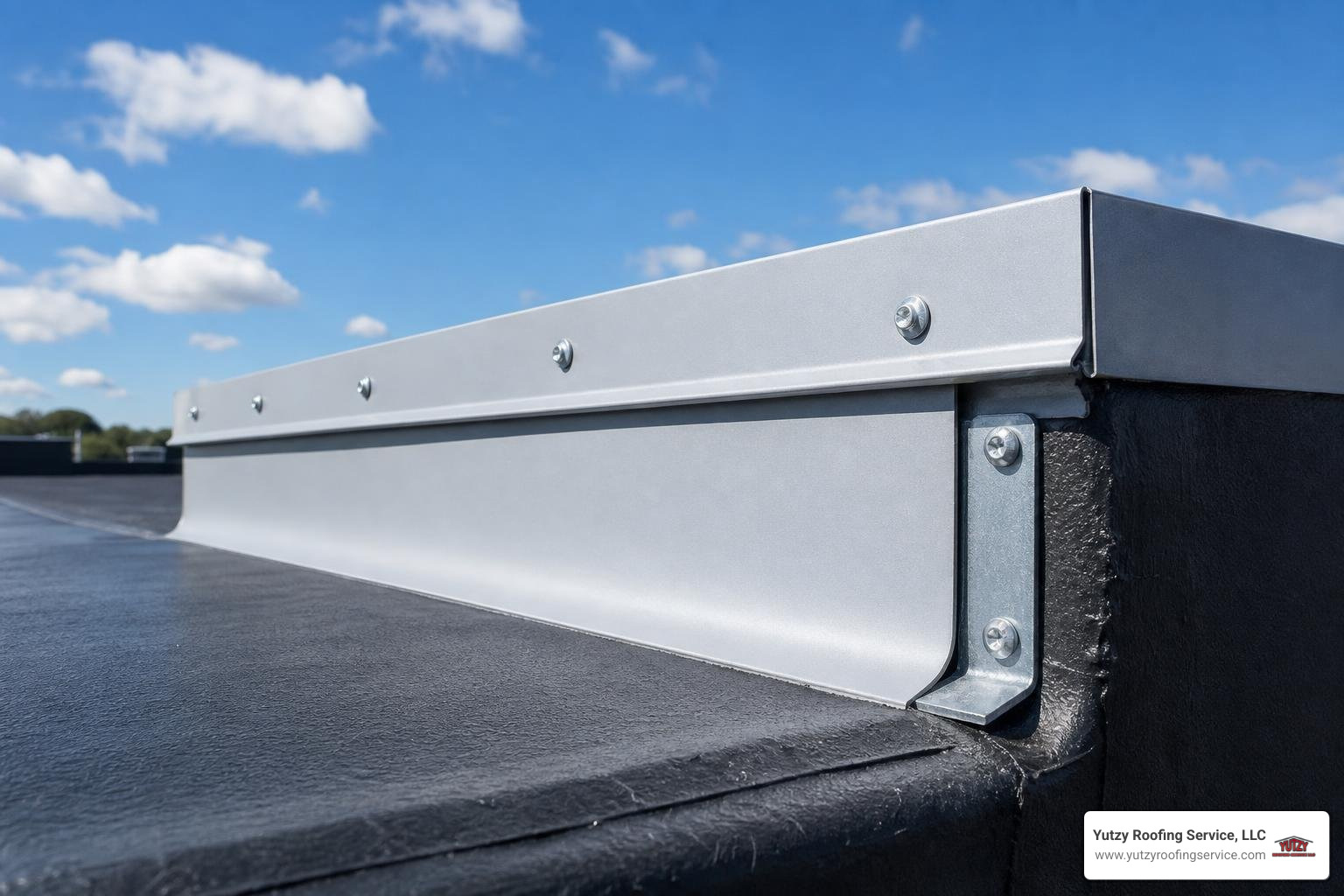
Many commercial roof failures are actually “built-in” on day one. When contractors cut corners to win bids, they often install materials to the bare minimum local building code. In regions like Wisconsin and Minnesota, where severe thunderstorms, heavy snow loads, and high winds are common, minimum code is often not enough to prevent long-term damage.
Standard Installation vs. Above-Code Wind Uplift Specifications
Wind damage rarely starts in the middle of a flat roof. It almost always begins at the edges, where high winds create a vacuum effect that tries to peel the roof back like the lid of a tin can.
To prevent this, we highly recommend installing roofs “above code.” One of the best ways to do this is by applying strict wind-uplift standards (similar to the famous Miami-Dade County specifications) even in standard wind zones. This involves:
- Tighter Fastening Patterns: Increasing the density of fasteners in the perimeter and corner zones of the roof, where wind pressures are highest.
- Continuous Cleats: Installing heavy-duty, continuous metal cleats to lock down the edge metal, preventing wind from getting underneath.
- Structural Accountability: Ensuring the edge metal is engineered and tested to resist extreme horizontal and vertical pressures.
By investing in these above-code details during your commercial new roof installation, you dramatically reduce the risk of catastrophic wind peel-back during major storm events.
Addressing Critical Failure Points at Perimeters and Penetrations
The vast majority of commercial roof leaks do not occur in the open, flat seams of the roof. They occur at perimeters, parapet walls, and penetrations (such as pipes, drains, and HVAC units).
- Parapet Walls: These walls must be wrapped in membrane and sealed with heavy-duty coping caps. We use continuous cleats and manufacturer-specified sealants to ensure every joint is watertight.
- Penetrations: A roof with 200 penetrations (pipes, vents, skylights) takes 30 to 50 percent longer to flash than a roof with only 50 penetrations on the exact same square footage. Each penetration must be individually flashed using pre-molded boots or liquid-applied flashing systems.
- Seam Welding: For TPO and PVC systems, we use automatic robotic welders running at 8 to 12 feet per minute for long, straight runs. This ensures a consistent, molecular weld. For tight details and corners, we use hand welders and physically probe the welded seams every 50 to 100 feet with a metal seam probe to verify the weld quality.
Cost Factors, Warranties, and Minimizing Operational Disruption
A new roof is a major investment, and understanding where your money is going helps you make the best decisions for your business’s bottom line.
Before the project starts, it’s helpful to know What to Expect During a Professional Roofing Installation.
Commercial New Roof Installation Cost Factors and Budgeting
The cost of a commercial new roof installation is influenced by several key variables:
- Tapered Insulation: If your roof deck is completely flat, water will pond. To prevent this, we install a tapered insulation package to build a 1/4-inch-per-foot slope. This adds $1.50 to $4.00 per square foot to the areas requiring slope, but it is essential for proper drainage.
- Replacement Deck Costs: If we find rotted wood or corroded steel during the tear-off, replacing the deck typically runs $7 to $14 per square foot installed.
- Landfill and Disposal Fees: Disposing of old roofing materials is a major expense. Landfill fees run $40 to $90 per ton, plus the cost of hauling.
- Penetrations and Complexity: As mentioned, the more HVAC units, pipes, and drains you have on your roof, the higher the labor costs will be.
For a detailed breakdown of these expenses, explore Factors That Influence Commercial Roofing Cost.
Contractor Workmanship vs. Manufacturer NDL Warranties
When comparing commercial roofing warranties, it is vital to understand the difference between a contractor’s workmanship warranty and a manufacturer’s No-Dollar-Limit (NDL) warranty.
- Contractor Workmanship Warranty: This is provided directly by the roofing company and typically covers installation errors and workmanship for 2 to 10 years.
- Manufacturer NDL Warranty: This is a premium warranty backed directly by the material manufacturer (such as GAF or Carlisle). It covers both labor and materials for 10 to 30 years. “No-Dollar-Limit” means that even if the cost of labor and materials doubles in 15 years, the manufacturer will cover the entire cost of repairing a covered leak.
To qualify for a manufacturer’s NDL warranty, the roofing contractor must hold a specific, high-tier certification with that manufacturer at the time of installation. The manufacturer will also send their own field inspector to walk the roof, complete a rigorous punch list, and sign off on the project before the warranty is officially issued.
At Yutzy Roofing Service, we also specialize in high-performance coatings and restorations that offer an up to 18-year non-prorated renewable warranty, giving you long-term peace of mind without the massive cost of a full structural replacement down the road.
Frequently Asked Questions About Commercial Roofing
Can a commercial roof be installed without disrupting building operations?
Yes, absolutely. Most commercial buildings remain fully occupied and operational during a roof installation. To minimize disruption, we use several strategies:
- Overnight and Weekend Work: For highly sensitive environments like medical clinics, offices, or schools, we can schedule loud work (like tear-offs or mechanical fastening) during off-hours.
- Low-VOC Systems: Traditional roofing adhesives can emit strong chemical odors. By using low-VOC (volatile organic compound) adhesives or fluid-applied silicone systems, we eliminate chemical smells inside the building.
- Sectioned Tear-offs: We only tear off what can be made watertight in the same day, ensuring your building’s interior is never exposed to the elements.
When should you start considering a new commercial roof?
Knowing when to replace your roof can save you thousands of dollars in emergency repairs and interior damage. You should start planning a replacement if you notice:
- Active, Recurring Leaks: If you are calling a roofer out multiple times a year for the same areas, the membrane has likely reached the end of its useful life.
- Widespread Wet Insulation: Once insulation becomes saturated, it loses its R-value and can cause structural wood or metal rot.
- Widespread Seam Failure: If the seams on your TPO or PVC roof are beginning to crack, split, or delaminate across the entire roof, localized repairs will no longer suffice.
For a complete list of warning signs, read When Should You Start Considering a New Commercial Roof.
What areas in Wisconsin are served for commercial roofing?
At Yutzy Roofing Service, LLC, we proudly serve commercial property owners and facility managers across Wisconsin and parts of Minnesota. Our primary service areas include:
- Wisconsin: Madison, Appleton, Wausau, Marshfield, Eau Claire, Fond Du Lac, and Green Bay.
- Minnesota: Mankato and Rochester.
Conclusion
A commercial new roof installation is a complex logistics exercise that requires careful planning, technical expertise, and absolute structural accountability. By understanding the pre-installation phase, choosing the right system for your specific building, and insisting on above-code installation details, you can ensure your investment protects your business for decades to come.
If your commercial roof is reaching the end of its lifespan, you may not need a complete, expensive tear-off. At Yutzy Roofing Service, LLC, we specialize in commercial roofing restoration, spray foam coatings, metal roof restoration, EPDM repairs, and preventative maintenance. We can often restore your existing roof to like-new condition, backed by our industry-leading up to 18-year non-prorated renewable warranty.
Schedule your commercial roofing consultation today and let us help you find the most reliable, cost-effective solution for your property.
