Sealant Chemistry Insights from a Metal Roof Sealant Industry Expert
Understanding the underlying chemical properties of commercial metal roof sealants is the single most critical step toward ensuring a long-lasting, watertight commercial facility. Every chemical formula behaves differently when subjected to thermal expansion, mechanical stress, and aggressive weather conditions. Asking any metal roof sealant industry expert, you will quickly learn that using the wrong product in the wrong location is the leading cause of premature roof leaks.
For additional background on general caulking options, explore our complete resource on the ultimate guide to roofing caulk for metal roofs.
Butyl, Silicone, and Elastomeric Comparisons
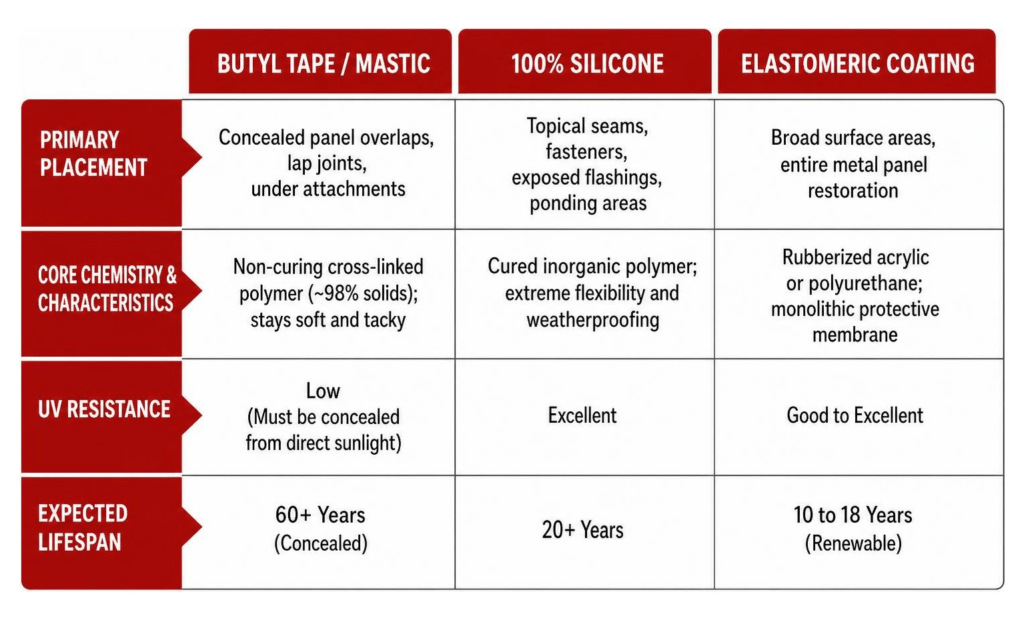
Choosing between butyl, silicone, and elastomeric sealants requires matching the product’s physical traits to its environment. Non-curing polymers like butyl excel inside concealed joints, while UV-resistant liquid coatings excel on exposed surfaces.
| Sealant Type | Primary Placement | Core Chemistry & Characteristics | UV Resistance | Expected Lifespan |
|---|---|---|---|---|
| Butyl Tape / Mastic | Concealed panel overlaps, lap joints, under attachments | Non-curing cross-linked polymer (~98% solids); stays soft and tacky | Low (Must be concealed from direct sunlight) | 60+ Years (Concealed) |
| 100% Silicone | Topical seams, fasteners, exposed flashings, ponding areas | Cured inorganic polymer; extreme flexibility and weatherproofing | Excellent | 20+ Years |
| Elastomeric Coating | Broad surface areas, entire metal panel restoration | Rubberized acrylic or polyurethane; monolithic protective membrane | Good to Excellent | 10 to 18 Years (Renewable) |
Butyl sealants maintain a tacky, flexible consistency indefinitely. Because they do not cure or skin over, they deform continuously as panels shift, maintaining an unbroken seal inside metal-to-metal lap joints. However, direct exposure to sunlight breaks down butyl copolymers over time.
100% silicone sealants, by contrast, offer exceptional resistance to atmospheric UV radiation and moisture accumulation. Silicone stays permanently flexible and will not break down under standing water, making it ideal for topical applications on flat or low-slope commercial roofs.
Elastomeric coatings (primarily acrylics and polyurethanes) are applied across whole roof assemblies. They create a seamless, monolithic layer over thousands of fasteners and seams, moving effortlessly with daily thermal expansion and contraction. To weigh coating options further, view our comparison on silicone vs elastomeric choosing the best tar and gravel coating.
Factory-Applied Butyl Tape vs. Field-Applied Liquid Sealants
A frequent point of debate among contractors is whether to specify factory-applied extruded butyl tape or field-applied liquid tube sealants. Field-applied tube sealants generally contain around 75% solids and 25% solvents or carriers. As those solvents evaporate during curing, the caulk shrinks, leaving a thinner film than originally installed. Additionally, liquid caulks applied with a hand-gun rely heavily on installer consistency.
Pre-formed extruded butyl tape contains approximately 98% solids. It offers strict dimensional consistency, ensuring an exact thickness across the entire joint. For a deeper breakdown of mastic materials, refer to our detailed guide on mastic tape for metal roofing the ultimate leak proof guide.
Substrates, Surface Preparation, and Environmental Stress Factors

Applying high-grade sealants to an uncleaned or unstable metal substrate guarantees adhesion failure. Any metal roof sealant industry expert will emphasize that surface preparation dictates whether a coating system achieves a chemical bond or peels off within months.
Preparing Metal Substrates and Handling Peeling Paint
Before applying sealants or coatings, commercial metal panels must be systematically cleaned and conditioned. The metal substrate itself directly dictates chemical adhesion:
- Galvanized Steel (G60 vs. G100): Galvanized steel relies on a sacrificial zinc coating to delay rust. Standard G60 steel contains significantly less zinc than G100 steel, which features 66% more zinc protection. G60 substrates are far more prone to edge micro-corrosion, requiring rust-inhibiting primers before sealant application.
- Galvalume: Consisting of a zinc-aluminum alloy, Galvalume offers superior long-term corrosion resistance compared to standard galvanized metal. However, original factory oils and oxide films must be completely washed off using commercial detergents to allow elastomeric adhesion.
- Factory Finishes (PVDF / Kynar 500 vs. SMP): High-performance PVDF (fluoropolymer) coatings retain their finish for decades, but their ultra-smooth surface makes adhesion difficult for topically applied sealants. Silicone-Modified Polyester (SMP) finishes tend to chalk and fade faster after years in the sun, requiring rigorous removal of chalky residues.
As late industry icon Scott Kriner: A life-long industry expert who helped grow the use of metal – Metal Construction News demonstrated throughout his metallurgical career, understanding coating degradation is key to choosing proper surface primers.
When dealing with flaking or peeling factory paint, simply washing the roof is insufficient. Loose paint must be mechanically removed via high-pressure power washing (typically 3,000+ PSI) or wire brushing. Once cleaned, contractors should conduct cross-hatch adhesion testing to verify that the underlying paint layer is firm before proceeding. Review best maintenance practices in our guide on the dos and donts of metal roof maintenance.
Mitigating UV Exposure, Thermal Movement, and Ponding Water
Commercial metal roof panels expand and contract continuously in response to temperature variations. A 100-foot run of steel roofing can easily expand up to an inch or more between winter cold and summer heat. This constant movement exerts relentless dynamic shear stress on seam sealants.
If a rigid, non-flexible caulk is used, thermal movement quickly tears the sealant away from the metal, causing dynamic stress cracking. Furthermore, standing or ponding water in low-slope valleys can accelerate chemical depolymerization in sub-standard sealants. Using high-grade acrylic elastomeric or 100% silicone systems ensures the membrane stretches smoothly without splitting or lifting away from seams.
Roof Attachment Techniques and Failure Prevention
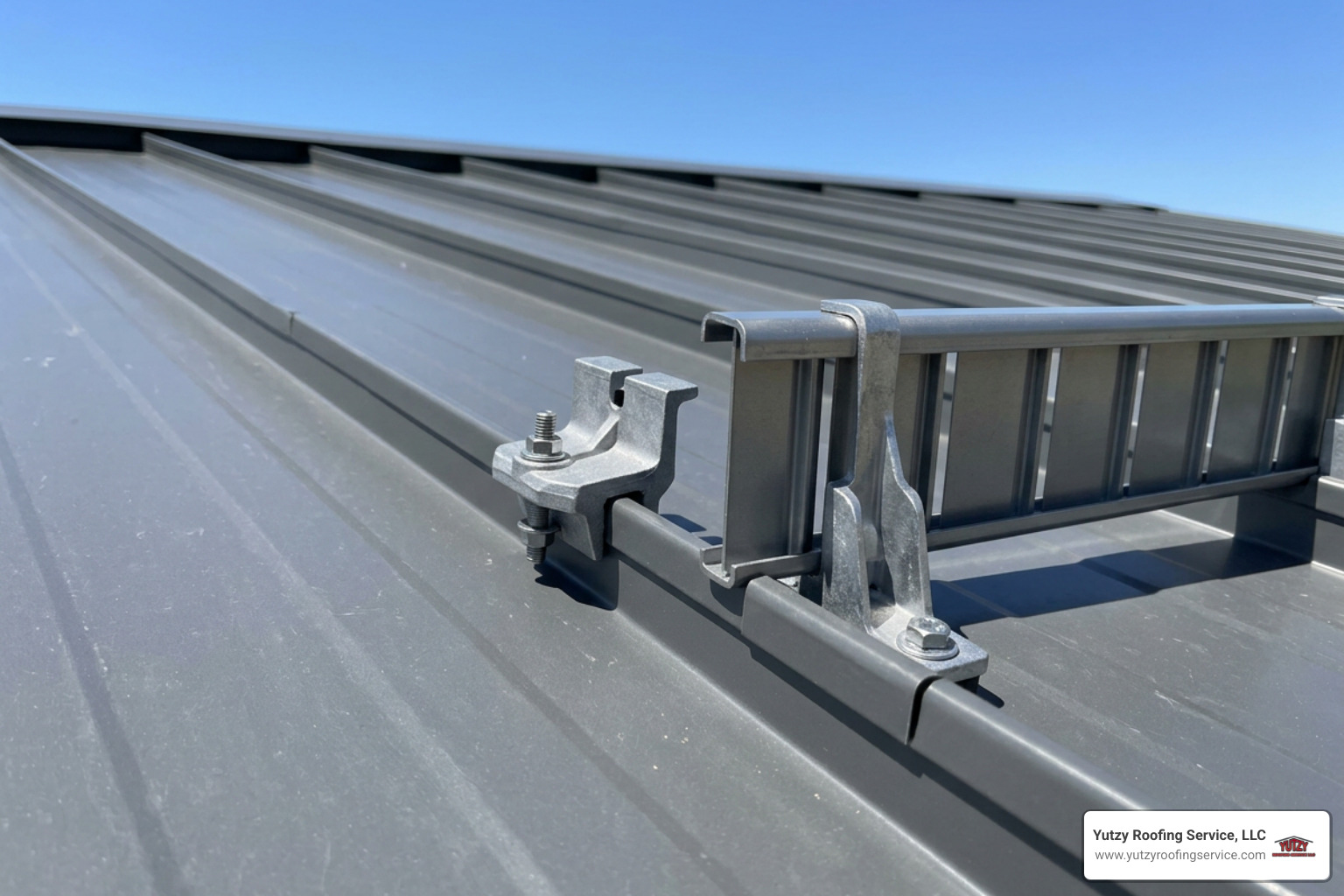
Mounting accessories—such as HVAC equipment, solar arrays, and snow guards—to commercial metal roofs introduces potential leak points if not sealed properly.
Insights from a Metal Roof Sealant Industry Expert on Solar Mounts and Accessories
The cleanest way to attach hardware to a standing seam metal roof is using non-invasive clamps that grip the standing seam without driving screws through the panel. Pioneered by industry visionaries like Metal Roof Advisory Group – Rob Haddock, zero-penetration clamp technologies preserve panel integrity while supporting heavy equipment loads.
When fasteners must penetrate the metal, sealing the attachment requires strict attention to detail:
- Encapsulation: The attachment foot should feature a built-in cavity or recess that completely encapsulates the butyl sealant or rubber gasket.
- Controlled Compression: Drive screws must be torqued accurately. Over-tightening crushes the gasket, squeezing the sealant out from under the bracket and exposing it to destructive UV rays. Under-tightening leaves gaps that invite water entry.
Common Causes of Sealant Failure and Prevention
Forensic failure investigations by roofing veterans such as Jim Mitchell show that sealant failure rarely stems from panel breakdown. Instead, sealants fail due to three preventable mistakes:
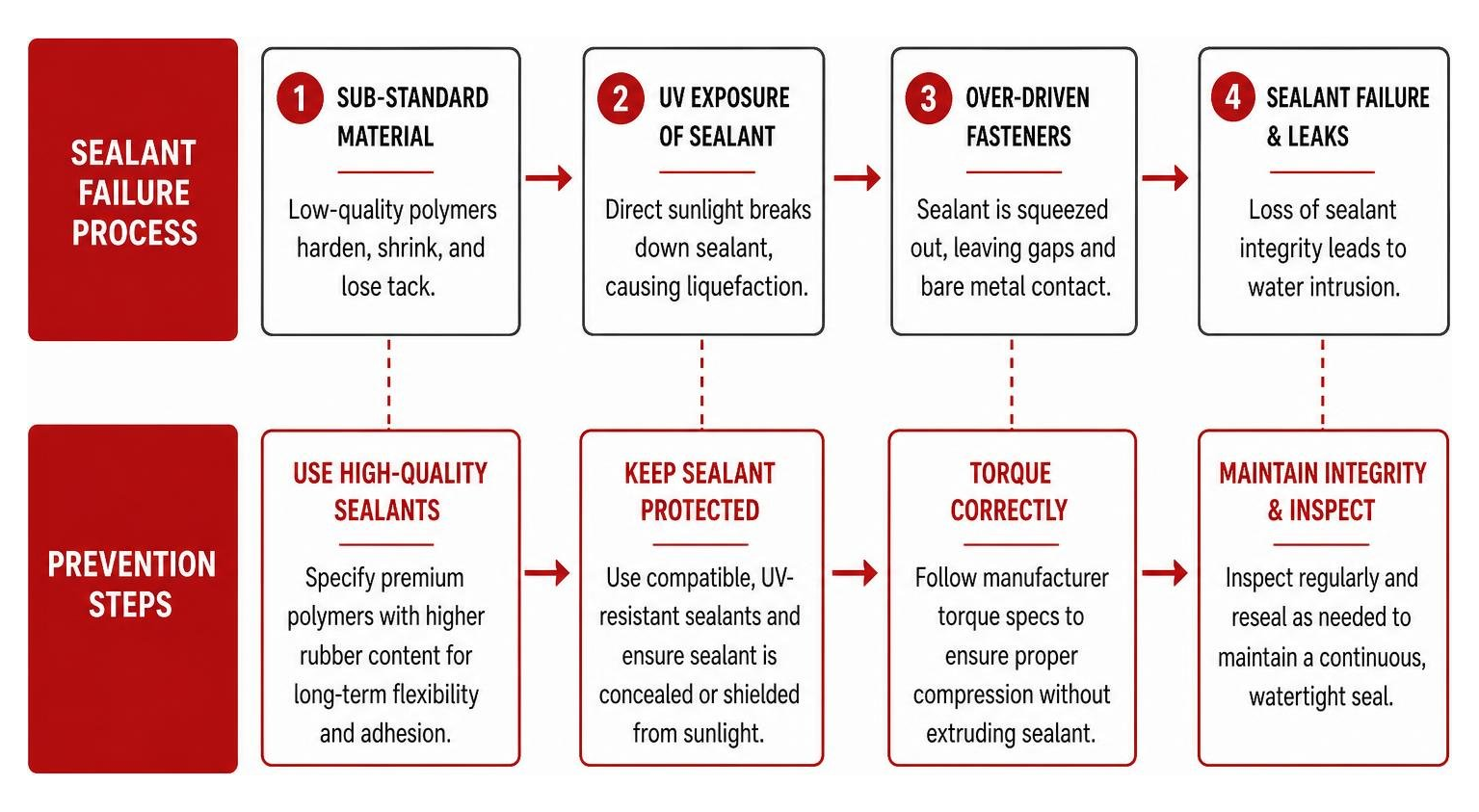
- Sub-Standard Polymer Formulations: Low-cost butyl tapes manufactured with high filler content and low rubber concentrations harden, shrink, and lose tackiness in as little as 5 to 7 years.
- Direct UV Exposure of Concealed Sealants: Leaving non-skinning butyl tapes exposed to direct sunlight causes rapid breakdown and liquefaction (depolymerization).
- Over-Driven Fasteners: Over-torquing screws squeezes the sealant thin, creating bare metal-to-metal contact areas that leak during thermal shifts.
Quality Verification, Industry Standards, and Service Life
Evaluating sealant durability requires looking past aggressive sales claims and examining standardized laboratory test results and real-world field data.
Critical ASTM Testing Standards and Performance Metrics
When specifying sealants for commercial building projects, verify compliance with recognized industry standards:
- ASTM E2140: Standard Test Method for Water Penetration Resistance of Metal Roof Panel Systems by Static Head of Water. This rigorous test submerges sealed panel joints under a 6-inch head of static water for six full hours to verify watertight performance.
- ASTM C-24 Committee Standards: Committee standards maintained by chemical technology leaders like Robert Stannard Email & Phone Number @ Tower Sealants | AeroLeads govern building seals, testing adhesion under cyclic movement, cold-temperature flexibility, and weather resistance.
Advice from a Metal Roof Sealant Industry Expert on Specifying Proven Products
Field studies conducted by the Metal Construction Association (MCA) across 14 commercial sites nationwide revealed that high-grade, cross-linked butyl tape used inside standing seam laps retained full elasticity and cohesive strength after 35 years of active field service. Laboratory testing projects its true service life beyond 60 to 66 years—outlasting many building structures themselves.
For commercial building managers seeking long-term protection, restoring an aging metal roof with professional liquid elastomeric systems extends panel life without requiring costly tear-offs. Learn more about structural preservation in our guide on metal roof restoration extend your roof life.
Frequently Asked Questions about Commercial Metal Roof Sealants
How long does butyl tape last on commercial standing seam roofs?
When installed within concealed overlap joints protected from UV exposure, high-performance butyl tape exhibits a service life exceeding 60 years. Field inspections of 35-year-old installations showed no degradation in cohesive strength or adhesion.
What substrate considerations matter when choosing Galvalume vs. Galvanized steel coatings?
Galvanized steel relies on a zinc layer that degrades faster if rated at G60 instead of G100, requiring anti-corrosive primers. Galvalume combines zinc and aluminum for longer rust resistance, but requires deep cleaning to remove residual mill oils before applying sealants.
How do thermal expansion and contraction cause sealant failure?
Metal roofs expand and contract significantly with ambient temperature changes. If a sealant lacks sufficient elastomeric movement capabilities, continuous expansion and contraction shear the bond between the sealant and the metal substrate, producing cracks and leaks.
Conclusion

Consulting a metal roof sealant industry expert proves that protecting a commercial metal roof is a precise discipline. A durable waterproofing strategy depends on pairing the right sealant chemistry—whether butyl tape, silicone, or elastomeric coatings—with the specific metal substrate and local environment.
Proper surface preparation, controlled fastener torque, and strict adherence to testing standards like ASTM E2140 make the difference between a leak-free roof and costly structural repairs. By choosing high-quality, field-tested materials, commercial building owners can ensure their metal roof systems deliver 50 or more years of reliable service.
At Yutzy Roofing Service, LLC, we have helped commercial building owners across Wisconsin and Minnesota—including Madison, Wausau, Appleton, Green Bay, Marshfield, Eau Claire, Fond Du Lac, Rochester, and Mankato—protect their investments since 1995. Our restoration systems feature renewable warranties up to 18 years, giving you confidence through every season.
Ready to secure your commercial facility? Contact our team today or read our metal roof sealant complete guide to explore your best repair options.
