
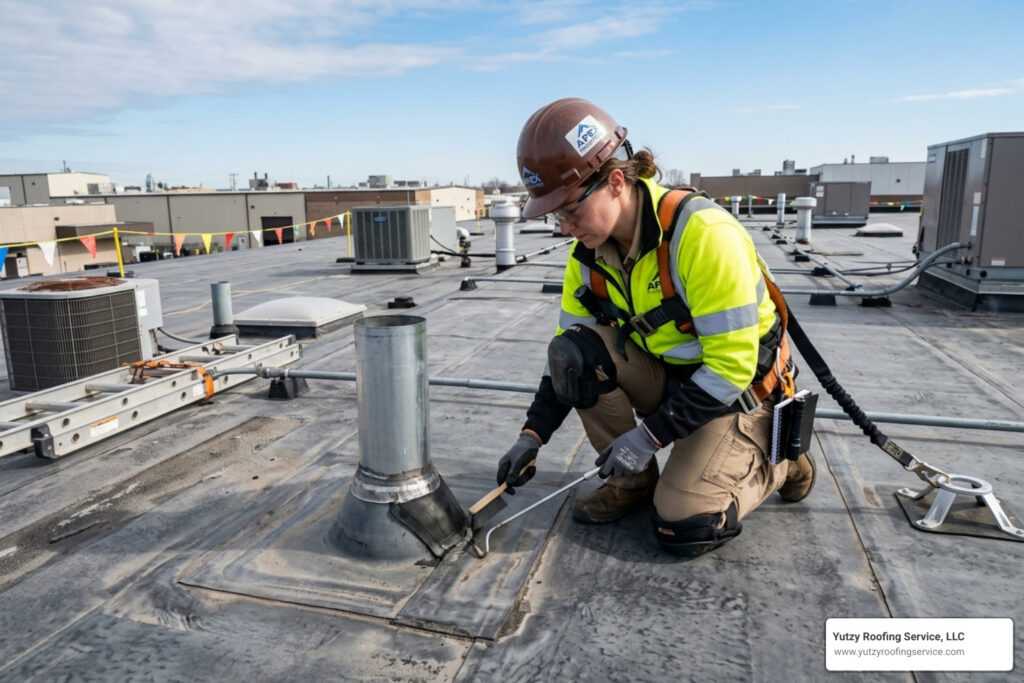
Why Finding a Roof Leak Is Harder Than It Looks
The best way to find a roof leak is to start inside your building, not on the roof. Here’s the fast answer:
- Check your ceiling and interior walls for water stains, mold, or musty odors
- Go into the attic or top-floor ceiling cavity and trace moisture stains uphill toward the roof peak
- Inspect common failure points first — flashing around vents, chimneys, HVAC units, and skylights
- Perform a controlled hose test — soak one small roof section at a time, starting low and moving up, while someone watches inside for drips
- Call a professional if the source isn’t found safely or the damage looks extensive
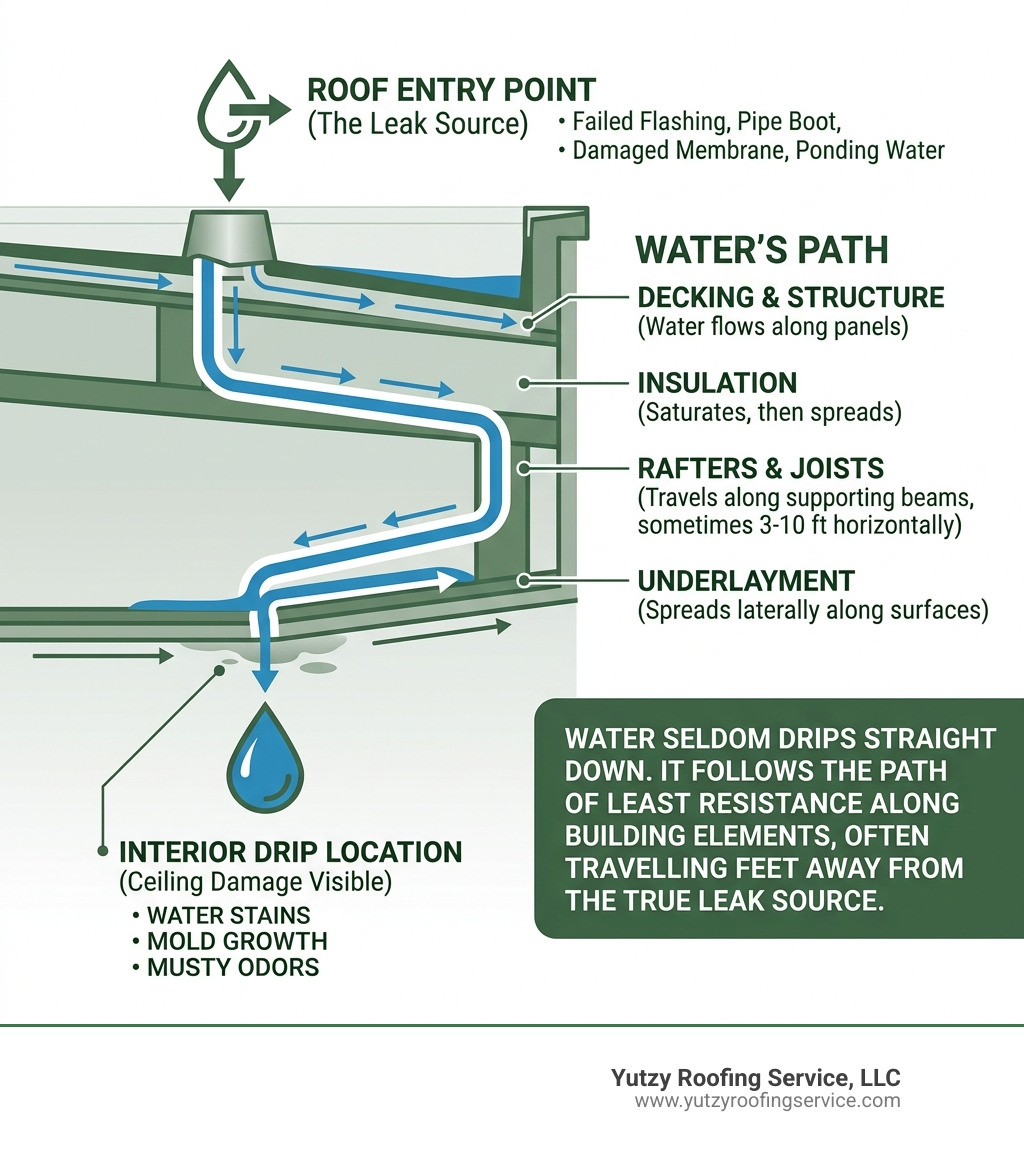
Water almost never drips straight down from where it enters. It travels along rafters, decking, and insulation — sometimes 3 to 10 feet — before showing up on your ceiling. That’s what makes roof leaks so frustrating to track down.
A ceiling stain in the middle of your building might trace back to a failed pipe boot near the roofline. A drip in the corner could be coming from step flashing on a dormer wall 6 feet away. The visible damage is just where the water ran out of places to go — not where it got in.
This is especially true on commercial flat roofs common across Wisconsin, where ponding water and membrane seams can send water sliding sideways 10 to 20 feet before it finds a way through.
Even a small, slow leak can lead to mold growth within 24 to 48 hours of the insulation or drywall getting saturated. That’s not a lot of time before a manageable repair turns into a major remediation job.
I’m Josh Yutzy, and at Yutzy Roofing Service we’ve been finding and fixing commercial roof leaks across Wisconsin since 1995 — the best way to find a roof leak is always a systematic, inside-out approach, which is exactly what this guide walks you through. Let’s get into it.
Identifying the Signs: Is It a Leak or Condensation?
Before you start climbing ladders or tearing into insulation, we need to make sure we’re actually dealing with a roof leak. Sometimes, the “drip” isn’t coming from the sky; it’s coming from the air inside your building.
In our experience serving areas like Wausau and Eau Claire, we often see property owners mistake condensation for a leak. During a cold Wisconsin winter, warm, moist air inside a commercial building rises. If it hits a cold roof deck or uninsulated ductwork, it turns into liquid water. This can create “phantom leaks” that only appear when it’s freezing outside, regardless of whether it’s raining or snowing.
Look for these key indicators:
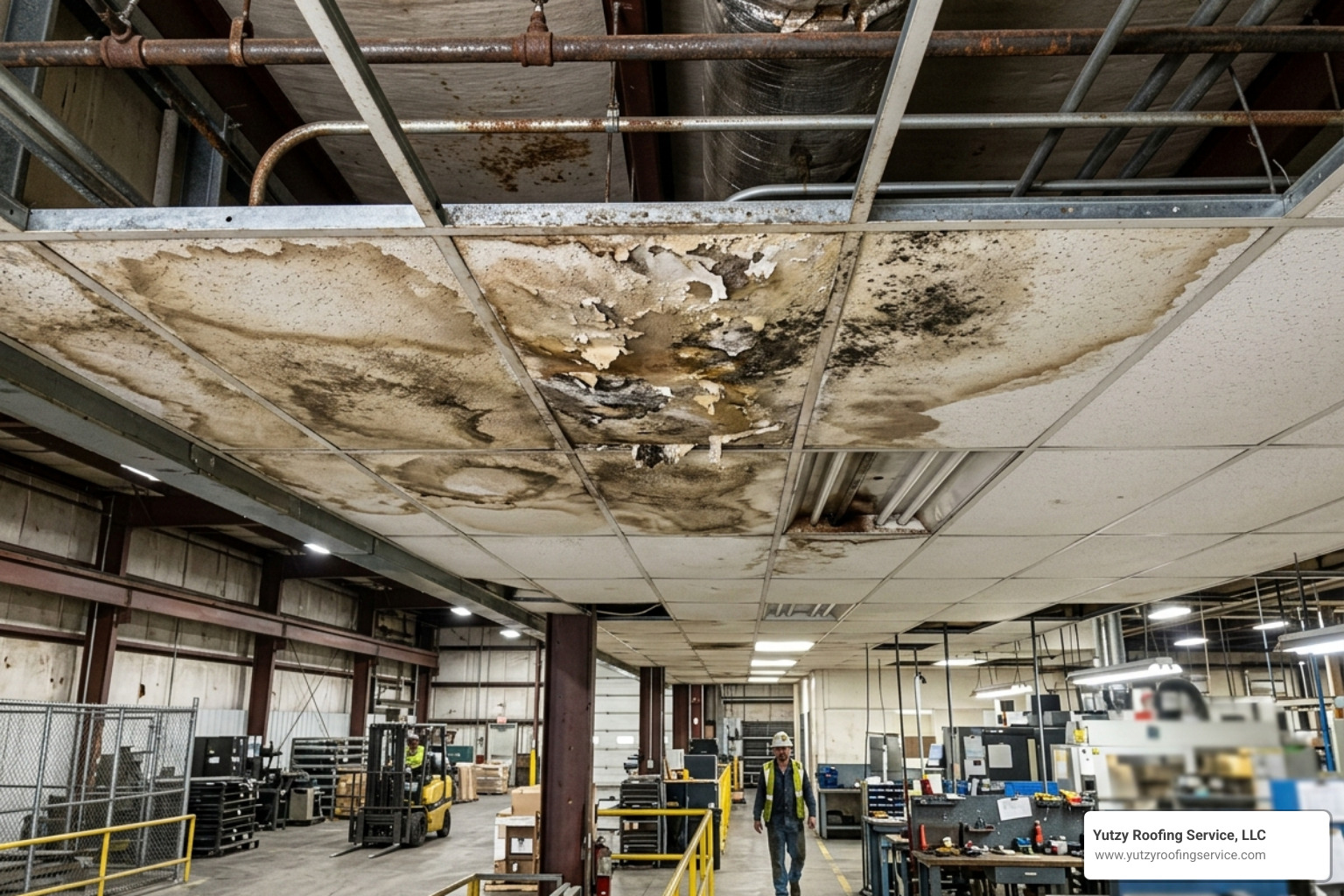
- Water Stains: These often look like brown, tea-colored rings on ceiling tiles or drywall.
- Mold Growth: If you see fuzzy black, green, or white spots, you have a moisture problem. Mold can begin growing within 24–48 hours of saturation.
- Musty Odors: That “old basement” smell in an upper-floor office is a dead giveaway that water is trapped somewhere.
- Sagging Drywall: When drywall or ceiling tiles absorb enough water, they lose structural integrity and start to bow or crumble.
To help you tell the difference, check out this comparison:
| Feature | Roof Leak | Attic/Ceiling Condensation |
|---|---|---|
| Timing | Happens during or shortly after rain/snowmelt. | Happens during extreme temperature shifts. |
| Location | Often near penetrations (vents, HVAC). | Often spread across the underside of the roof deck. |
| Water Volume | Can be a steady drip or heavy flow. | Usually a slow, consistent “sweating” or dampness. |
| Stain Pattern | Concentrated spots or trails. | Widespread spotting or damp insulation. |
If you’re seeing these signs in the Madison area, you can learn more about specific local indicators in our guide to Signs Leaky Roof Repair In Madison Wi.
Common Causes of Commercial Roof Failures
Why do roofs leak in the first place? It’s rarely a random hole in the middle of a field of shingles or membrane. Statistics show that 90% of leaks occur at roof penetrations.
- Flashing Failure: Flashing is the metal or membrane used to seal the “seams” of your roof. It’s found around chimneys, dormers, and walls. Over time, sealant cracks or the metal pulls away. Flashing failures cause the majority of roof leaks.
- Roof Penetrations: Every time a pipe, vent, or HVAC unit goes through the roof, it creates a potential entry point. Pipe boots (the rubber seals around pipes) typically fail after 8–15 years.
- Ponding Water: On flat roofs, water that stays for more than 48 hours is a major threat. It puts immense pressure on seams and can eventually seep through even microscopic cracks.
- Membrane Punctures: Dropped tools, heavy foot traffic, or wind-blown debris can puncture EPDM or TPO membranes.
For a deeper dive into how these issues develop over time, check out this How to Find a Roof Leak: Step-by-Step Detection Guide 2026.
The Best Way to Find a Roof Leak: A Systematic Interior Search

If you have access to the space between your ceiling and the roof (like an attic or crawlspace), this is your best vantage point. The best way to find a roof leak is to do your detective work while the roof is dry, using a high-powered flashlight.
When you get up there, follow these steps:
- Safety First: Only step on secure framing members (joists). Never step on insulation or the backside of the ceiling drywall, or you’ll find yourself in the room below much faster than you intended!
- The Flashlight Test: Shine your light along the rafters and the underside of the roof deck. Look for dark streaks, watermarks, or “tracks” where water has traveled.
- The Daylight Test: Turn off your flashlight and any work lights. Let your eyes adjust for about 30 seconds. If you see any pinpricks of daylight coming through the roof, you’ve found a hole.
- Check the Insulation: Damp or matted insulation is a huge clue. Water often saturates the insulation before it ever reaches your ceiling.
For more detailed tips on what to look for during this phase, see Your Guide To Roof Leak Repairs How To Spot A Leaking Roof.
Tracing the Path of Least Resistance
Water is lazy—it always follows the path of least resistance. Because of gravity, the best way to find a roof leak source is to trace the moisture “uphill.”
If you find a wet spot on a rafter, follow that rafter upward toward the ridge of the roof. Water often enters at a high point, runs down the side of a wooden beam, and only drips off when it hits a low point or a nail. This is known as the 3-10 foot rule: the actual leak is almost always 3 to 10 feet higher (uphill) than the spot where you see the drip.
Once you find a suspicious area, mark it. You can push a small nail up through the roof deck (if it’s a shingle roof) so you can find the exact spot when you’re standing on the exterior. If you’re dealing with a commercial membrane, mark the area with chalk on the interior deck to correlate it with exterior measurements.
This methodical tracing is supported by experts at How to Find a Roof Leak: Step-by-Step Guide | Big Fish Roofing, who emphasize that the entry point is rarely directly above the stain.
Exterior Inspection and Safety Protocols
Now it’s time to head outside. However, we cannot stress this enough: roofing is dangerous. Across the U.S., falls are a leading cause of injury.
- Ladder Safety: Use the 4:1 rule—for every 4 feet of height, the base of the ladder should be 1 foot away from the wall. The ladder should extend at least 3 feet above the roof edge.
- Fall Protection: If the roof is steep (above a 4:12 pitch), you should use a safety harness.
- Weather Conditions: Never go on a roof that is wet, icy, or during high winds. A wet roof is incredibly slippery.
If you aren’t comfortable climbing, the best way to find a roof leak from the ground is using a pair of high-quality binoculars. From the safety of the pavement, you can often spot:
- Cracked or missing shingles.
- Exposed nails (nail pops).
- Lifted flashing around chimneys.
- Clogged gutters causing water to back up under the eaves.
If you are dealing with a metal roof, you’ll want to look for specific issues like rusted fasteners or failed seams. We explain these nuances in Drip Drip Drip How To Identify And Fix A Metal Roof Leak.
Using the Water Test: The Best Way to Find a Roof Leak Source
If a visual inspection doesn’t reveal the culprit, it’s time to simulate a storm. The “hose test” is the gold standard for DIY leak detection.
How to perform a controlled water test:
- Two-Person Team: One person stays inside (in the attic or under the leak) with a flashlight and a phone. The other person goes on the roof with a garden hose.
- Start Low: This is the most important rule. If you start at the top, water will run down and mask the leak source. Start at the eaves, directly above where the interior leak appeared.
- Sectional Testing: Soak a small area (about 3×3 feet) for at least 5 minutes.
- Wait and Communicate: The person inside should watch for drips. If nothing happens after 5 minutes, move the hose up to the next section.
- Isolate Penetrations: Once you’re near a vent pipe or chimney, soak just the base of that unit to see if the flashing is the culprit.
This systematic approach is the most reliable way to confirm a leak’s location. For a step-by-step walkthrough of this method, check out How to Find Where Your Roof Is Leaking: Step-by-Step Guide for Homeowners & Pros.
Tools and Techniques for Pinpointing Hidden Leaks
Sometimes, a garden hose isn’t enough, especially on complex commercial flat roofs in places like Appleton. When visual signs are misleading, we turn to technology.
- Moisture Meters: These devices can detect water hidden behind drywall or under roofing membranes that you can’t see with the naked eye.
- Borescopes: These are tiny cameras on flexible cables. You can drill a small hole in a ceiling and “snake” the camera in to see exactly where water is dripping from a rafter without tearing down the whole ceiling.
- Chalk: Simple but effective for marking suspected zones during your search.
If you’re struggling with a flat roof in the Fox Valley area, our guide on Flat Roof Leak Repair In Appleton Wi covers specific tools for those systems.
Advanced Technology: The Best Way to Find a Roof Leak in 2026
In 2026, we have access to tools that make the “needle in a haystack” search much easier. At Yutzy Roofing Service, we often use these advanced methods for our commercial restoration projects:
- Infrared Thermography: Thermal cameras detect temperature differences. Since wet insulation holds heat differently than dry insulation, a thermal scan can “see” a leak through the roof membrane.
- Electronic Leak Detection (ELD): This uses a low-voltage electrical current to find even microscopic breaches in a waterproof membrane.
- Drone Surveys: Drones equipped with high-resolution and thermal cameras can safely inspect massive commercial roofs in a fraction of the time it takes to walk them.
These high-tech options are often the best way to find a roof leak on large industrial buildings. You can read more about these modern standards in this How to Find a Roof Leak: Step-by-Step Guide for All Roof Types.
Temporary Solutions and Professional Intervention
Once you find the leak, you need to stop the damage—fast. While you wait for a permanent repair, here are some emergency fixes:
- Redirect the Water: Inside the building, you can sometimes use a piece of plywood or plastic to “funnel” the drip into a bucket, preventing it from soaking a large area of the floor.
- Roofing Cement: For small cracks in flashing or around nails, a “goopy” roofing mastic can provide a temporary seal.
- Emergency Tarping: If a large area is damaged, a heavy-duty tarp is your best friend. On flat roofs, we use “weighted tarps” secured with sandbags (never use bricks or rocks, which can tear the membrane).
- Flex Seal/Tape: While not a permanent fix, high-quality waterproof tapes can buy you a few days of dry weather.
For a full list of emergency steps, see our article on What To Do If Your Commercial Roof Is Leaking.
When to Call a Commercial Roofing Expert
DIY detection is great for small issues, but there are times when you need to call in the pros. You should reach out to an expert if:
- The leak is located in a roof valley (these are complex and easy to mess up).
- The roof is flat or low-slope, as these require specialized membrane knowledge.
- There is structural damage, like rotting wood or sagging steel decks.
- The leak keeps coming back after you’ve tried to patch it.
If you’re in the Madison area and dealing with a stubborn flat roof issue, check out Flat Roof Leak When To Call The Professionals In Madison Wi.
Frequently Asked Questions about Roof Leaks
Why does my roof only leak during heavy, wind-driven rain?
This usually happens because of flashing or siding issues. Normal rain falls vertically, but wind can push water sideways or even “uphill” under shingle tabs and flashing. If your roof only leaks when the wind blows from the east, for example, check the step flashing on that side of the building.
How long can a roof leak go unnoticed before causing mold?
Not long at all. Mold can begin to grow within 24 to 48 hours of moisture hitting organic material like drywall, wood, or paper-faced insulation. A slow “seeping” leak is often more dangerous than a big drip because it stays hidden long enough to cause massive structural rot and air quality issues.
Can I fix a commercial roof leak myself using retail sealants?
For a very minor, temporary fix? Yes. But for a permanent solution? Usually no. Commercial roofs (like EPDM, TPO, or built-up roofs) require specific primers and compatible materials. Using a hardware-store silicone on an EPDM roof, for example, can actually damage the membrane further and void your warranty.
Conclusion
Finding a roof leak doesn’t have to be a nightmare. By starting inside, tracing the path uphill, and using a systematic water test, you can pinpoint most problems yourself. However, a patch is just a band-aid.
At Yutzy Roofing Service, LLC, we specialize in long-term commercial roofing restoration. Whether you need spray foam coatings, metal roof restoration, or EPDM repairs, we serve businesses from Green Bay to Mankato with a commitment to quality. We are proud to offer a non-prorated, renewable warranty of up to 18 years, giving you peace of mind that once we find and fix your leak, it stays fixed.
Don’t let a small drip turn into a major capital expense. Learn more about professional flat roof leak repair and how our restoration systems can save your roof—and your sanity.
