
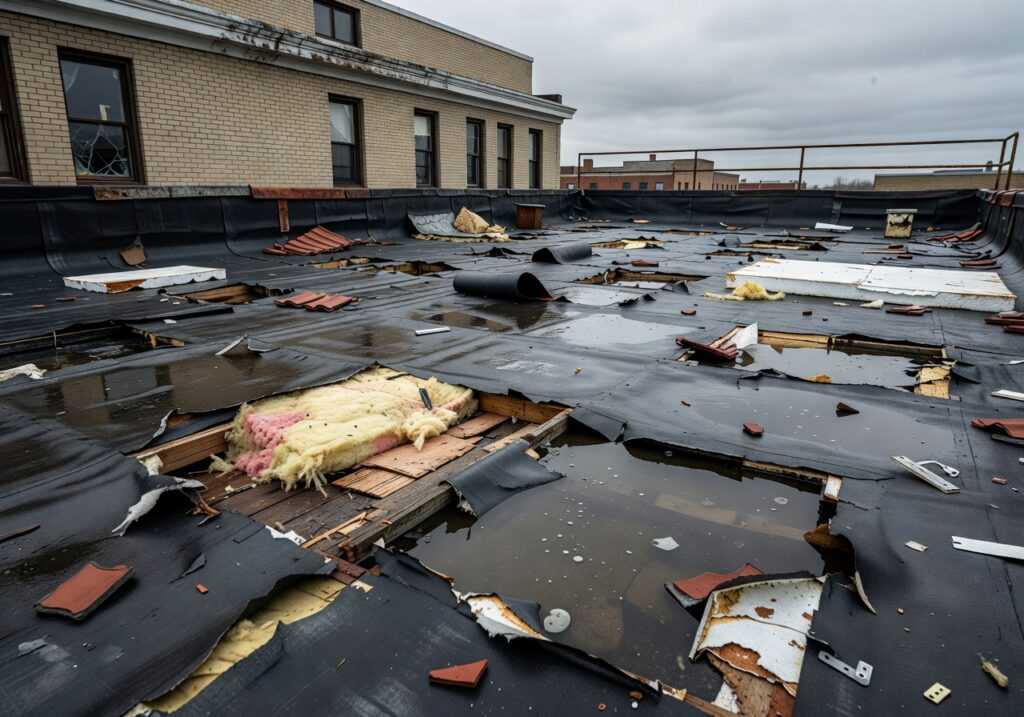
When Storm Damage Strikes: What You Need to Know About Getting Insurance to Pay for Roof Replacement
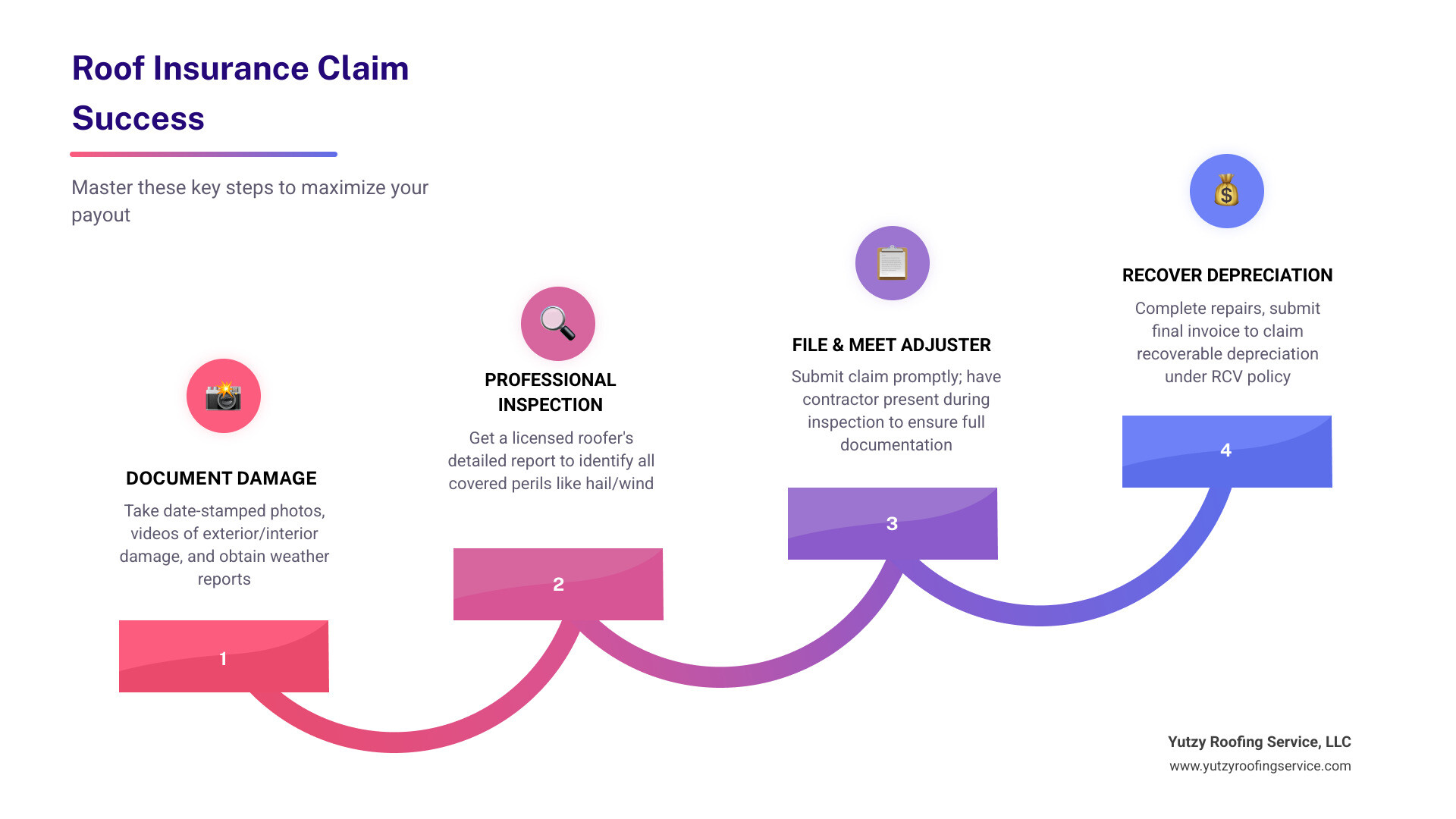
Knowing how to get insurance to pay for roof replacement can save you thousands of dollars when storm damage hits your property. Here’s a quick overview of the process:
- Document the damage – Take date-stamped photos and videos immediately after the storm
- Get a professional roof inspection – A licensed roofer’s report strengthens your claim
- Review your policy – Understand your coverage type (ACV vs. RCV) and deductibles
- File your claim promptly – Contact your insurer right away; most policies have strict deadlines
- Meet the adjuster with your contractor present – Ensure all damage gets properly noted
- Review the settlement and recover depreciation – If you have RCV coverage, you can claim the remaining depreciation after repairs are complete
A damaged roof rarely comes with a warning. One severe storm can leave your building exposed to water intrusion, structural damage, and rapidly rising repair costs. And with the average roof replacement running around $9,520, the financial pressure is real.
The good news? Most homeowners and commercial property insurance policies do cover sudden roof damage caused by wind, hail, fire, and falling debris. The challenge is navigating the claims process correctly — because missteps like missed deadlines, poor documentation, or filing the wrong type of claim can result in a denied or underpaid claim.
More than 40% of all home insurance claims involve wind or hail damage, making roof claims the most common type filed. Yet many property owners still leave money on the table simply because they don’t know the right steps to take.
I’m Josh Yutzy of Yutzy Roofing Service, LLC — a family-owned roofing company serving Wisconsin since 1995 — and I’ve helped countless property owners understand how to get insurance to pay for roof replacement after storm and weather damage. In this guide, I’ll walk you through exactly what to do, step by step.
Understanding Your Policy: ACV vs. RCV and Covered Perils
Before you pick up the phone to call your agent, you need to understand the language of your policy. Not all your insurance coverage is created equal. The most critical distinction is between Actual Cash Value (ACV) and Replacement Cost Value (RCV).
ACV vs. RCV: The Payout Gap
In an ACV policy, the insurance company pays you what your roof is worth today, accounting for its age and condition. If you have a 15-year-old shingle roof with a 20-year lifespan, the insurer will likely only pay about 25% of the replacement cost, leaving you to cover the rest.
Conversely, an RCV policy covers the full cost of a brand-new roof (minus your deductible). While RCV premiums are higher, they are the gold standard for avoiding massive out-of-pocket expenses.
| Feature | Actual Cash Value (ACV) | Replacement Cost Value (RCV) |
|---|---|---|
| Payout Basis | Depreciated value based on age | Current market cost for new materials |
| Out-of-pocket | High (you pay the depreciation) | Low (you usually only pay the deductible) |
| Premium Cost | Lower | Higher |
What is a “Covered Peril”?
Insurance doesn’t pay for a new roof just because yours looks “tired.” To trigger a payout, the damage must be caused by a “covered peril.” According to the Insurance Information Institute, the most common reasons for successful claims include:
- Wind Damage: High gusts that lift shingles or peel back metal panels.
- Hail Hits: Impacts that bruise shingles or dent metal, compromising the water-shedding layer.
- Fire and Lightning: Sudden catastrophic events.
- Falling Debris: A tree limb crashing through the deck during a Wisconsin thunderstorm.
It is important to note that standard policies almost always exclude “wear and tear” or damage resulting from a lack of maintenance. If your roof is leaking because it’s 30 years old and the granules have simply washed away over time, insurance likely won’t foot the bill. This is why understanding roof repair vs replacement which is right for you is vital; sometimes, the damage isn’t a “claimable” event but a maintenance necessity.
The 80% Rule
Many insurers utilize the “80% rule,” which states that you must insure your home for at least 80% of its total replacement value to receive full payment on partial losses. If you are under-insured, your payout for a roof replacement could be significantly reduced.
Step-by-Step Guide on How to Get Insurance to Pay for Roof Replacement
Navigating the bureaucracy of an insurance company requires a methodical approach. We recommend following these steps to ensure you don’t miss out on the funds you’re entitled to.
1. Review Your Policy and Deductible
Before filing, check your “Declarations Page.” Look specifically for your deductible. In states like Wisconsin, you might have a flat $1,000 deductible, but in hail-prone regions, you might see a percentage-based deductible (e.g., 1-2% of the home’s value). If your home is insured for $400,000, a 2% deductible means you pay $8,000 out of pocket before the insurance kicks in.
2. Identify the “Date of Loss”
Insurance companies require a specific date when the damage occurred. If you’re wondering how to get insurance to pay for roof replacement, having a weather report that matches your claim date is the single best way to prove your case.
3. Mitigate Further Damage
You have a legal obligation to prevent “secondary damage.” If a storm rips a hole in your roof, you must have it tarped immediately. If you don’t, and rain ruins your drywall and flooring two days later, the insurance company may deny the interior portion of the claim because you failed to mitigate the loss. Emergency tarping is a standard requirement, and the cost is usually reimbursable as part of the claim.
4. File the Claim and Get a Claim Number
Once you’ve confirmed damage exists, call your insurer’s claims hotline. They will provide a claim number—keep this handy for every conversation you have moving forward. At this stage, property owners often ask, “how long does it take to replace a roof?” While the physical work may only take 2-5 days, the insurance approval process can take anywhere from two weeks to two months.
Documenting Damage: How to Get Insurance to Pay for Roof Replacement
Documentation is the “evidence” in your “case” against the insurance company. If you can’t prove it, it didn’t happen.
- Photos and Videos: Take wide shots of the house and close-ups of the damage. If you see “bruises” on shingles or missing tabs, document them.
- Interior Signs: Don’t just look up at the sky. Look at your ceilings. Water stains, bubbling paint, or damp attic insulation are clear indicators of a compromised roof.
- The Power of Data: Tools like Verisk help insurers track roof age and weather events. You should do the same. Save news clippings or weather app alerts from the day of the storm.
- Structural Framing: Sometimes the damage isn’t just on the surface. Heavy impacts or fallen trees can crack rafters or shift the ridge beam. Ensure your contractor inspects the “bones” of the roof as well.
Navigating Denials: How to Get Insurance to Pay for Roof Replacement
It is a frustrating reality: claims get denied. Common reasons include “pre-existing wear and tear,” “improper installation,” or “damage below the deductible.”
If you receive a denial letter, don’t panic. You have rights.
- Request a Re-inspection: Ask for a different adjuster. Sometimes the first person on the scene misses something or is simply having a bad day.
- Contact your state’s Department of Insurance: If you feel you’re being treated unfairly, filing a formal complaint can often get the insurer to take a second look.
- Leverage Contractor Expertise: This is where we come in. A professional roofer can meet the adjuster on the roof and point out “functional damage” that an adjuster might have categorized as “cosmetic.”
- Formal Appeals: If a second inspection fails, you can submit a formal appeal including a detailed report from your contractor and perhaps a third-party engineer. Knowing restore or replace your roof in madison wi how to decide often involves having the right data to prove that a repair is no longer a viable or “code-compliant” option.
Maximizing Your Payout: Recoverable Depreciation and Supplements
Once your claim is approved, you won’t get one giant check for the full amount immediately. The process usually happens in two stages.
The Two-Check System
First, the insurance company sends a check for the ACV (Actual Cash Value). This is the “used” value of your roof. For a roof that costs $9,520 to replace, they might send you $5,000 initially.
The remaining $4,520 is held back as “recoverable depreciation.” You only get this second check after the work is completed and you submit a final invoice from a licensed contractor. This ensures the money is actually spent on the roof and not a new jet ski.
Supplemental Claims
As we tear off your old roof, we often find “hidden” damage—rotted decking or flashing that wasn’t visible during the initial inspection. We then submit a supplemental claim to the insurance company. Because we use the same estimating software as the adjusters, we can usually get these items approved quickly so you aren’t stuck with the bill.
If the insurance payout still doesn’t cover your dream roof, there are always roof replacement financing a look at your options to bridge the gap for upgrades like metal or high-end shingles.
Material Matching and Code Upgrades
In many states, if an insurer can’t find shingles that perfectly match your existing ones, they may be legally required to replace the entire roof, even if only one slope was damaged. Additionally, if local building codes have changed since your roof was built (like requiring ice and water shield in Wisconsin), “Law and Ordinance” coverage in your policy will pay for these mandatory upgrades.
Regional Factors: From Wisconsin Storms to Texas Hail
Geography plays a massive role in how claims are handled.
- Wisconsin and the Midwest: Our biggest enemies are hail and “ice damming.” Ice dams occur when snow melts and refreezes at the eaves, backing up water under the shingles. This is often covered by insurance, but insurers will look closely at whether your attic was properly ventilated.
- Texas and the South: Hail is so common here that many policies have separate, higher deductibles just for wind and hail.
- Florida: Hurricane deductibles are often 2% to 10% of the home’s value. However, Florida also offers wind mitigation credits for homeowners who install roofs that meet the IBHS FORTIFIED program standards.
For our commercial clients, the stakes are even higher. Deciding on commercial roof repair or replacement whats the best choice often depends on the specific “buy-back” options or exclusions in a commercial policy, which tend to be more complex than residential ones.
Choosing a Reputable Contractor for Your Claim
The contractor you choose can make or break your claim. You want someone who speaks “Insurance-ese.”
- Avoid “Storm Chasers”: These are out-of-state companies that knock on doors after a storm, take your insurance check, and disappear. Always hire a local, established company with a physical office in places like Marshfield, Appleton, or Madison.
- Insurance Software Proficiency: Most adjusters use a program called Xactimate. If your roofer uses the same software, it makes the “Scope of Loss” comparison much smoother.
- Presence at Inspections: Never let an adjuster walk your roof alone. A reputable contractor will be there to ensure the adjuster sees every dent and every lifted shingle.
- Verification: Check their social media, Google reviews, and ensure they are licensed and insured in Wisconsin or Minnesota.
Frequently Asked Questions about Roof Insurance Claims
Will filing a roof claim increase my insurance rates?
It’s possible, but usually, a single claim for a “catastrophic event” (like a massive hail storm that hits your whole neighborhood) won’t cause a spike on its own. Insurance companies generally raise rates by zip code after a major storm. If everyone’s rates are going up anyway, you might as well get your roof replaced!
How old can my roof be for insurance to still cover replacement?
There is no “magic age,” but it gets harder as the roof nears the end of its life. If your roof is over 20 years old, the insurer may have already switched your coverage to ACV-only. However, if a tree falls on a 25-year-old roof, it’s still a covered peril; you’ll just receive a heavily depreciated payout.
Can I upgrade to a metal roof if insurance is paying for shingles?
Yes! Insurance will pay you the “replacement cost” of your current shingle roof. You can then apply that money toward a more durable option, like a metal roof or spray foam coating. You simply pay the difference out of pocket. Many of our clients find this is the perfect time to invest in our renewable 18-year non-prorated warranty systems.
Conclusion
Getting your insurance to pay for a roof replacement isn’t about “gaming the system”—it’s about holding the insurance company to the promises they made in your policy. Success comes down to three things: immediate documentation, professional advocacy, and a deep understanding of your policy.
Don’t wait until the next storm to figure out your coverage. If you suspect your roof has storm damage, or if you’re a commercial property owner looking for a maintenance partner who understands the insurance landscape, reach out to us.
At Yutzy Roofing Service, LLC, we’ve been protecting Wisconsin and Minnesota roofs for nearly 30 years. Whether you’re in Eau Claire, Green Bay, or Rochester, we’re here to help you navigate the process from the first shingle to the final insurance check.
Ready for an inspection? Visit us at https://www.yutzyroofingservice.com/ and let’s get your property protected.
