How to Choose the Best Commercial Roofers for Wisconsin and Minnesota Properties
#
If you manage a commercial property in Wisconsin or southern Minnesota, finding a reliable commercial roofing partner is one of the most important decisions you’ll make for your building.
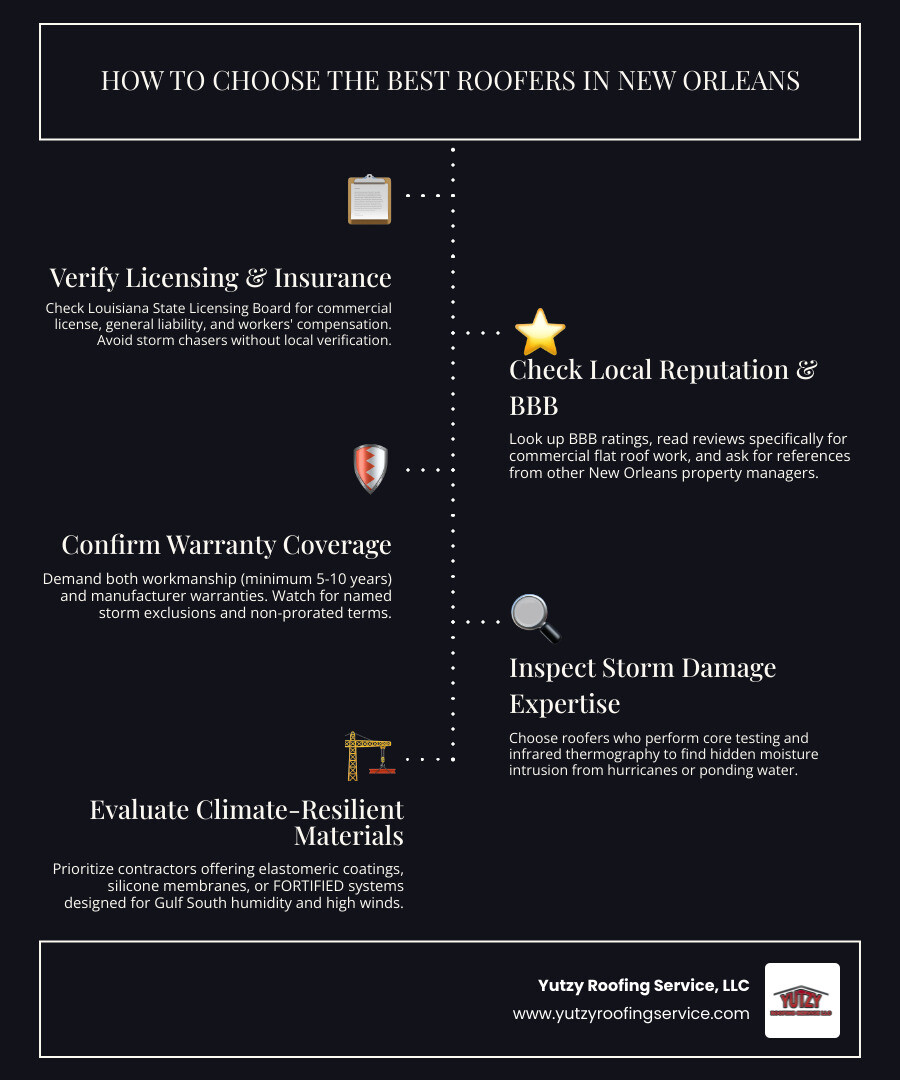
Property owners sometimes compare contractors across tough-weather markets, including searches for roofers in New Orleans, because coastal roofers must think carefully about wind, moisture, heat, and storm damage. Yutzy Roofing Service is not a New Orleans roofing contractor. We are based in Marshfield, Wisconsin, and serve commercial roofing customers in areas such as Madison, Appleton, Wausau, Green Bay, Eau Claire, Fond Du Lac, Mankato, and Rochester. The practical vetting advice below is written for commercial property owners in our service region while using severe-weather roofing principles that apply broadly.
Commercial roofs in the Upper Midwest face their own harsh conditions. High winds, hail, snow loads, ice, freeze-thaw cycles, UV exposure, and seasonal humidity put enormous stress on flat and low-slope roofs across Wisconsin and Minnesota.
The stakes are high. A small leak left unaddressed can escalate into mold, structural rot, wet insulation, and expensive interior damage. With many contractors appearing in online directories and on the Better Business Bureau, sorting the reliable from the unreliable takes real effort.
This guide cuts through the noise. Whether you’re dealing with storm damage, aging flat roof membranes, metal roof leaks, or rising energy costs, the guidance below is built for commercial property owners who need practical answers fast.
I’m Josh Yutzy, and my family has been in the roofing business since 1995. At Yutzy Roofing Service, we work with commercial property owners facing core problems such as storm damage, worn flat roofs, failing seams, and the need for cost-effective restoration over costly tear-offs. We proudly serve Wisconsin communities like Madison, Appleton, and Wausau, along with additional service areas in Wisconsin and Minnesota. Read on for the full breakdown.
Commercial roofing terminology:
When selecting a commercial roofing partner in Wisconsin or Minnesota, you cannot afford to treat the decision lightly. Commercial structures require specialized inspection, appropriate materials, and careful adherence to local building rules.
High-wind, hail, snow, and freeze-thaw conditions mean that basic patching may not be enough. To protect your investment, you need a commercial contractor who understands wind uplift, membrane adhesion, drainage, insulation performance, UV exposure, and the maintenance requirements of flat and low-slope roofing systems.
Verifying Credentials of Commercial Roofers
Verifying credentials is your first line of defense. Never take a contractor’s word at face value. Actively confirm that they carry the appropriate registration, insurance, manufacturer training, and financial protections for your commercial project.
- Commercial Licensing and Permits: Licensing and permitting rules vary by state and municipality. For example, Louisiana has specific commercial licensing requirements through the Louisiana State Licensing Board for Contractors (LSLBC). For projects in Wisconsin and Minnesota, confirm that the contractor is properly registered where required, understands local permitting rules, and has experience with commercial roof restoration and repair.
- General Liability Insurance: A reputable commercial roofer should carry meaningful general liability insurance to protect your building and assets during the project.
- Workers’ Compensation: Commercial roofs are high-risk environments. If an installer is injured on your property and the contractor lacks workers’ compensation coverage, your business could face serious legal and financial exposure.
- Physical Office Verification: Avoid temporary operators who appear after major storms and disappear when warranty service is needed. Verify that the company has a permanent, physical office in its stated service area rather than only a temporary address.
- Subcontractor Coverage: Ensure that the contractor’s insurance policies extend to any subcontractors they bring onto your commercial job site.
- Commercial Restoration Experience: Ask for examples of similar flat roof restoration, spray foam coating, EPDM repair, or metal roof restoration projects, not just general roofing experience.
Understanding Workmanship vs. Manufacturer Warranties from Commercial Roofers
A warranty is only as good as the company backing it. When evaluating proposals, you will encounter two distinct types of warranties:
- Workmanship Warranties: Offered directly by the contractor, this covers the labor and installation process. For commercial flat roofs, workmanship warranties often vary depending on the system, preparation, and project scope.
- Manufacturer Warranties: Backed by the material manufacturer, this covers defects in the roofing products themselves.
For stronger protection, ask whether non-prorated warranty coverage is available. A non-prorated warranty is designed to avoid reducing coverage simply because the roof system has aged.
Additionally, ask about wind, hail, ponding water, and maintenance requirements. In storm-prone regions, you must understand what the warranty includes, what exclusions apply, and what inspection or maintenance records are required to keep coverage active.
Commercial Roof Repair vs. Full Restoration in Wisconsin and Minnesota
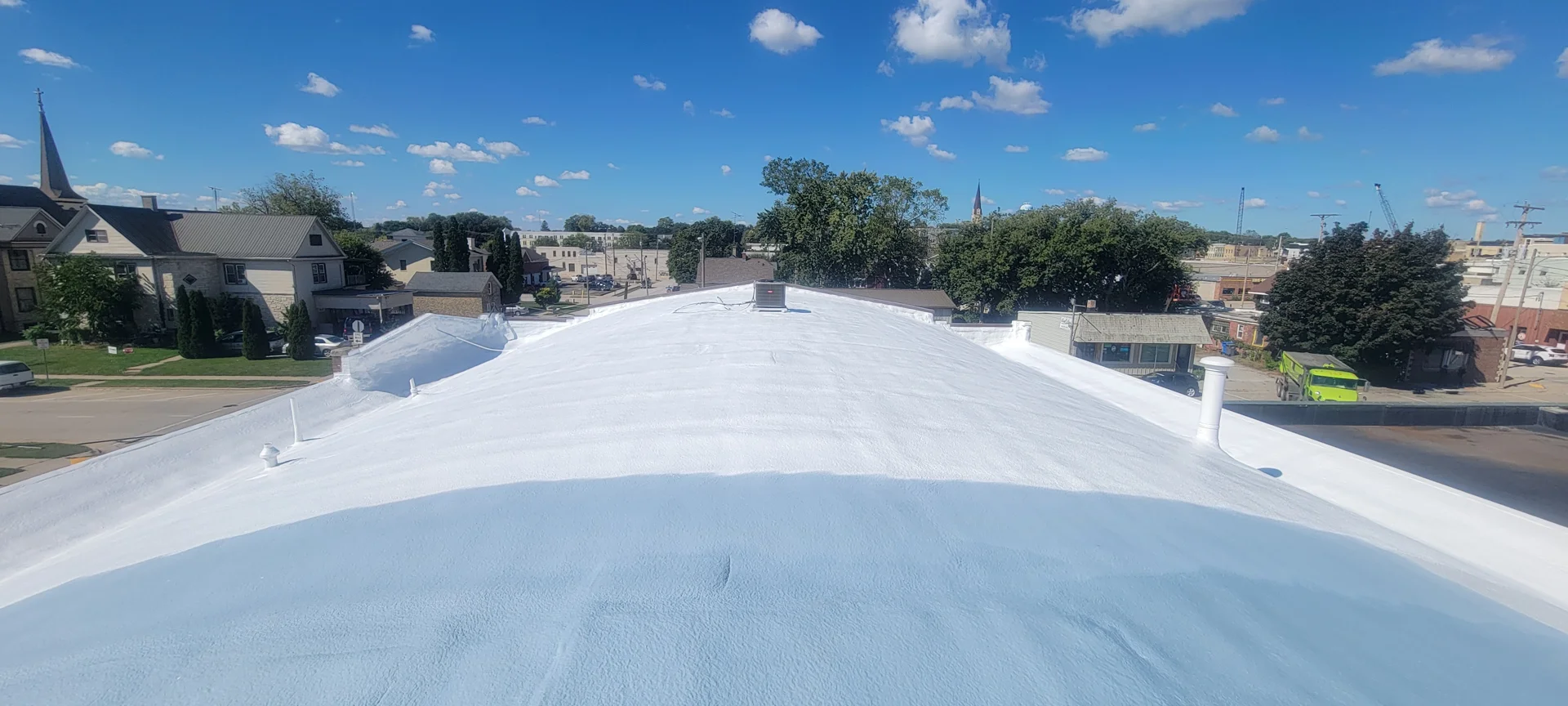
Many commercial property owners believe that when a flat roof starts leaking, a complete tear-off and replacement is the only option. However, in modern commercial roofing, a full replacement is often an unnecessary expense. Roof restoration can offer a highly effective, sustainable, and budget-friendly alternative when the existing roof is a good candidate.
| Factor | Commercial Roof Patching (Repair) | Full Roof Restoration | Full Roof Replacement |
|---|---|---|---|
| Primary Purpose | Fixes localized, active leaks immediately | Renews the entire roof surface seamlessly | Complete structural overhaul |
| Average Lifespan | Temporary (1 to 5 years) | Extended by 10 to 18+ years (renewable) | 20 to 30 years |
| Cost Profile | Lowest upfront cost | 50% to 70% cheaper than replacement | Highest cost (labor & disposal) |
| Disruption | Minimal | Low noise, no building closure required | High noise, potential operational downtime |
| Tax Benefits | Expensed immediately | Often classified as maintenance (tax write-off) | Capitalized asset (depreciated over decades) |
For flat roofs experiencing widespread but superficial wear, fluid-applied restoration systems such as elastomeric coatings, silicone membranes, and spray polyurethane foam (SPF) can seal the surface without the disruption of a full tear-off.
At Yutzy Roofing Service, we specialize in high-performance commercial roofing restoration, offering premium spray foam coatings, elastomeric systems, metal roof restoration, and reliable EPDM repairs backed by an up to 18-year non-prorated renewable warranty.
Detecting Hidden Storm Damage on Flat Roofs
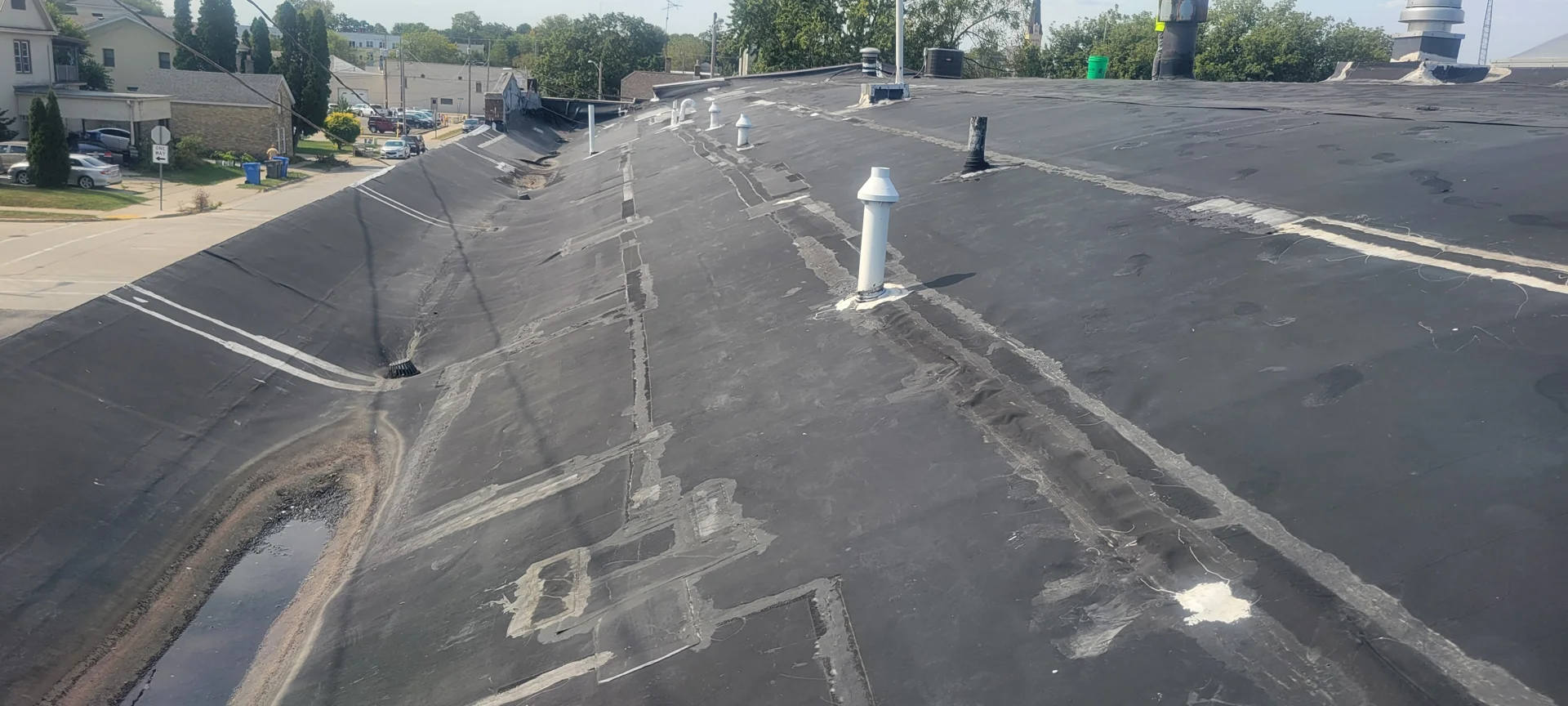
After a severe hailstorm, wind event, or heavy rain, physical damage to a flat commercial roof is not always visible from the ground. Flat roofing systems like TPO, EPDM, modified bitumen, and coated metal can harbor hidden moisture intrusion that slowly damages decking and insulation.
Professional commercial inspectors use diagnostic tools and hands-on testing to identify these hidden threats:
- Infrared Thermography: Thermal imaging cameras detect temperature differences on the roof surface. Wet insulation can retain heat differently than dry insulation, helping identify suspicious zones for further inspection.
- Core Testing: Taking physical core samples of the roof’s cross-section allows technicians to inspect the underlying roof deck and insulation layers for rot, moisture, and structural decay.
- Wind Uplift Review: Evaluates whether seams, edges, fasteners, and membrane adhesion appear capable of resisting future high-wind events.
- Moisture Meters: Pinpoint specific zones of water trapped beneath the membrane before leaks become obvious inside your building.
- Drainage Evaluation: Identifies ponding water, blocked drains, low spots, and problem areas that may worsen during freeze-thaw cycles.
Navigating Commercial Insurance Claims After Midwest Storms
Filing an insurance claim for commercial storm damage can be complex. Insurance adjusters represent the interests of the carrier, which means you need thorough documentation to support a fair claim.
- Immediate Emergency Tarping: As a building owner, you may have an obligation to mitigate further damage. Work with a local emergency roofer when temporary protection is needed to help prevent water from damaging inventory, equipment, or tenant spaces.
- Comprehensive Photo Documentation: Take high-resolution photos of the entire roof surface, flashing, drainage areas, equipment curbs, and interior ceiling damage before permanent repairs begin.
- Detailed Scope of Work: Work with experienced commercial roofers who can provide a detailed, line-item estimate covering the exact materials, labor, preparation, wet insulation removal, and permits required.
- Understand Your Policy Limits: Review your commercial policy to see how wind, hail, water intrusion, and deductibles are handled.
- Keep Maintenance Records: Inspection reports, maintenance logs, and repair invoices can help document the condition of the roof before the storm.
Climate-Resilient Materials for Wisconsin and Minnesota Commercial Buildings
Selecting the right materials is critical to helping your commercial building withstand high winds, hail, snow, ice, UV exposure, seasonal humidity, and freeze-thaw cycles.
- Spray Polyurethane Foam (SPF): SPF is applied as a liquid that expands into a solid, seamless barrier. Because it has no field seams or joints, it can reduce common leak points on flat and low-slope roofs. SPF also provides strong thermal insulation, helping reduce heating and cooling loads in commercial buildings.
- Silicone and Elastomeric Coatings: These coatings are applied directly over existing flat roofs, including worn TPO, EPDM, and metal when the roof is properly prepared. Silicone is highly resistant to ponding water, while reflective coatings can reduce heat gain during hot summer weather.
- EPDM Repair Systems: Ethylene Propylene Diene Monomer (EPDM) is durable, but age, UV exposure, thermal movement, and weathering can cause seams and penetrations to fail over time. Advanced primers and fluid-applied sealants can restore watertight integrity without a costly replacement when the roof remains structurally sound.
- Metal Roof Restoration Systems: For aging commercial metal roofs, restoration can address corrosion, exposed fasteners, failed seams, and leaks without installing a new metal roof. Proper preparation and coating can improve weather resistance and extend service life.
How Commercial Roof Restoration Enhances Wind and Weather Resistance
A professionally executed commercial roof restoration does more than stop leaks; it reinforces the protective envelope of your building.
By applying high-tensile elastomeric, silicone, or spray foam systems over a suitable existing roof, you can reduce seams and vulnerable transitions, which are common failure points during high-wind and heavy-rain events. These fluid-applied systems bond directly to the prepared substrate, creating a continuous barrier that helps resist wind uplift, water intrusion, UV exposure, and thermal movement.
Restoring your roof can also be an environmentally responsible choice. It helps keep roofing waste out of landfills and can lower energy use by improving reflectivity and insulation performance.
Frequently Asked Questions About Wisconsin and Minnesota Commercial Roofing
What are the typical costs and timelines for commercial roof restoration?
The cost of commercial roof restoration often ranges from $3.00 to $7.00 per square foot, depending on the size of the roof, the type of coating used, access, preparation requirements, wet insulation removal, and the condition of the existing substrate. This can be 50% to 70% cheaper than a full tear-off and replacement when restoration is appropriate.
Many commercial restorations can be completed in 3 to 7 days, weather permitting. Because there is no noisy tear-off process in many restoration projects, your business can often remain operational throughout the work.
How do elastomeric and silicone roof coatings protect flat roofs from moisture and temperature swings?
Moisture, ponding water, UV exposure, and freeze-thaw cycles can all accelerate deterioration on flat and low-slope roofs. Standard acrylic coatings may not be the best choice for areas with long-term ponding water.
Silicone coatings are highly resistant to ponding water and form a seamless, rubber-like shield that helps prevent moisture from penetrating the roof assembly. Elastomeric coatings are flexible and reflective, helping the roof handle thermal movement while reducing heat absorption during warmer months.
What are the benefits of commercial metal roof restoration?
Instead of replacing an aging, rusty commercial metal roof, a fluid-applied metal roof restoration system can extend its service life. The process typically involves treating existing rust, tightening or replacing fasteners, sealing seams with heavy-duty reinforcing mesh, and applying a reflective protective coating. This helps prevent future corrosion, seals leaks, and can reduce heat gain by reflecting solar energy.
Conclusion
Maintaining a secure, watertight commercial roof is essential for protecting your business, assets, and tenants from severe weather. For property owners in Wisconsin and southern Minnesota, choosing the right commercial roofer means carefully vetting insurance, experience, restoration options, warranties, and long-term maintenance support.
At Yutzy Roofing Service, we bring decades of dedicated commercial expertise to every project. We are based in Marshfield, Wisconsin, and proudly serve areas such as Madison, Appleton, Wausau, Green Bay, Eau Claire, Fond Du Lac, Mankato, and Rochester. We specialize in flat roof restoration, spray foam coatings, EPDM repairs, and metal roof restoration systems engineered for demanding commercial buildings. If you are ready to secure your building with a sustainable, energy-efficient roofing system backed by an up to 18-year non-prorated renewable warranty, contact Yutzy Roofing Service today for a professional consultation.
