
What Does Blow-In Foam Insulation Cost for Commercial Buildings?
Blow-in foam insulation cost is one of the first questions property owners ask when planning an energy upgrade — and the answer depends heavily on whether you mean loose-fill blown-in insulation or spray polyurethane foam (SPF).
Here’s a quick snapshot of 2026 pricing:
| Insulation Type | Cost per Sq Ft (Installed) | Best For |
|---|---|---|
| Blown-in fiberglass | $0.50 – $1.10 | Residential attics |
| Blown-in cellulose | $0.60 – $2.30 | Residential walls/attics |
| Open-cell spray foam | $1.00 – $2.50 | Interior commercial applications |
| Closed-cell spray foam | $2.00 – $4.50 | Commercial roofs, high-moisture areas |
For most commercial properties in Wisconsin, closed-cell spray polyurethane foam is the relevant product — not the residential loose-fill materials you’ll see quoted on home improvement sites. Those two product categories carry very different price tags and very different performance outcomes.
The confusion between these two insulation types is common, and it leads many building owners to budget incorrectly or compare quotes that aren’t measuring the same thing. This guide cuts through that noise.
I’m Josh Yutzy, and through decades of commercial roofing work across Wisconsin with Yutzy Roofing Service, LLC, I’ve seen how blow-in foam insulation cost decisions can make or break a property owner’s energy budget. Understanding what you’re actually buying — before you get a quote — is the most important step.
Understanding the Terminology: Blown-In vs. Spray Foam Insulation
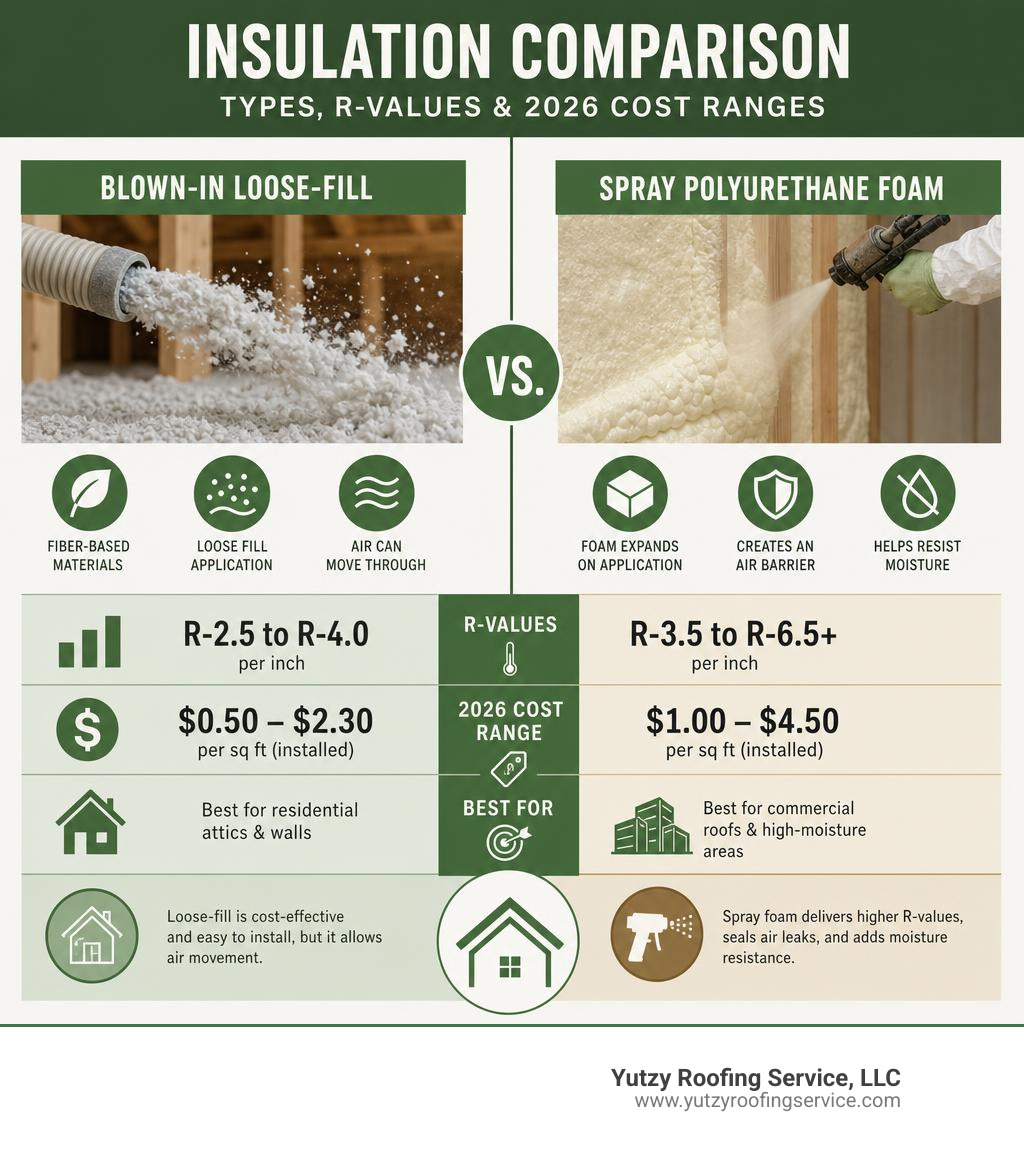
When commercial property managers or building owners search for a “blown-in foam insulation cost,” they are often blending two entirely different insulation technologies. This misnomer – “blow-in foam” – usually refers to either blown-in loose-fill insulation, which consists of dry, fiber-based materials blown through a hose, or spray polyurethane foam, which is applied as a liquid and expands rapidly into a dense, solid foam barrier.
To make an informed financial decision for your commercial facility, it is essential to understand the difference between open-cell and closed-cell polyurethane foam, as well as how they compare to traditional loose-fill options. Choosing the wrong type can lead to roof failures, moisture retention, and inflated energy bills.
To explore the fundamental advantages of choosing foam-based systems over traditional alternatives, read our Benefits of Spray Foam Insulation In-Depth Guide.
What is Blown-In (Loose-Fill) Insulation? (And Why It’s Not for Commercial Roofs)
Blown-in or loose-fill insulation is a process where a machine shreds and blows chunks of fiberglass, cellulose, or mineral wool into cavities, attics, or wall spaces.
- Fiberglass: Made from spun glass fibers, this is the most affordable loose-fill option, costing around $0.50 to $1.10 per square foot.
- Cellulose: Consisting primarily of recycled paper treated with fire-retardant chemicals, such as borate, cellulose typically costs between $0.60 and $2.30 per square foot.
- Mineral Wool: Made from rock or industrial slag, this material offers excellent fire resistance but is heavier and more expensive.
While these materials perform adequately in residential attics, they are highly unsuitable for commercial flat roofs or low-slope industrial buildings. Loose-fill insulation cannot handle traffic, offers zero structural support, and acts like a giant sponge when exposed to roof leaks. Once wet, cellulose and fiberglass lose their thermal resistance entirely, settle under the weight of the water, and can cause catastrophic deck rot or ceiling sagging.
To learn more about the physical properties of these materials, see the Department of Energy Insulation Materials Guide.
What is Commercial Spray Foam Insulation? (The Professional Solution)
For commercial structures, spray polyurethane foam (SPF) is the industry standard for high-performance insulation. Applied as a liquid mixture of polyol resin and isocyanate, SPF expands within seconds of contact with the substrate, filling every crack, gap, and seam.
Unlike loose-fill fibers, SPF creates an airtight, monolithic seal across the entire roof deck or wall cavity. For commercial flat roofs, closed-cell spray foam serves a dual purpose: it acts as a superior thermal barrier and a seamless, watertight roofing system. This eliminates the seams and fasteners that are notorious for failing on commercial roofs.
To understand how this technology integrates directly into your commercial roofing system, refer to our Spray Foam Roofing: An In-Depth Guide for Building Owners.
What is the Real Commercial Spray Foam Insulation Cost per Square Foot?

In the commercial roofing and insulation industry, pricing is rarely calculated solely by the square foot of floor space. Instead, spray foam contractors price projects using board feet, a unit of volume equal to a 12-inch by 12-inch square at 1 inch of thickness, or by the square foot at a specified target thickness.
The nationwide average cost to install spray foam insulation on commercial structures in 2026 ranges from $1.00 to $4.50 per square foot, depending on the type of foam chosen and the thickness required to meet local building codes.
Here is a realistic breakdown of what commercial property owners are paying in 2026:
| Foam Type | Cost per Board Foot | Cost per Sq. Ft. (at 2-inch thickness) | Cost per Sq. Ft. (at 3-inch thickness) |
|---|---|---|---|
| Open-Cell SPF | $0.35 – $0.65 | $0.70 – $1.30 | $1.05 – $1.95 |
| Closed-Cell SPF | $1.00 – $2.00 | $2.00 – $4.00 | $3.00 – $6.00 |
How Material Choice Affects Your Commercial Insulation Cost
The choice between open-cell and closed-cell spray foam is the single largest variable affecting your total blow-in foam insulation cost.
- Open-Cell Spray Foam: With a density of approximately 0.5 lbs per cubic foot, open-cell foam is lightweight and flexible. It has an R-value of about 3.5 to 3.8 per inch. Because it uses less raw material, it is significantly cheaper. However, its open structure allows moisture vapor to permeate, meaning it cannot be used on exterior roof decks or in high-humidity commercial environments without a separate vapor barrier.
- Closed-Cell Spray Foam: Weighing in at 2.0 lbs or more per cubic foot, closed-cell foam is dense, rigid, and completely impermeable to water. It boasts an exceptional R-value of 5.6 to 8.0 per inch. For commercial roofs, closed-cell foam is the only viable option because it adds structural shear strength to the building, resists wind uplift, and functions as its own vapor barrier.
For detailed industry standards on material selection, consult the Spray Polyurethane Foam Alliance Technical Resources and the Office of Energy Efficiency & Renewable Energy Commercial Building Guide.
How R-Value Requirements Impact Your Commercial Insulation Cost
Your building’s location dictates the minimum R-value required by state and local commercial energy codes. Wisconsin and Minnesota span Climate Zones 6 and 7, which are among the coldest regions in the country. Under the current commercial codes, roof insulation on modern commercial buildings must often achieve a minimum of R-30 to R-40, depending on the specific building classification.
Achieving R-30 with closed-cell spray foam requires a thickness of approximately 4.5 to 5 inches. If you are insulating a 10,000-square-foot commercial warehouse roof deck in Madison, WI, or Rochester, MN, the sheer volume of material required to meet these code targets will naturally drive up your initial project cost compared to a project in a warmer climate zone.
Local labor and material rates also vary by city. Market conditions, roof access, project size, coating requirements, and substrate condition can all affect the final installed price for commercial properties in Madison, Appleton, Green Bay, Wausau, and other Wisconsin or Minnesota service areas.
Key Factors That Dictate Your Total Commercial Insulation Investment
When we prepare a commercial spray foam quote for a client in Wausau, Fond du Lac, or Eau Claire, we look at several critical cost drivers beyond simple square footage.
For a realistic look at the macro-level costs associated with large-scale spray foam roofing installations, see our guide on Polyurethane Spray Foam: How Much Does It Cost for Your Roof. If you are trying to understand the baseline cost factors of whole-structure spray foam applications, you can also read How Much Does It Really Cost to Spray Foam Your Home.
Labor and Accessibility Challenges in Commercial Buildings
Labor typically accounts for 30% to 50% of the total cost of a professional commercial insulation project. High-volume commercial spray foam application requires highly trained, certified technicians who understand chemistry, ambient temperature limits, and proper gun techniques.
Accessibility is another major factor. Insulating a wide-open commercial warehouse with a flat, unobstructed deck is relatively straightforward. However, if our crews must navigate complex roof geometries, high-pitched industrial structures, heavy HVAC equipment, or parapet walls, the labor time increases. Working on high-rise commercial structures in Appleton or Green Bay also requires specialized safety rigging, lifts, and fall-protection setups, which will be reflected in the final bid.
Preparation and Remediation Costs
Applying spray foam to a compromised substrate is a recipe for failure. Before we can spray SPF, the existing surface must be clean, dry, and structurally sound.
- Old Insulation Removal: If the building has existing fiberglass or cellulose insulation that is wet, moldy, or compacted, it must be completely removed and disposed of. This process typically adds $1.00 to $2.00 per square foot to the project cost.
- Mold Remediation: If moisture has penetrated the roof deck, mold remediation may be required before application. This can cost anywhere from $10 to $25 per square foot for targeted areas.
- Asbestos Abatement: In older industrial buildings throughout Wisconsin and Minnesota, old pipe wraps or deck materials may contain asbestos. Professional asbestos abatement is a highly regulated process that can add thousands of dollars to the preparation phase before any new insulation can be applied. For general context on these prep-work costs, you can read How Much Does Blown-In Insulation Really Cost?.
Long-Term ROI: Is High-Performance Spray Foam Worth the Premium?

It is no secret that the upfront cost of commercial closed-cell spray foam is higher than that of fiberglass batts or loose-fill cellulose. However, looking only at the initial invoice is a mistake. Spray foam is an investment that pays direct dividends back into your business’s bottom line.
To benchmark your property’s potential savings, you can refer to the EPA Energy Star Commercial Buildings program guidelines.
Energy Bill Reductions and Payback Period
Commercial buildings insulated with closed-cell spray foam typically experience a 15% to 30% reduction in heating and cooling costs (and in some poorly insulated industrial warehouses, savings can reach up to 50%). Because SPF expands to create an absolute air barrier, it stops conditioned air from escaping and prevents freezing winter drafts from entering.
This drastic reduction in thermal loss directly reduces the wear and tear on your commercial HVAC systems, allowing you to install smaller, less expensive heating and cooling units when it comes time for replacement. For a typical commercial property spending $10,000 annually on energy, a 30% savings translates to $3,000 kept in your pocket every single year. Most commercial SPF roof investments pay for themselves entirely within 3 to 7 years.
Durability and Structural Benefits
Unlike loose-fill cellulose or fiberglass, which settle, degrade, and lose their R-value over a 10- to 20-year period, closed-cell spray foam is incredibly durable. When applied professionally and protected by a quality elastomeric coating, a commercial SPF roof can easily last 80 to 100 years.
Furthermore, closed-cell foam is highly water-resistant. If a commercial roof membrane is punctured, the closed-cell foam beneath it will not allow water to migrate horizontally through the roof system, preventing widespread water damage. Because of its dense, rigid structure, it also adds significant wind-uplift resistance and structural shear strength to metal deck buildings, helping protect your commercial assets during severe Midwestern storms.
Frequently Asked Questions About Commercial Insulation Cost
Is DIY installation cheaper for commercial spray foam insulation?
While DIY spray foam kits exist for small, localized projects, attempting to insulate a commercial roof or large industrial facility yourself is highly discouraged. Commercial-grade SPF application requires specialized high-pressure reactors, heated hoses, and custom spray guns that cost upwards of $50,000 to purchase and maintain.
More importantly, spray foam is a precise chemical reaction. If the isocyanate and polyol are mixed at the wrong temperature or pressure — even by a few degrees — the foam may fail to cure properly. This can lead to shrinking, cracking, pockets of unreacted chemicals, and lingering chemical odors that can force a building evacuation. Hiring a professional commercial contractor ensures the job is done safely, up to code, and backed by a structural warranty.
How long does blown-in vs. spray foam insulation last?
Blown-in cellulose and fiberglass insulation typically have a functional lifespan of 15 to 30 years. Over time, gravity causes loose-fill materials to settle and compress, which significantly reduces their R-value. Additionally, if loose-fill materials are exposed to roof leaks or high humidity, they will clump, grow mold, and degrade rapidly.
In contrast, closed-cell spray foam does not settle, sag, or pack down. It retains its full R-value and structural integrity for the life of the building (often 80+ years) when protected from direct UV exposure by a professional roof coating.
Are there tax credits or rebates available for commercial insulation in 2026?
Yes! Under Section 179D of the Internal Revenue Code (which was expanded under the Inflation Reduction Act), commercial building owners who install energy-efficient interior or roof insulation can qualify for substantial federal tax deductions.
Additionally, major utility providers across Wisconsin and Minnesota offer commercial energy efficiency rebates for buildings that upgrade their thermal envelopes. We recommend consulting with your tax professional and your local utility representative to maximize these incentives, which can drastically lower your net blow-in foam insulation cost.
Conclusion
When evaluating your insulation options, it is clear that the true blow-in foam insulation cost is about much more than just the initial price per square foot. While cheap, residential-grade loose-fill materials might look appealing on paper, they simply cannot deliver the seamless air sealing, moisture protection, and structural durability that a commercial property demands. Investing in high-quality, professionally applied closed-cell spray foam is the most effective way to protect your commercial roof, slash your monthly energy bills, and secure your property for the next several decades.
At Yutzy Roofing Service, LLC, we specialize in commercial roofing restoration, high-performance spray foam coatings, metal roof restoration, and flat roof maintenance. We are proud to serve commercial property owners throughout Wisconsin and Minnesota — including Marshfield, Appleton, Eau Claire, Fond Du Lac, Green Bay, Madison, Wausau, Mankato, and Rochester.
We stand behind our work with an industry-leading, up to 18-year non-prorated renewable warranty to give you total peace of mind. To learn more about how we can transform your commercial facility, read our guide on Spray Foam Roofing: What Is It and How Can It Benefit You, or contact our team today to schedule a professional energy evaluation.
