
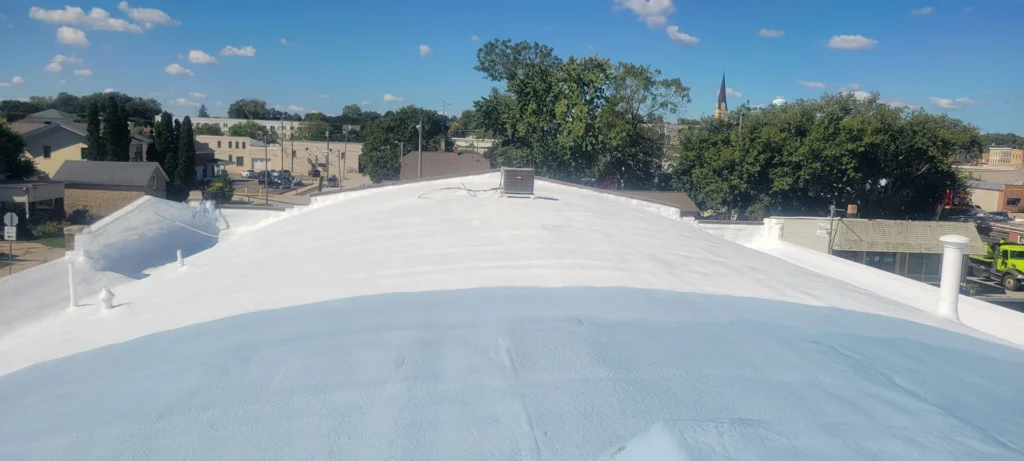
Why the Benefits of Spray Foam Insulation Matter for Commercial Buildings
The benefits of spray foam insulation go far beyond just keeping a building warm — this material is one of the most powerful tools available for cutting energy waste, stopping moisture damage, and strengthening a commercial roof from the inside out.
Here’s a quick summary:
| Benefit | What It Means for You |
|---|---|
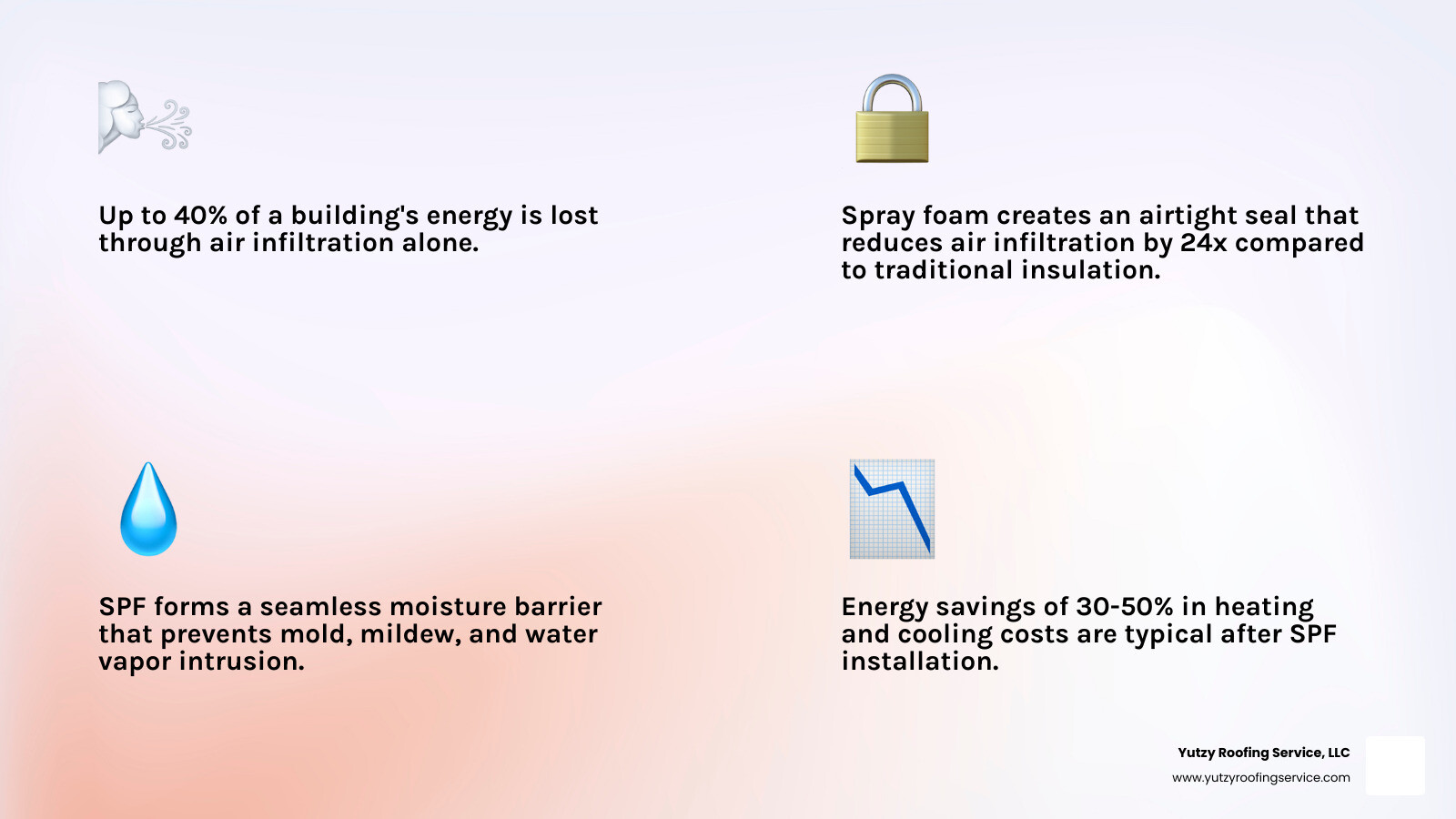
| Energy savings | Up to 30-50% reduction in heating and cooling costs |
| Airtight seal | 24x less air infiltration than traditional insulation |
| Moisture barrier | Stops water vapor, prevents mold and mildew |
| Structural strength | Improves wind uplift and racking resistance |
| Long lifespan | SPF roofs can last 30+ years with proper maintenance |
| R-value stability | Thermal performance does not degrade over time |
| HVAC efficiency | Can reduce HVAC system sizing by up to 35% |
Spray polyurethane foam (SPF) is created by combining two liquid chemicals — isocyanate and polyol resin — that expand on contact to form a rigid, seamless barrier across your entire building envelope. Unlike traditional insulation materials like fiberglass, it doesn’t just slow heat transfer — it also seals air leaks and controls moisture in a single application.
Up to 40% of a building’s energy is lost through air infiltration alone. For a commercial property owner dealing with Wisconsin’s brutal temperature swings, that’s a significant and unnecessary expense year after year.
I’m Josh Yutzy of Yutzy Roofing Service, LLC — our team has been installing spray foam roofing systems across Wisconsin since 1995, and we’ve seen how the benefits of spray foam insulation transform aging commercial roofs into high-performing, energy-efficient assets. In this guide, I’ll walk you through everything you need to know to make a confident decision.
Understanding the Core Benefits of Spray Foam Insulation
At its core, spray foam is different because it does more than one job at once. Traditional insulation usually handles thermal resistance only. SPF can provide insulation, air sealing, and in many assemblies, moisture control in one system.

That matters because heat, air, and moisture rarely cause problems separately. They usually team up like bad coworkers.
When properly installed, spray foam can help:
- Reduce uncontrolled air leakage
- Limit heat transfer through the roof assembly
- Control moisture movement
- Reduce condensation risk
- Improve comfort inside the building
- Support long-term roof performance
This is one reason industry resources such as the Spray Polyurethane Foam Alliance’s overview of SPF benefits emphasize SPF as a whole-building-envelope material, not just another insulation product.
Another major advantage is reduced thermal bridging. Because SPF is spray-applied and conforms tightly to surfaces, joints, and penetrations, it helps create more continuous coverage than many traditional insulation systems. And unlike loose or fibrous products, properly installed spray foam does not settle or sag in the same way over time.
R-value stability is also a key selling point. Fiberglass and similar materials can lose real-world performance when installation is imperfect or when air moves through them. Spray foam is much less vulnerable to that problem because it combines insulation with air sealing.
Maximizing Energy Efficiency: The Primary Benefits of Spray Foam Insulation
For most building owners, energy performance is the headline benefit.
Heating and cooling typically account for 50% to 70% of the energy used in the average American building environment. If air leaks are left unchecked, a lot of that money escapes through the roof, wall transitions, penetrations, and edges.
Spray foam addresses that directly. Research cited in the materials above shows:
- Up to 40% of building energy can be lost due to air infiltration
- Spray foam may reduce heating and cooling costs by up to 15% in typical cases by minimizing leaks
- Some applications report overall energy savings of 30% or greater compared to alternative insulation systems
- Closed-cell spray foam has shown average energy savings up to 50% or more in some scenarios
For commercial roofs, this can be especially important. Roof assemblies take a beating in Wisconsin and Minnesota climates, where cold winters, humid summers, and rapid seasonal swings expose every weak point in the building envelope.
Because SPF forms a continuous layer, it helps stop the convective heat loss that often undermines fiberglass and similar materials. It can also help building owners avoid oversized HVAC equipment. In some projects, HVAC sizing can be reduced by as much as 35% because the building leaks less conditioned air.
If you want a deeper look at that side of the equation, our article Foam Roofing Helps Boost Energy Efficiency explains how SPF contributes to lower operating costs. For a more technical perspective, the research on energy performance and closed-cell foam shows that closed-cell SPF can maintain more of its labeled thermal performance under real-world conditions than fiberglass.
Improving Indoor Air Quality and Comfort
Energy savings get the attention, but comfort is often what occupants notice first.
A building with air leaks tends to have:
- Drafts
- Hot and cold spots
- More dust intrusion
- More outdoor pollutants entering through gaps
- Greater humidity swings
Spray foam helps because it seals cracks and penetrations that let unconditioned air sneak in. That can reduce the entry of dust, pollen, and other airborne irritants. The result is often a more even indoor environment and a building that feels less drafty and less noisy.
The article How Spray Foam Insulation Can Contribute to a Healthier, More Efficient Building Envelope also highlights how SPF contributes to a tighter, healthier envelope when used correctly.
That said, tighter buildings need smarter ventilation. Spray foam is excellent at reducing uncontrolled air movement, but that means mechanical ventilation becomes more important, not less. We always recommend that building owners think of SPF as part of a system that includes proper ventilation and safe operation of combustion appliances. Tight is good. Tight without ventilation planning is not.
Open-Cell vs. Closed-Cell: Choosing the Right Performance
Not all spray foam performs the same way. The two main categories are open-cell and closed-cell.
For commercial roofing and many demanding building-envelope applications, closed-cell is usually the product owners ask about most, because it offers higher R-value, greater rigidity, and stronger moisture resistance.
| Feature | Open-Cell SPF | Closed-Cell SPF |
|---|---|---|
| Approx. R-value per inch | About 3.5 | About 6.0 to 7.0 |
| Density | Lower | Higher |
| Expansion | Expands more | Expands less |
| Moisture resistance | Lower | Higher |
| Vapor control | Limited | Better, especially at greater thickness |
| Structural rigidity | Minimal | Adds strength |
| Sound control | Very good | Good |
| Cost | Usually lower | Usually higher |
Open-cell foam is softer and expands more, which can help it fill irregular spaces and support sound attenuation. Closed-cell foam is denser and more rigid, making it a better fit where higher R-value per inch, stronger water resistance, and added structural performance matter.
In commercial roof applications, closed-cell foam is often preferred because:
- It delivers more thermal resistance in less thickness
- It resists water better
- It adds strength to the assembly
- It can function as an air barrier at relatively thin applications
- It can serve as a vapor retarder at greater thicknesses
If you’re comparing roof-specific options, our page Spray Foam Roofing: What is it and How Can it Benefit You explains why SPF roofing is often chosen for restoration projects.
As for cost-effectiveness, open-cell is commonly less expensive up front, but closed-cell often delivers more value where space is limited or moisture exposure is a concern. In our service areas across Wisconsin and nearby Minnesota markets, that higher-performance profile is often worth serious consideration.
Structural Integrity and Weather Resilience for Commercial Buildings
One of the lesser-known advantages of spray foam is that it can help make a building tougher.
Closed-cell SPF has been shown in industry research to improve racking resistance in framed wall assemblies and increase wind-uplift resistance when applied beneath roof decks or within roof systems. In plain English: it can help the building assembly hold together better under stress.
For commercial owners, that matters during:
- High winds
- Wind-driven rain
- Hail events
- Freeze-thaw cycles
- Severe seasonal temperature swings
Because SPF adheres directly to the substrate and forms a continuous layer, it can also act as a secondary water barrier in many roof systems. That added protection can be valuable when storms test every seam and flashing detail.
Our guide What is Spray Polyurethane Foam Roofing and What are its Benefits covers this in more detail for building owners considering roof restoration.
Another important point: closed-cell SPF is recognized in industry guidance as a flood-damage-resistant material in certain applications. That does not mean every roof becomes flood-proof, of course, but it does speak to the material’s resilience when compared with absorptive insulation products.
Long-Term Durability and the Benefits of Spray Foam Insulation
Durability is where spray foam starts to justify its higher upfront cost.
SPF roofing systems have effective lifespans that can exceed 30 years when properly installed and maintained. That doesn’t mean “install it and forget it forever.” It means that with inspections, recoating schedules, and repairs when needed, the system can perform for decades.
Additional long-term advantages include:
- Strong R-value retention over time
- Resistance to sagging and settling
- Reduced risk of moisture accumulation in the assembly
- Lower likelihood of mold and mildew growth when moisture is controlled
- Fewer entry paths for insects and pests because gaps are sealed
Closed-cell foam also does not provide a food source for mold. That’s important, but worth stating carefully: spray foam helps reduce mold risk primarily by controlling air leakage and moisture, not by magically making water problems disappear. If a roof leak is ignored, no insulation type is going to clap and solve it.
For more on roof system longevity, see our article 13 Reasons to Have a Foam Roof System Installed.
Long-Term ROI: Energy Savings and Maintenance
The upfront cost of spray foam is usually higher than basic insulation options. That’s true, and pretending otherwise would be silly.
But cost and value are not the same thing.
When owners evaluate SPF over the long term, they should look at:
- Reduced energy bills
- Lower air leakage
- Potential HVAC downsizing
- Fewer moisture-related repairs
- Longer roof service life
- Lower tear-off and replacement frequency in restoration projects
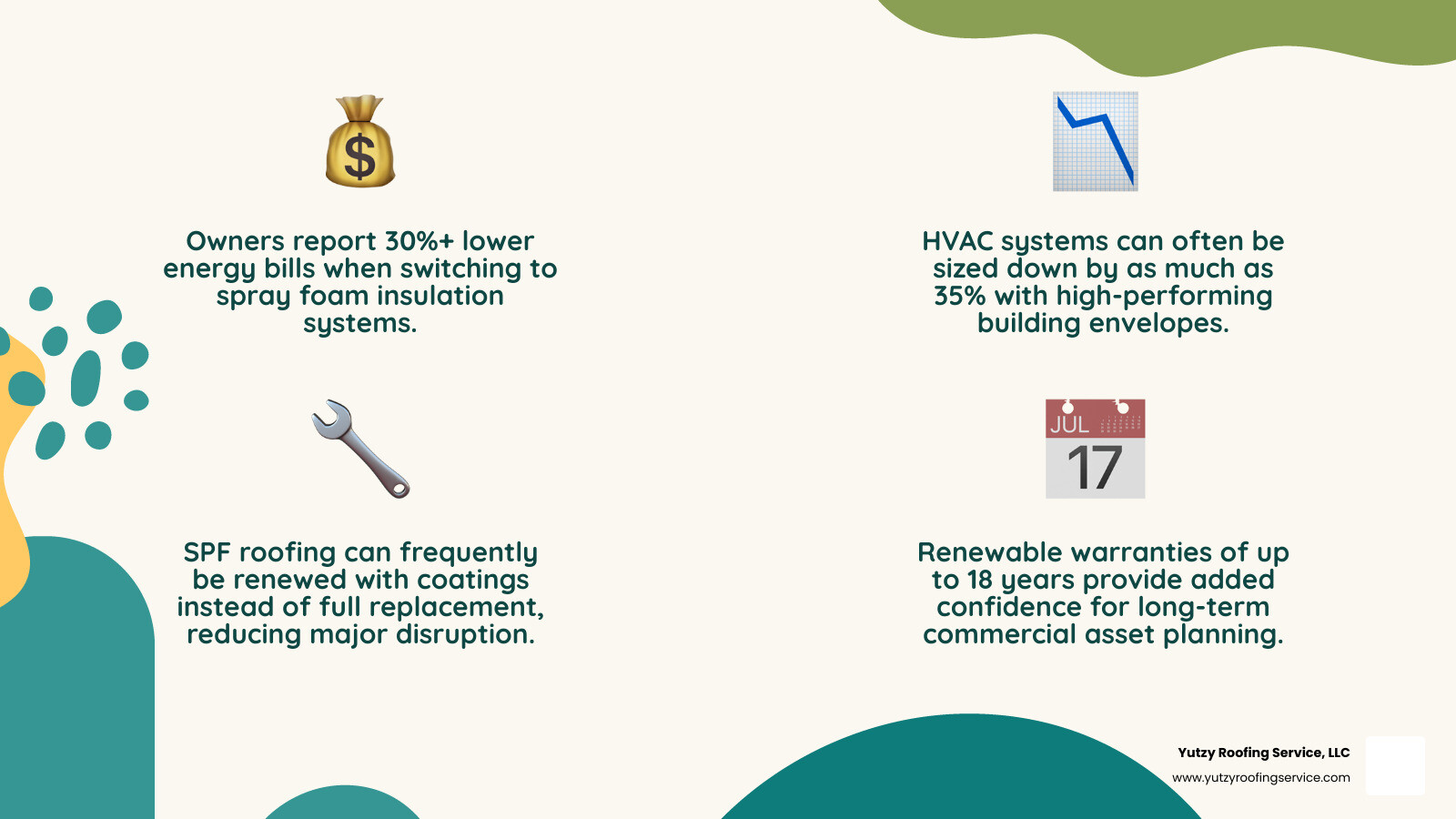
Research in the materials above notes savings of 30% or more in some applications compared with alternative insulation systems. It also notes HVAC systems may be sized down by as much as 35% when the envelope performs better.
For roof-specific budgeting, our page Polyurethane Spray Foam: How Much Does It Cost for Your Roof breaks down the financial side in more detail.
For commercial owners, maintenance is another big ROI factor. SPF roofing can often be renewed with coatings rather than replaced outright, which may help avoid major disruption and defer full replacement costs. At Yutzy Roofing Service, we also offer up to an 18-year non-prorated renewable warranty on qualifying systems, which can add confidence when planning long-term asset management.
Tax incentives and energy-related programs may also help offset costs in some cases, depending on the project and timing. Because these programs change, we always suggest confirming current eligibility in 2026 before counting on them in a budget.
For a broader industry explanation of financial and performance benefits, see Why Choose Spray Foam?.
Frequently Asked Questions about Spray Foam Insulation
Does spray foam insulation lose its R-value over time?
Spray foam is known for stable long-term thermal performance. Open-cell products are commonly around R-3.5 per inch, while closed-cell products are often around R-6.0 to R-7.0 per inch.
More importantly, properly installed SPF tends to keep performing well because it does not sag, compress, or allow air movement through the material the way fibrous insulation can. Research cited above found closed-cell SPF maintained a much higher percentage of labeled R-value in real-world hot and cold conditions than fiberglass.
So while all materials age, spray foam generally holds its effective performance far better than traditional fibrous insulation systems.
Is professional installation necessary for spray foam?
Yes. Absolutely yes.
Spray foam is not a “close enough” product. The installer has to manage:
- Surface preparation
- Temperature conditions
- Mixing ratios
- Spray technique
- Lift thickness
- Cure conditions
- Safety controls
Improper application can cause major problems, including:
- Poor adhesion
- Voids
- Uneven thickness
- Shrinkage or pulling away from substrates
- Incomplete curing
- Odor issues
- Reduced performance
Professional installation also matters for occupant safety during application. SPF chemicals must be handled correctly, and re-entry times must be followed. Once cured and installed according to specifications, spray foam is widely used in building assemblies, but the installation phase is when expertise matters most.
How does spray foam perform in extreme weather?
Very well, especially closed-cell SPF in commercial roof applications.
Research and industry guidance point to several strengths:
- Strong resistance to wind uplift when integrated into roof systems
- Good protection against wind-driven rain
- Added durability during hail and storm events
- Useful moisture resistance in severe weather conditions
- Reliable performance despite major seasonal temperature swings
This is especially relevant in our service areas like Madison, Appleton, Wausau, Marshfield, Eau Claire, Fond du Lac, Green Bay, Mankato, and Rochester, where buildings need to handle snow loads, summer heat, rain, and freeze-thaw cycling without constant drama.
Conclusion
The biggest benefits of spray foam insulation come down to performance that keeps paying you back: better energy efficiency, stronger moisture control, improved durability, more consistent comfort, and a roof system that can stand up to demanding Midwest weather.
For commercial buildings, SPF is more than insulation. It’s a restoration and protection strategy.
At Yutzy Roofing Service, LLC, we help building owners across Wisconsin and nearby Minnesota markets improve aging roof systems with commercial roofing restoration, spray foam coatings, metal roof restoration, EPDM repairs, and maintenance solutions built for long-term value. If you’re exploring options in Madison, Appleton, Wausau, or surrounding service areas, we’re here to help you evaluate whether SPF is the right fit for your building.
To take the next step, contact us for a spray foam roofing consultation.
You can also keep learning with these related resources:
- Spray Foam Roofing is an Excellent Choice
- Spray Foam Roofing: An In-Depth Guide for Building Owners
- Benefits of Spray Polyurethane Foam (SPF) for Your Commercial Roof
- The Pros and Cons of SPF Roofing for Commercial Buildings Explained
- 4 Big Benefits of Spray Polyurethane Foam Roofing for Commercial Buildings
