Why the Right Water Proofing Solution for Roof Systems Can Save Your Business Thousands
Finding the right water proofing solution for roof restoration doesn’t have to be complicated. Here are the most effective options for commercial flat roofs:
| Solution | Best For | Lifespan |
|---|---|---|
| Liquid-applied polyurethane membrane | Complex details, retrofits, irregular surfaces | 10–20+ years |
| EPDM sheet membrane | Large flat roof areas, UV exposure | Up to 30 years |
| TPO membrane | Energy efficiency, heat-welded seams | 15–25 years |
| PVC membrane | Chemical exposure, industrial facilities | 15–25 years |
| Elastomeric/acrylic coating | Budget-friendly maintenance, cool roofs | 10–15 years |
Water damage is one of the most costly problems a commercial property owner can face. In fact, it accounts for roughly 24% of all U.S. property insurance claims, with an average cost of nearly $11,745 per claim. For a Wisconsin business owner dealing with freeze-thaw cycles, heavy snow loads, and hot summers, a failing roof isn’t just an inconvenience — it’s a direct threat to your building and bottom line.
The good news? You don’t always need a full tear-off to stop the leaks. Modern waterproofing systems can restore an aging roof, extend its life by 10–20 years, and cut long-term costs by up to 30% — without shutting down your operations.
I’m Josh Yutzy, and my family’s roofing company has been installing high-performance water proofing solutions for roof systems across Wisconsin since 1995. Over nearly three decades, we’ve seen what works — and what fails — on commercial roofs in some of the most demanding weather conditions in the Midwest. In this guide, I’ll walk you through the top options so you can make a confident, cost-smart decision.
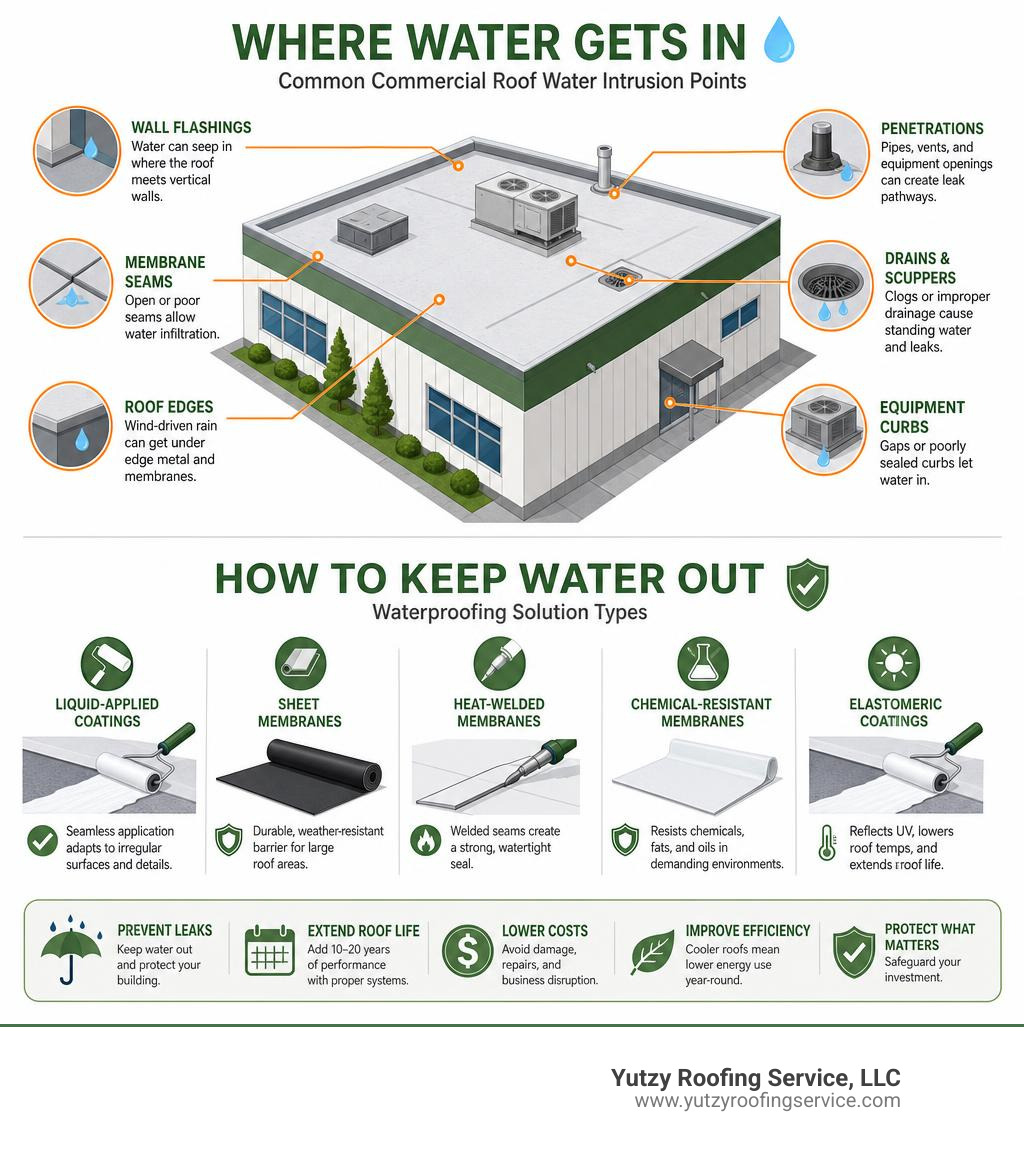
Water proofing solution for roof terms made easy:
Selecting the Best Water Proofing Solution for Roof Restoration
Selecting the right commercial roof waterproofing system requires a thorough evaluation of your building’s current state and long-term needs. A flat roof on an industrial building in Eau Claire, WI faces vastly different stressors than a commercial warehouse in Rochester, MN.
To choose the ideal water proofing solution for roof restoration, we must analyze several critical factors:
1. Substrate Condition and Core Integrity
Before applying any waterproofing system, we must assess the structural deck. Is the roof substrate concrete, plywood, metal, or an existing built-up roof (BUR)? If moisture has already penetrated deep into the insulation, sealing it in will cause wood rot, metal corrosion, or structural decay. We use thermal imaging and core cuts to ensure the deck is dry and structurally sound. If the deck is sound but the surface is worn, a fluid-applied system or a recover membrane can save you tens of thousands of dollars compared to a full tear-off.
2. Flashing Failures and Complex Penetrations
The vast majority of commercial roof leaks do not start in the middle of a flat field. They start at the details: HVAC curbs, pipes, drains, expansion joints, and perimeter flashings. If your roof has a forest of equipment penetrations, traditional sheet membranes require tedious, manual cutting and sealing, which increases the margin for human error. In these cases, a liquid-applied system that flows seamlessly around irregular geometries is often the superior choice.
3. Ponding Water
Flat roofs are rarely perfectly flat; they should have a slight slope to direct water to drains. However, structural settling over the decades can lead to ponding water (water that sits on the roof for more than 48 hours without evaporating). Traditional bituminous roofs and acrylic coatings degrade rapidly under standing water. If your roof is prone to ponding, you need a highly water-resistant material like polyurethane, polyurea, or silicone that will not break down under constant submersion.
4. Local Climate and Thermal Shock
In Wisconsin and Minnesota, roofs experience extreme thermal shock. On a freezing January night in Wausau, WI, temperatures can plummet to -20°F. By July, the midday sun can heat a dark roof surface to 150°F. This rapid expansion and contraction will crack rigid materials. Your waterproofing solution must possess a high elongation rate—often between 300% and 1,300%—allowing it to stretch and recover without tearing.
5. Budget vs. Lifecycle Value
While a simple acrylic coating might have the lowest upfront cost, it may only last 10 years and require more frequent maintenance. Conversely, a high-performance polyurea or reinforced polyurethane system might cost more initially, but it can easily extend your roof’s life by 20 years and reduce your energy bills.
To help visualize how these factors influence your choice, consider this comparison between traditional sheet membranes and modern liquid-applied systems:
| Feature | Single-Ply Sheet Membranes (EPDM, TPO) | Liquid-Applied Systems (Polyurethane, Polyurea) |
|---|---|---|
| Seamlessness | Has seams every 10–12 feet (potential leak points) | 100% seamless, monolithic barrier |
| Application Method | Adhesive, mechanical fasteners, or heat welding | Cold-applied roller, squeegee, or spray |
| Detailing Complexity | High (requires custom flashing boots and tape) | Low (self-leveling liquid conforms to any shape) |
| Elongation & Flexibility | Moderate to high (varies by material) | Very high (up to 1,300% elongation) |
| Ponding Water Resistance | Good (if seams are perfectly welded) | Excellent (no seams to fail under standing water) |
| Tear-Off Required? | Often yes, unless used as a lightweight recover | No, can be applied directly over sound existing roofs |
Top Waterproofing Materials: Pros, Cons, and Performance
Every commercial roof has a unique personality, shaped by its slope, age, structural load limits, and the business operating underneath it. Let’s break down the most popular waterproofing materials available in 2026 to help you find the perfect match.
Single-Ply Sheet Membranes: EPDM, TPO, and PVC
Single-ply membranes are pre-fabricated sheets of synthetic materials rolled out across the roof deck and secured mechanically, with adhesives, or by ballasting.
EPDM (Ethylene Propylene Diene Monomer)
EPDM is a highly durable synthetic rubber membrane. It has been a staple of flat roofing for decades because of its outstanding resistance to ultraviolet (UV) light, ozone, and weathering.
- Pros: Outstanding lifespan (often exceeding 30 years), highly flexible in sub-zero temperatures, and highly resistant to hail damage.
- Cons: Black color absorbs heat (increasing cooling costs in summer), and its taped or glued seams can dry out and fail over time, requiring professional repairs.
- Best For: Large, open commercial flat roofs in colder climates where heating costs outweigh cooling costs.
TPO (Thermoplastic Polyolefin)
TPO is a single-ply reflective membrane made from polypropylene and ethylene-propylene rubber. It is typically white, making it a favorite for energy-conscious building owners.
- Pros: Highly reflective surface reduces cooling energy costs by 10–30%, and its seams are hot-air welded, making them up to three times stronger than taped EPDM seams.
- Cons: Formulations vary widely between manufacturers, and low-quality TPO can become brittle and crack under intense UV exposure.
- Best For: Retail centers, warehouses, and office buildings looking to cut down on summer air conditioning bills.
PVC (Polyvinyl Chloride)
PVC is another thermoplastic membrane known for its exceptional strength and chemical resistance.
- Pros: Impervious to animal fats, oils, and industrial chemicals; highly fire-resistant; and features welded seams for a watertight seal.
- Cons: Higher material cost than TPO and EPDM, and older formulations can lose plasticizers over time, becoming brittle.
- Best For: Restaurants, manufacturing facilities, food processing plants, and roofs with heavy chemical exhaust.
For a deeper dive into specifying these systems, consult the Single-Ply Membrane Roofing Systems Guide.
Liquid-Applied Membranes: A Seamless Water Proofing Solution for Roof Systems
If seams are the enemy of a dry building, then liquid-applied membranes are the ultimate peace treaty. These systems are applied as a cold liquid that cures to form a continuous, rubbery, 100% seamless barrier.

Liquid-applied systems are particularly for roof restoration because they eliminate the labor-intensive tear-off process. By applying a high-performance coating over your existing, structurally sound roof, you can avoid sending tons of waste to Wisconsin landfills while securing a watertight seal around every single penetration.
Among these, polyurethane and polyurea technologies stand out:
Polyurethane Systems
Polyurethane membranes, such as the SikaRoof® Liquid Membrane | One-component PU Waterproofing System, offer a highly flexible, moisture-triggered curing process. They cure to form a thick, elastic membrane with exceptional tensile and tear strength.
- Pros: Excellent crack-bridging capabilities, highly resistant to traffic and UV rays, and vapor-permeable (allowing the substrate to “breathe” out trapped moisture without blistering).
- Cons: Must be applied within specific temperature and humidity ranges to cure properly.
- Best For: Roof refurbishments with complex detail areas, balconies, plaza decks, and roofs with high foot traffic.
To understand how these systems can save your existing roof, read more about The Waterproof Truth About Commercial Flat Roof Coating.
Why Elastomeric Coatings Are a Cost-Effective Water Proofing Solution for Roof Maintenance
Elastomeric coatings are thin, liquid-applied protective layers designed to extend the life of an existing, functional roof membrane. Unlike thick waterproofing membranes, coatings are typically applied at a lower dry film thickness to protect against UV degradation, minor leaks, and thermal movement.
Acrylic Coatings
Acrylic coatings are water-based, easy to apply, and highly economical.
- Pros: Low VOCs, cost-effective, and highly reflective in white formulations.
- Cons: Not suitable for ponding water (they will re-emulsify and wash away under standing water) and cannot be applied in freezing temperatures.
- Best For: Well-sloped metal roofs or modified bitumen roofs looking for UV protection and energy savings.
Silicone Coatings
Silicone coatings are solvent-based and highly water-resistant.
- Pros: Completely impervious to ponding water, highly UV-stable, and do not degrade under standing water.
- Cons: Attract dirt easily (which reduces reflectivity over time), and are highly slippery when wet, making future roof maintenance a bit treacherous.
- Best For: Flat roofs with minor drainage issues and ponding water areas.
Premium Polyurethane Hybrids
For the ultimate balance of economy and performance, premium hybrid systems like Sikalastic® -560 | Premium Polyurethane Waterproofing System utilize advanced co-elastic technology. This water-based polyurethane-acrylic hybrid provides exceptional elasticity, UV stability, and improved resistance to standing water compared to standard acrylics.
By reflecting up to 85% of solar radiation, these cool roof coatings can reduce roof surface temperatures by up to 50°F, translating to a 10–30% reduction in cooling energy costs for your facility. For local insights on choosing the right heat-reflective system, refer to The Ultimate Guide to Choosing the Best Heat Proof Paint for Roof Cooling.
Surface Preparation and Substrate Restoration Best Practices
Ask any seasoned commercial roofer, and they will tell you the same thing: A waterproofing system is only as good as the surface preparation beneath it. You could buy the most expensive, high-tech polyurea membrane on the market, but if you apply it over dirt, grease, or moisture, it will peel off like a sunburn within a year.
At Yutzy Roofing Service, we dedicate up to 70% of our project timeline to preparing the substrate before a single drop of waterproofing is applied. Here is our step-by-step best practice protocol:
Step 1: Deep Cleaning
The entire roof surface must be thoroughly cleaned of dirt, moss, algae, loose gravel, and grease. We use high-pressure power washing (often between 2,000 and 4,000 PSI) combined with specialized biodegradable cleaners to ensure a pristine surface.
Step 2: Moisture Assessment and Core Testing
Applying a waterproof barrier over trapped moisture is a recipe for disaster. When the sun heats the roof, trapped water turns to vapor, expands, and creates massive blisters that rupture the new membrane. We perform thermal imaging scans and use electronic moisture meters to verify that the substrate moisture content is below 4%. Any wet insulation board we find is cut out and replaced with dry, matching material.
Step 3: Repairing Structural Defects and Seams
Before coating, we address any structural issues. On metal roofs, this means replacing rusted fasteners, treating rust with inhibitors, and sealing seams. For single-ply roofs, we repair punctures and reinforce any failing seams. We often use specialized high-build sealants like Sikalastic®-614 | Liquid-Applied Membrane to detail flashing connections and penetrations. For a comprehensive look at sealing metal substrates, check out our Metal Roof Sealant Complete Guide.
Step 4: Priming
Depending on the substrate (concrete, rusted metal, weathered EPDM, or asphalt), a specialized primer is applied. The primer acts as a chemical bridge, ensuring maximum adhesion between the roof deck and the new waterproofing membrane.
Step 5: Reinforcement Detailing
For high-stress areas, expansion joints, and cracks wider than 1/4 inch, we embed a heavy-duty polyester reinforcement fleece into a wet base coat of the liquid membrane. This “wet-on-wet” application ensures the membrane can handle localized structural movement without tearing.
Frequently Asked Questions About Roof Waterproofing
How long does a liquid-applied waterproofing membrane last?
A professionally installed, high-quality liquid-applied waterproofing membrane typically lasts between 10 and 20 years. The actual lifespan depends heavily on the dry film thickness applied, the quality of the material, and the severity of local weather conditions.
The best part about liquid-applied membranes is that they are renewable. When the system reaches the end of its design life, you do not need to tear it off. Instead, we can clean the surface and apply a thin “recoat” or top coat, which bonds perfectly to the existing layer, instantly extending the warranty and lifespan for another 10 to 15 years.
Can you apply waterproofing coatings over an existing roof without a tear-off?
Yes, absolutely. This process is known as a “roof recover” or “roof restoration,” and it is one of our specialties. As long as the existing roof deck is structurally sound and the insulation is dry, we can apply a liquid membrane or a new single-ply recover system directly over the old roof.
This approach offers massive benefits:
- Cost Savings: You avoid the expensive labor costs associated with tearing off and disposing of the old roof.
- Zero Operational Downtime: Your business can remain open and fully operational during installation since there is no open roof exposed to the elements.
- Environmental Friendliness: It keeps tons of non-biodegradable roofing waste out of local landfills in Marshfield, Green Bay, and Madison.
What maintenance is required to keep a waterproofed roof in top condition?
While modern waterproofing membranes are highly durable, they are not completely “set-it-and-forget-it.” Regular maintenance is the single most effective way to protect your investment. In fact, proactive maintenance can reduce the likelihood of major water intrusion by up to 75%.
Our recommended maintenance routine includes:
- Bi-Annual Inspections: Inspect your roof at least twice a year—once in the spring after the snow melts, and once in the fall before the winter freeze.
- Keep Gutters and Drains Clear: Clogged drains lead to ponding water, which puts unnecessary stress on your roof’s flashing. Clear out leaves, twigs, and debris regularly.
- Trim Overhanging Branches: Wind-blown branches can scrape against the membrane, puncturing the waterproof seal. Keep trees trimmed back at least 10 feet from your roofline.
- Inspect Seals and Flashings: Check around HVAC units, pipes, and perimeter edges to ensure the sealant remains intact and flexible.
Conclusion

At Yutzy Roofing Service, LLC, we believe that you shouldn’t have to cross your fingers and hope for the best every time a storm rolls through Wisconsin or Minnesota. Protecting your commercial building is about choosing a water proofing solution for roof restoration that is engineered to handle the brutal Midwest climate.
Whether your building in Madison, Appleton, Wausau, or Mankato needs an EPDM repair, a high-durability polyurea liquid membrane, or a complete commercial roof restoration, our team has the hands-on expertise to deliver a seamless, leak-free shield. We stand behind our work with an industry-leading, up to 18-year non-prorated renewable warranty, giving you ultimate peace of mind.
Ready to stop the leaks and start saving on your energy bills? Contact us today at our Marshfield, WI headquarters (9106 Woehrle Lane, Marshfield, WI 54449) or any of our service locations across Wisconsin and Minnesota to schedule a professional roof inspection.
To learn more about your options before you call, read our detailed breakdown on The Different Types of Roof Waterproofing Methods Explained. Let’s build a dry, secure future for your business together!
