Is an Acrylic Roof Coating Right for Your Commercial Building?
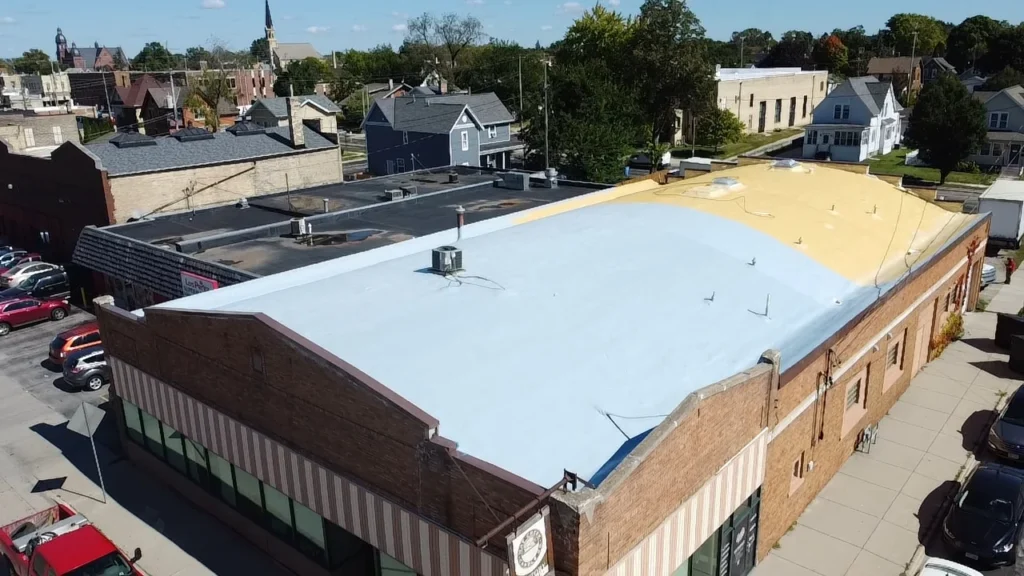
Acrylic roof coating is a water-based, elastomeric coating applied directly over existing commercial roofing membranes to restore, protect, and reflect solar heat — without tearing off your current roof.
Here’s a quick summary to help you decide if it’s the right fit:
| Feature | Acrylic Roof Coating |
|---|---|
| Best for | Sloped and low-slope commercial roofs with good drainage |
| Reflects | Up to 85–89% of solar heat |
| Cost | Most affordable coating option on the market |
| Application temp | 50°F or above |
| Avoid if | Roof has chronic ponding water |
| Warranty | Up to 20 years depending on thickness |
| VOCs | Low — water-based and environmentally friendly |
If your commercial roof in Wisconsin is leaking, fading, or losing its protective membrane, a full tear-off isn’t always the answer. Acrylic coatings let you restore what’s already there — at a fraction of the replacement cost — while adding a reflective layer that cuts your cooling bills.
Wisconsin’s climate is brutal. Summers bake flat roofs. Winters push membranes to their limits. The right coating system can extend your roof’s life by a decade or more, and acrylic is often the most cost-effective starting point for building owners looking to protect their assets without breaking the budget.
I’m Josh Yutzy, and our family has been restoring and protecting commercial roofs across Wisconsin since 1995 — acrylic roof coating systems are one of the most common solutions we recommend for aging but structurally sound roofs. Let me walk you through everything you need to know to make a confident, informed decision.
Essential acrylic roof coating terms:
What is an Acrylic Roof Coating and How Does It Work?
To understand why an acrylic roof coating is such a game-changer for commercial buildings, we have to look past the bucket. While it might look like thick latex house paint when we first open it, the underlying chemistry is entirely different.
Acrylic roof coatings are formulated with highly advanced, 100% water-based acrylic polymers. They are designed specifically to handle the extreme environments found on top of commercial facilities. When applied, these polymers cure to form a fully adhered, seamless, and rubber-like membrane. This is what we call “elastomeric” properties.
Because it is elastomeric, the coating can stretch and contract alongside your roof. In places like Wausau or Green Bay, a commercial roof experiences dramatic temperature swings. In the dead of winter, the roof contracts; in the heat of a July afternoon, it expands. A standard paint would crack and flake under this stress, but an elastomeric acrylic coating stretches and snaps back into place without losing its bond.

Furthermore, these coatings offer exceptional ultraviolet (UV) resistance. The sun’s UV rays are the primary cause of roof degradation, slowly breaking down single-ply membranes and asphalt-based roofs until they become brittle and crack. Acrylic coatings act as a sacrificial shield, absorbing those rays and reflecting them away from the building.
To learn more about how these coatings shield your facility, check out our guide on the 7 Surprising Advantages of Roof Coatings and Sealants.
Key Advantages of an Acrylic Roof Coating
If you are looking to balance high performance with a smart budget, acrylic is tough to beat. It has earned the largest share of the reflective coatings market for several very good reasons:
- Incredible Cost-Effectiveness: Acrylic is widely recognized as the most cost-effective roof coating on the market. The material costs are highly competitive, and because it is water-based, it is exceptionally easy and fast to install. This translates to lower labor costs and a faster return on your investment.
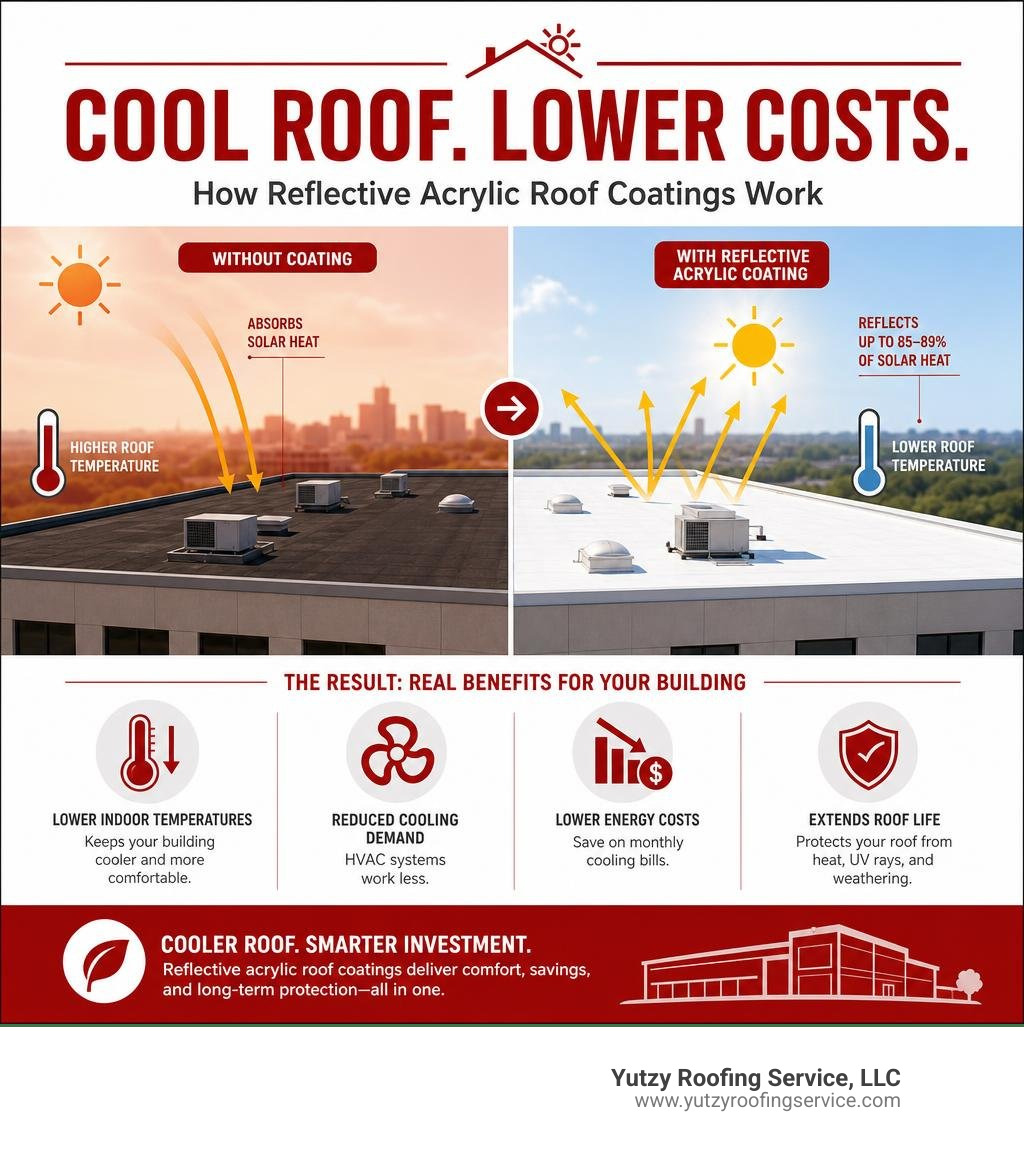
- Superior Solar Reflectance: High-quality white acrylic coatings reflect around 85% to 89% of the heat from sunlight. Instead of absorbing that thermal energy and radiating it down into your warehouse, retail space, or office, the roof bounces the heat back into the atmosphere.
- Environmentally Friendly (Low VOCs): Because they are water-based, acrylic coatings release very low levels of Volatile Organic Compounds (VOCs). They lack the harsh, solvent-based odors of older tar coatings, making them safe for our crew to apply and completely safe for the environment throughout their lifespan. Cleanup requires nothing more than simple soap and water.
- Tensile Strength at Low Temperatures: Premium acrylic formulas are engineered to adapt to cold weather. For example, systems like the Met-A-Gard system utilize core acrylic components where elongation and tensile strength actually increase significantly at lower temperatures, ensuring the coating doesn’t become brittle when a Wisconsin blizzard hits.
For a deeper dive into how this compares to other options, explore our Detailed Guide to Roof Coating Options.
Limitations and Environmental Factors
While we love acrylic, we also believe in giving our clients in Madison, Appleton, and Eau Claire the complete, honest truth. No single roofing material is perfect for every single scenario. Here are the limitations you must keep in mind:
- Ponding Water Vulnerability: Acrylic coatings are water-soluble during their liquid phase and remain somewhat sensitive to prolonged water immersion even after they cure. If your flat roof has low spots that collect standing “ponding” water for more than 48 hours after a rainstorm, an acrylic coating can soften, swell, and eventually blister or peel.
- Cold Temperature Application Limits: Because they are water-based, you cannot apply acrylic coatings when freezing temperatures are on the horizon. We only apply these systems when the ambient air and substrate temperatures are at least 50°F and rising, with no rain forecast for at least 24 to 48 hours.
- Gradual Weathering and Loss of Mil Thickness: Over years of exposure to wind, rain, snow, and UV radiation, acrylic coatings will slowly shed a tiny fraction of their thickness (known as mil thickness loss). This is normal weathering, but it means that after 10 to 15 years, a thin re-coat will be required to maintain the warranty and protection.
Comparing Acrylic to Silicone and Polyurethane Coatings
When choosing a commercial restoration system, you will generally find three primary chemistries: acrylic, silicone, and polyurethane. Understanding how they differ in chemistry, cost, and real-world performance is key to spending your maintenance budget wisely.
To help visualize how they stack up, we have put together a comparison table:
| Feature | Acrylic Coatings | Silicone Coatings | Polyurethane Coatings |
|---|---|---|---|
| Primary Base | Water-based polymer | Moisture-cure liquid silicone | Solvent-based isocyanate |
| Initial Material Cost | Lowest | Moderate to High | High |
| Ponding Water Resistance | Poor (requires good drainage) | Excellent (the gold standard) | Moderate to Good |
| UV Resistance | Excellent | Outstanding | Variable (requires aliphatic topcoat) |
| Abrasion Resistance | Moderate | Poor (tears easily, attracts dirt) | Excellent (great for foot traffic) |
| Ease of Re-coating | Excellent (bonds easily to itself) | Poor (nothing sticks to silicone) | Moderate |
For a deeper look into the waterproofing capabilities of these different chemistries, read The Waterproof Truth About Commercial Flat Roof Coating.
Silicone vs. Acrylic
Silicone is often praised as the “ponding water champion” because it is a highly hydrophobic material that does not break down or swell under standing water. However, that high-performance waterproofing comes with a premium price tag.
Additionally, silicone has a few unique drawbacks. It naturally attracts dirt and airborne particles, which means a white silicone roof can quickly turn gray and lose some of its reflective properties unless it is regularly washed.
Silicone is also notoriously difficult to re-coat. Because almost nothing sticks to cured silicone (including new silicone, in some cases, without special primers), future repairs or re-coating can be a labor-intensive headache. Acrylic, by comparison, is incredibly easy to clean, maintains its bright white reflectivity longer, and can be easily re-coated down the road with minimal surface preparation.
Polyurethane vs. Acrylic
Polyurethane coatings are solvent-based and are incredibly tough. They offer the highest impact and abrasion resistance of the three, making them the preferred choice for commercial roofs that support heavy mechanical equipment, HVAC units, or frequent foot traffic.
However, polyurethane is a complex system to install. It often requires a multi-coat application consisting of an aromatic basecoat (which is highly durable but sensitive to UV light) and an aliphatic topcoat (which provides the necessary UV protection).
Polyurethanes are also highly sensitive to moisture during the application process and carry strong solvent odors. Acrylic is much more user-friendly, carries virtually no odor, and provides comparable UV protection at a fraction of the cost—making it the superior choice for roofs that do not experience heavy, regular foot traffic.
Best Commercial Substrates and Climate Considerations
An acrylic roof coating is highly versatile, but it performs best on specific substrates and sloped designs that promote positive drainage.

- Sloped Metal Roofs: This is where acrylic truly shines. Metal roofs naturally shed water, eliminating the risk of ponding water. The elastomeric properties of acrylic are perfect for sealing the seams and fasteners of metal roofs, which expand and contract wildly during Wisconsin summers.
- Single-Ply Membranes (TPO, PVC, EPDM): Aged single-ply membranes that have begun to chalk or weather can be beautifully restored with an acrylic system. Often, a primer is applied first to ensure a powerful chemical bond to the old membrane.
- Modified Bitumen & Built-Up Roofs (BUR): Smooth or granulated asphalt roofs can be coated to block UV rays, preventing the asphalt from baking, cracking, and leaking.
- Spray Polyurethane Foam (SPF): Acrylic is a classic protective topcoat for SPF roofs, shielding the foam from UV degradation.
Understanding how your substrate behaves in our local climate is essential. If you are planning a restoration project, we recommend checking out The Ultimate Guide to Flat Roof Coating Experts and Maintenance Plans to see how proper planning preserves your investment.
As a local commercial roofing contractor serving Wisconsin communities from Eau Claire and Marshfield to Madison and Milwaukee, we understand how regional weather patterns affect these systems. Working with a local expert ensures your facility leverages these systems for maximum longevity and performance.
How to Apply an Acrylic Roof Coating System
Applying an acrylic coating is a highly detailed, multi-step process. We don’t just open a bucket and start rolling; a successful application requires meticulous preparation.
- Moisture Scan and Repair: We first perform a thorough moisture scan to identify any wet insulation under the membrane. Any saturated areas must be cut out and replaced before coating.
- Thorough Surface Preparation: We pressure wash the entire roof surface (typically at 2000 to 2500 PSI) using biodegradable cleaners to remove all dirt, grease, mold, and loose debris. The roof must be 100% clean and dry.
- Detailing Seams and Penetrations: We apply a heavy-duty acrylic flashing mastic or reinforcing fabric tape to all seams, fasteners, penetrations, and flashing details. This reinforces the most vulnerable leak areas.
- Applying the Coating: Using a heavy-duty, single-component airless sprayer, we apply the coating. High-build formulas like GacoFlex A48 can be applied up to 80 wet mils (about 5 gallons per square) in a single pass on vertical surfaces without sagging.
- Curing: Standard acrylic coatings dry to the touch in about 90 minutes under warm conditions, with a complete cure in 8 to 24 hours depending on the humidity and temperature.
For those interested in high-performance product options that we often use in our restorations, read about The Best Conklin Coatings to Save Your Roof.
Substrate Compatibility and Performance Standards
To ensure your building receives a commercial-grade application, we only use products that meet strict industry standards.
- ASTM D6083: This is the standard specification for liquid-applied acrylic coatings used in roofing. It guarantees the product has the tensile strength, elongation, and weatherability required for commercial use.
- CRRC (Cool Roof Rating Council): This third-party organization verifies the initial and aged solar reflectance and thermal emittance of the coating, proving its energy-saving claims. Building owners can review rated cool-roof products through the Cool Roof Rating Council.
- California Title 24: This strict energy code sets standards for cool roof reflectivity, which many high-solids acrylic coatings easily exceed.
- Adhesion Testing: Before we coat any roof, we perform an on-site adhesion test (ASTM D903) to ensure the coating will bond permanently to your specific substrate.
Frequently Asked Questions About Roof Restoration
Restoring a commercial roof is a major decision. Here are the answers to the most common questions we hear from building owners in Wisconsin and Minnesota.
To explore more technical discussions, browse our Tag: Elastomeric Coatings archive.
Can acrylic coatings handle ponding water?
Generally, no. Acrylic coatings are water-based, meaning they can soften and re-emulsify if they are submerged under water for extended periods. If your roof has areas where water stands for more than 48 hours, those areas must be addressed first. We can install tapered insulation to improve drainage, or we may recommend a silicone coating for those specific low-lying sections.
What is the typical lifespan and warranty of an acrylic system?
A professionally applied acrylic roof coating system typically lasts between 10 and 20 years, depending on the thickness of the application (the dry mil thickness).
- A 10-year system typically requires a dry film thickness of around 22 to 26 mils.
- A 20-year system requires a heavier application, resulting in a dry film thickness of 35 to 40 mils.
At Yutzy Roofing Service, we offer up to an 18-year non-prorated renewable warranty on our commercial restorations. When the warranty period is nearing its end, the roof can simply be cleaned and coated with a thin topcoat to extend the warranty for another decade.
How much can a building owner save on energy bills?
By reflecting up to 85% to 89% of solar heat, a white acrylic roof coating can reduce your building’s cooling costs by up to 30% to 40%. On average, building owners save up to $0.50 per square foot on their energy bills after installing a white reflective coating. This also reduces the “heat island effect” in urban areas like Madison and Green Bay, keeping the local environment cooler.
Conclusion
When it comes to protecting your commercial property, an acrylic roof coating offers an unbeatable combination of affordability, high reflectivity, and ease of maintenance. It allows you to completely bypass the messy, expensive, and wasteful process of a full roof tear-off, while giving your building a highly reflective, seamless shield that lowers your energy bills.
At Yutzy Roofing Service, LLC, we specialize in high-quality commercial roof restorations across Wisconsin and Minnesota—including Madison, Appleton, Wausau, Eau Claire, and Rochester. We are proud to back our work with an industry-leading, up to 18-year non-prorated renewable warranty, giving you complete peace of mind for decades to come.
Ready to see if an acrylic coating is the right choice for your facility? Contact us today to schedule a professional roof inspection and personalized consultation.
Discover more about how we protect local properties by reading about The Benefits of Commercial Roof Coatings in Madison WI.
