
Why Commercial Flat Roof Coating Is the Smartest Investment for Your Building
Commercial flat roof coating is a liquid-applied protective layer that seals, waterproofs, and restores an existing flat roof — without tearing it off.
Here’s a quick look at the most common coating types and what they do best:
| Coating Type | Best For | Key Strength |
|---|---|---|
| Silicone | Ponding water, UV exposure | 95%+ solids, moisture-cure |
| Acrylic Elastomeric | UV reflection, energy savings | High solar reflectivity, low VOC |
| Copolymer Rubber | Flexibility, leak-stopping | 500% elongation, 0.025 perms |
| Urethane-Silicone | High-traffic roofs, adhesion | Combines strength + UV stability |
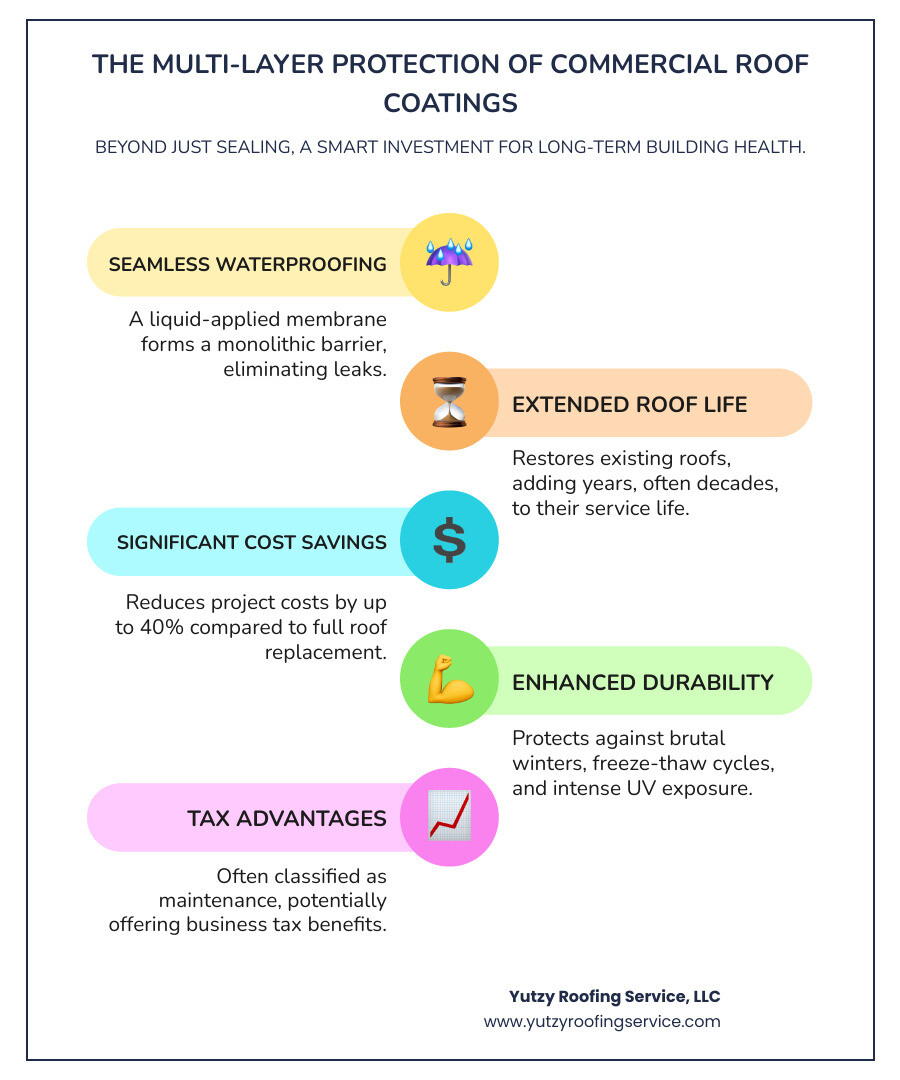
The core benefit is simple: restore instead of replace. Roof coatings can cut project costs by up to 40% compared to a full tear-off — and because they’re classified as maintenance, they may offer real tax advantages for your business.
For commercial property owners in Wisconsin, the stakes are even higher. Brutal winters, freeze-thaw cycles, and intense summer UV both stress flat roofs year-round. A failing roof doesn’t just leak — it threatens inventory, equipment, and the people inside your building.
The good news? A properly applied coating creates a seamless, monolithic barrier that can add years — sometimes decades — of life to an aging roof.
I’m Josh Yutzy, and since 1995 my family’s company has been restoring and protecting commercial flat roofs across Wisconsin using professional-grade commercial flat roof coating systems. In this guide, I’ll walk you through everything you need to know to make a confident, cost-smart decision for your building.
Understanding Commercial Flat Roof Coating Systems
When we talk about a commercial flat roof coating, we aren’t just talking about a thick coat of paint. These are highly engineered liquid membranes designed to bond to your existing roof substrate. Think of it like a custom-fitted, waterproof “hug” for your building.
Selecting the right chemistry is the most important step in the process. A product that works wonders on a metal roof in Wausau might not be the best choice for a concrete deck in Madison that struggles with drainage. To ensure long-term success, you must choose the right type of roof membrane for your commercial building based on its specific architectural needs.

High-Solids Silicone for Ponding Water
In waterproofing, silicone is often the heavyweight champion. Premium silicone coatings, such as high-solids formulations, often contain over 95% solids. This means that when the liquid is applied, almost all of it stays on the roof as a thick, protective membrane rather than evaporating away.
The standout feature of silicone is its inorganic chemistry. Unlike water-based coatings, silicone is naturally hydrophobic—it repels water. This makes it the premier choice for roofs that suffer from “ponding water” (water that sits for 48 hours or more). While other coatings might soften or bubble when submerged, silicone remains stable.
Many of these systems, including the GAF Surface Seal SB Roof Coating, cure into a seamless rubber membrane that can handle the expansion and contraction common in Wisconsin’s fluctuating climate.
Choosing the Best Commercial Flat Roof Coating for UV Exposure
If your main goal is to lower your energy bills and protect your roof from the sun’s punishing rays, an acrylic elastomeric coating might be your best bet. These water-based systems are famous for their high solar reflectivity and thermal emittance.
By reflecting up to 85% or more of the sun’s UV spectrum, these “cool roof” coatings keep the roof surface significantly cooler. This reduces the thermal load on your building, meaning your HVAC system doesn’t have to work nearly as hard during a humid Green Bay July. When looking for the best performance, we always look for products that meet ASTM D6083 standards, ensuring they have the strength and flexibility required for professional use. You can explore more about energy efficient roof options to see how these rankings impact your bottom line.
Copolymer Rubber and SPF Solutions
For roofs that require extreme durability and “stretch,” copolymer rubber coatings offer incredible performance. Some of these industrial-grade coatings boast 500% elongation with nearly 100% memory retention. This means the coating can stretch five times its original size and snap back to its original shape without cracking.
These coatings also feature exceptionally low vapor transmission ratings (often as low as 0.025 perms). This prevents moisture from migrating through the membrane and into your building’s structure.
In many cases, we combine these coatings with Spray Polyurethane Foam (SPF). This creates a powerful duo: the foam provides a high R-value for insulation, while the coating provides the UV protection and waterproofing. There are big benefits to spray polyurethane foam roofing for those looking to add structural integrity and massive energy savings to their facility.
Key Benefits of Restoring Your Commercial Roof
Restoring a roof is almost always a better move than a total replacement, provided the underlying structure is still sound. A commercial flat roof coating creates a seamless barrier that eliminates the most common point of failure: the seams.
| Feature | Silicone | Acrylic | Copolymer Rubber |
|---|---|---|---|
| UV Resistance | Excellent | Superior | Very Good |
| Ponding Water | Best | Fair | Good |
| Elongation | ~250% | ~300% | ~500% |
| Permeability | Low | High | Extremely Low |
Beyond just stopping leaks, these systems offer top benefits for commercial roofs in areas like Madison, WI, including significant life extension of the existing substrate.
Cost-Effective Commercial Flat Roof Coating vs. Replacement
Let’s talk numbers. A full roof tear-off is expensive, messy, and disruptive to your business operations. By choosing a restoration coating, you can often save up to 40% on total project costs.
There’s also a hidden financial perk: the IRS often classifies roof coatings as “maintenance” rather than a capital improvement. This means you may be able to write off the entire cost of the project in the year it’s completed, rather than depreciating it over 39 years. Saving money through roof restoration is a strategy that smart facility managers use to stay under budget while keeping their assets protected.
Energy Efficiency and Cool Roof Certification
Many of the coatings we use are CRRC (Cool Roof Rating Council) rated. A bright-white reflective roof can lower roof surface temperatures by as much as 50 to 60 degrees during the summer.
This isn’t just about comfort; it’s about compliance and cash. Many states have adopted standards like California’s Title 24, and while Wisconsin has its own codes, the energy-saving principles remain the same. High Solar Reflective Index (SRI) values mean less heat is absorbed into the building, which directly translates to lower utility bills. There are at least 7 surprising advantages to using roof coatings that go beyond simple leak prevention.
Compatibility and Preparation for a Successful Application
You can have the most expensive coating in the world, but if the roof isn’t prepared correctly, it will fail. Adhesion is everything.
Before we ever open a bucket of coating, we perform a thorough inspection. This includes checking for trapped moisture and performing adhesion tests to ensure the new coating will bond permanently to the old surface. Following a maintenance plan and expert guide is the only way to ensure the roof is actually a candidate for restoration.
Surface Compatibility: From EPDM to Metal
One of the best things about modern commercial flat roof coating technology is its versatility. We can successfully coat a wide variety of surfaces:
- EPDM (Rubber): Requires specific primers but responds exceptionally well to restoration. EPDM restoration is a core service for many of our clients.
- Metal: Coatings stop rust in its tracks and seal the thousands of fasteners that typically leak.
- Modified Bitumen & BUR: Coatings fill in the cracks of aged asphalt and protect the granulated surface from further UV degradation.
- Concrete: Provides a seamless waterproof skin that prevents “spalling” and water intrusion.
Critical Preparation Steps and Mastic Repair
Preparation starts with a deep clean. We typically power wash the surface at 600–1,000 PSI to remove dirt, mold, and loose debris. Once the roof is clean and dry, we address the “trouble spots.”
We use heavy-duty roof mastic to reinforce all seams, flashings, and penetrations (like HVAC units and vents). This “detail work” is what actually stops the leaks. Think of it as the foundation of the project. If you’ve ever wondered how flat roof leak repair works, it’s this combination of localized repair and total surface coating that does the trick.
Performance Metrics: Durability in Extreme Weather
In Wisconsin and Minnesota, a roof coating has to be tough. Between the heavy snow loads in Eau Claire and the wind in Fond du Lac, the “tensile strength” of a coating matters. Some of our premium coatings offer a tensile strength of up to 1,620 PSI.
This strength, combined with low-temperature flexibility, ensures that the coating won’t become brittle and crack when the thermometer hits -20°F. We take pride in extending the life of Wisconsin roofs by using materials specifically tested for these harsh environments.
Managing Ponding Water and Moisture Transmission
Ponding water is the “silent killer” of flat roofs. When water sits on a roof, it puts immense hydrostatic pressure on the seams. If your coating has a high permeability rating, that moisture will eventually seep through.
By using coatings with low vapor transmission (measured in “perms”), we create a barrier that keeps water out at a molecular level. This is critical because pooling water can have harmful effects on the structural deck if left unaddressed.
Frequently Asked Questions about Commercial Flat Roof Coating
How much does commercial flat roof coating cost per square foot?
While prices vary based on the type of coating and the amount of prep work needed, most professional commercial flat roof coating projects cost between $2.00 and $5.00 per square foot. This is significantly less than the $8.00 to $15.00+ per square foot you might pay for a full tear-off and replacement.
Can you apply a roof coating over an existing leaking roof?
Yes, but with a major catch: the roof must be structurally sound and dry. We cannot coat over wet insulation or rotted decking. We first find and repair the leaks using mastic and fabric reinforcement, then apply the coating to prevent future leaks. If the roof is too far gone, we will always tell you honestly that a replacement is necessary.
How long does a professional roof coating last in Wisconsin?
A high-quality coating system typically lasts 10 to 20 years. The best part? These systems are “renewable.” When the coating finally begins to wear down after two decades, you can simply clean the surface and apply a thin “re-coat” to add another 10–20 years of life. This can be done indefinitely, effectively making it a “lifetime” roof.
Conclusion
Choosing a commercial flat roof coating is one of the most responsible things you can do for your building and your budget. It stops leaks, slashes energy costs, and keeps thousands of pounds of old roofing material out of our local Wisconsin landfills.
At Yutzy Roofing Service, LLC, we don’t just “paint” roofs. We engineer long-term restoration solutions. We are so confident in our systems that we offer up to an 18-year non-prorated renewable warranty. Whether you are in Marshfield, Appleton, Madison, or Wausau, our team is ready to help you protect your investment.
Don’t wait for the next heavy rain to find out your roof is failing. Contact Yutzy Roofing Service today for a professional inspection and see if your building is a candidate for a liquid-applied restoration.
