Why Commercial Roof Warranty in Wisconsin Is More Complex Than Most Owners Realize
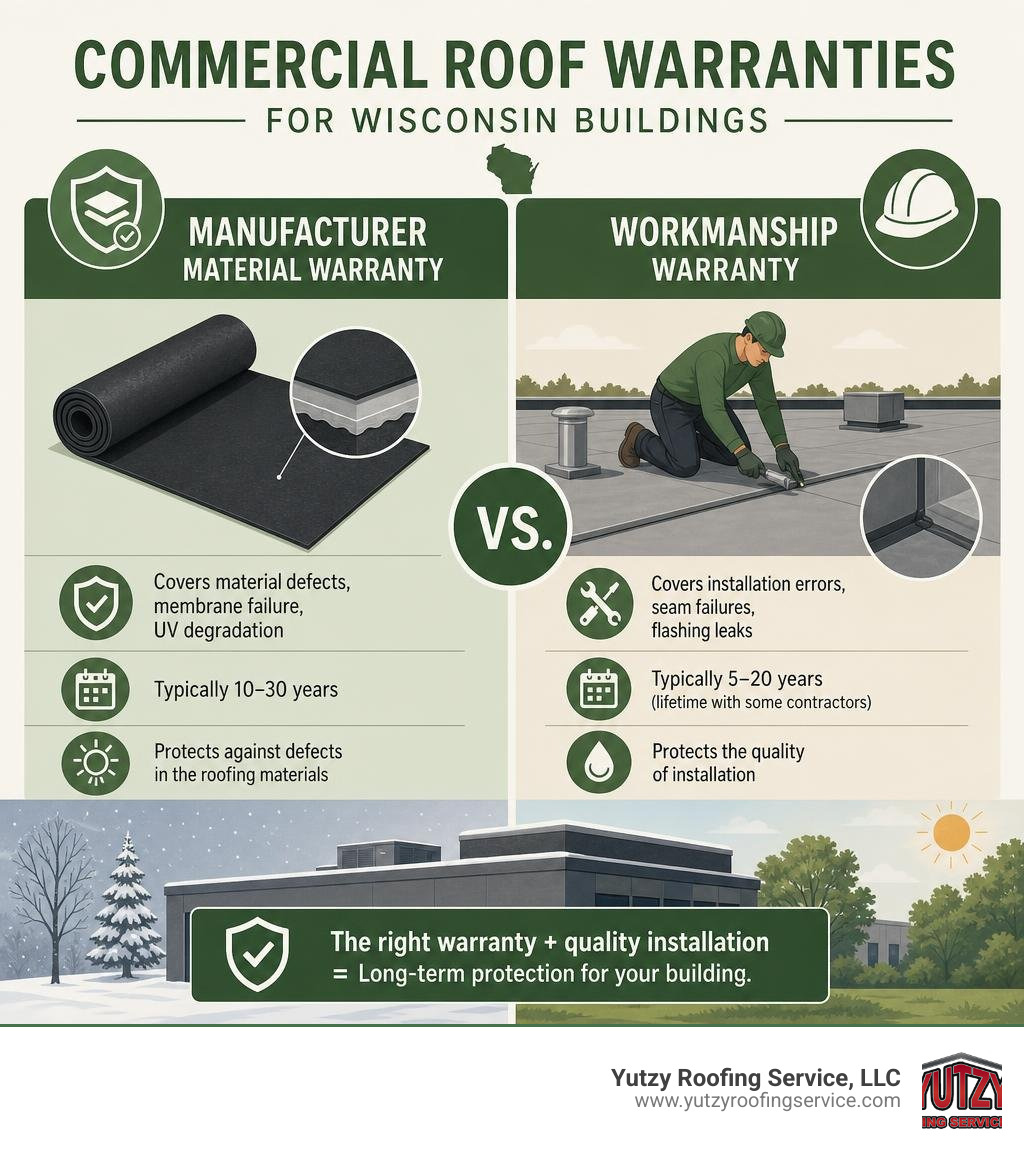
Understanding your commercial roof warranty options in Wisconsin comes down to three core types:
| Warranty Type | Who Provides It | What It Covers | Typical Duration |
|---|---|---|---|
| Manufacturer Material | Roofing material manufacturer | Material defects, membrane failure, UV degradation | 10–30 years |
| Contractor Workmanship | Your roofing contractor | Installation errors, seam failures, flashing leaks | 5–20 years (lifetime with some contractors) |
| Full System / Extended | Manufacturer + certified installer | Edge-to-edge coverage, labor and materials combined | 10–25 years |
The right warranty protects your building investment for decades. The wrong one — or a voided one — leaves you paying out of pocket when Wisconsin’s winters do their worst.
Wisconsin commercial property owners face a real problem: roofing warranties look solid on paper but can fail in practice. In fact, 9 out of 10 new roofs installed today can’t pass a simple warranty inspection due to poor workmanship — meaning most owners don’t even know their coverage is already void.
Wisconsin’s climate makes this even more urgent. Freeze-thaw cycles, heavy snow loads, ice damming, and summer hail all put commercial roofs under constant stress. Without the right warranty — and a contractor who keeps it valid — a single bad winter can become a very expensive problem.
I’m Josh Yutzy, and at Yutzy Roofing Service, LLC, we’ve been navigating commercial roof warranty in Wisconsin for businesses across the state since 1995 — from EPDM restorations to spray foam systems with up to 18-year non-prorated renewable warranties. In this guide, I’ll walk you through everything you need to know to choose, protect, and use your commercial roof warranty effectively.
Understanding the Types of Commercial Roof Warranty Wisconsin Options
When you invest in a commercial roof, you are not just buying physical materials like rubber, metal, or foam; you are purchasing a long-term asset protection plan. To secure that asset, you must understand how different warranties interact under Wisconsin law.
Manufacturer Material Warranties
A manufacturer’s material warranty is the most basic level of protection. It is a guarantee from the company that manufactured the roofing membrane (such as Duro-Last, GAF, or Carlisle) that the product itself will not fail prematurely due to manufacturing defects.
For example, if your EPDM membrane begins to crack, split, or degrade under normal UV exposure within the warranty period (often 10 to 20 years), the manufacturer is responsible for providing replacement materials.
However, there is a catch: material warranties rarely cover the labor cost to install the replacement membrane. Furthermore, if a leak occurs because a contractor installed that material incorrectly, the manufacturer will deny the claim instantly. This is why relying solely on a material warranty is a risky strategy for Wisconsin business owners.
Contractor Workmanship Warranties
A contractor workmanship warranty is issued directly by the commercial roofing company that installs or restores your roof. This warranty covers the labor, installation techniques, and physical application of the roofing system. If a seam fails, flashing pulls away, or a drain connection leaks due to an installation error, the contractor must return to fix it at no cost to you.
In Wisconsin, workmanship warranties can vary wildly. Some local contractors offer standard 5-year or 10-year workmanship coverage, while others claim to offer “lifetime” coverage.
When evaluating these offers, look closely at the stability of the company. A lifetime warranty is only as good as the company backing it. Since we started in 1995, we have seen many fly-by-night operations vanish, leaving building owners with worthless pieces of paper. Working with established commercial roofing contractors in Wisconsin ensures that your installer will actually be around to honor their promises.
Full System and Extended Warranties
If you want complete peace of mind, a full system warranty (often called an NDL or “No Dollar Limit” warranty) is the gold standard. These warranties are backed by the manufacturer but cover both materials and the labor required to repair leaks.
To obtain a full system warranty, the roofing system must be installed by a manufacturer-certified contractor who adheres strictly to rigid installation guidelines. Once the project is complete, a third-party manufacturer inspector must physically visit the property to verify that the installation complies with their exact standards.
While these warranties carry a higher upfront cost and require meticulous registration, they offer edge-to-edge protection. If your roof leaks, the manufacturer coordinates the repair, covering both the material and the labor costs without a dollar limit.
It is also important to distinguish between express and implied warranties. An express warranty is the written contract you sign with your contractor or manufacturer. Implied warranties, governed by the Uniform Commercial Code (UCC) in Wisconsin, are unwritten guarantees that the roofing materials are fit for their ordinary purpose. Wisconsin’s version of the UCC for sales is published in Wisconsin Statutes Chapter 402, which can be useful background when reviewing commercial material purchases. However, most express commercial warranties contain clauses that explicitly disclaim all implied warranties, making the written contract your primary legal line of defense.
Commercial Roofing Materials and Their Warranty Lifespans
The material you choose for your low-slope or flat commercial roof directly dictates the type and duration of the commercial roof warranty in Wisconsin you can secure.
| Roofing System | Typical Lifespan in WI | Standard Manufacturer Warranty | Restoration/Coating Warranty |
|---|---|---|---|
| EPDM (Rubber) | 20–30 Years | 15–25 Years | 10–18 Years (Renewable) |
| Spray Polyurethane Foam (SPF) | 30–50+ Years (with recoats) | 10–20 Years | Up to 18 Years (Non-Prorated) |
| Metal (Standing Seam) | 50+ Years | 30–50 Years (Material only) | 10–18 Years (Restoration) |
| TPO / PVC | 20–30 Years | 15–25 Years | 10–15 Years |
Single-Ply Membranes: EPDM Repairs and Maintenance
Ethylene Propylene Diene Monomer (EPDM) is a traditional, highly durable synthetic rubber membrane commonly installed on low-slope warehouses, retail centers, and offices across Appleton, Eau Claire, and Fond Du Lac. EPDM can easily last 30+ years with proper upkeep.
However, EPDM is highly reliant on adhesives and seam tapes. Over time, Wisconsin’s intense seasonal temperature swings can cause these seams to pull apart, leading to localized leaks.
When seams fail, you do not necessarily need a costly roof replacement. Our EPDM restoration and repair services utilize advanced elastomeric coatings to seal failing seams and protect the membrane, often qualifying the restored roof for a brand-new, long-term warranty without the disruption of a tear-off. If you are planning a project in the state capital, working with experts in commercial flat roofing in Madison can help you determine if your EPDM system is a candidate for restoration.
Spray Polyurethane Foam and Commercial Roof Warranty Wisconsin Coverage
Spray Polyurethane Foam (SPF) is one of the most energy-efficient and watertight systems available for Wisconsin commercial properties. It is sprayed as a liquid, expanding into a seamless, solid foam barrier that fills cracks, seals around penetrations, and eliminates seams entirely (which are the source of 85% of flat roof leaks).
SPF systems must be protected from UV rays with a high-performance elastomeric top coat (usually acrylic or silicone). Because these systems are seamless, their warranties are highly attractive. At Yutzy Roofing Service, LLC, we offer up to an 18-year non-prorated, renewable warranty on our spray foam and fluid-applied systems.
This means that near the end of your 18-year term, we can perform a simple clean-and-recoat process to extend your warranty for another 10 to 18 years. To learn more about how these specialized coverages work, read our guide on Common Spray Foam Coating Warranty Questions Answered.
Metal Roof Restoration and Protective Coatings
Many industrial and commercial facilities in Wausau, Green Bay, and Marshfield feature standing-seam metal roofs. While metal roofs are incredibly tough and can last 50 years or more, they are prone to rust, loose fasteners, and seam movement caused by thermal expansion.
Instead of paying for an expensive, disruptive metal tear-off and replacement, we specialize in metal roof restoration. We clean the existing metal, treat rust, tighten or replace fasteners, seal all seams with heavy-duty fabric reinforcement, and apply a seamless elastomeric coating.
This process stops leaks, lowers cooling costs by reflecting up to 86% of solar heat, and allows us to issue a long-term, non-prorated warranty on the restored system. If you want to dive deeper into metal-specific protections, check out The Ironclad Guide to Madison Metal Roofing Warranties.
Wisconsin Weather Impacts and Keeping Your Warranty Valid
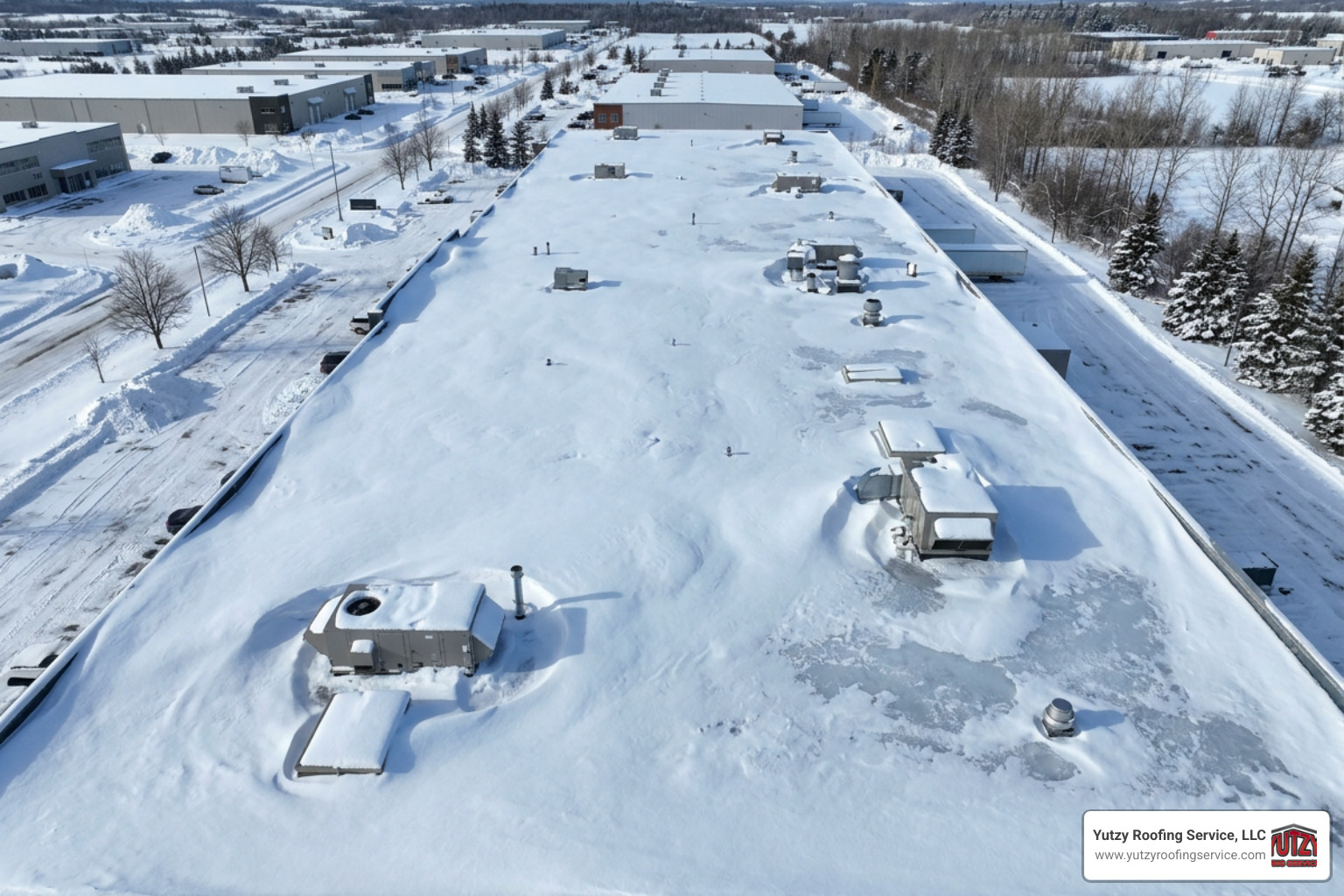
Wisconsin’s climate is notoriously brutal on commercial roofing systems. From heavy snow loads in the Northwoods to rapid freeze-thaw cycles in Madison and Milwaukee, your roof takes a constant beating. Understanding how these weather patterns affect your commercial roof warranty in Wisconsin is critical to avoiding denied claims.
Freeze-Thaw Cycles and Ice Damming
The freeze-thaw cycle is a silent killer for low-slope commercial roofs. When snow melts during a sunny winter day, the water runs toward the drains. As temperatures plummet after sunset, that water freezes, expands, and forces its way into tiny cracks, seams, or flashing joints.
This cycle can lead to ice damming on flat roofs, which prevents proper drainage and causes water to pond behind the ice. Most standard manufacturer warranties include a 48-hour ponding water exclusion. This means that if water stands on your roof for more than 48 hours without draining, any resulting leaks or membrane damage are not covered by the warranty.
Ensuring proper roof slope, clear drains, and utilizing seamless systems like spray foam or fluid-applied coatings are the best ways to combat freeze-thaw damage and keep your warranty intact.
Heavy Snow Loads and Structural Stress
In northern Wisconsin, including areas like Eau Claire and Wausau, winter snow loads can easily exceed 40 pounds per square foot. This immense weight puts severe structural stress on commercial buildings.
If a roof suffers structural deformation or collapse due to excessive snow accumulation, standard manufacturer warranties will not cover the damage, as this is classified as an “act of God” or a structural failure rather than a material defect.
To protect your building and maintain your warranty, you must coordinate professional, safe snow removal during extreme winters and maintain clear documentation of these preventative efforts.
Hail Damage and Storm Claims
Summer in Wisconsin brings severe thunderstorms and hail. Hail impacts can puncture single-ply membranes like EPDM or TPO, fracture aged asphalt systems, and dent metal panels.
It is a common misconception that a roof warranty covers hail damage. In reality, almost all commercial roof warranties explicitly exclude hail damage unless you have purchased an expensive “hail rider” add-on.
If hail damages your commercial roof, the remedy must be pursued through your commercial property insurance policy rather than your roof warranty. For step-by-step guidance on navigating this process, read our articles on Everything You Need to Know About Replacing a Hail Damaged Roof and How to Get Insurance to Pay for Roof Replacement.
The Critical Role of Professional Installation and Restoration
As mentioned earlier, 9 out of 10 new roofs fail their initial warranty inspections due to poor workmanship. Manufacturers are incredibly strict about how their systems are installed. If a contractor cuts corners, uses incompatible adhesives, or fails to flash a penetration according to the manufacturer’s manual, the manufacturer will void the material warranty immediately.
This is why you must work with certified, experienced professionals who understand Wisconsin commercial roofing systems. At Yutzy Roofing Service, LLC, our team is trained to execute installations and restorations that align perfectly with manufacturer specifications, ensuring your warranty is registered and fully active from day one.
Annual Inspections and Documented Maintenance
You cannot simply install a commercial roof and forget about it for 20 years. Nearly every commercial roof warranty requires the building owner to perform regular, documented maintenance.
To keep your warranty valid, you should schedule professional inspections twice a year — once in the spring to assess winter damage, and once in the fall to prepare for the cold. During these inspections, drains must be cleared of debris, seams checked, and minor punctures repaired immediately.
If a leak occurs and you cannot provide documented proof of annual inspections and basic maintenance, the manufacturer has the legal right to void your warranty. If your warranty is nearing its end or has already expired, you can learn about your next steps in our guide, Life After Expiration: A Guide to Non-Renewable Warranty Alternatives.
Navigating Commercial Roof Warranty Wisconsin Transfers and Claims
If you decide to sell your commercial property in Appleton, Green Bay, or Madison, a transferable warranty adds significant value to the sale. However, warranties do not transfer automatically.
Typically, the transfer process requires:
- Written notice to the manufacturer or contractor within 30 days of the property transfer.
- A professional roof inspection to verify the system is in good condition.
- Payment of a transfer fee (usually a few hundred dollars).
- Submission of all historical maintenance records.
Failure to complete these steps within the specified timeframe will result in the warranty terminating upon the sale of the building.
Frequently Asked Questions About Wisconsin Commercial Roof Warranties
What is the difference between a prorated and a non-prorated warranty?
A prorated warranty depreciates in value over time. For example, on a 20-year prorated warranty, the manufacturer might cover 100% of repair costs in year one, but only 50% in year ten, and 10% in year nineteen. This leaves the building owner covering a significant portion of the bill as the roof ages.
A non-prorated warranty provides full coverage for the entire duration of the term. Whether a defect occurs in year two or year seventeen, the warrantor covers the covered repair or replacement costs in full. Our up to 18-year renewable warranties are completely non-prorated, giving you consistent, reliable protection.
Does my commercial roof warranty cover ponding water?
Most standard single-ply warranties exclude coverage for damage caused by ponding water (water that remains on the roof for 48 hours or longer). Ponding water puts immense pressure on seams and accelerates the breakdown of adhesives.
However, high-quality seamless systems, such as spray polyurethane foam and certain silicone fluid-applied coatings, are naturally resistant to standing water. Some premium manufacturer warranties (like Duro-Last) do offer ponding water coverage. It is vital to clarify this exclusion with your contractor before selecting a roofing system.
How do I file a warranty claim with a Wisconsin contractor?
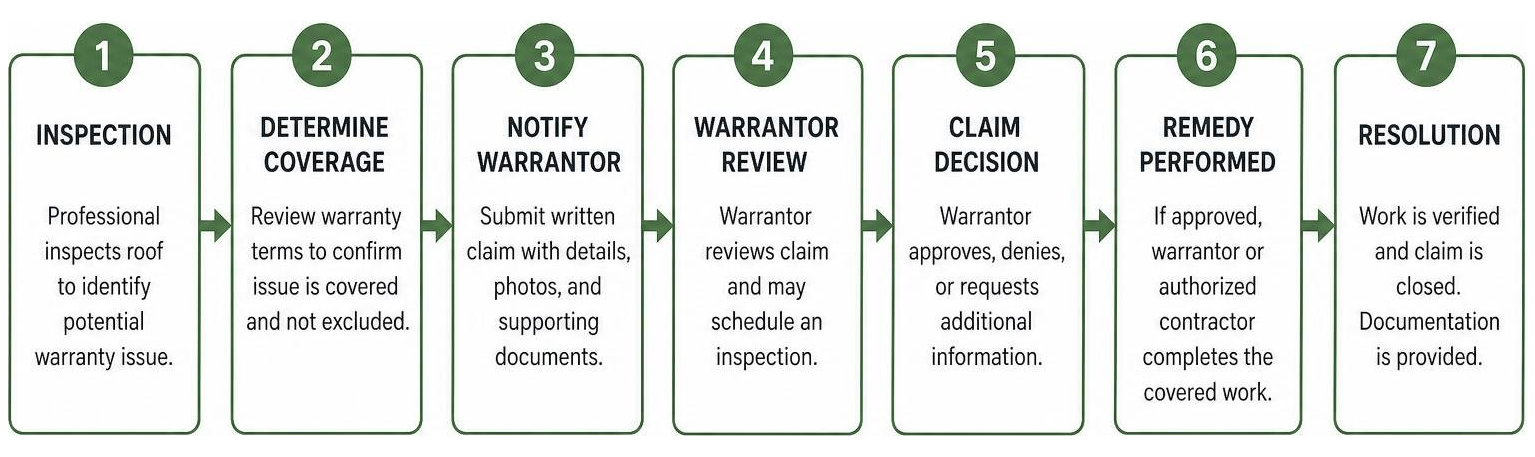
If you discover a leak or defect, follow these steps immediately:
- Document the damage: Take clear photos of the roof issue and any interior water damage.
- Submit written notice: Contact your roofing contractor or manufacturer in writing (email or certified mail) as soon as possible. Most warranties require notice within 30 days of discovering a leak.
- Provide maintenance records: Have your annual inspection and maintenance logs ready to prove compliance.
- Schedule an inspection: The contractor or manufacturer will send an inspector to determine if the leak is caused by a covered defect or an excluded event (like storm damage or third-party foot traffic).
For projects in northern areas, reaching out to specialized local commercial roofing experts can help ensure a fast, localized response to your claim.
Conclusion

A commercial roof warranty in Wisconsin is not just a marketing gimmick; it is a critical tool for protecting your business’s physical infrastructure and financial health. However, a warranty is only as strong as the materials used, the weather it is designed to withstand, and the contractor who installs and maintains it.
At Yutzy Roofing Service, LLC, we do not believe in cutting corners. We have spent over three decades building a reputation for honesty, meticulous craftsmanship, and unmatched customer service across Wisconsin — from Madison and Appleton to Wausau and Green Bay.
Whether you need EPDM repairs, a seamless spray foam coating, or a complete metal roof restoration, we back our work with up to an 18-year non-prorated, renewable warranty that gives you genuine, long-term peace of mind.
Don’t wait for the next heavy Wisconsin snowfall or summer hailstorm to find out if your roof is protected. Schedule a consultation with Wisconsin’s commercial roofing experts at Yutzy Roofing Service, LLC today, and let us help you keep your business dry, efficient, and secure for decades to come.
