2026 Baseline: National Average Price for Roof Repair and Regional Trends
When budgeting for commercial building repairs, establishing a benchmark helps separate standard maintenance fees from inflated estimates. Across the country, minor service calls and localized fixes average between $395 and $1,966. Comprehensive industry studies, such as the 2026 Roofing Cost Report data on national pricing, show that nationwide residential and light commercial repair jobs average $4,699 when larger water-mitigation efforts or multiple failure points are involved. Facility managers should also account for diagnostic time, material compatibility testing, and mobilization fees, which often appear as separate line items on commercial invoices.
Over the last five years, roofing expenses have trended upward steadily. Between 2022 and 2026, baseline repair pricing rose by approximately 17.7%, moving from an average of $637 to roughly $750 for routine calls, driven by wage growth and material manufacturing overhead. This steady increase makes it more important for property owners to benchmark local pricing before approving work orders, especially when multiple contractors submit bids for the same scope.
Calculating the Average Price for Roof Repair by Region and State
Labor indices and regional climate regulations create significant pricing differences across the map. As highlighted in state-by-state repair cost benchmarks, high-cost metropolitan centers and coastal storm zones face steep surcharges, whereas Midwestern regions remain balanced. Coastal markets often carry additional costs for wind-uplift engineering, salt-air corrosion protection, and stricter building code compliance, all of which push repair invoices higher than comparable work in the upper Midwest.
In our service territory—including Wisconsin hubs like Madison, Appleton, Wausau, Eau Claire, Fond Du Lac, and Green Bay, as well as Mankato and Rochester, MN—routine commercial repairs typically track slightly below national coastal highs. A localized commercial repair in Wisconsin generally falls in the $350 to $850 range for minor work and $1,100 to $1,600 for moderate remediation. Building owners in these markets benefit from competitive labor rates and shorter material shipping distances, which help keep the average price for roof repair more predictable.
Labor Rates and Crew Fee Structures
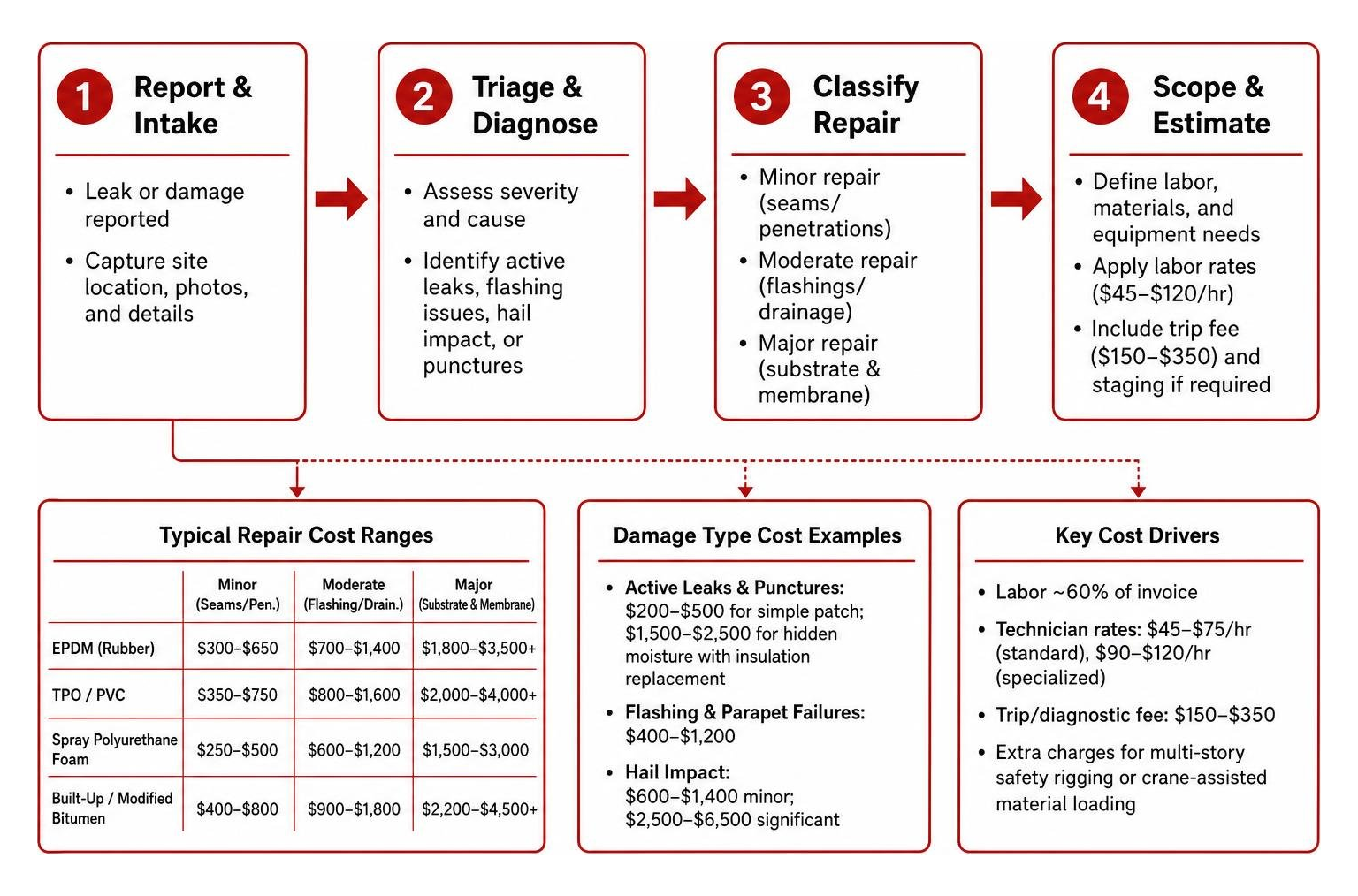
Labor constitutes roughly 60% of any roofing repair invoice. Standard hourly wages for experienced commercial roofers range from $45 to $75 per technician, with specialized commercial technicians reaching $90 to $120 per hour depending on required certifications. Crew size also matters: a two-person team can handle most membrane patches, while larger flashing rebuilds may require three or four technicians working in sequence.
Most commercial contractors charge a minimum trip or diagnostic dispatch fee ($150 to $350) to cover travel, roof mounting, and setup. If a repair involves multi-story safety rigging or crane-assisted material loading, equipment staging fees will factor directly into the final invoice. Property managers should request a line-item breakdown before work begins so that mobilization, labor, materials, and disposal costs are clearly separated.
Typical Repair Costs by Damage Type and Material
Repair costs vary substantially based on the exact failure mechanism and the chemistry of the installed roofing system. The table below provides a practical reference for budgeting across common commercial membrane types.
| Material / System Type | Minor Repair (Seams/Penetrations) | Moderate Repair (Flashing/Drainage) | Major Substrate & Membrane Repair |
|---|---|---|---|
| EPDM (Rubber Membrane) | $300 – $650 | $700 – $1,400 | $1,800 – $3,500+ |
| TPO / PVC Single-Ply | $350 – $750 | $800 – $1,600 | $2,000 – $4,000+ |
| Spray Polyurethane Foam | $250 – $500 | $600 – $1,200 | $1,500 – $3,000 |
| Built-Up / Modified Bitumen | $400 – $800 | $900 – $1,800 | $2,200 – $4,500+ |
Determining the Average Price for Roof Repair by Specific Damage Type
The source of water intrusion dictates the required labor time and materials. A small puncture in an open field is far less expensive to address than a failed parapet wall flashing that has allowed moisture to travel across the roof deck.
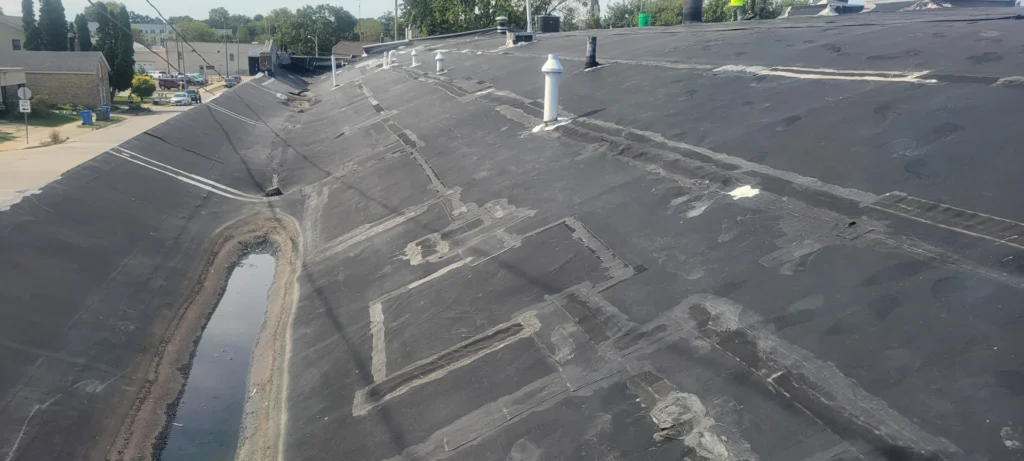
- Active Leaks and Punctures: A single puncture in an open field can be patched quickly for $200 to $500. However, when tracking actual pricing to fix severe water penetration, hidden moisture that travels laterally along structural metal decks can elevate costs to $1,500–$2,500 due to diagnostic and insulation replacement needs. Thermal imaging and electronic leak detection may add $250 to $600 to the initial service call.
- Flashing and Parapet Wall Failures: Deteriorated flashing along edge metal, HVAC curbs, or parapet walls costs between $400 and $1,200 to reseal or reconstruct with fresh termination bars. When underlying wood blocking or metal counterflashing is also deteriorated, the repair scope expands and costs can rise by 30% to 50%.
- Hail Impact: Hail damage on commercial roofs ranges from $600 to $1,400 for minor membrane bruising, but can exceed $2,500 to $6,500 if internal reinforcement is fractured across wide sections. Insurance adjusters often require documented impact evidence, so property managers should photograph damage immediately after a storm event.
Material-Specific Patching and Membrane Restoration Expenses
Single-ply systems like EPDM and TPO require compatible elastomeric primers, hot-air welding equipment, or specialized bonding adhesives to ensure patches hold up against severe weather. Using the wrong adhesive or primer can cause premature patch failure, so material compatibility testing is a standard part of professional repair work.
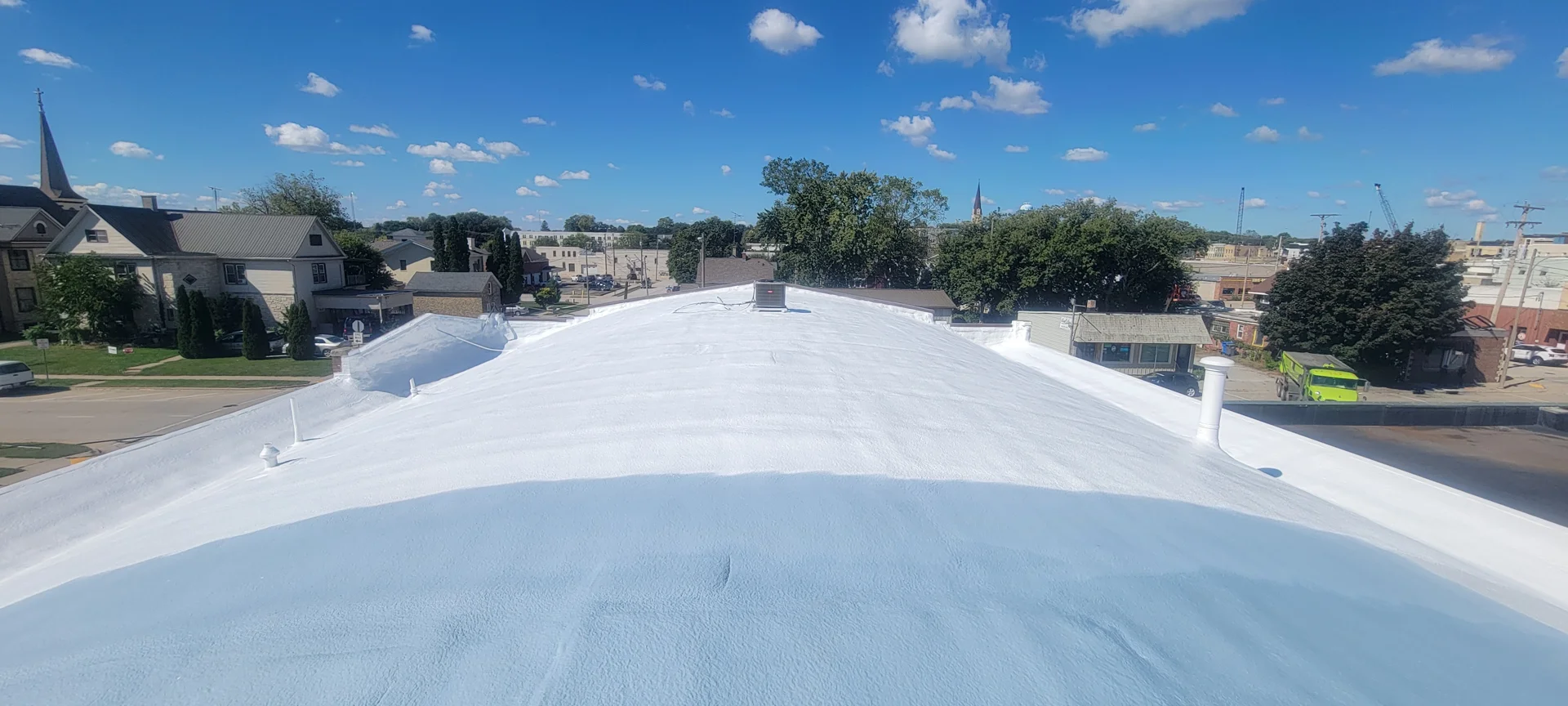
For continuous systems, evaluating spray foam roof maintenance costs shows that minor surface recoating and localized foam patching are among the most economical repairs, often requiring simple elastomeric caulking and high-solids coating topcoats without complex structural tear-off. Spray foam systems also benefit from periodic reapplication of protective topcoats, which can extend the service life of the underlying foam by several years.
Key Variables Influencing Property Roof Repair Budgets
Beyond the visible damage, structural and geometric factors dictate job complexity. Reviewing the core factors driving structural roofing project expenses helps property managers budget accurately and avoid surprise change orders.
Height, Slope, and Equipment Accessibility Challenges
Roof access directly impacts labor efficiency:
- Low-Slope Commercial Flats: Provide easier foot access, lowering staging costs and allowing crews to move materials quickly across the roof surface.
- Multi-Story Commercial Facilities: Require crane hoists, external scaffolding, and specialized perimeter tie-offs, adding 15% to 30% in setup overhead. Elevator access and interior stairwells can reduce some of this burden, but material handling still requires careful planning.
- Steep-Slope Sections: Trigger OSHA fall-protection mandates, harness setups, and stage rigging that increase labor hours by 20% to 50%. Steep sections also slow down material application, since crews must work from secured anchor points rather than moving freely across the surface.
Emergency Response and Seasonal Timing Surcharges
When storms strike Wisconsin or Minnesota, emergency service calls outside standard operating hours carry premiums ranging from 25% to 100% over standard rates. After-hours dispatch often requires overtime pay, expedited material delivery, and temporary water-mitigation measures such as tarps or temporary sealants.
Scheduling non-critical repairs during off-peak windows—such as late autumn prior to winter freezes—can secure savings of 10% to 15% compared to peak summer construction months. Spring and early summer are typically the busiest seasons for roofing contractors, so property managers who can wait until late fall often receive more competitive pricing and faster scheduling.
Strategic Maintenance vs. Full Replacement Budgeting
Proactive maintenance programs extend the functional lifespan of commercial roofing systems while avoiding unplanned capital expenses. Implementing proactive methods to minimize roof maintenance expenses allows building owners to stop moisture intrusion before it reaches internal structural components. Scheduling routine evaluations helps keep costs predictable, and reviewing current professional roof inspection pricing can help facilities avoid large diagnostic charges later.
Evaluating Repair vs. Full Roof Replacement
When assessing whether to continue spot repairs or invest in complete restoration, the “25% Rule” serves as a practical guide:
- Repair: Damage covers less than 20% to 25% of the total membrane surface, the underlying insulation is dry, and the roof is under 15–20 years old. In these cases, targeted repairs can restore watertight integrity at a fraction of replacement cost.
- Restoration Coating: The membrane is weathered but structurally intact; applying a silicone or acrylic restoration system can extend service life by 10 to 18 years at roughly half the cost of tear-off. Restoration coatings also reduce the building’s cooling load by reflecting solar heat, which can lower energy costs during summer months.
- Replacement: Saturated insulation exceeds 30% of the roof deck, or widespread structural degradation exists. Careful review of evaluating repair vs replacement trade-offs ensures capital funds are spent wisely and that the selected approach matches the building’s long-term occupancy plans.
Insurance Coverage and Warranty Protection
Standard commercial property policies cover sudden, accidental events like windstorms, tornado impact, or severe hail. However, gradual wear, lack of preventative maintenance, or aging seams are excluded. Property managers should document all maintenance activities, since insurers may request service records when evaluating a claim.
To safeguard commercial investments, we back our restoration systems with non-prorated renewable warranties of up to 18 years, giving building owners long-term protection against unexpected repair bills. A non-prorated warranty means coverage does not decrease in value over time, which is a significant advantage compared to standard manufacturer warranties that depreciate annually.
Frequently Asked Questions About Roof Repair Costs
How much does professional roof leak diagnostic and repair cost?
Basic diagnostic visits utilizing infrared moisture scanning or electronic leak detection range from $250 to $600. When paired with immediate localized patching of the identified source, total minor repair costs typically fall between $450 and $1,200. More complex leak investigations that require multiple visits or destructive testing can push diagnostic costs higher, but these are usually reserved for recurring leaks that have not responded to initial repairs.
When does repairing a roof make more financial sense than full replacement?
Repair or restoration is the best financial option when water intrusion is isolated, the insulation remains dry, and less than 25% of the membrane is compromised. Applying a high-performance roof coating restores watertight integrity without the expense and operational downtime of a full tear-off. Building owners should also consider the remaining useful life of the roof; if the membrane has 10 or more years of expected service left, targeted repairs are almost always the better financial choice.
What hidden fees can increase the final cost of a roof repair?
Hidden costs often stem from deteriorated roof decking beneath wet insulation ($2.20 to $3.00 per square foot for wood/metal deck repair), hazardous material abatement, permit fees ($50 to $500), and disposal charges for multiple underlying roof layers. Additional costs can arise from temporary water mitigation, such as tarping or interior drying, and from after-hours access requirements if the building operates around the clock.
Conclusion
Understanding commercial roofing repair pricing helps property managers protect structural integrity while keeping operational budgets balanced. Whether managing a single membrane puncture or addressing broad perimeter flashing degradation, localized repairs and modern restoration systems provide durable protection without the heavy expense of complete tear-offs.
At Yutzy Roofing Service, LLC, we specialize in advanced commercial roof restoration, elastomeric roof coatings, and comprehensive EPDM, PVC, and TPO membrane repairs throughout Wisconsin and Minnesota. Backed by non-prorated warranties up to 18 years, our solutions ensure your building stays watertight through every season. If your commercial facility is currently dealing with leaks or interior moisture, explore our guide to resolving interior water damage and structural leaks to take the next step toward permanent protection.
