Choose a Commercial Metal Roof Sealant That Matches the Detail
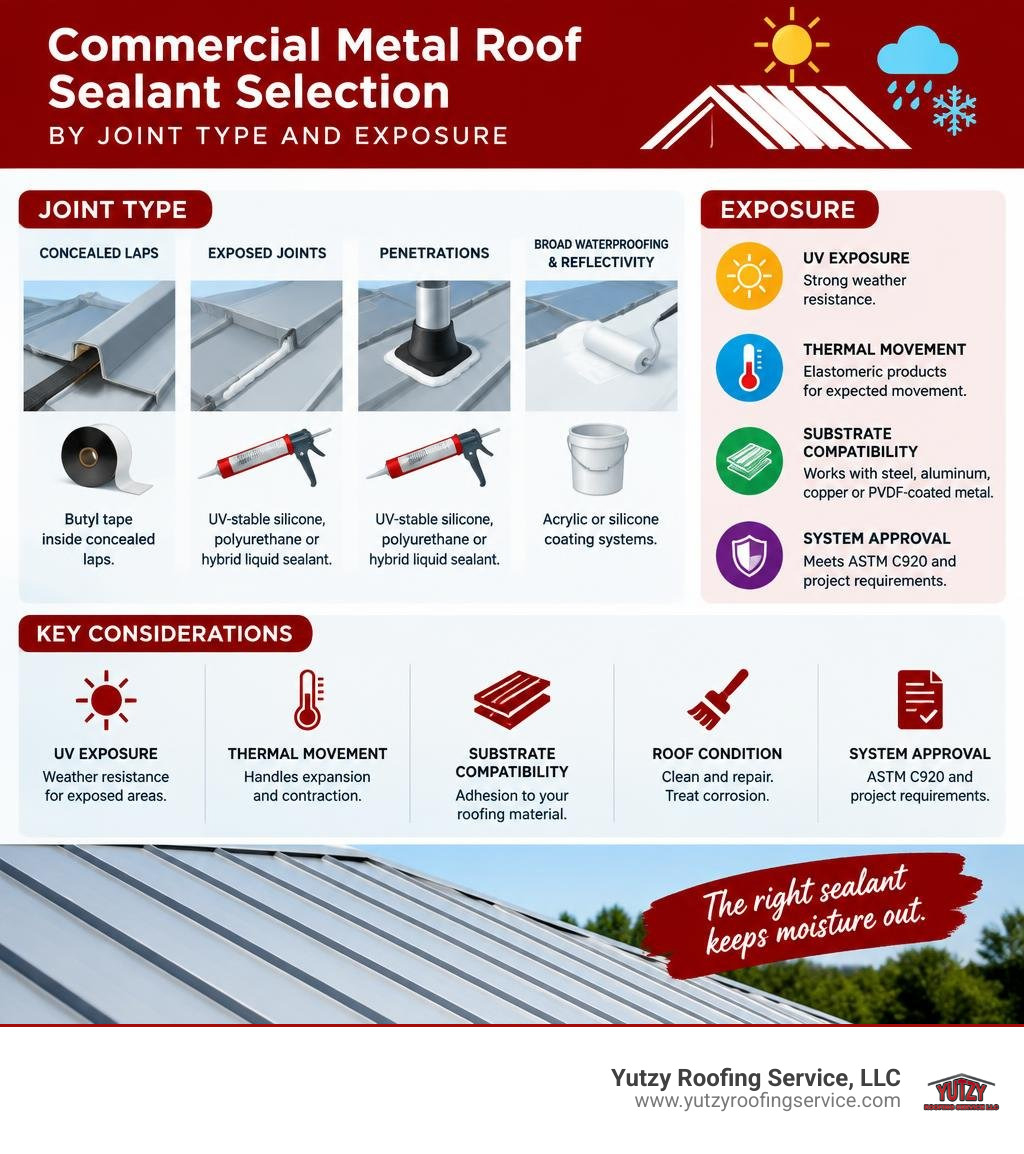
For metal roof sealant commercial roofing projects, match the material to the joint, exposure, and movement it must handle. Use butyl tape inside concealed laps, select a UV-stable silicone, polyurethane, or hybrid liquid sealant for exposed joints and penetrations, and consider acrylic or silicone coating systems when broader waterproofing and reflectivity are needed.
A sound choice should account for:
- UV exposure: Exposed sealant needs strong weather resistance.
- Thermal movement: Metal expands and contracts sharply through Wisconsin winters and summers. Look for elastomeric products rated for the expected joint movement.
- Substrate compatibility: Confirm adhesion to galvanized steel, aluminum, copper, or PVDF-coated metal.
- Condition of the roof: Remove loose rust, dirt, oils, and failed sealant before repairs. Treat active corrosion rather than simply covering it.
- System approval: Check the product data sheet for standards such as ASTM C920 and any project-specific wind, code, or regional approval requirements.
The sealant is a small part of a commercial roof assembly, but it often controls whether moisture stays out at seams, fasteners, flashings, and equipment penetrations. A well-installed metal roof can last more than 50 years, while a failed joint seal can allow water into an otherwise serviceable roof system.
I am Josh Yutzy of Yutzy Roofing Service, LLC. Our family business has served commercial roofing customers in Wisconsin since 1995, and our experience with metal roof sealant commercial roofing helps property owners pursue durable repairs and restoration without compromising on material quality.
Terms related to metal roof sealant commercial roofing:
Core Chemistry Comparison: Selecting the Right Metal Roof Sealant Commercial Roofing Formulation
Choosing the correct chemical formulation requires understanding your building envelope’s specific demands. When evaluating commercial metal roofing: what to know includes knowing how different metal panels interact with chemical adhesives. Commercial metal roof panels experience substantial thermal expansion and contraction cycles. The adhesive bond must resist shearing stresses without tearing or peeling away from the substrate.
Whether your commercial facility features standing seam panels, R-panel metal profiles, or architectural corrugated sheet metal, chemical compatibility governs long-term weatherproofing. Atmospheric exposure—including ponding water, industrial emissions, and severe freeze-thaw cycles across Upper Midwest winters—quickly degrades improper chemistries.
Silicone, Polyurethane, Acrylic, and Hybrid Chemistries
Different chemical polymer backbones deliver distinct advantages depending on whether they serve as internal joint barriers, exposed perimeter seals, or broad protective membranes. When learning how to navigate the ultimate guide to roofing caulk for metal roofs, commercial facility managers must evaluate these primary categories:
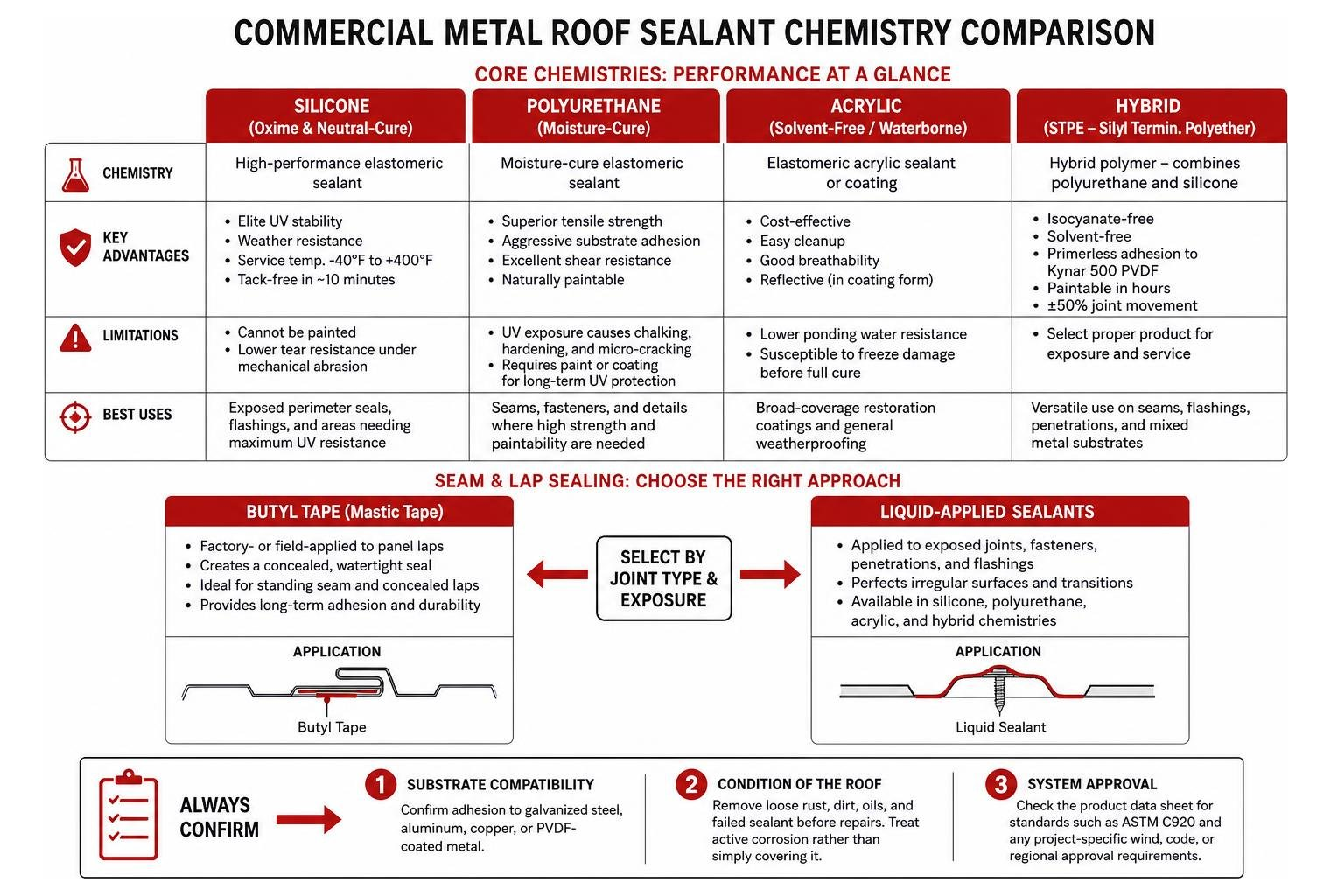
- Oxime and Neutral-Cure Silicones: Formulated as high-performance elastomeric sealants, oxime silicones provide elite UV stability and weather resistance. Products like Novaflex Metal Roof Sealant Technical Information demonstrate exceptional service temperature ranges from -40°F to +400°F and become tack-free in as little as 10 minutes. Silicones are largely inorganic, meaning ultraviolet rays do not break down their molecular backbone. However, standard silicones cannot be painted and exhibit low tear resistance when subjected to mechanical abrasion.
- Moisture-Cure Polyurethanes: Polyurethanes offer superior tensile strength, aggressive substrate adhesion, and natural paintability. They cure via ambient humidity to form a durable elastomeric rubber. While polyurethanes provide excellent shear resistance, prolonged UV exposure will eventually cause them to chalk, harden, and micro-crack if left unpainted or uncoated.
- Solvent-Free and Waterborne Acrylics: Primarily utilized in broad-coverage commercial restoration coatings, elastomeric acrylics cure to form a monolithic, reflective weather barrier. Acrylic sealants and coatings are cost-effective, easy to clean up, and offer good breathability. Their limitation lies in low ponding water resistance and susceptibility to freeze damage if exposed to freezing temperatures prior to full cure.
- Silyl-Terminated Polyether (STPE) Hybrids: Hybrid formulations combine the best traits of polyurethane and silicone. Products such as MetaLink High Performance Metal Roof Sealant and Titebond WeatherMaster Metal Roof Caulks & Sealants offer isocyanate-free formulations, solvent-free safety, primerless adhesion to Kynar 500 PVDF coatings, and paintability within hours of application while maintaining ±50% joint movement capabilities.
Butyl Tape vs. Liquid-Applied Sealants for Seams and Laps
Commercial standing seam and exposed-fastener metal profiles rely on two distinct sealing configurations: concealed internal seals and exposed external seals. Understanding the advantages of mastic tape for metal roofing is critical when evaluating panel laps.
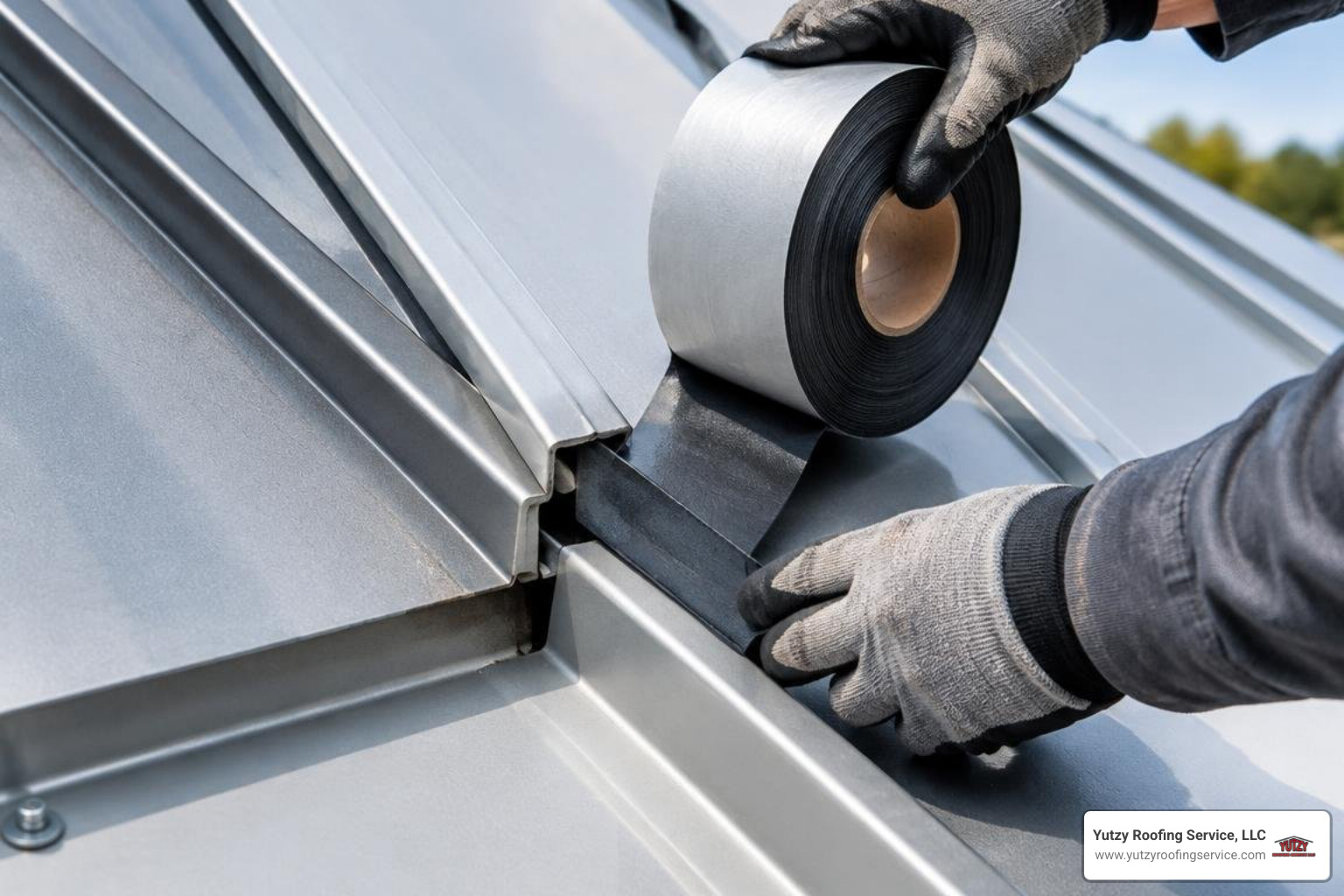
Butyl tape is a cross-linked, non-skinning, 100% solids polyisobutylene mastic tape. It is formulated specifically for placement within concealed mechanical joints, end laps, and under flashing flanges before fasteners are driven home. Comprehensive field evaluations by the Metal Construction Association across 14 commercial test sites revealed that butyl tape used in metal roofing laps showed no deterioration in cohesive strength or resistance to penetration even after 35 years of continuous service. The projected service life for high-grade butyl tape inside concealed laps exceeds 60 years.
However, butyl tape must never be applied topically as an exposed weather sealant. Direct exposure to solar UV radiation and atmospheric ozone rapidly degrades the unvulcanized polymers. Liquid-applied sealants—such as STPE hybrids, neutral silicones, and reinforced brush-grade urethanes—are engineered specifically for exposed surface detailing, flashing perimeters, pipe boots, and fastener encapsulation.
Performance Comparison Matrix
The table below outlines how common commercial sealant chemistries perform against standard engineering parameters:
| Property / Metric | Butyl Mastic Tape | Neutral-Cure Silicone | Moisture-Cure Polyurethane | Elastomeric Acrylic | STPE Hybrid Polymer |
|---|---|---|---|---|---|
| Primary Placement | Concealed panel laps & flanges | Exposed joints & penetrations | Perimeter flashing & dynamic joints | Broad-area coatings & flashings | Universal exposed joints & laps |
| Joint Movement Capability | ±10% to ±15% (shear) | ±50% (ASTM C920) | ±25% to ±35% | ±15% to ±25% | ±50% (ASTM C920 Class 50) |
| UV Resistance | Poor (Requires UV concealment) | Superior (Unaffected by UV) | Moderate (Chalks over extended time) | Excellent (Formulated for solar reflection) | Superior (Non-yellowing / crack-resistant) |
| Paintability | No | No | Yes (After full cure) | Yes (Self-topcoating) | Yes (Paintable within 1–2 hours) |
| Tensile / Tear Strength | High cohesive tack; low tear | Moderate tensile; low tear | High tensile; superior tear resistance | Moderate tensile; requires mesh for high stress | High tensile; balanced tear resistance |
| Tack-Free Time | Non-skinning (instant seal) | 10 to 45 minutes | 2 to 6 hours | 1 to 4 hours | 15 to 30 minutes |
| Service Temperature Range | -40°F to +200°F | -40°F to +400°F | -40°F to +180°F | -20°F to +180°F | -75°F to +212°F |
| Expected Service Life | 35 to 60+ years (concealed) | 15 to 25 years | 10 to 15 years | 7 to 12 years | 15 to 20+ years |
Critical Performance and Engineering Selection Factors
Commercial roof assemblies are active dynamic systems. A 150-foot continuous run of industrial steel roofing panels expands and contracts significantly between summer surface temperatures exceeding 150°F and sub-zero winter freezes in locations like Marshfield, Wausau, and Eau Claire.
When facility managers must evaluate choosing the best caulk for metal roofs, thermal coefficient calculations determine whether a product will survive or rupture.
Mechanical Properties of Metal Roof Sealant Commercial Roofing Polymers
High-performance commercial sealants require specific mechanical properties to withstand building envelope shifts and wind-shear stresses:
- Elongation and Recovery: High elongation percentages (often exceeding 400% to 800% at break) mean little if the polymer lacks elastic recovery. A commercial sealant must stretch as joint gaps widen in winter, then return to its original dimension without permanent deformation as metal warms and expands in summer.
- Joint Movement Class: Specifiers should mandate products rated for at least ASTM C920 Class 50 movement, which guarantees the cured sealant withstands ±50% joint expansion and contraction under continuous cycling without adhesive failure.
- Low-Temperature Extrudability and Cold Flexibility: Winter emergency repairs and late-season commercial restorations in Wisconsin require sealants that can be gunned below freezing (down to 0°F) and maintain elastomeric flexibility down to -40°F or lower without embrittlement.
- Shrinkage and Solids Content: Sealants formulated with heavy solvent or plasticizer loads shrink significantly upon curing—sometimes losing 15% to 30% of their volume. Premium commercial formulas like Titebond WeatherMaster Metal Roof Sealant feature less than 2% VOCs and negligible shrinkage, ensuring the applied bead volume remains intact inside the joint.
Industry Standards, Testing, and Regional Approvals
Specifying commercial sealants requires adhering to recognized building codes and material testing standards:
- ASTM C920 Compliance: The baseline standard for elastomeric joint sealants. For commercial metal roofing, look for Type S (single-component), Grade NS (non-sag), Class 50 or Class 25, and Use M, G, and A (tested for metal, glass, and aluminum adhesion).
- Federal Specification TT-S-00230C: Federal standard specifying single-component building sealants for high-stress government and commercial structures.
- Miami-Dade County Notice of Acceptance (NOA): High-velocity hurricane zone (HVHZ) certification demonstrating that the sealant maintains bond integrity under extreme wind uplift and wind-driven water pressures.
- AAMA 800 Series: American Architectural Manufacturers Association standards governing mastic tapes (AAMA 804.1 / 807.1) and elastomeric exterior sealants (AAMA 802.3).
- South Coast Air Quality Management District (SCAQMD) Rule 1168: Stringent low-VOC standard ensuring environmental safety and workplace compliance during application.
Surface Preparation and Application Best Practices for Commercial Facilities
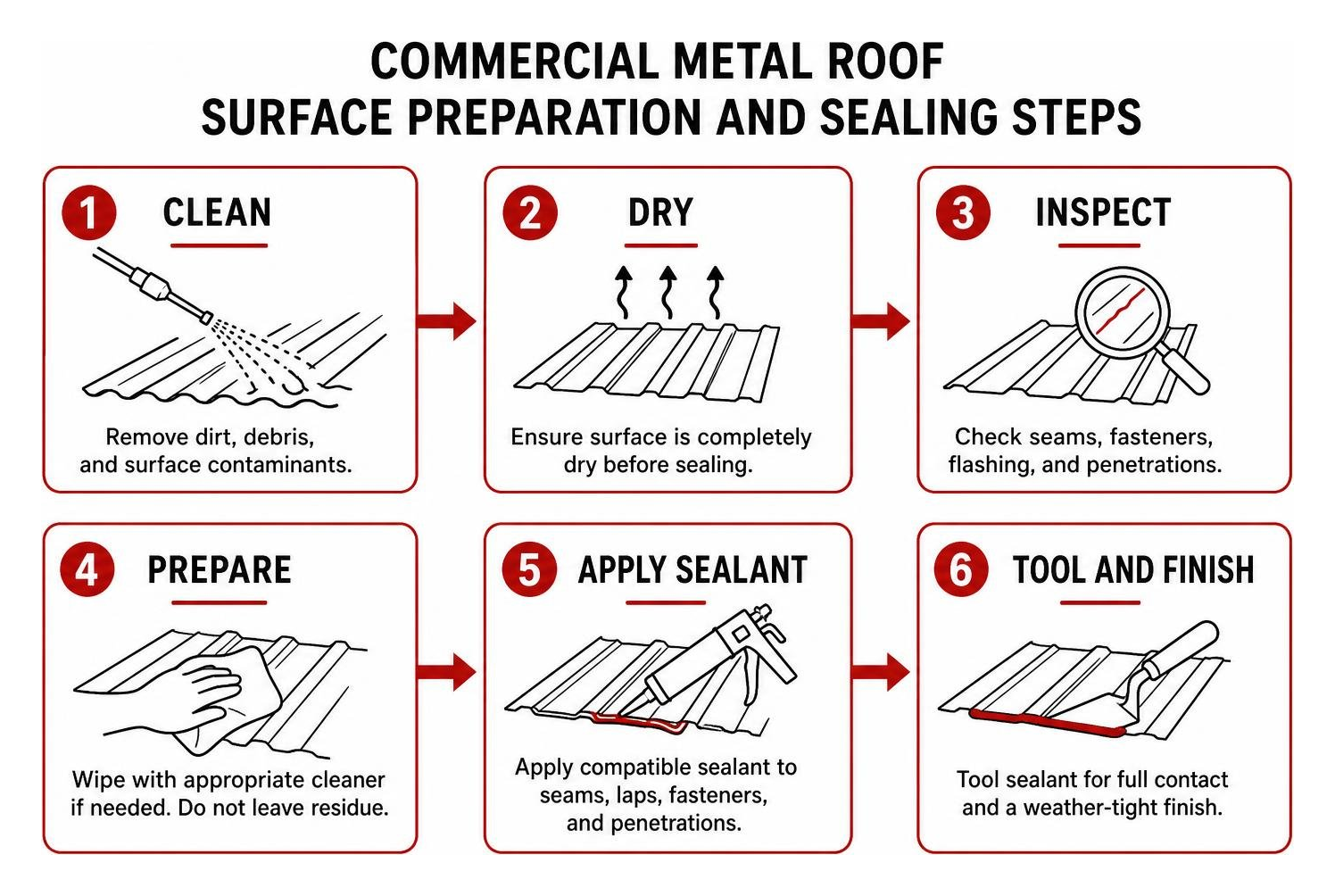
Even the highest-grade polymer chemistry will experience adhesive failure if applied over contaminated, wet, or improperly prepared metal panels. Following systematic restoration protocols ensures metal roof leak repair remains permanent rather than temporary.
Surface Preparation Protocols for Metal Roof Sealant Commercial Roofing Projects
Commercial roof restoration demands rigorous substrate preparation prior to gunning sealant or laying mastic:
- High-Pressure Washing and Degreasing: Wash surfaces at 2,500 to 3,500 PSI using biodegradable cleaners to strip away accumulated industrial soot, airborne oils, biological growth, and chalked factory finishes.
- Failed Sealant Removal: Cut, scrape, and mechanically abrade away dried-out caulks, cracked asphalt patches, and delaminated coatings. Applying fresh sealant over old, failed silicone or tar leads directly to adhesive bond failure.
- Oxidation and Scale Removal: Treat oxidized Galvalume or galvanized steel by wire-brushing loose rust scale down to sound metal.
- Dryness Verification: Ensure the roof substrate is completely moisture-free. While some STPE hybrids can adhere to damp surfaces in emergency settings, optimal commercial adhesion requires dry metal above the dew point to prevent trapping moisture beneath the seal.
Treating Fasteners, Lap Seams, and Penetration Flashings
Applying metal roof sealants on commercial buildings involves three primary joint configurations:
- Fastener Encapsulation: Backed-out, over-driven, or stripped commercial roofing screws represent primary entry points for water. Replace damaged fasteners with oversized commercial screws containing fresh EPDM washers. Then, encapsulate each fastener head completely with a dedicated elastomeric brush-grade sealant or caulk dollop, creating a solid watershed dome.
- Three-Course Reinforcement on Horizontal Lap Seams: For low-slope commercial panel end laps, apply a three-course elastomeric system:
- Apply an initial 30-mil foundation coat of high-performance polymer caulk or liquid coating.
- Embed a stitch-bonded polyester or geo-textile reinforcing membrane spanning 4 to 6 inches across the seam.
- Saturate the membrane immediately with a top layer of sealant/coating, locking the fabric in place to bridge dynamic thermal expansion.
- Penetrations and HVAC Curbs: Mechanical units, vent pipes, and conduit penetrations require flexible sealing boots. Strip old flashings, install split-boot assemblies with stainless steel clamping bands, seal the base flange to the roof profile using hybrid elastomeric sealant, and fasten on 1-inch centers. Consult the ultimate guide to metal roof sealants according to the pros for intricate parapet and wall-flashing junction detailing.
Frequently Asked Questions About Commercial Metal Roof Sealants
Can sealant be applied over surface rust on commercial metal roof panels?
You should never apply standard commercial sealants over loose, flaky, or structural rust scale. However, light surface oxidation and micro-corrosion can be sealed successfully if proper preparation is performed. First, mechanically abrade the surface using wire wheels or abrasive pads to remove all loose rust and scaling.
Next, apply a dedicated rust-inhibiting metal primer or utilize a direct-to-rust restorative coating engineered with active corrosion inhibitors. These specialized primers chemically convert iron oxide into a stable, non-reactive base, creating a sound foundation for the liquid top-sealant to bond with maximum adhesion.
What is the expected lifespan and recoat cycle for commercial sealants?
Lifespans vary depending on chemistry, roof slope, and climate exposure:
- Butyl Tape: When installed in concealed standing seams or protected lap joints, high-grade butyl tape delivers a maintenance-free service life exceeding 35 to 60 years.
- Silicone Sealants and Coatings: Provide an expected service life of 10 to 15 years before requiring a maintenance wash and topcoat refresh.
- STPE Hybrid Polymers: Deliver 15 to 20 years of joint flexibility on exposed dynamic perimeter flashings.
- Waterborne Elastomeric Acrylics: Typically operate on a 5 to 10 year recoat cycle, functioning as an economical, renewable barrier when properly inspected on a semi-annual basis.
How do sealant costs impact the total cost of ownership for commercial metal roofs?
While high-performance commercial sealants (such as STPE hybrids and oxime silicones) carry a higher per-cartridge price than cheap generic caulks, materials account for only 15% to 25% of total commercial restoration labor costs.
Using inferior sealants leads to early joint failures, interior building damage, inventory loss, and recurring emergency service calls. By investing in premium, ASTM C920-rated sealants and multi-course elastomeric restoration systems, commercial property owners can defer full roof replacement by 15 to 20+ years—saving up to 50% to 70% compared to the capital expenditure of tearing off and rebuilding a commercial metal roof.
Conclusion
Preserving the weather-tight integrity of commercial metal roofs across Wisconsin’s demanding climate requires matching the right sealant chemistry to every joint, seam, and flashing detail. From high-altitude wind resistance to extreme freeze-thaw thermal expansion in Appleton, Green Bay, Madison, and Rochester, using high-performance polymers ensures uninterrupted protection.
At Yutzy Roofing Service, LLC, we specialize in comprehensive commercial roof restorations, elastomeric liquid coatings, and long-term preventative maintenance. We protect commercial facilities with proven, renewable, non-prorated commercial warranty options up to 18 years, keeping your building completely dry without the disruption of a costly roof replacement.
To evaluate your facility’s roof seams, flashings, and restorative coating options, explore our comprehensive metal roof sealant complete guide or contact our team today to schedule an expert on-site roof evaluation.
