
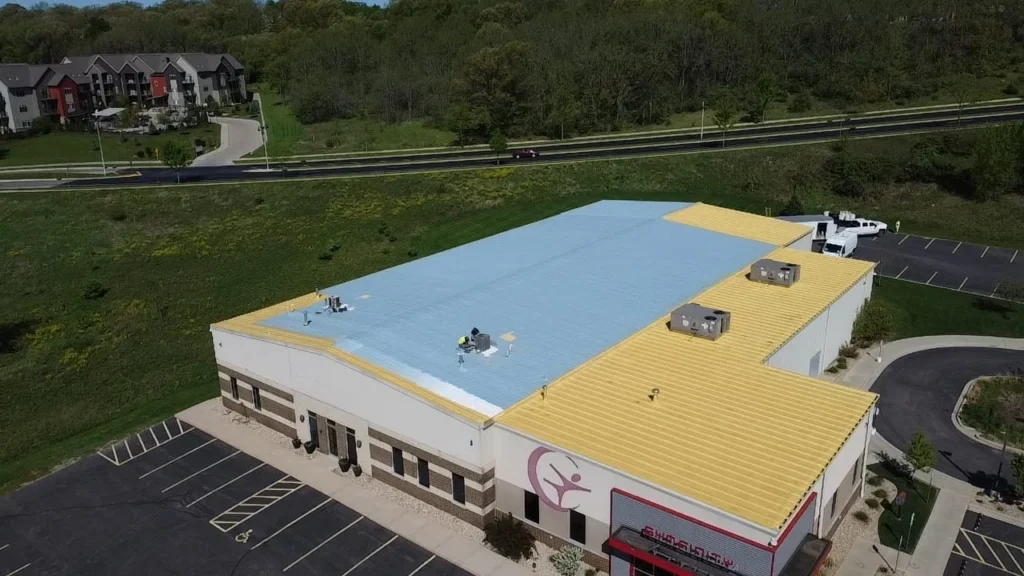
Core Architecture of a Spray Foam Roofing System
The strength of a spray polyurethane foam roof comes from how its layers function together. Rather than relying on mechanical fasteners and glued seams like traditional single-ply membranes (such as TPO or EPDM), an SPF assembly is chemically bonded directly to the underlying roof deck or prepared existing membrane.
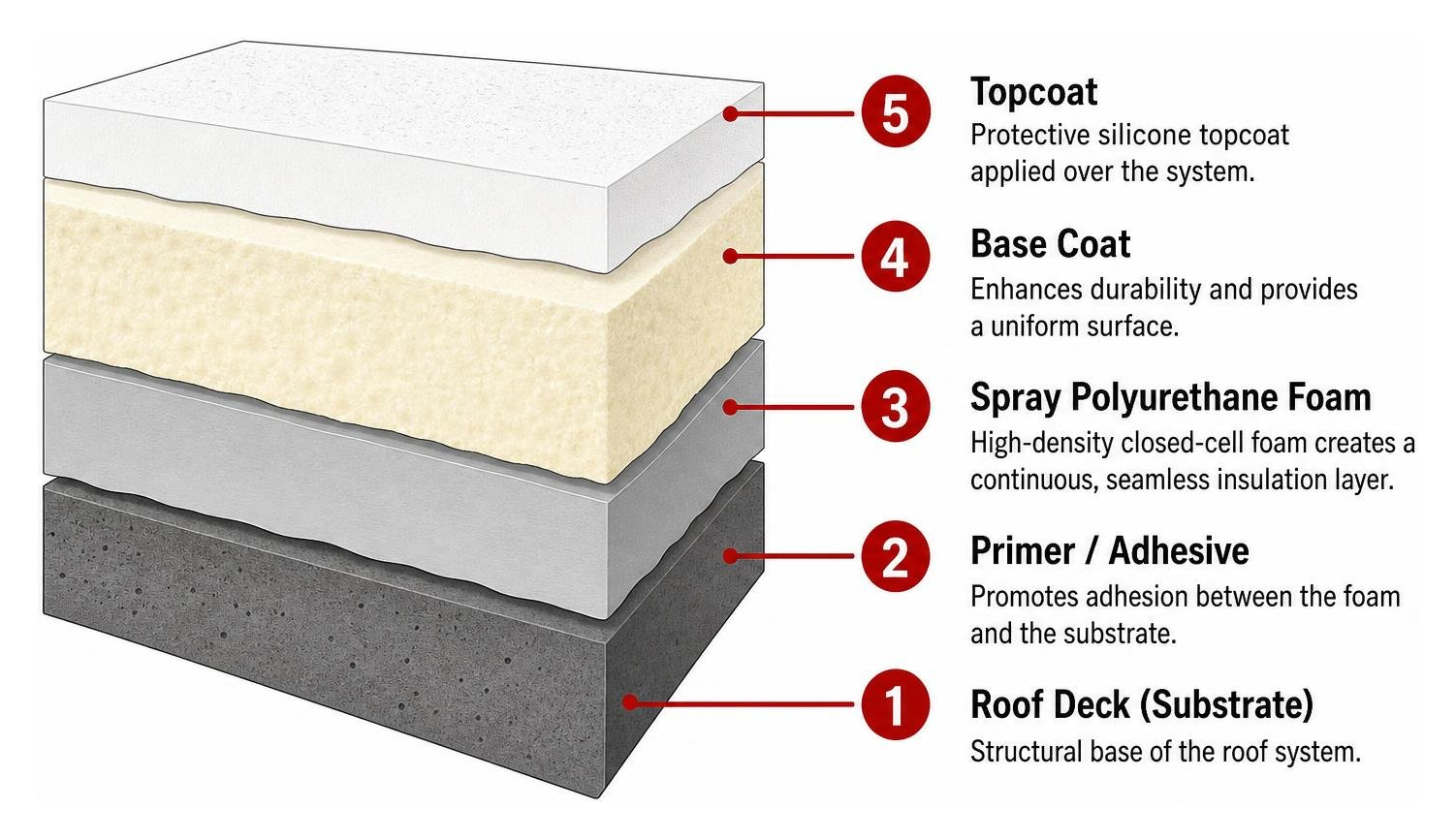
A commercial SPF assembly consists of high-density closed-cell foam that expands 20 to 30 times its liquid volume within seconds of application. This rapid expansion creates a continuous, rigid, self-flashing monolithic barrier over flat and low-slope decks.
Because the foam conforms precisely to pipes, HVAC curbs, parapet walls, and drains, it completely eliminates the flashing seams that account for the vast majority of commercial roof leaks.
Furthermore, the system adds negligible structural loading. A fully coated SPF roof generally adds less than 0.5 pounds per square foot per inch of thickness, allowing building owners to install a complete, high-performance roof recover without exceeding dead-load structural limits.
| Protective Topcoat Chemistry | Elongation & Flexibility | UV & Weather Resistance | Ponding Water Resistance | Ideal Application Environment |
|---|---|---|---|---|
| Silicone | Moderate to High (150%–300%) | Exceptional; does not chalk or degrade under UV | Excellent; handles continuous ponding without softening | Commercial flat roofs with low slope or persistent water ponding |
| Acrylic | High (200%–400%) | High reflectivity; great solar protection | Fair; requires positive drainage to prevent degradation | Well-drained low-slope facilities seeking maximum solar heat reflection |
| Polyurethane (Aromatic/Aliphatic) | Very High tensile strength | Good (with aliphatic topcoat for UV protection) | Excellent; highly durable and impact-resistant | Industrial roofs with heavy mechanical maintenance and foot traffic |
| Polyurea | Extreme (300%–500%+) | High toughness; rapid cure times | Superior; chemical and abrasion resistant | High-abuse industrial settings and extreme chemical-exposure zones |
Closed-Cell Foam Dynamics and R-Value
Commercial roofing applications require specialized closed-cell formulations rather than standard light-density insulation foams. Roofing-grade closed-cell polyurethane foam has an in-place core density between 2.5 and 4.0 lb/ft³, which delivers a compressive strength typically exceeding 40 to 65 psi.
This high density allows the roof to easily support standard foot traffic, routine HVAC maintenance, and rolling loads without crushing the insulation cells.
Advanced commercial spray foam products deliver aged R-values around 6.2 to 6.3 per inch. By sealing air leaks and establishing continuous exterior insulation, facility managers capture substantial benefits of spray polyurethane foam for commercial facilities, often reducing heating and cooling costs by up to 30% to 40%.
Because closed-cell foam exhibits a closed-cell content exceeding 90%, it serves as both an air barrier and a water-impermeable barrier. Even if mechanical damage punctures the surface coating, moisture cannot travel laterally through the roof assembly.
Protective Elastomeric Coating Systems
While closed-cell polyurethane foam delivers structure and thermal insulation, it is vulnerable to ultraviolet (UV) radiation from sunlight. Unprotected foam will slowly degrade and chalk over time when exposed to the sun. To prevent this, applicators apply a durable protective elastomeric coating over the freshly sprayed foam.
The protective coating must be applied within 24 hours of foam installation to prevent surface degradation. Total coating dry film thickness (DFT) generally ranges between 20 and 40 mils, depending on the specified warranty length and system requirements.
For added protection against hail, bird pecks, and heavy maintenance foot traffic, roofing crews often embed ceramic granules or aggregate into the wet base or intermediate coating pass. These granules increase puncture resistance and enhance surface traction during damp maintenance checks.
Commercial Performance and Environmental Durability
Understanding the structural realities and the pros and cons of SPF roofing for commercial properties helps property managers select the appropriate roofing assembly. Because SPF expands and adheres as a continuous liquid-applied material, it moves naturally with thermal building expansion and contraction cycles rather than tearing at fastened joints.
Hail, Wind Uplift, and Fire Resistance
Commercial roofs must withstand severe storm conditions. SPF assemblies undergo stringent testing to verify structural resistance under extreme environmental stress:
- Hail Impact Resistance: Evaluated under Factory Mutual (FM) 4470, closed-cell foam absorbs and dissipates the impact energy of hailstones. Even during severe hailstorms, minor surface dimpling can be easily repaired with compatible elastomeric caulk without requiring a complete roof replacement.
- Wind Uplift Resistance: Traditional mechanically attached single-ply membranes rely on perimeter fasteners that can pull free during heavy wind events. SPF is fully adhered across 100% of the roof surface. Field and laboratory tests show that wind uplift resistance of SPF applied directly to a clean structural concrete deck can reach approximately 900 psf, consistently exceeding FM 4474 wind uplift thresholds.
- Fire Safety Ratings: SPF roof assemblies meet Class A external fire ratings under ASTM E108 and UL 790 when installed with approved elastomeric coatings. Furthermore, standard testing ensures compliance with ASTM E84 flame-spread standards.
Federal and military construction projects outline strict quality parameters in UFGS 07 57 13 Sprayed Polyurethane Foam Roofing specifications, highlighting SPF as an approved system for complex shapes, critical low-slope operations, and long-term asset security.
Maximizing Life Expectancy of Your Spray Foam Roofing System
Unlike single-ply membranes that must eventually be torn off and sent to landfills when their seams fail, a spray foam roofing system is renewable. The underlying closed-cell foam does not break down unless exposed to UV light.
By following a long-term spray polyurethane foam performance guide, commercial building owners can expect their systems to last 40 or more years. Achieving this longevity requires three core practices:
- Bi-Annual Inspections: Conduct routine roof walk-throughs in spring and autumn to clear drain strainers, check HVAC flashing perimeters, and clear windborne debris.
- Thermal Moisture Scanning: Periodic infrared thermography confirms that roof insulation remains dry and structurally sound.
- Scheduled Recoats: Elastomeric coatings naturally wear down over 10 to 20 years. Pressure washing the aged coating and applying a fresh topcoat restores the original millage, renewing the manufacturer warranty without tearing off the foam.
Professional Application and Quality Standards
Applying spray foam is both a science and a trade craft. Because the chemical reaction takes place right on your commercial roof deck, specialized equipment and environmental controls are necessary.
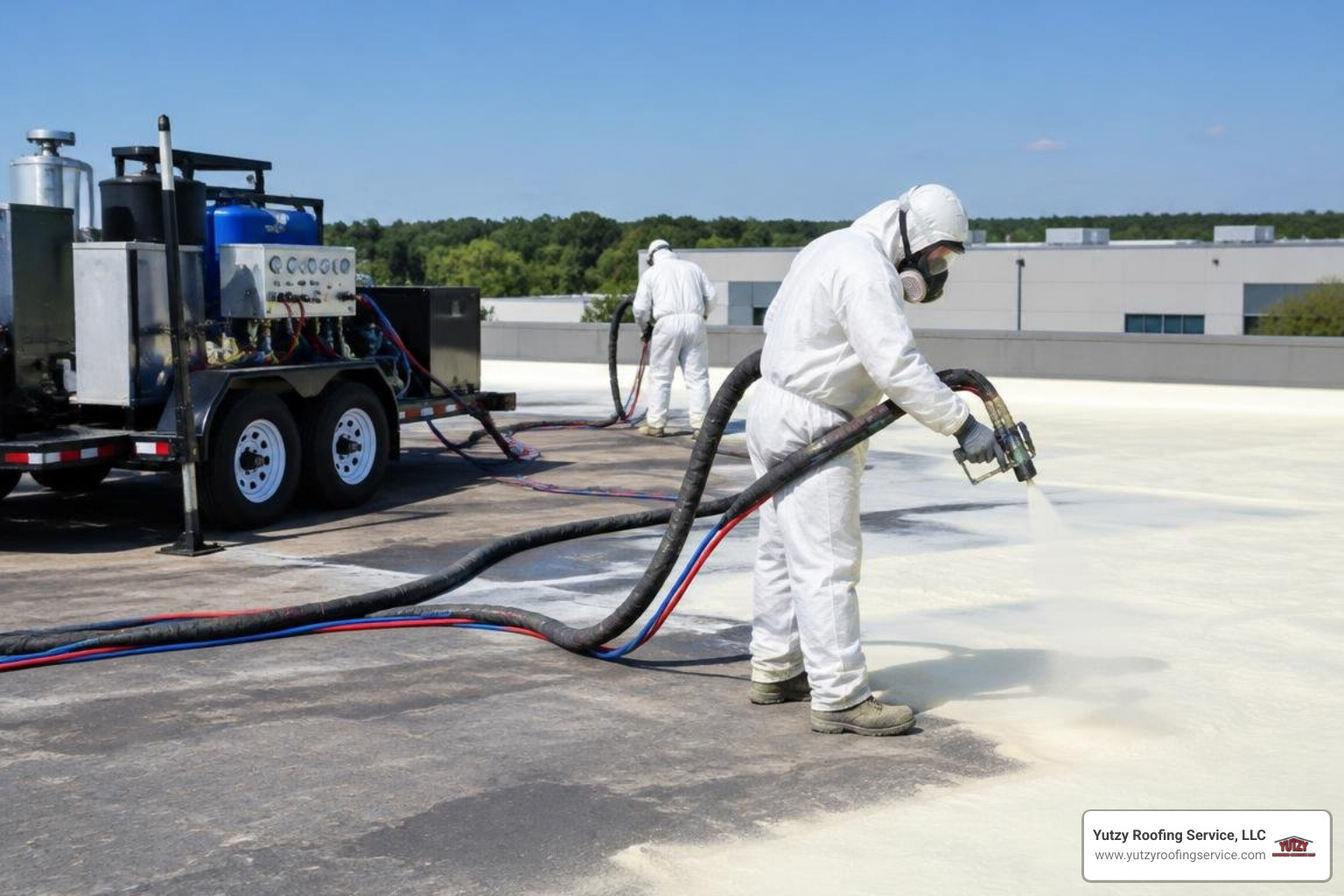
Crews utilize mobile processing rigs equipped with high-pressure proportioner units, heated hoses (often extending hundreds of feet to the roof surface), and specialized impingement spray guns. Liquid A-side (polymeric isocyanate) and B-side (resin blend containing polyols, catalysts, and modern low-GWP HFO blowing agents) are pumped separately, preheated, and mixed at the spray gun tip at pressures exceeding 1,000 psi.
Applicators must monitor ambient conditions carefully, especially when navigating regional climate considerations for commercial SPF roofs. Installation parameters include:
- Substrate Temperature: Must be between 50°F (10°C) and 130°F (54°C) with dry surfaces.
- Moisture Limits: Foam must never be applied over dew, frost, or unevaporated rainwater; surface moisture testing ensures solid chemical adhesion.
- Wind Velocity: Ambient winds must be below 15 to 25 mph, with windscreens deployed to prevent liquid overspray onto nearby vehicles or adjacent structures.
Precision Installation Process for a Spray Foam Roofing System
Applying an SPF roof follows a structured, step-by-step installation sequence to ensure long-term adhesion and weatherproofing:
- Substrate Preparation: The existing roof is swept and power-washed to remove all grease, dust, and loose contaminants. Any areas of saturated insulation are removed and patched level. If performing a commercial metal roof restoration with SPF, fastener tightness and seam stability are verified.
- Primer Application: When working over specific surfaces like aged metal, concrete, or single-ply membranes, an adhesion-promoting primer is rolled or sprayed down.
- Foam Spraying: The applicator sprays the polyurethane foam in uniform passes between 0.5 inches and 1.5 inches per lift, building to the specified minimum thickness (typically 1.0 to 1.5 inches). Crews can also build up extra foam thickness in low areas to correct water ponding and improve roof drainage toward scuppers and drains.
- Base Coating: Within 24 hours of curing, a base pass of elastomeric coating is applied across the foam to seal the surface.
- Topcoat and Granule Broadcast: The final UV-reflective topcoat is sprayed, and ceramic roofing granules are embedded to provide long-term abrasion resistance.
Code Compliance and Contractor Qualifications
Commercial spray foam roofing systems are recognized in model building codes, including 2015/2021 IBC Section 1507.14 and IRC Section R905.14. To ensure compliance, commercial building owners should verify that their contractor holds active certification through the Spray Polyurethane Foam Alliance (SPFA) Professional Certification Program (PCP).
Certified contractors maintain daily on-site quality control logs tracking ambient temperature, relative humidity, dew point, foam core density, adhesion pull-tests, and coating dry film thickness (DFT).
Frequently Asked Questions About Commercial SPF Roofs
How long does a commercial spray foam roof last?
With regular inspections and scheduled recoating every 10 to 20 years, an SPF roof can last 40 or more years. Because the closed-cell foam base remains protected beneath the UV-resistant elastomeric coating, the insulation layer does not naturally degrade, making the roof a renewable asset.
Can spray foam be applied over existing commercial roof substrates?
Yes. SPF is well suited for roof recover applications over built-up roofs (BUR), modified bitumen, metal decks, concrete, and single-ply membranes like EPDM and TPO. Because it adds less than 0.5 lbs per square foot per inch, it eliminates the labor costs, business downtime, and landfill fees associated with a full structural tear-off.
What maintenance is required to maintain coating warranties?
Standard commercial warranties require semi-annual roof inspections (in spring and fall) and prompt cleanup after major hail or severe storm events. Maintenance involves keeping roof drains clear of debris, sealing accidental punctures or mechanical cuts with compatible elastomeric caulk, and scheduling topcoat re-application before the existing coating wears thin.
Conclusion
A well-installed spray foam roofing system provides seamless waterproofing, high thermal efficiency, and long-term durability for commercial facilities. By eliminating leak-prone seams, correcting low-slope drainage, and delivering continuous exterior insulation, an SPF roof protects your building asset while lowering overall utility costs.
At Yutzy Roofing Service, we install high-performance commercial spray foam roofing systems backed by up to 18-year non-prorated renewable warranties. Whether your commercial facility is located in Madison, Appleton, Wausau, Eau Claire, Fond Du Lac, Green Bay, Marshfield, Mankato, or Rochester, our team is ready to help you evaluate your roof.
Contact Yutzy Roofing Service today to schedule a comprehensive roof assessment and discover how a seamless spray foam system can protect your facility for decades to come.
