What You Need to Know About Roof Coating in 2026
A roof coating is a liquid-applied protective layer that bonds to your existing roof surface — sealing leaks, reflecting heat, and adding years of life without tearing off what’s already there.
Here’s what commercial property owners need to know at a glance:
| Question | Quick Answer |
|---|---|
| What is it? | A thick, elastic liquid membrane applied over an existing roof |
| Who is it for? | Commercial and industrial buildings with low-slope or flat roofs |
| Main benefits | Waterproofing, energy savings, extended roof life, less waste |
| Common types | Acrylic, silicone, polyurethane, asphalt, aluminum |
| How long does it last? | Typically 5–20 years depending on product and maintenance |
| Cost vs. replacement? | Significantly cheaper — avoids tear-off labor and landfill costs |
If your commercial roof in Wisconsin is showing wear — cracked seams, minor leaks, or heat loss — you’re likely weighing two options: a costly full replacement or a smarter, more affordable restoration. For many building owners, a quality roof coating is the answer that gets overlooked.
Wisconsin’s climate is brutal on commercial roofs. Freeze-thaw cycles crack membranes. Summer heat degrades seams. And every year without action compounds the damage. The good news? A properly applied coating can stop that cycle before it forces a full tear-off.
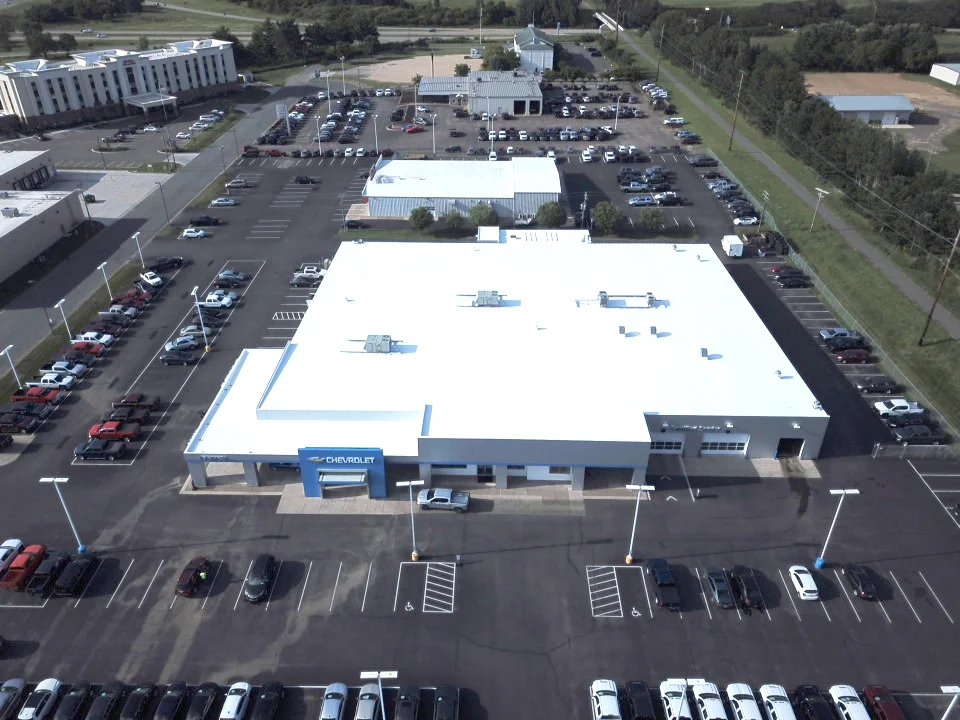
According to industry data, reflective roof coatings can keep a roof surface up to 55°F cooler than an uncoated roof on a summer afternoon — and can cut HVAC energy use by as much as 50%. At the same time, they help divert roofing waste from landfills, where roofing materials already rank as the third-largest contributor to landfill waste nationwide.
I’m Josh Yutzy, and our family business has been protecting commercial roofs across Wisconsin, Missouri, and Kansas since 1995 — including hands-on experience with roof coating systems for flat and low-slope commercial buildings. In this guide, I’ll walk you through everything you need to make a confident coating decision for your property.
What Roof Coating Is and How It Protects Commercial Roofs
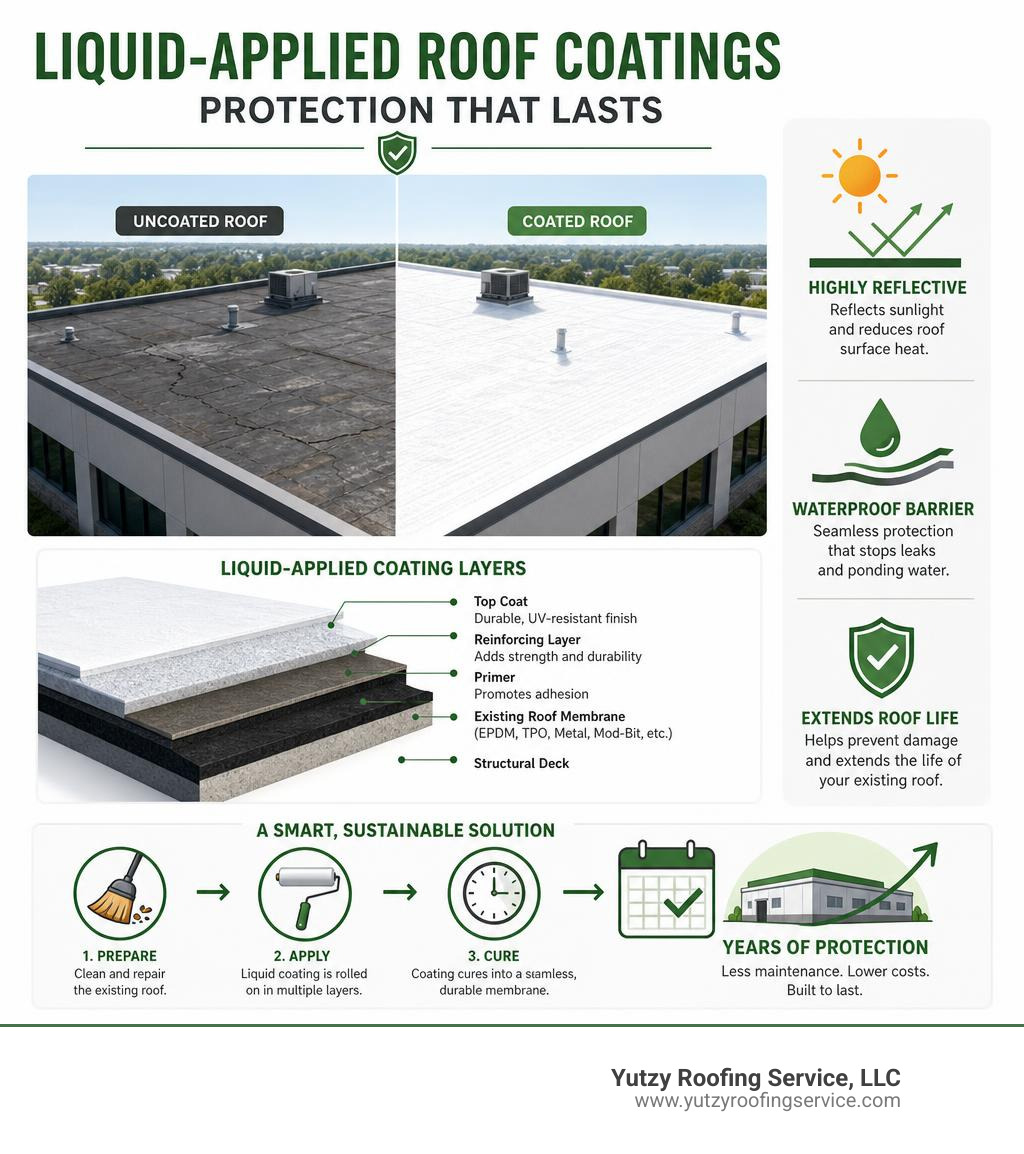
At its core, a roof coating is not just paint. It is a highly engineered, liquid-applied protective membrane that cures into a seamless, rubber-like barrier over your existing commercial roof. Formulated with elastomeric resins, these systems are designed to withstand extreme UV radiation, shed water effortlessly, and accommodate the natural expansion and contraction (thermal movement) of your building.
For commercial and industrial facilities with flat or low-slope roofing systems, coatings serve as a powerful restoration strategy. Instead of paying for an expensive and disruptive tear-off, applying a high-quality maintenance coating allows us to extend the life of your existing roof structure while providing immediate waterproofing protection.
How roof coating forms a waterproof membrane
When we apply a liquid roof coating, it starts as a thick fluid that flows into every nook, cranny, and microscopic crack on your roof’s surface. As it cures, it forms a continuous, monolithic dry film. Unlike traditional roofing sheets, which rely on glued or welded seams, a coated roof has absolutely zero seams.
This seamless nature is crucial because seams are historically the first place a commercial roof fails. During application, we pay special attention to critical details:
- Dry Film Thickness (DFT): We measure the application rate in “wet mils” to ensure that once cured, the dry film thickness meets the manufacturer’s strict specifications for long-term waterproofing.
- Detailing Seams and Flashings: Before coating the entire field, we seal all seams, penetrations, fasteners, and flashing details using specialized flashing grade sealants or a reinforced fabric mesh embedded between layers of coating.
- Elastic Movement: High-quality elastomeric coatings can achieve incredible elasticity—sometimes up to 600% to 1200% elongation depending on the formulation. This allows the membrane to stretch during freezing Wisconsin winters and contract during hot summers without cracking or losing adhesion.
To make sure the membrane bonds permanently, we always perform adhesion testing before starting a project. This ensures the chemistry of the coating matches perfectly with your existing roof substrate.
Roof coating vs. paint: why thickness and solids matter
It is a common misconception that a roof coating is simply “thick white paint.” In reality, they are entirely different chemical beasts.
Paint is designed primarily for aesthetics. It is thin, rigid, and has low solids content, meaning most of the liquid evaporates into the air as it dries, leaving a very thin film behind. A roof coating is formulated with premium resins and a high percentage of solids (often 70% to 95% or more in high-solids formulations).
| Feature | Standard Exterior Paint | Premium Roof Coating |
|---|---|---|
| Solids by Volume | Typically 30% to 40% | 50% to 95%+ |
| Application Rate | ~1 gallon per 400 sq. ft. | 1.5 to 3+ gallons per 100 sq. ft. |
| Dry Film Thickness | 1 to 2 mils | 15 to 30+ mils |
| Elongation (Stretch) | Minimal (cracks easily) | 150% to 1200% (moves with roof) |
| Tensile Strength | Low | High (resists tears and hail) |
This massive difference in solids content means that a roof coating leaves behind a thick, durable, rubbery layer of dry waterproofing that can handle foot traffic, thermal shock, and constant exposure to the elements.
When roof coating is not the right solution
As much as we love the benefits of roof restoration, we are always honest with our clients: coatings are not a magic wand for a completely ruined roof. There are times when a coating is simply not the right solution, and attempting to apply one would be a waste of your hard-earned money.
A roof is a poor candidate for coating if it has:
- Severe Structural Damage: If the metal decking or wood structure beneath the roof membrane has rotted, sagged, or failed, a coating cannot restore its structural integrity.
- Saturated Insulation: If water has bypassed the outer membrane and soaked the underlying insulation boards, sealing that moisture inside with a coating will rot the deck from the inside out and cause the coating to blister and fail.
- Severe Ponding on Unsuitable Substrates: While some coatings handle standing water well, applying standard coatings over a roof with major structural drainage issues is a recipe for disaster.
- Adhesion Failure: If the existing roof membrane is too degraded, chalky, or dirty to pass an adhesion test even after deep cleaning and priming, a coating will not stick.
To avoid these pitfalls, we always conduct a professional inspection, which may include core sampling or infrared moisture scans, to ensure your roof is structurally sound and dry before recommending a restoration system.
Types of Coatings and Compatible Commercial Roof Surfaces
Choosing the right chemistry is the most important decision in any roof restoration project. Different coatings excel in different environments, and matching the coating to your specific roof substrate is key to a successful application.
| Coating Type | Best For | Key Advantage | Ponding Water Resistance | Relative Cost |
|---|---|---|---|---|
| Acrylic | Metal roofs, sloped roofs, budget-friendly projects | High reflectivity, easy cleanup, low VOCs | Poor (not for flat roofs) | $ |
| Silicone | Flat roofs, low-slope roofs, ponding areas | Exceptional water resistance, one-coat application | Excellent | $$$ |
| Polyurethane | High foot-traffic areas, hail-prone zones | Extreme impact and tear resistance | Good | $$$ |
| Asphalt / Aluminum | Smooth BUR, modified bitumen | Traditional durability, cost-effective | Moderate | $$ |
Acrylic coatings for reflectivity and cost control
Acrylic roof coatings are water-based elastomeric systems that have been popular for decades. Formulated to meet or exceed strict standards like ASTM D6083, they offer fantastic UV reflectivity and are highly cost-effective.
Because they are water-based, they have very low VOC (volatile organic compound) levels and a low odor during application, making them excellent for sensitive environments like hospitals, schools, and retail centers. However, acrylics cure through evaporation, meaning they require warm, dry weather to cure properly. Because they can re-emulsify (soften) under standing water, they should only be used on roofs with positive drainage and no history of ponding.
Silicone coatings for ponding water and durable waterproofing
If your commercial building has a flat roof where rainwater tends to sit for days, silicone is the gold standard. High-solids silicone roof coatings are moisture-cured systems, meaning they actually use moisture in the air to trigger the curing process.
Once cured, silicone forms a highly durable, slick, and completely waterproof membrane that is unaffected by ponding water. It will not degrade or soften under standing water, and it offers unmatched UV stability, meaning it won’t chalk or break down over decades of intense sunlight. Many premium silicone systems can even be applied in a single thick coat, saving significantly on labor.
Asphalt, aluminum, and polyurethane coatings for specialized needs
For specialized commercial needs, other chemistries come into play:
- Asphalt Emulsions: These are clay-stabilized, water-based asphalt coatings used as a heavy-bodied base coat to fill cracks and smooth out rough surfaces on built-up roofing (BUR) or modified bitumen systems.
- Aluminum Reflective Coatings: A classic choice for asphaltic roofs, these coatings combine asphalt binders with aluminum flakes to provide a bright, reflective metallic finish that protects the underlying asphalt from UV degradation.
- Polyurethane Coatings: Typically applied in a multi-coat system (a flexible aromatic polyurethane base coat for waterproofing, topped with an aliphatic polyurethane top coat for UV resistance), urethanes offer incredible tensile strength, tear resistance, and hardness. They are the ideal choice for roofs that experience heavy foot traffic, mechanical maintenance, or frequent hail.
Compatible surfaces for commercial coating systems
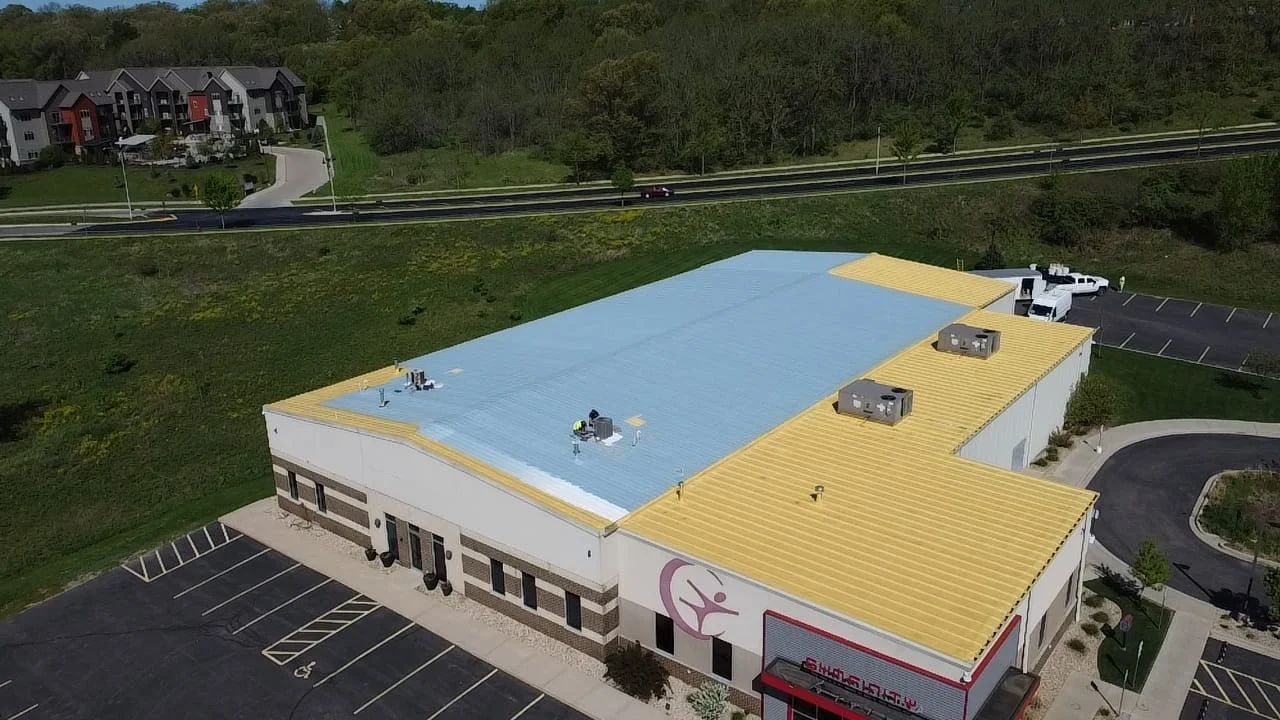
Commercial roof coatings are incredibly versatile and can be applied over a wide range of existing roof systems, provided the surface is properly prepared and the correct primers are used:
- Metal Roofs: Excellent for stopping rust and sealing fasteners.
- EPDM (Rubber): Requires a specialized primer to ensure the coating bonds to the synthetic rubber. Check out our waterproofing guide for flat coatings to learn more about protecting rubber membranes.
- TPO and PVC (Single-Ply): Aged single-ply membranes are perfect candidates for restoration, though they often require specific adhesion-promoting primers.
- BUR and Modified Bitumen: Smooth or granulated asphaltic roofs can be restored beautifully, often using an asphalt emulsion base coat followed by an acrylic or silicone top coat.
- Concrete and Spray Polyurethane Foam (SPF): Coatings provide the vital UV protection that SPF roofs require to prevent degradation.
Energy, Waterproofing, and Environmental Benefits of Reflective Coatings
Opting for a cool roof restoration isn’t just about stopping leaks—it’s also a highly effective way to slash your building’s operating costs and reduce your environmental footprint.
How reflective coatings reduce heat and cooling costs

Traditional dark commercial roofs act like giant radiators, absorbing up to 90% of solar radiation and transferring that heat directly into your building. On a hot 90°F summer day in Wisconsin, an uncoated gray or black roof surface can easily reach temperatures of 150°F to 180°F.
By applying a highly reflective white roof coating, the roof surface reflects 80% or more of sunlight. This keeps the roof surface up to 55°F cooler than a traditional roof.
This drastic temperature drop has immediate benefits:
- Reduced HVAC Load: Your air conditioning units don’t have to work nearly as hard to keep the building cool, reducing energy wear-and-tear.
- Lower Energy Bills: Cool roof coatings can reduce HVAC energy use by up to 50% during peak summer months.
- Extended Equipment Life: Because your rooftop HVAC units are drawing in cooler air from a reflective roof surface rather than superheated air from a black membrane, they run more efficiently and last longer.
How coatings reduce urban heat island impact
When hundreds of dark roofs and asphalt parking lots in a city absorb heat, they create what is known as the “urban heat island effect,” making urban areas significantly warmer than surrounding rural landscapes.
By restoring commercial roofs with highly reflective, high-emissivity coatings, we help lower localized city temperatures, reduce smog formation, and ease the strain on the local electrical grid during peak demand times. It’s a simple way for local businesses to directly lower their carbon footprint.
How restoration compares to tear-off replacement
A full roof replacement is a massive undertaking. It involves high labor costs, noisy tear-off processes that can disrupt your daily business operations, and significant landfill fees.
From an environmental standpoint, the numbers are staggering: roofing materials are the third-largest contributor to waste in landfills. Applying a commercial roof coating allows us to extend the life of your existing, structurally sound roof, preventing millions of pounds of roofing waste from entering landfills. In fact, roof coatings help prevent 2.5 billion square feet of roofing waste from entering landfills each year.
To learn more about how a simple coating can protect your bottom line and the planet, read our article on the 7 coating and sealant advantages.
How to Choose, Apply, and Maintain the Right Coating System
A successful roof restoration project relies on careful planning, proper material selection, and meticulous execution.
Key selection factors before specifying a system
Before we specify a coating system for your building, we evaluate several key factors:
- Existing Roof Substrate: Is it metal, EPDM, TPO, or built-up asphalt?
- Roof Slope and Drainage: Does the roof drain quickly, or are there areas of standing (ponding) water?
- Local Climate: In Wisconsin cities like Madison, Appleton, and Wausau, roofs must endure heavy snow loads, freezing temperatures, and hot summers.
- Foot Traffic: Does your roof host frequent HVAC maintenance traffic?
- Warranty Requirements: Are you looking for a short-term 5-year leak-free guarantee, or a premium, renewable 10-to-18-year non-prorated system warranty?
Application methods and surface preparation
A roof coating is only as good as the prep work beneath it. In fact, we spend about 75% of our time on any project preparing the surface before a single gallon of coating is applied.
Our step-by-step process includes:
- Deep Cleaning: We pressure-wash the roof to remove dirt, mold, grease, and loose debris. Any residual dirt will ruin the coating’s ability to bond.
- Rust Treatment: For metal roofs, we treat and prime any rusted areas to stop corrosion in its tracks.
- Seam and Detail Repair: We reinforce all seams, flashings, and penetrations using heavy-duty elastomeric flashing compounds and polyester reinforcement fabric.
- Priming: If required by the substrate (such as EPDM or TPO), we apply an adhesion-promoting primer.
- Coating Application: Depending on the project, we apply the coating using professional airless spray equipment for a seamless finish, or heavy-duty rollers and brushes for smaller or highly detailed areas. We use wet mil gauges constantly during application to ensure the coating is applied at the exact thickness required for the warranty.
For more details on keeping your restored roof in peak condition, check out our flat roof coating maintenance planning guide.
Premium high-solids vs. standard coatings
While it may be tempting to opt for a cheaper, standard-grade coating, premium high-solids coatings are almost always the smarter investment for commercial properties.
Standard coatings often contain a high percentage of water or solvents that evaporate during the curing process, meaning you have to apply multiple coats to achieve the desired dry film thickness. Premium high-solids coatings (especially high-solids silicones) lose very little volume during curing. This allows us to apply a thicker, more durable waterproof membrane in fewer coats, saving on labor and providing superior long-term protection against UV rays, physical impacts, and ponding water.
Lifespan, inspections, and maintenance requirements
A professionally applied commercial roof coating system typically lasts between 10 to 20 years depending on the dry film thickness applied. The best part? These systems are completely renewable. Before the original warranty expires, the roof can be cleaned and top-coated with a thin maintenance layer, extending the warranty and protection for another decade or more.
To maximize this lifespan, we recommend simple maintenance:
- Annual Inspections: Inspect the roof in the spring and fall to clear debris, clean out drains, and check for any physical damage from wind or rooftop service technicians.
- Post-Storm Checks: Look for hail damage or debris that could puncture the membrane.
- Prompt Repairs: If a technician drops a tool and punctures the coating, the spot can be easily patched in minutes using a compatible elastomeric sealant.
Where to purchase quality coatings and when to hire a contractor
While basic roof sealants are available at local hardware stores, commercial-grade restoration systems require professional-grade materials from top industrial manufacturers. Brands like Conklin offer highly engineered, ASTM-tested, and CRRC-rated coating systems that are only available to manufacturer-approved, factory-trained applicators.
While some small-scale repairs can be handled by a maintenance team, restoring an entire commercial roof is not a DIY job. It requires specialized high-pressure airless sprayers, precise moisture-detection equipment, and experienced technicians who know how to handle complex flashing details without disrupting your daily operations. For local context on professional coating applications, you can read about specialized coating services in Wisconsin, such as the regional coating supply context in Fond du Lac.
Frequently Asked Questions
Can roof coating stop leaks?
Yes, a professionally applied roof coating is highly effective at stopping leaks, particularly those caused by failing seams, degraded flashings, or backing-out fasteners on metal roofs. However, if your roof has active leaks that have already saturated the underlying insulation, those wet areas must be cut out and replaced before any coating can be applied.
How long does a coating system last?
A standard commercial roof coating system lasts between 10 and 20 years. The exact lifespan depends on the type of coating chemistry used, the dry film thickness applied, and whether the roof receives regular basic maintenance. Because the system is renewable, you can simply recoat the roof at the end of its service life to start the clock over again.
Is coating cheaper than replacement?
Absolutely. A professional roof restoration using elastomeric coatings typically costs 50% to 70% less than a full roof tear-off and replacement. It avoids the high labor costs of tear-off, eliminates expensive landfill disposal fees, reduces your heating and cooling bills immediately, and allows your business to remain fully open and operational during the entire application process.
Conclusion
Restoring your commercial roof with a high-quality roof coating is one of the smartest, most cost-effective, and environmentally friendly decisions you can make for your property in 2026. By avoiding the massive disruption and expense of a full tear-off, you can secure a seamless, waterproof barrier that slashes your energy costs and keeps your building safe from Wisconsin’s unpredictable weather.
At Yutzy Roofing Service, LLC, we specialize in high-performance commercial roofing restoration, spray foam coatings, metal roof restoration, EPDM repairs, and custom maintenance plans. We are proud to back our work with an industry-leading, up to 18-year non-prorated renewable warranty, serving commercial clients across Wisconsin—including Madison, Appleton, Wausau, Marshfield, Eau Claire, Fond Du Lac, and Green Bay—as well as Mankato and Rochester, MN.
If you’re ready to stop leaks, lower your energy bills, and save your roof, we’d love to help. To learn more about how a cool roof can benefit your specific property, explore commercial coating benefits in Madison WI or contact us today to schedule your professional roof inspection!
