What to Do When a Commercial Flat Roof Leaks
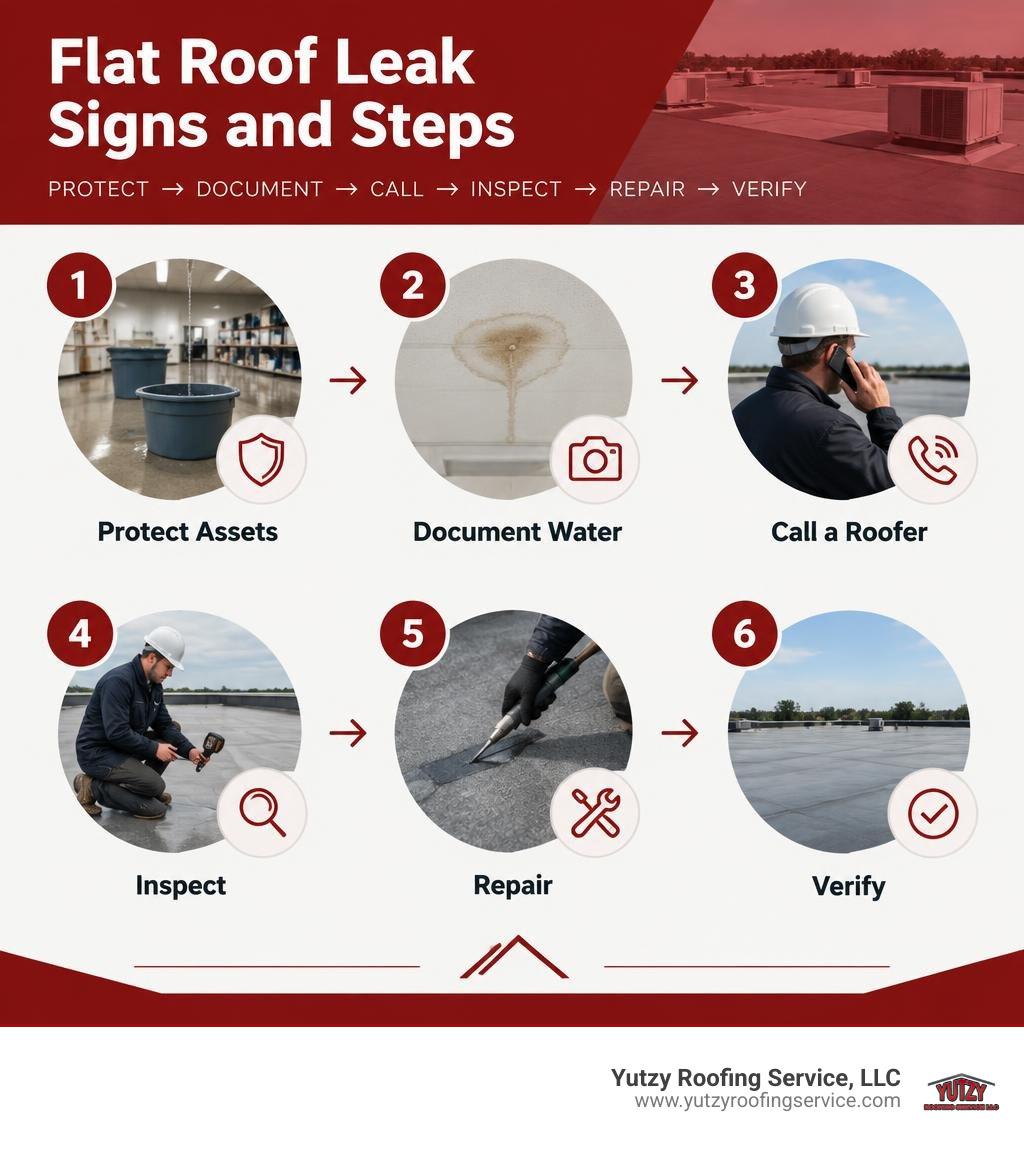
For commercial flat roof leak repair, first protect people, equipment, and inventory beneath the leak. Document where water appears, then call a commercial roofer to trace its source. A lasting repair may require removing wet insulation, fixing the damaged membrane or flashing, and checking that the area no longer leaks.
The stain on a ceiling may be far from the roof opening. That is why a patch without a proper inspection can leave hidden moisture behind. For Wisconsin property managers, a prompt diagnosis can help limit damage and business disruption.
I’m Josh Yutzy, part of the family behind Yutzy Roofing Service, which has served Wisconsin since 1995. I draw on our commercial flat roof leak repair work to help property managers understand the next steps.
Commercial Flat Roof Leak Repair: Professional Diagnosis and Execution
When water penetrates a commercial facility, locating the exact breach requires precision. Water travels along structural purlins, conduits, and deck flutes before revealing itself below, meaning an interior drip rarely sits directly beneath the roof puncture. A certified commercial roofing contractor uses advanced diagnostic methods to track this moisture path back to its origin.
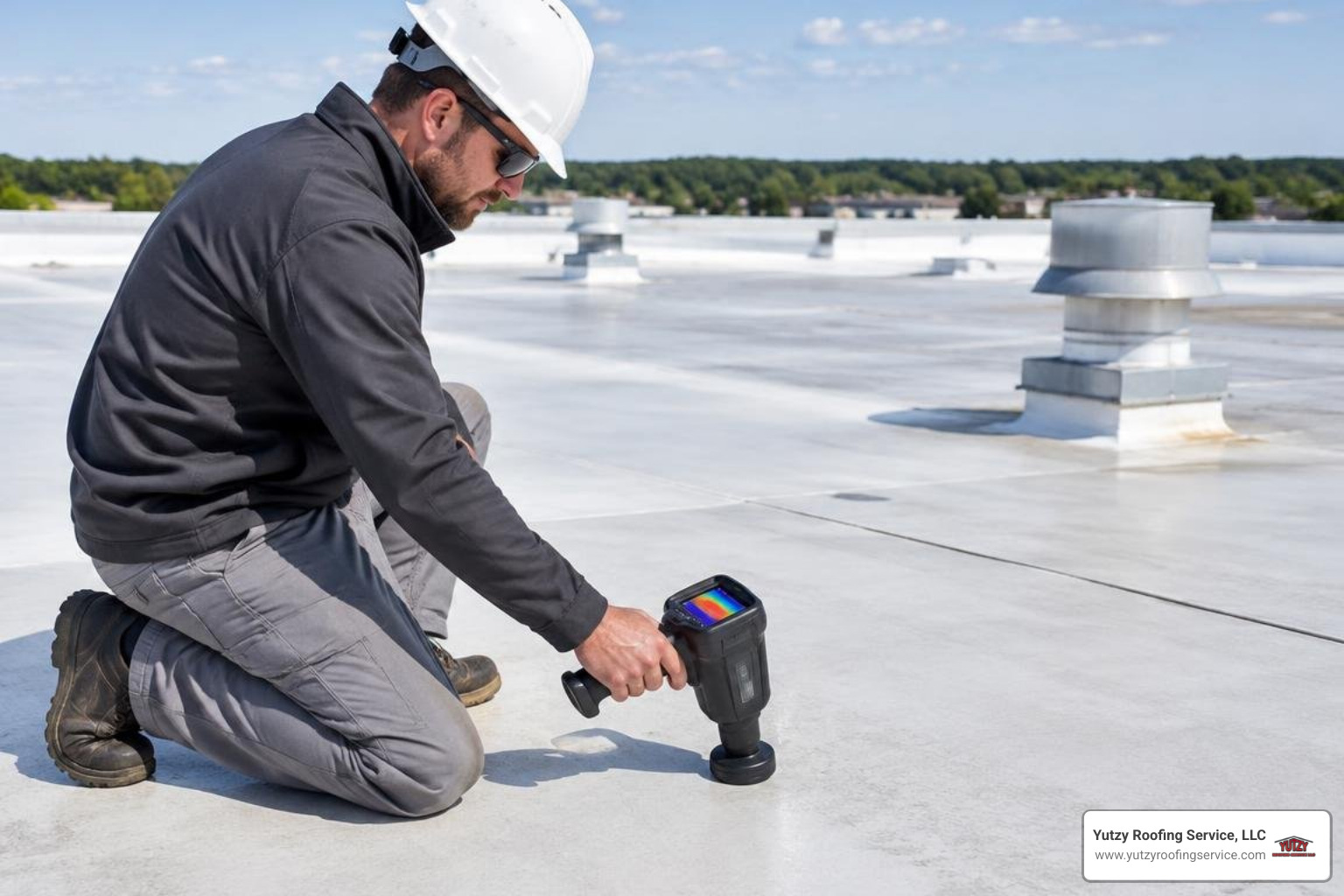
A thorough assessment often includes an infrared moisture scan, non-destructive moisture meters, and visual inspections of critical flashings, parapet walls, and seams. When managing facility health, reviewing commercial roof repair: what to know helps set realistic expectations for structural assessments. Moisture scanning reveals saturated sub-layers that are completely invisible from the surface, ensuring no compromised decking or soaked polyiso boards are left behind.
Ignoring early warning signs leads to rapid structural decay and compromised air quality. Understanding the critical importance of commercial roof leak repair explained underscores why temporary exterior patches often fail: trapped water continues to rot the decking from within. The National Roofing Contractors Association emphasizes comprehensive evaluations to preserve commercial building envelopes and maintain manufacturer standards over decades of service.
Critical Steps in Commercial Flat Roof Leak Repair
A professional repair goes far beyond applying a coat of sealant over a crack. Commercial diagnostic protocols follow an exact sequence to restore long-term watertight performance:
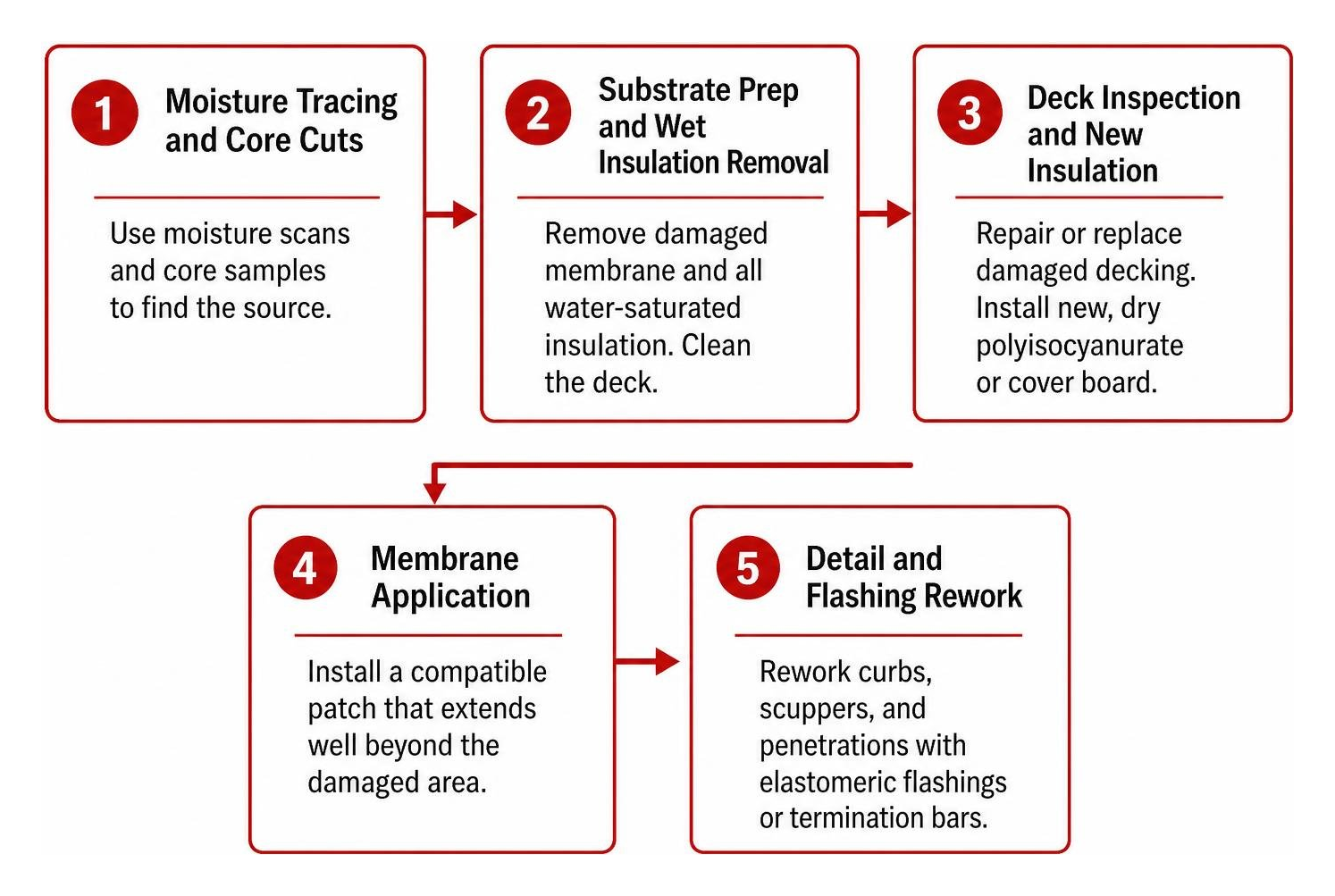
- Moisture Tracing and Core Cuts: Technicians conduct non-destructive testing and take core samples when necessary to verify the depth of water penetration.
- Substrate Prep and Wet Insulation Removal: The contractor cuts out the compromised membrane, removes all water-saturated insulation, and cleans the exposed structural deck.
- Deck Inspection and New Insulation: Any corroded steel or degraded wood decking is treated or replaced, followed by closely fitted, dry polyisocyanurate or cover board.
- Membrane Application: A compatible patch—whether heat-welded single-ply, adhesive-bonded rubber, or multi-ply asphalt—is installed, extending well past the damaged area.
- Detail and Flashing Rework: Curbs, scuppers, and penetrations receive elastomeric flashings or specialized termination bars.
- Quality Assurance and Verification: A water test verifies that the seam integration is watertight.
If you notice moisture pooling indoors, knowing what to do about a leaky commercial roof can prevent equipment loss. For unexpected daytime emergencies, evaluating my commercial roof is leaking: what can I do now? offers practical containment steps while our technicians mobilize.
Single-Ply and Modified Bitumen Repair Strategies
Different roofing materials require dedicated repair techniques. Using incompatible products, like petroleum-based mastic on a single-ply membrane, degrades the material and voids existing warranties.
| Roofing System | Primary Leak Causes | Professional Repair Method | Critical Considerations |
|---|---|---|---|
| TPO (Thermoplastic Polyolefin) | Punctures from foot traffic, seam separation, aged weld fatigue | Hot-air welded TPO patch with rounded corners | Surface must be deep-cleaned with weathered membrane cleaner before robotic or hand welding. |
| PVC (Polyvinyl Chloride) | Chemical exposure, thermal cycling, brittle flashing seams | Hot-air welded PVC membrane patch | Highly resistant to grease and chemicals; requires precise welding temperatures. |
| EPDM (Rubber) | Dried seam tape, failed adhesives, shrinking flashing details | EPDM splice adhesive, seam tape, and cured rubber patch | Primers are mandatory; sealants must be specifically formulated for synthetic rubber. |
| Modified Bitumen | Granule loss, blister cracking, open lap joints | Torch-applied or cold-adhesive modified cap sheet | Proper heat control avoids membrane scorch and ensures complete asphalt flow. |
Single-ply rubber roofs frequently suffer seam issues as factory adhesives degrade over time. Reviewing our quick and easy flat rubber roof leak solutions shows how specialized primers and cured splice covers restore rubber roofing integrity. For built-up or modified bitumen membranes, our flat commercial roof repair guide outlines how multi-layer reinforcement protects roof curbs and expansion joints.
Commercial Flat Roof Repair vs. Replacement Decisions
Deciding between patching an existing system or investing in capital replacement depends on roof age, leak frequency, and wet insulation volume. Ongoing patch jobs on an expired system can quickly exceed the cost of an engineered restoration.

Commercial property managers must weigh immediate cash flow against ongoing structural disruption. Consulting commercial roof repair or replacement: what is the best choice? provides a framework for evaluating life-cycle expenditures. When localized leaks are caught early, targeted repairs or fluid-applied coatings deliver years of reliable service without a disruptive tear-off. For an overview of effective restorative options, see these commercial roof leak repair top solutions.
Commercial Flat Roof Leak Repair Cost Factors and Diagnostics
The cost to repair a commercial flat roof varies based on several building factors:
- Repair Area: Standard commercial spot repairs often run between $6 and $18 per square foot of repaired area.
- Project Complexity: Isolated punctures might cost $2,500 to $5,000, while projects involving extensive insulation removal, multiple HVAC curbs, and deck remediation can pass $15,000.
- Wet Insulation Extent: Saturated sub-layers require deep tear-outs and new insulation boards, raising labor and disposal costs.
- Rooftop Accessibility: High-rise structures, parapet walls with limited hoist points, and complex piping raise staging expenses.
- Insurance and Liability: Insurers closely monitor flat commercial properties due to ponding water and interior claims. Maintaining certified repair records keeps policies valid and lowers commercial liability risks.
For additional insight into protecting building equity during storm seasons, read don’t let it rain on your parade: the best way to fix a leaky flat roof.
The 25 Percent Rule and Roof Restoration Options
A trusted guideline in the roofing industry is the 25 Percent Rule: when more than 25 percent of a roof’s surface or underlying insulation is compromised, ongoing repairs usually become uneconomical.
Most commercial flat roofs have an expected service life of 15 to 30 years, depending on sun exposure, seasonal temperature swings, and foot traffic. As membranes age, they lose their elasticity. Single-ply materials become brittle, while asphalt systems develop widespread alligatoring. When a roof reaches this stage, single-point repairs often lead to a cycle of endless patching.
Fluid-applied restorations, spray foam coatings, and reinforced membrane systems create a seamless barrier over existing sound substrates. These systems seal flashings and curb penetrations without the noise, landfill waste, or capital expense of a total tear-off. At Yutzy Roofing Service, our restorations can qualify for up to 18-year non-prorated renewable warranties, giving property owners long-term protection and predictable maintenance budgets.
Persistent standing water accelerates membrane aging. Property owners dealing with drainage issues should review the harmful effects of pooling water on commercial roofs to understand how low spots degrade sealants and strain structural decks.
Proactive Maintenance to Prevent Roof Failure
Preventative care is the most cost-effective way to maximize roof longevity. The NRCA recommends semi-annual inspections—ideally in spring and autumn—as well as assessments after major severe weather events.
Key maintenance steps include:
- Clearing internal drains, scuppers, and downspouts of debris.
- Checking expansion joints, parapet flashings, and rooftop HVAC seals.
- Documenting minor seam gaps and surface wear before water reaches the sub-deck.
- Implementing walk pads around service equipment to eliminate puncture points.
For structured maintenance strategies, property managers can implement our 6 tips for preventing commercial roof leaks.
Whether you manage an industrial facility in Madison, a retail property in Appleton, or a warehouse in Wausau, our team at Yutzy Roofing Service provides prompt diagnostics, metal restorations, spray foam coatings, and long-term EPDM repair. Explore our professional commercial flat roof leak repair services to schedule an inspection with our commercial roofing team.
