
Why Flat Roof Leaks Are Hard to Pinpoint
Finding a leak on a commercial flat roof in May 2026 requires more than just a bucket and a ladder; it requires an understanding of fluid dynamics. Unlike a sloped roof where water generally moves downward in a predictable line, a flat roof is a complex assembly of layers where water can migrate in almost any direction once it breaches the outer membrane.
The best way to find a leak on a flat roof starts with understanding water movement
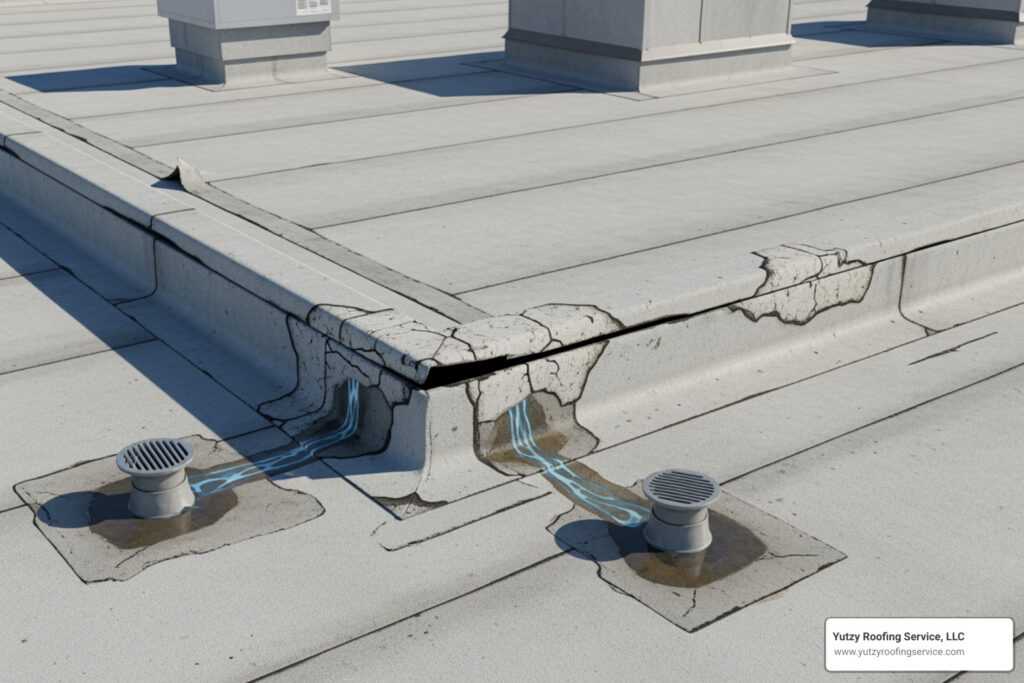
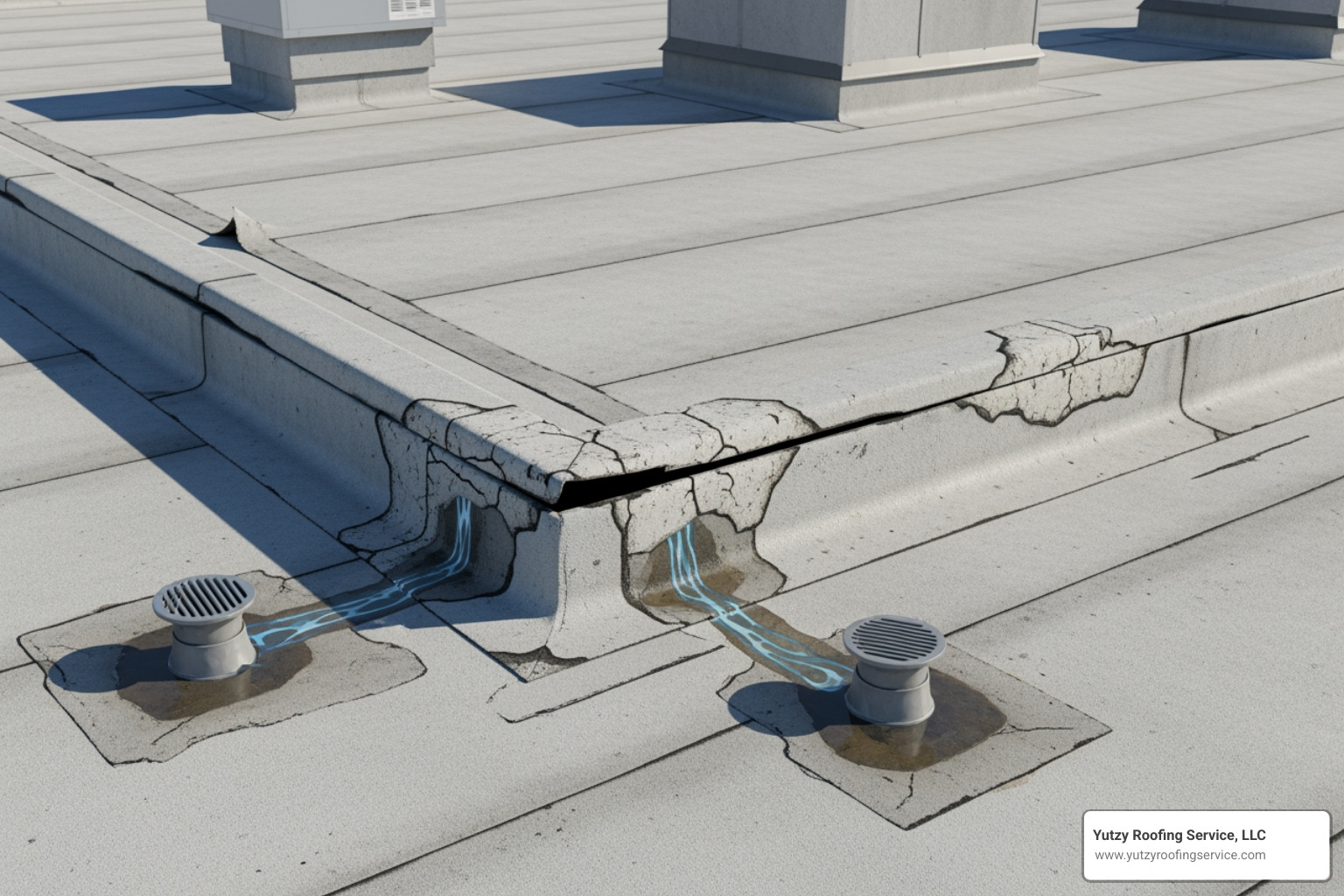
Water is sneaky. On a commercial flat roof, water often enters through a tiny pinhole or a hairline crack in a seam. Once it gets under the membrane, it hits the insulation or the structural deck. Because flat roofs are rarely perfectly flat—they usually have a slight 1/4-inch per foot slope—the water begins to travel laterally.
It can travel 10 feet, 20 feet, or even up to 50 feet from the actual entry point before it finds a gap in the decking or a seam in the vapor barrier to drip through. This lateral travel means that the best way to find a leak on a flat roof involves ignoring the “drip spot” initially and looking “uphill” toward higher elevations, parapet walls, or deck channels that might be funneling water toward your ceiling tiles.
The most common flat roof leak sources
Most leaks don’t happen in the middle of a wide-open membrane field. Instead, they occur where the roof is “interrupted.” Based on our experience serving areas like Madison and Appleton, WI, here are the usual suspects:
- Seams: The points where two sheets of membrane (like EPDM or TPO) meet. Over time, adhesive fails or heat-welds delaminate.
- Flashings: The material used to seal the roof to walls, curbs, or vents. This is the #1 failure point.
- Penetrations: Anything that pokes through the roof, such as HVAC units, pipes, and drains.
- Ponding Water: Water that stands for more than 48 hours. This adds weight and pressure, eventually forcing its way through microscopic imperfections.
- Freeze-Thaw Cycles: In Wisconsin and Minnesota, the constant expansion and contraction of ice can pull seams apart and crack older, brittle membranes.
More info about roof leak detection
Safe Preparation Before You Inspect
Safety is the absolute priority when inspecting a commercial roof. A leaking roof often means the underlying structure is compromised.
What to look for inside before going onto the roof
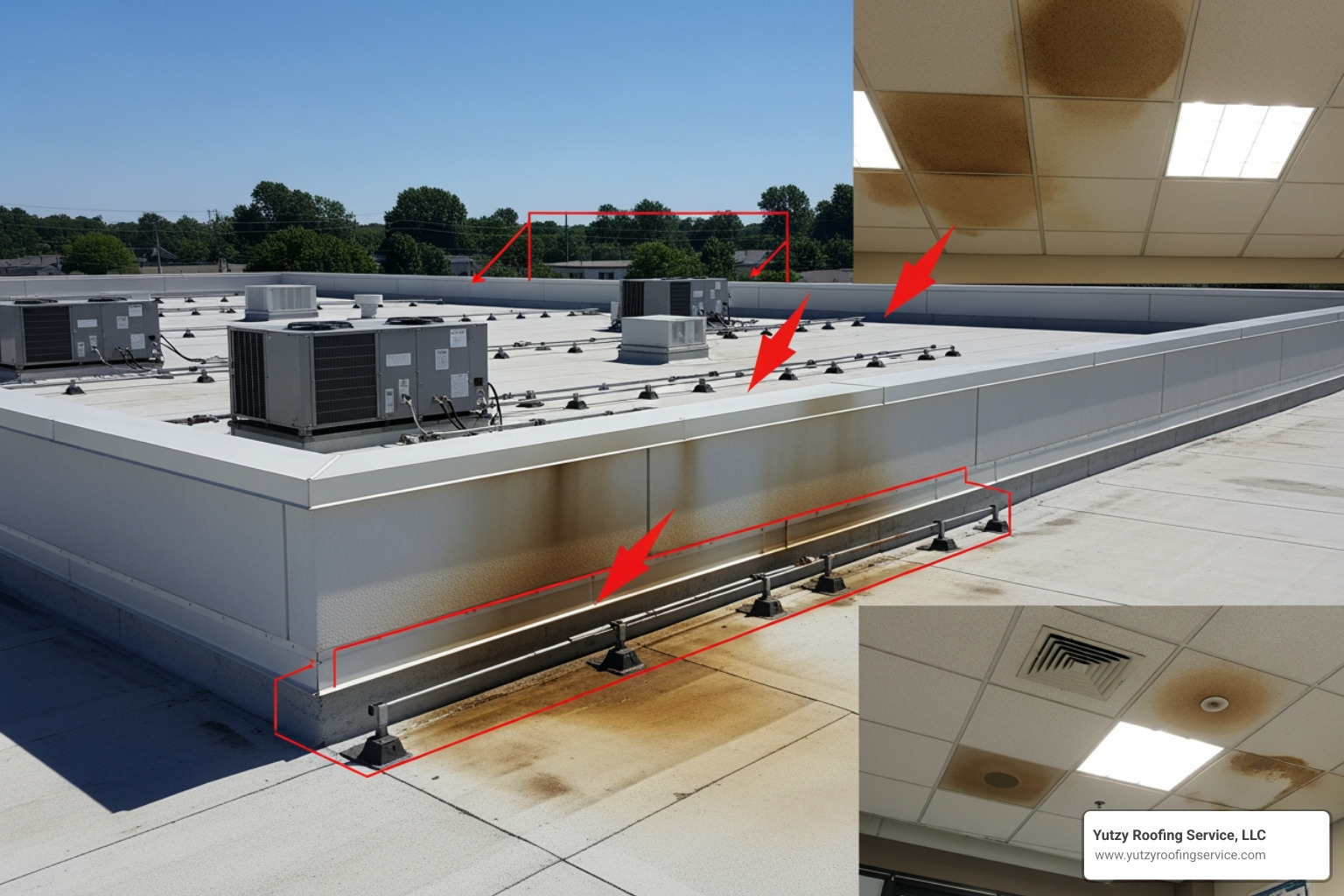
Before you climb up, do your detective work inside. Map the leak by measuring the distance from the drip to the nearest exterior walls.
- Look for patterns: Does it only leak during wind-driven rain? (This suggests wall or parapet issues).
- Check the color: “Tea-colored” water often indicates it has been soaking through wood or old insulation.
- Rule out mechanicals: Check if the moisture is near an HVAC unit during the humid Wisconsin summer; it might just be a clogged condensate drain rather than a roof breach.
How to prepare the roof surface for accurate leak detection
You can’t find a leak on a dirty roof.
- Clear Debris: Remove leaves, silt, and “concentric rings of dirt” which indicate where water has been ponding.
- Clean the Membrane: Use a broom or leaf blower to dry the area. If you’re looking for a tiny hole in EPDM or TPO, the surface needs to be clean enough to see the material’s texture.
- Check Drains: Ensure scuppers and drains are clear. Sometimes “leaks” are just water backing up over the top of flashing because the drain is plugged with a bird’s nest.
More info about severe weather roof prep
The Best Way to Find a Leak on a Flat Roof Step by Step
A systematic approach beats a “guess and patch” approach every time.
Start with the most likely leak points, not the drip spot
Once you are on the roof, use your interior measurements to find the “shadow” of the leak. Then, move “uphill” from that spot.
- Inspect all penetrations within 6 to 10 feet: Check the caulking around vent pipes and the “pitch pockets” (metal pans filled with sealant).
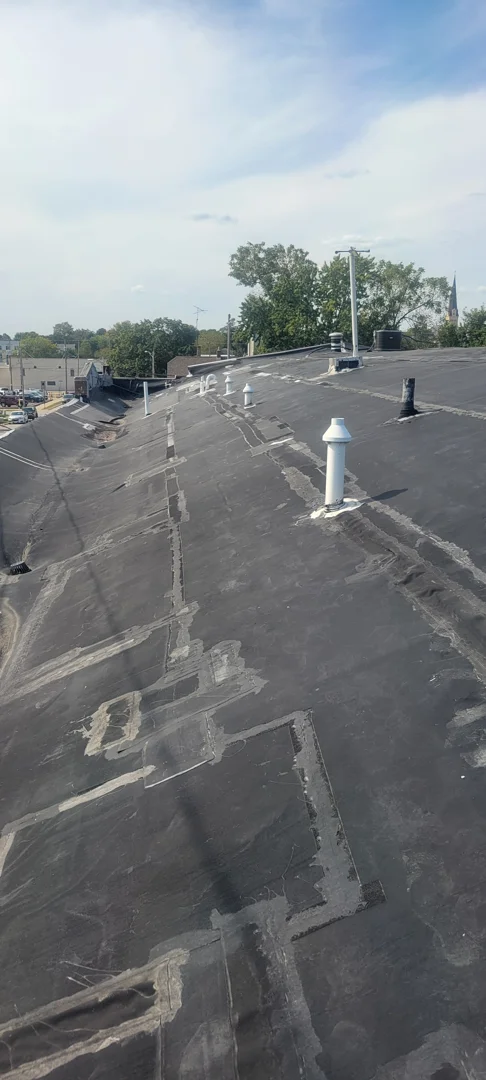
- Examine the seams: Take a blunt tool, like a flathead screwdriver, and gently “probe” the edges of the seams. If the tool sinks into the seam easily, you’ve found a failure.
- Check the perimeter: Look at the metal coping caps on top of the parapet walls. Water often enters here and runs down the inside of the wall.
Use the right leak detection methods in the right order
While a visual inspection is the first step, modern technology makes the best way to find a leak on a flat roof much more accurate.
| Method | How it Works | Best For |
|---|---|---|
| Visual Inspection | Looking for cracks, punctures, or open seams. | Obvious damage and debris issues. |
| Moisture Meter | Measures electrical resistance to find damp insulation. | Identifying the “trail” of water under the membrane. |
| Thermal Imaging | Uses infrared to see temperature differences (wet insulation holds heat longer). | Finding hidden leaks after the sun goes down. |
| Electronic Leak Detection | Uses a low-voltage current to find breaches in the membrane. | Precise pinpointing on TPO or PVC roofs. |
How to locate a leak on a flat roof
How to hose test without creating false positives
Hose testing should be your last resort because it can introduce a lot of water into your building if done incorrectly.
- Work from low to high: Start at the drain and work your way up the slope. If you start at the top, water will run over every potential leak point on the way down, making it impossible to know which one is the culprit.
- Be patient: Spend 10-15 minutes on each small zone (about a 5×5 area).
- Use a helper: One person stays inside with a radio or phone to alert the person with the hose the moment a drip starts.
How to find roof leak on a flat roof
Repair Options After You Find the Leak
Once the entry point is identified, you need to decide between a “band-aid” and a cure.
Best temporary fixes for an active flat roof leak
If it’s currently pouring in Marshfield or Green Bay, you need an emergency fix.
- Roofing Cement: Can be applied to damp surfaces to plug a hole temporarily.
- Peel-and-Stick Tape: Specialized heavy-duty tapes can seal a seam for a few weeks.
- Containment: Inside the building, use a “leak diverter” (a tarp with a hose attachment) to funnel water into a drum rather than letting it ruin your floors.
More info about what to do when a commercial roof is leaking
Permanent repairs by membrane type
The best way to find a leak on a flat roof is only useful if the repair matches the material.
- EPDM (Rubber): Requires cleaning the area with a specific primer before applying a self-adhesive EPDM patch.
- TPO/PVC: These are thermoplastic. The best repair is “heat welding” a new piece of membrane over the hole using a specialized hot-air tool.
- Modified Bitumen/BUR: Often repaired with “three-coursing”—a layer of roofing cement, a layer of fabric mesh, and another layer of cement.
More info about flat roof leak repair
When patching is no longer enough
There comes a point where “one more patch” is a waste of money. We recommend considering a full restoration or replacement if:
- The insulation is saturated: If the “board” under the roof is soggy, it will rot your deck and breed mold.
- Seams are failing everywhere: If you fix one seam and the one next to it pops a week later, the adhesive has reached the end of its life.
- The roof is over 20 years old: Most commercial flat roofs are designed for a 15-25 year lifespan.
More info about the importance of commercial roof leak repair explained
Preventing Future Leaks on Flat Roofs
The cheapest leak to fix is the one that never happens.
Maintenance practices that stop small issues from becoming major leaks
In our Wisconsin service areas, we see roofs take a beating from heavy snow and summer storms.
- Biannual Inspections: Check the roof in the Spring (after the thaw) and the Fall (before the snow).
- Clear the Drains: A clogged drain is the fastest way to turn a roof into a swimming pool.
- Trim the Trees: Overhanging branches can puncture membranes during high winds.
Preventive Maintenance Checkpoints:
- Check for “alligatoring” (cracking) on bitumen roofs.
- Look for “bridging” (where the membrane pulls away from the wall angle).
- Ensure all “pitch pockets” are topped off with fresh sealant.
More info about preventing commercial roof leaks
When to bring in a specialist for difficult-to-find leaks
If you’ve tried the hose test and visual inspection but the drip continues, it’s time for professional leak detection. Specialized tools like Infrared Thermography can “see” through the membrane to find exactly where the water is hiding in your insulation. This is especially critical for “overlay” roofs where a new roof was installed over an old one, creating a “sandwich” where water can hide for months.
More info about keeping your flat roof functional
Frequently Asked Questions about the Best Way to Find a Leak on a Flat Roof
What if the stain inside is nowhere near the actual roof leak?
This is the “Flat Roof Rule.” Because of the metal decking or concrete slabs used in commercial buildings, water will run along the “ribs” of the deck until it finds a hole or a low point. Always look uphill and check the nearest seams or penetrations.
Can you find a flat roof leak without cutting into the roof?
Yes. Using Thermal Imaging or Electronic Leak Detection (ELD), we can find breaches without causing any damage to the membrane. These non-destructive methods are the gold standard for modern commercial roofing.
How do you know whether it is a roof leak or HVAC-related moisture?
If it only leaks when the air conditioning is running—even if it isn’t raining—it’s likely an HVAC issue. Check the primary and secondary condensate pans. If the leak only happens during a torrential downpour, it’s likely the roof.
Conclusion
The best way to find a leak on a flat roof is to be a detective. Don’t just react to the drip; look for the evidence, understand how water moves across your specific roof type, and use the right technology to confirm your findings.
Whether you are in Eau Claire, Fond Du Lac, or Rochester, MN, the key is early intervention. A small puncture is a $300 fix today; saturated insulation and a rotted deck could be a $30,000 problem next year. At Yutzy Roofing Service, we specialize in helping Wisconsin business owners protect their investments with high-quality repairs and renewable warranties.
