

When Your Roof Is Leaking Right Now: What You Need to Know About Emergency Roof Seal
An emergency roof seal is a fast-acting waterproofing product you apply directly to a leaking roof — even in active rain — to stop water from getting in until a permanent repair can be made.
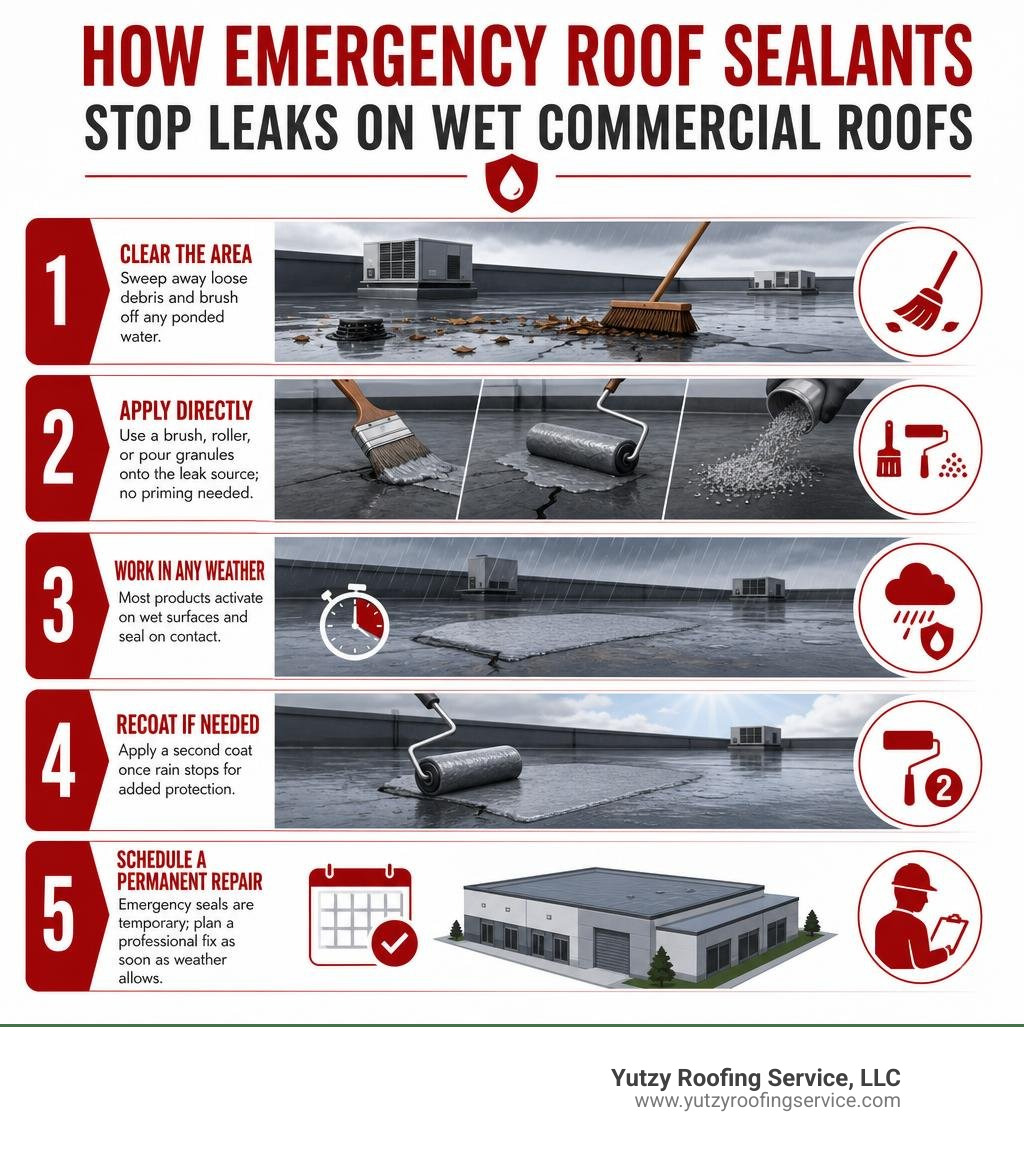
Quick answer: How to use an emergency roof seal
- Clear the area — sweep away loose debris and brush off any ponded water
- Apply directly — use a brush, roller, or pour granules onto the leak source; no priming needed
- Work in any weather — most products activate on wet surfaces and seal on contact
- Recoat if needed — apply a second coat once rain stops for added protection
- Schedule a permanent repair — emergency seals are temporary; plan a professional fix as soon as weather allows
If you own a commercial property in Wisconsin, you know how fast a small roof leak can turn into a big problem. One storm, one crack in your flat roof membrane, and water is already finding its way inside. That’s exactly the situation these products are built for.
But not all emergency sealants work the same way — and using the wrong one on the wrong surface can make your permanent repair harder and more expensive.
I’m Josh Yutzy, and with over 30 years of roofing experience across Wisconsin, Missouri, and Kansas, I’ve seen how the right emergency roof seal can protect a commercial building from serious water damage while we get the right weather window for a lasting fix. In the sections below, I’ll walk you through everything you need to choose and apply the right product for your situation.
Quick emergency roof seal terms:
What is an Emergency Roof Seal and How Does It Work?
When a severe storm hits places like Wausau, Appleton, or Madison, a compromised commercial roof can quickly lead to costly inventory loss or structural damage. An emergency roof seal is a highly specialized, fast-acting compound designed to provide instant waterproofing. Unlike standard roofing cements or sealants that require dry, warm conditions to cure, these emergency solutions are engineered to work under pressure—literally.
At its core, an emergency sealant relies on advanced chemistry to establish a barrier while water is actively flowing. These products feature incredible elastomeric flexibility, meaning they can stretch and contract alongside your building’s natural thermal movements without cracking or peeling.
When applied to a compromised area, the sealant forms a tight, immediate bond that stops water in its tracks. This allows commercial building owners to gain control over active leaks, protecting interior assets before a commercial roofing crew can perform a comprehensive inspection and permanent restoration. For more details on protecting your facility during a crisis, check out our emergency roof covering tips.
How an Emergency Roof Seal Stops Leaks in the Rain
You might wonder how any substance can stick to a surface that is completely soaked or submerged under ponding water. The secret lies in wet activation, moisture displacement, and heavy fiber reinforcement.
Many high-performance emergency sealants are formulated with solvent-based acrylic resins, specialized rubberized polymers, or advanced polyurethanes. When these compounds are applied to a wet surface, they physically displace the water molecules, pushing them away from the substrate so the adhesive resins can latch directly onto the roof membrane.
Additionally, many of these products contain built-in synthetic fibers. These fibers act like a tiny, built-in web, allowing the sealant to bridge and fill small gaps, cracks, and punctures without sagging or running, even in a heavy downpour.
A prime example of this advanced chemistry is WATERSTOP Emergency Waterproof Coating | Bostik UK. This solvent, bitumen, and isocyanate-free formulation can be applied directly to wet surfaces without any priming, creating an instant barrier that resists immediate rainfall and standing water.
Compatible Surfaces for an Emergency Roof Seal
Commercial buildings utilize a wide array of roofing systems, and it is vital to know which emergency sealant works with your specific setup. Applying an incompatible sealant can fail immediately or, worse, chemically degrade your existing roof membrane. Fortunately, modern emergency sealants are highly versatile and compatible with:
- Single-Ply Membranes: Aged EPDM (rubber), TPO, PVC, and Hypalon roofs.
- Asphalt-Based Systems: Built-Up Roofing (BUR), Modified Bitumen (MB), and old bitumen coatings.
- Metal Roofing: Corrugated metal panels, standing seam systems, and flashing joints. If you suspect your metal roof is failing, you can read our guide on metal roof leak identification.
- Hard Substrates: Concrete decks, fiber-cement panels, slate, and clay tiles.
- Accessories: Gutters, downpipes, and lead flashing abutments.
Before climbing up or sending your maintenance crew onto the roof, always verify the product label matches your roof type. For instance, while some rubberized wet patches excel on single-ply EPDM, certain solvent-heavy sealants might require a barrier or are better suited for asphalt and metal.
When to Use an Emergency Seal vs. Permanent Repair
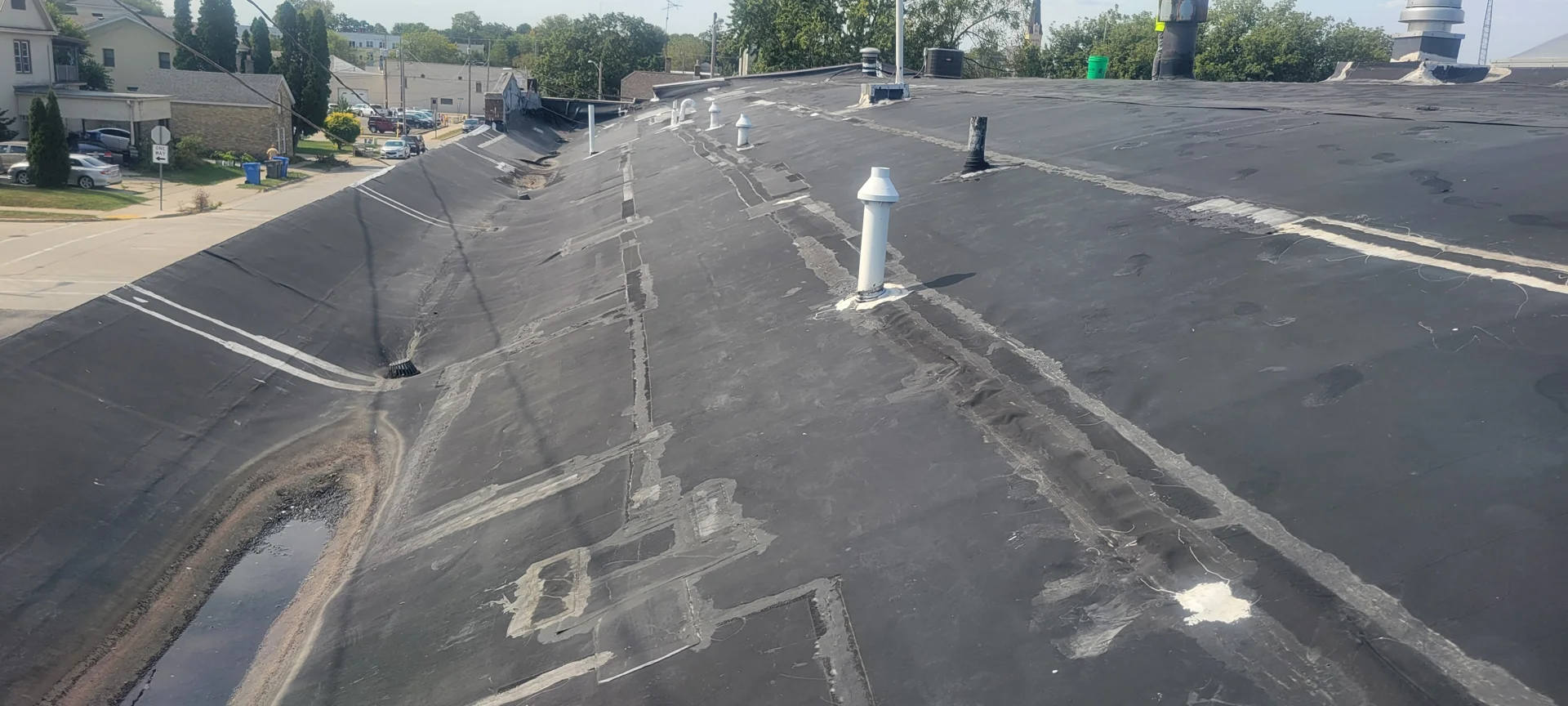
When water is actively dripping into your warehouse or retail space, your immediate priority is temporary mitigation. However, you must understand that an emergency roof seal is a stopgap measure, not a permanent fix.
Emergency sealants should be used when weather constraints make a permanent repair impossible. If it is 35°F and pouring rain in Green Bay, our team cannot perform a hot-air weld on a TPO membrane or apply a permanent elastomeric spray foam coating. In these harsh conditions, applying a temporary patch is the smartest way to prevent structural damage and mold growth.
You can learn more about how we transition these temporary fixes into lasting solutions by reading about flat roof leak repair. If you are unsure whether your roof’s current damage warrants a quick patch or immediate professional intervention, check out our guide on knowing if you need emergency roof repair.
Temporary Lifespan of Emergency Patches
While some high-end emergency coatings boast a theoretical 5-year limit under perfect conditions, their real-world lifespan is much shorter due to extreme weather exposure. In Wisconsin, the intense freeze-thaw cycles, heavy snow loads, and blistering summer UV rays will degrade temporary patches far faster than permanent, professionally applied systems.
The temporary nature of these products means they should only buy you time—usually a few weeks to a few months—until dry, warm weather arrives.
Furthermore, a critical step that many building owners overlook is complete removal before permanent repair. Most professional repair materials, such as brand-new EPDM flashing or commercial roof coatings, will not adhere to the oily, solvent-heavy residue left behind by emergency wet patches. Prior to executing a permanent restoration, the temporary material must be thoroughly scraped away or chemically cleaned to ensure the new membrane bonds correctly to the substrate.
Choosing the Right Emergency Roof Seal for Your Commercial Property
Selecting the right product depends on the size of the leak, the roof material, and the current weather conditions. The table below outlines the primary categories of emergency roof sealants available on the market as of June 2026:
| Product Type | Form | Best For | Key Advantage | Typical Coverage |
|---|---|---|---|---|
| Liquid Acrylic/Bitumen Coatings | Thick liquid (brush/roller) | Small cracks, seams, gutters, flashing | Can be applied under ponding water; bridges gaps with added fibers | Approx. 1 m² per liter |
| Rubberized Wet Patches | Heavy paste (trowel/caulk gun) | Moving joints, punctures, flashing details | Extreme flexibility in freezing temperatures; high solids content | Varies by joint depth; 11 fl. oz cartridge to 3.5-gal pails |
| Emergency Granules / Powders | Dry pourable granules | Flat roofs with active ponding water | Automatically follows water flow to the leak source and swells to seal | Approx. 50 sq. ft. per 25 lb container |
If you are dealing with cold-weather leaks or moving joints, an ultra-premium rubberized wet patch like Henry 209 Extreme Wet Patch Roof Leak Repair: Ultimate Leak Protection in All Conditions is an outstanding option. It is formulated for easy spreading in cold temperatures and offers superior elastomeric flexibility compared to standard plastic roof cements.
On the other hand, if you are dealing with a flat asphalt or concrete roof with minor cracks, a high-performance liquid coating is highly effective. You can find retail-ready solutions like Thompsons Emergency Roof Seal 1L | Toolstation, which is a solvent-based acrylic resin reinforced with fibers designed to immediately bridge and seal small gaps, even in a downpour.
How to Properly Apply an Emergency Seal
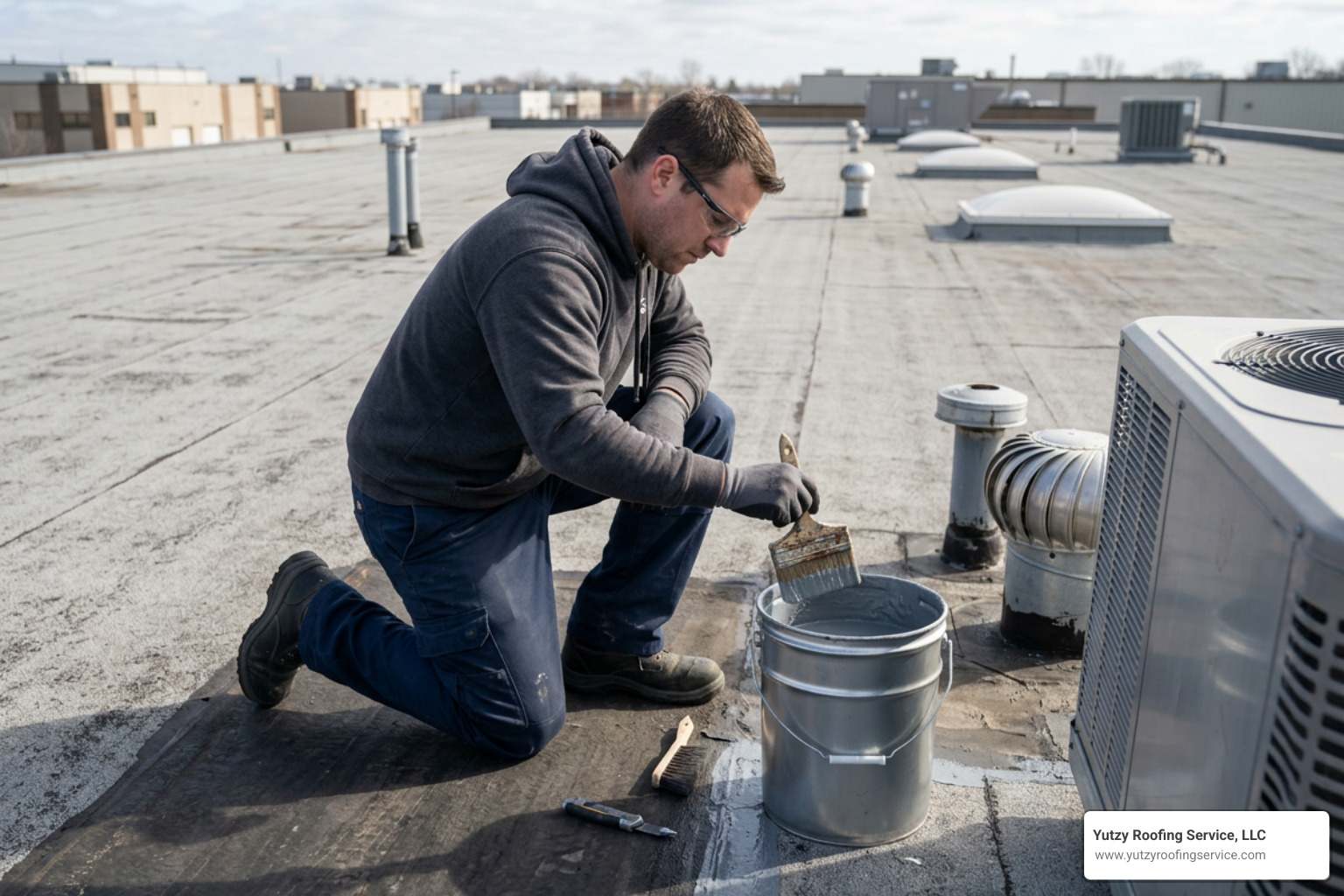
Applying an emergency roof seal might seem as simple as dumping a bucket of sealant over a wet spot, but proper application is the difference between a dry building and a failed patch that wastes time and money.
Even in an emergency, taking a few minutes to prepare the surface will drastically improve the sealant’s adhesion. To understand how temporary seals fit into the bigger picture of maintaining your facility, read our comprehensive guide on commercial roof leaks.
Step-by-Step Application in Wet Weather
When you must apply a sealant during active rainfall, follow this professional step-by-step process:
- Safety First: Wet roofs are incredibly slick, especially single-ply membranes like TPO and EPDM. Ensure all personnel wear slip-resistant footwear and fall protection gear.
- Debris Removal: Use a stiff bristle brush or broom to sweep away loose dirt, gravel, rust, or leaves from the target area. Sealant will not stick to loose mud or organic debris.
- Displace Ponded Water: If there is deep ponded water over the leak, use a squeegee or broom to push the bulk of the standing water away from the area.
- Prepare Blisters: If the leak is caused by a blister in an asphalt roof, carefully cut open the blister to release trapped moisture, then clear out any dirt inside.
- Brush Application: Stir your sealant tin thoroughly. Using a disposable brush or soft broom, apply a thick, continuous layer of the sealant over the leak. Aim for an application thickness of at least 1.5mm to 2mm per coat. Extend the sealant at least 6 inches beyond the damaged area in all directions.
- Apply Scrim Bandages: For larger cracks, moving joints, or flashing upstands, bed a reinforcing polyester scrim bandage directly into the first wet coat of sealant, then apply a second layer of sealant directly over the top. This “sandwich” technique provides the structural strength needed to resist physical tearing.
- Curing and Clean Up: While the product waterproofs immediately, it can take up to 24 hours to cure fully. Clean your brushes and any accidental spills immediately using white spirit or a designated solvent cleaner.
Frequently Asked Questions about Emergency Roof Sealants
Navigating emergency roof repairs can raise plenty of questions. Here are the answers to the most common queries we receive from commercial building owners.
Can you apply emergency roof seal in the rain?
Yes! High-quality emergency roof sealants are specifically formulated to displace moisture and adhere directly to wet substrates. Many products can even be applied underwater or directly into ponding water on flat roofs. However, you should avoid applying them if there is active snow, frost, or ice on the roof, as frozen surfaces prevent the sealant from contacting the actual roof membrane.
How long does an emergency roof seal last?
An emergency roof seal is designed as a temporary fix. Under normal weather conditions, a high-quality, two-coat application can prevent leaks for anywhere from a few months up to 5 years, depending on wear and application quality. However, because these materials degrade under continuous UV exposure and building movement, we strongly recommend scheduling a professional inspection as soon as the weather clears.
Can you paint over emergency roof sealants?
Generally, no. Painting over emergency roof coatings is not recommended. These sealants are highly elastomeric and designed to flex. Standard paints are far more rigid; if applied over a flexible sealant, the paint layer will quickly crack, peel, and flake away as the roof expands and contracts. Additionally, the heavy oils and solvents in many emergency patches can bleed through and discolor paint.
Conclusion
When your commercial building is under pressure from a sudden roof leak, an emergency roof seal is an invaluable tool to minimize immediate water damage. However, once the storm passes and the roof dries, you need a permanent, worry-free solution.
At Yutzy Roofing Service, LLC, we specialize in helping commercial property owners transition from stressful emergency patches to long-term, reliable protection. Serving communities across Wisconsin—including Marshfield, Wausau, Appleton, Madison, Green Bay, Eau Claire, and Fond Du Lac—we provide expert commercial roofing restoration, spray foam coatings, metal roof restoration, EPDM repairs, and comprehensive preventative maintenance.
We stand behind our work with an industry-leading, up to 18-year non-prorated renewable warranty, giving you ultimate peace of mind. Don’t let temporary patches become a permanent gamble. Get professional commercial roofing services from Yutzy Roofing Service today, and let us protect your investment for decades to come.
