What “bad dog roofing” Really Means
bad dog roofing is best understood here as an ambiguous search phrase, not as a reference to any specific company. Property owners may use searches like this when they recall a dog-themed name, see animal-themed contractor advertising, or simply want to compare roofers with memorable branding.
| Quick answer | What it means for a commercial property owner |
|---|---|
| Is it one company? | Not necessarily. Similar-sounding names may refer to unrelated local businesses or general contractors. |
| What services are common? | Leak repair, storm-damage work, roof replacement, inspections, maintenance, and some commercial roofing systems. |
| Does the name prove quality? | No. A memorable name is marketing, not proof of insurance, workmanship, or warranty coverage. |
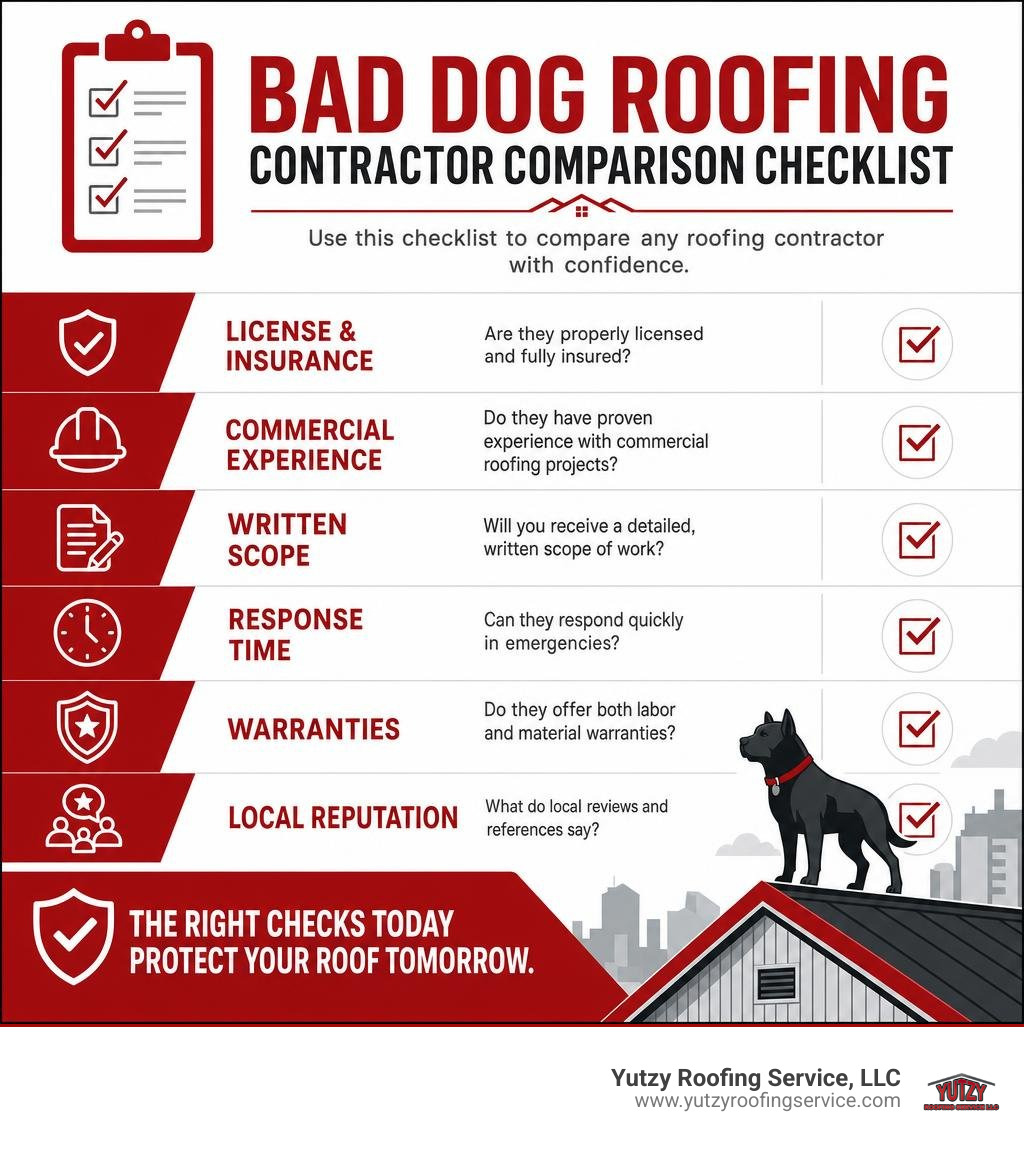
| What should you compare? | Local reputation, commercial experience, proof of insurance, written scope, response time, and labor and material warranties. |
Animal-themed roofing names can be easy to remember, especially after a storm or an urgent leak. But a commercial building owner should look past the branding. The real question is whether a contractor has the commercial expertise, proper licensing, and strong warranty coverage to protect your investment. Reviews can also vary widely by location, even when trade names sound similar.
I am Josh Yutzy of Yutzy Roofing Service, LLC, a family-owned roofing company serving Wisconsin since 1995, and I have seen why evaluating contractors found through bad dog roofing and similarly worded searches requires more than a quick name search. The next sections explain how to separate branding from the credentials and service record that protect a commercial roof.
Common bad dog roofing vocab:
Evaluating Pet-Themed Contractor Branding
When you type bad dog roofing into a search engine, you may see a mix of catchy, canine-inspired trade names, local contractors, directory listings, and unrelated results. Branding in the contracting industry often relies on memorable identities. Dogs can evoke feelings of loyalty, protection, agility, and toughness, which are traits every property manager wants in a contractor.
However, animal-themed branding can obscure the true structural organization behind a company. Businesses operate under various legal structures, ranging from sole proprietorships and localized LLCs to larger multi-location operations. Understanding these differences is essential when evaluating a contractor for a major commercial project.
When reviewing animal-themed trade names and marketing, commercial property owners should look beyond the logo to analyze the operating structure, service capabilities, and geographical scope of the business.
Are Pet-Branded Roofing Companies Independent Businesses or Franchises?
A major distinction among companies found through bad dog roofing searches is whether a business operates as an independent local contractor or as part of a broader multi-location operation.
- Multi-Location Operations: Some roofing businesses operate across multiple regions with standardized procedures and centralized scheduling. Individual branch locations may follow corporate guidelines and deploy uniform technology.
- Independent Regional Contractors: Independent regional contractors establish their own operational guidelines, material suppliers, and service standards. A family-owned company like Yutzy Roofing Service falls into this category, with deep roots in the communities it serves.
- General Contracting Outfits: Some companies incorporate roofing into broader general construction portfolios rather than specializing strictly in exterior envelope systems.
Understanding whether you are dealing with a local owner-operator or a branch of a larger organization helps set expectations regarding communication, pricing flexibility, and long-term warranty support.
Key Services Offered Under Pet-Branded Roofing Banners
While brand names vary, most roofing contractors provide a core set of exterior services. For commercial facilities, these services typically divide into reactive emergency repairs, planned maintenance, and total system restoration or replacement.
- Emergency Leak & Storm Damage Repair: Rapid response protocols designed to mitigate immediate moisture intrusion, apply emergency tarping, and repair damaged membrane seams or flashing.
- Routine Inspections & Assessments: Comprehensive evaluations of roof deck integrity, drainage performance, and perimeter edges.
- Commercial Roof Restoration: Application of liquid-applied spray foam coatings, elastomeric roof coatings, and metal roof restoration treatments that extend system service life without requiring a complete tear-off.
- Single-Ply & Built-Up Maintenance: Dedicated upkeep for commercial membrane systems such as EPDM, TPO, and modified bitumen.
Because commercial buildings feature complex flat or low-slope architectural requirements, verifying that a contractor possesses specialized commercial installation experience is far more critical than their marketing persona.
Core Technology and Services in Modern Exterior Contracting
The modern roofing industry has seen significant technological advancements over the past decade. Progressive roofing contractors frequently utilize advanced inspection methods to document roof conditions, identify hidden moisture, and provide exact estimates.
One prominent innovation is the adoption of automated aerial survey equipment paired with thermal imaging sensors. Instead of relying solely on physical walk-throughs that run the risk of missing localized membrane delamination or sub-surface wet insulation, contractors employ drone technology and high-resolution photo documentation.
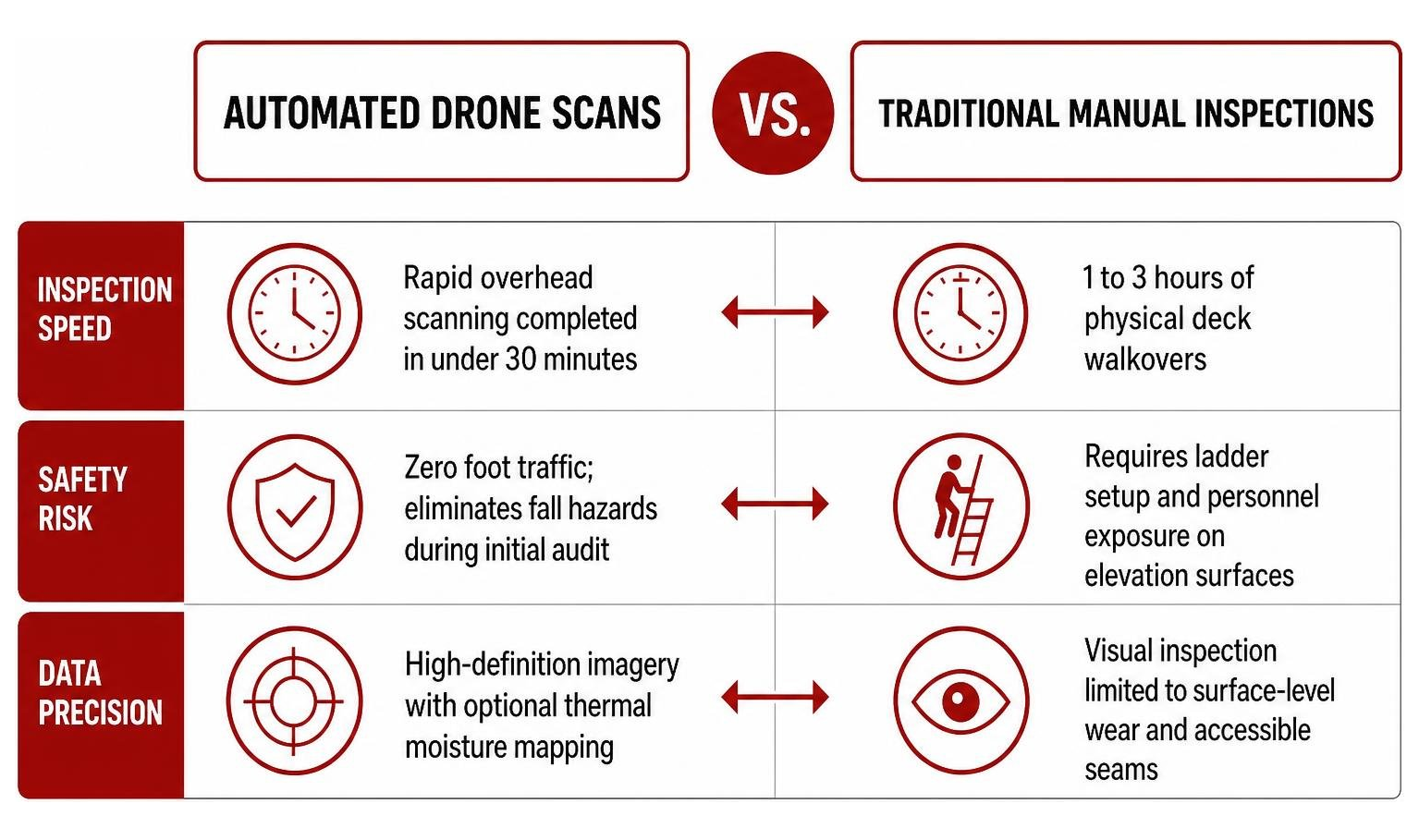
| Assessment Feature | Automated Drone Scans | Traditional Manual Inspections |
|---|---|---|
| Inspection Speed | Rapid overhead scanning completed in under 30 minutes | 1 to 3 hours of physical deck walkovers |
| Safety Risk | Zero foot traffic; eliminates fall hazards during initial audit | Requires ladder setup and personnel exposure on elevation surfaces |
| Data Precision | High-definition imagery with optional thermal moisture mapping | Visual inspection limited to surface-level wear and accessible seams |
| Record Keeping | Digital archive stored in permanent cloud storage vaults | Paper-based reports or manual photo logs |
| Scope Accuracy | Precise aerial square-footage and pitch calculations | Manual measuring tape readings prone to calculation variance |
These modern inspection protocols are often paired with standardized multi-point checklists. For instance, comprehensive multi-point exterior inspections evaluate critical failure points such as mechanical curb flashing, expansion joints, parapet walls, scuppers, internal drains, and HVAC pipe boot seals.
Proper jobsite protection during commercial work is equally vital. Advanced contractors utilize protective perimeter tarping systems to prevent debris, fastener waste, and old roofing materials from damaging surrounding landscaping, parking facilities, or customer vehicles.
Evaluating Ratings, BBB Complaints, and Service Reliability
A humorous or catchy business name does not guarantee top-tier field performance. When assessing any contractor found through searches like bad dog roofing, commercial property managers should perform rigorous due diligence across neutral third-party rating platforms, such as the Better Business Bureau and independent review aggregators.
Third-party verification channels provide valuable insight into how a contractor handles disputes, executes warranty repairs, and maintains communication over time.
Common Customer Complaints and How to Avoid Them
Analyzing aggregate complaints across various roofing operations reveals recurring operational friction points. By understanding these common complaints, commercial building owners can structure contracts to avoid similar issues:
Communication Breakdowns During Emergency Claims: Some roofing operations utilize third-party call centers or automated routing services. During severe weather events, messages between property owners and local project teams can drop, leading to extended delays during active roof leaks.
- Prevention: Require direct contact details for local project managers and regional superintendents rather than relying exclusively on general toll-free support numbers.
Pipe Boot & Component Maintenance Misunderstandings: A frequent point of contention involves non-shingle components, such as rubber pipe boots and penetration seals. Pipe boots exposed to harsh ultraviolet light and severe freeze-thaw cycles typically require maintenance or replacement every 5 to 7 years. Property owners often mistakenly assume a long material warranty covers these wearing components.
- Prevention: Explicitly review warranty terms to understand which components fall under routine maintenance versus long-term material coverage.
Warranty Expiration Disagreements: Standard installer labor warranties often range from 1 to 5 years, whereas commercial coating or restoration warranties can extend up to 18 years non-prorated. When leaks occur after a short labor warranty expires, property owners may face out-of-pocket repair bills despite holding active long-term material protection.
- Prevention: Partner with commercial specialists who provide clear, long-term, non-prorated renewable warranties covering both labor and leak-free performance.
Subcontracting Quality Control: Larger contractors sometimes scale up rapidly by subcontracting labor during peak storm seasons. If third-party crews fail to adhere to manufacturer installation guidelines, premature system failure can result.
- Prevention: Verify whether the contractor employs dedicated, factory-trained applicators or requires strict quality control oversight on all subcontracted labor.
What Commercial Property Owners Must Look For in a Roofing Partner
Selecting a commercial roofing partner requires a disciplined evaluation process. Commercial structures demand specialized engineering considerations, robust safety compliance, and financial protection that far exceed basic exterior work.

Whether you are evaluating a regional contractor or reviewing options found through bad dog roofing searches, ensure your selected roofer meets these essential criteria:
- State Licensing & Registration: Confirm that the business holds active state contractor licenses appropriate for your jurisdiction. In regions with strict commercial trade requirements, operating without proper credentials compromises building safety and invalidates manufacturer warranties.
- Comprehensive Commercial Insurance: Verify that the contractor maintains at least $2,000,000 in general liability insurance alongside full Workers’ Compensation coverage for all project personnel. Request a Certificate of Insurance (COI) issued directly from the insurer listing your organization as a certificate holder before work begins.
- Specialization in Commercial Systems: Commercial flat and low-slope roof restoration requires specialized expertise in liquid-applied spray foam coatings, single-ply EPDM/TPO membrane repairs, and elastomeric systems. Avoid contractors whose primary experience lies outside commercial structures.
- Non-Prorated Renewable Warranties: Evaluate the structure of offered warranties carefully. Prorated warranties decrease in value over time, leaving property owners responsible for high repair bills in later years. A strong, non-prorated renewable warranty, such as the 18-year renewable coverage offered by Yutzy Roofing Service, provides full protection for the entire term and can be extended with routine re-coatings.
- Geographic Presence: Choose a roofer with established physical operations in your state. For commercial properties located in Wisconsin, such as Marshfield, Madison, Green Bay, Wausau, Appleton, Eau Claire, and Fond Du Lac, or Southern Minnesota, including Rochester and Mankato, working with an established local specialist ensures fast emergency response times and familiarity with regional climate stresses.
Frequently Asked Questions about Pet-Branded Roofers
Why are pet-themed names popular among roofing contractors?
Pet-themed trade names are widely used because they project approachable, trustworthy, and protective traits. Canine-inspired branding helps contractors stand out in competitive markets, creating an easily recognizable brand identity that consumers remember when emergency repairs arise.
How do I verify a local roofing contractor’s license and insurance?
You can verify a contractor’s state license through your state’s official department of licensing or professional regulation website. To verify insurance coverage, request a formal Certificate of Insurance (COI) directly from the contractor’s insurance agency, ensuring it lists active general liability and workers’ compensation policy limits.
What is the standard warranty duration for commercial roof repairs?
Standard patch or component repairs typically come with a 1-year labor guarantee. However, full commercial roof restoration projects—utilizing high-performance elastomeric coatings or spray polyurethane foam systems—frequently offer comprehensive, non-prorated warranties ranging from 10 to 18 years, which can often be renewed through periodic maintenance.
Conclusion
Searching for bad dog roofing can lead to a broad mix of results, including pet-themed identities, regional contractors, general builders, and franchise-style operations. While memorable branding can help you remember a company’s name, it should never replace thorough vetting of corporate licensing, commercial expertise, insurance coverage, and warranty terms.
For commercial building owners, maintaining a watertight structure requires a partner who understands the technical complexities of commercial roof restoration, single-ply EPDM systems, and liquid-applied spray foam coatings. Rather than relying on short-term labor guarantees or prorated material coverage, invest in long-term protection backed by reliable non-prorated warranties.
At Yutzy Roofing Service, LLC, we have provided high-performance commercial roofing solutions across Wisconsin and Minnesota since 1995. Our specialized restoration options backed by renewable warranties up to 18 years ensure your commercial property stays protected against harsh weather without the expense of an unnecessary total tear-off. Contact our expert team today to explore our full line of Commercial Roofing Restoration Services and schedule a comprehensive roof assessment.
