

How to Stop a Commercial Roof Valley Leak
For roof valley leak repair, first contain the water inside the building and note where it appears. Then have a commercial roofing contractor trace the entry point and inspect the valley, flashing, and roof deck. A surface patch may slow the leak, but a lasting repair must address the failed flashing or waterproofing beneath it.
I’m Josh Yutzy of Yutzy Roofing Service, LLC, a family-owned roofing business serving Wisconsin since 1995. I draw on our team’s commercial roofing experience to explain what roof valley leak repair involves and when damage calls for more than a localized fix.
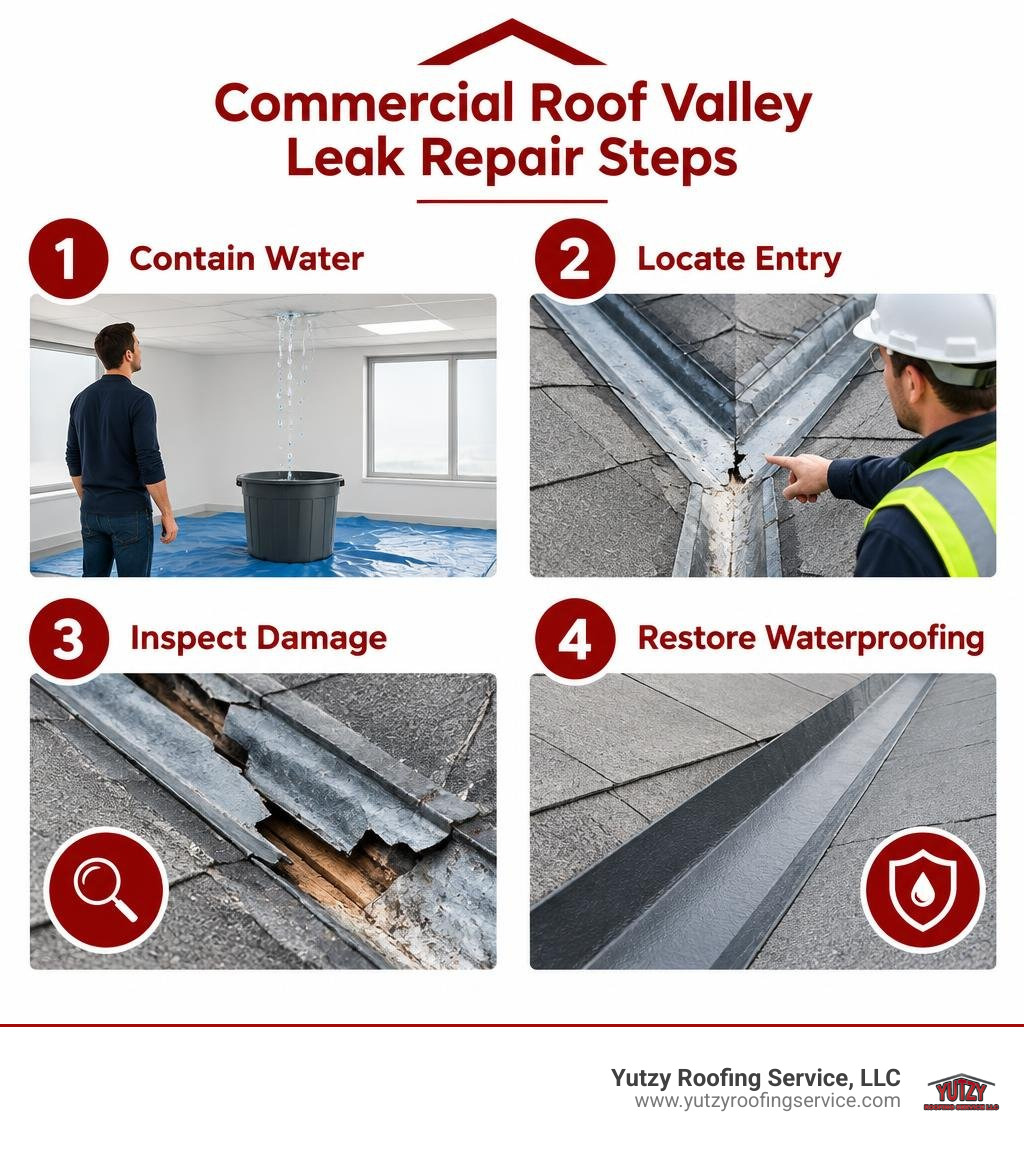
Similar topics to roof valley leak repair:
Introduction to Commercial Roof Valley Vulnerabilities
Roof valleys are the heavy-traffic expressways of commercial drainage. Where two intersecting roof planes meet, they form an internal angle designed to collect and shed massive volumes of water. Because of this geometry, valleys handle significantly more hydrostatic pressure than flat expanses or single-pitch slopes.
When a standard roof slope of 4:12 joins to create a valley, the effective pitch within the drainage trough drops to roughly 2.8:12. This flatter slope slows runoff velocity while concentrating water from hundreds of square feet of roof area directly over a critical structural seam.
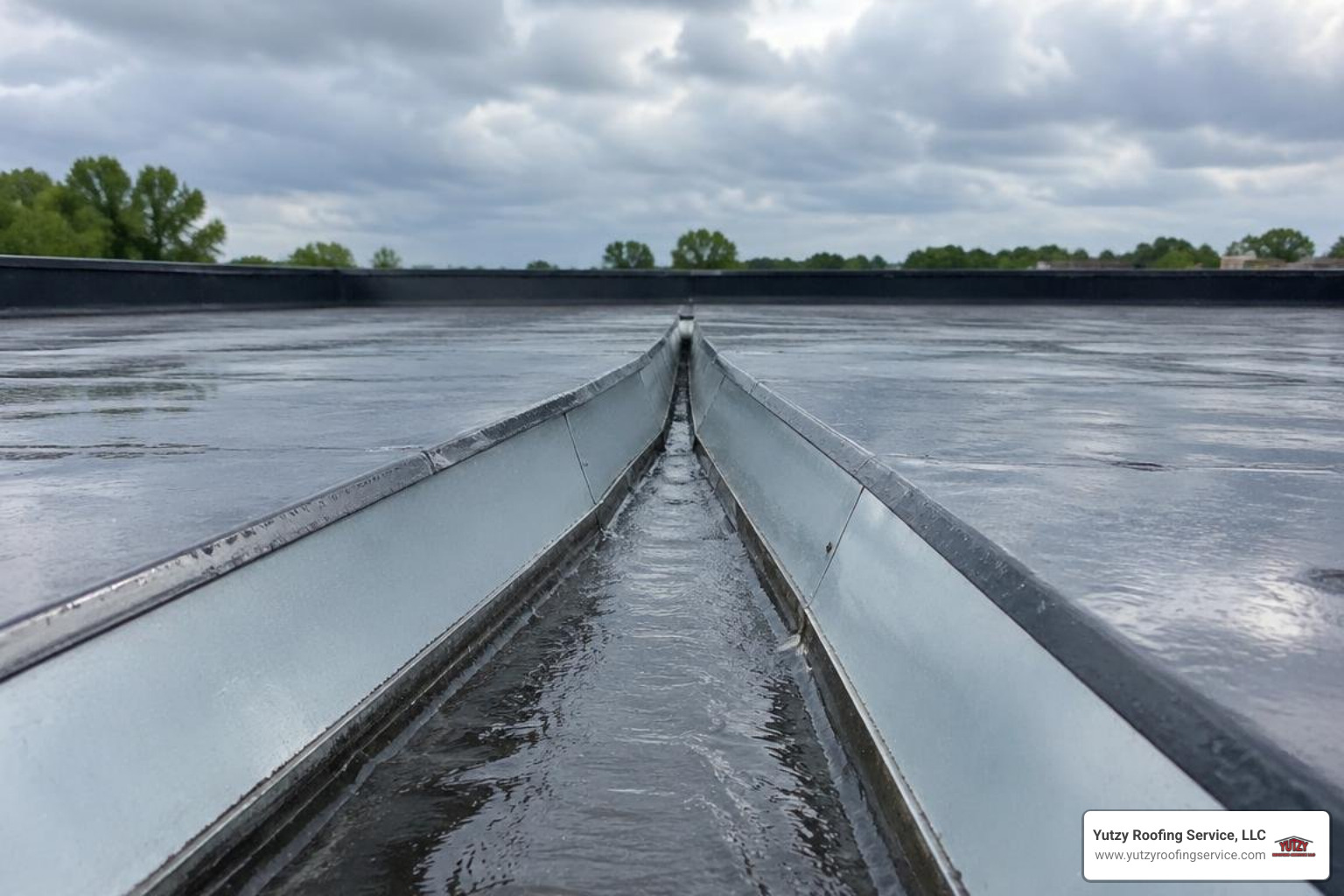
In regions across Wisconsin, like Madison, Appleton, and Wausau, commercial buildings endure between 80 and 120 freeze-thaw cycles every year. This severe thermal movement causes metal flashing and surrounding membrane materials to expand and contract at different rates. Over time, that constant movement stresses fasteners, splits lap seams, and cracks aging sealants.
When you combine thermal expansion with the sheer volume of storm runoff and ice accumulation, it is easy to see why flashing details account for 80% to 90% of all commercial roof leaks.
Professional Roof Valley Leak Repair and Flashing Restoration
Addressing a failing drainage channel requires precise commercial waterproofing rather than temporary surface fixes. True restoration ensures long-term building code compliance, preserves structural integrity, and restores the water-shedding efficiency of the entire slope intersection.
Diagnosing Failure Points Before Starting Roof Valley Leak Repair
A water spot on an acoustic ceiling tile rarely sits directly beneath the roof penetration. Water entering a damaged valley often migrates 10 to 15 feet along structural purlins, rafters, or metal decking before finding a path into the building interior.
Professional technicians begin by mapping interior moisture signs and deploying non-destructive diagnostics like infrared thermography to trace thermal anomalies. Exploring common problems with roof valleys and how to solve them often reveals subtle entry points that escape casual observation. These common failure mechanisms include:
- Capillary Wicking: Water drawn sideways under overlapping materials due to surface tension and improperly sealed edges.
- Membrane Punctures and Tears: Damage from accumulated storm debris, heavy foot traffic, or mechanical equipment maintenance.
- Fastener Backout: Screws or nails driven too close to the drainage line that work loose from thermal cycling.
- Failed Transition Sealants: Dried, cracked caulking where valley metal meets parapet walls, expansion joints, or curbs.
Understanding what to do about a leaky commercial roof starts with accurate diagnosis before tearing into roofing assemblies.
Professional Roof Valley Leak Repair and Flashing Restoration Process
Executing a permanent repair demands systematic disassembly and multi-layered sealing. Skilled contractors follow these core phases:
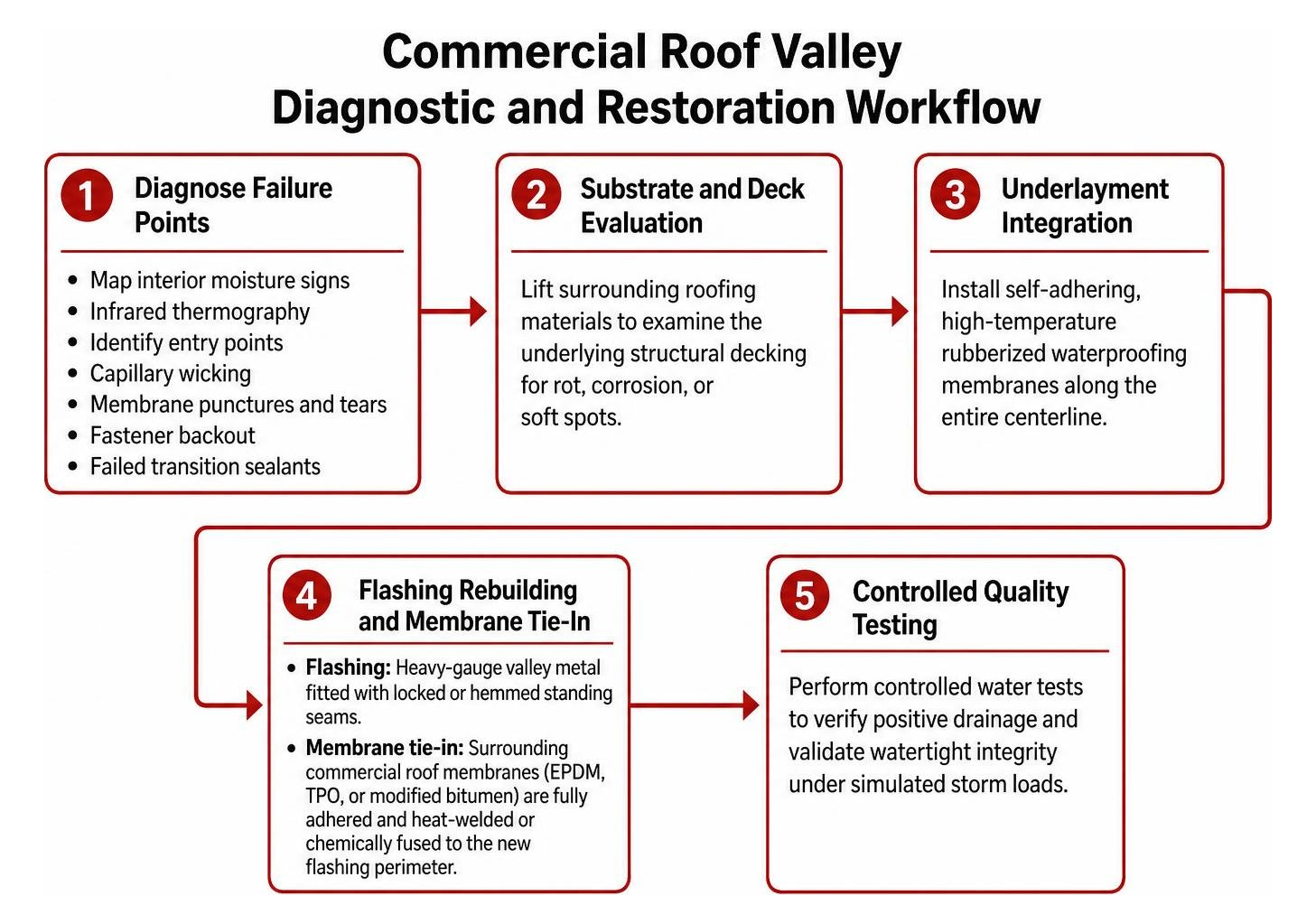
- Substrate and Deck Evaluation: The technician lifts surrounding roofing materials to examine the underlying structural decking for rot, corrosion, or soft spots.
- Underlayment Integration: Contractors install self-adhering, high-temperature rubberized waterproofing membranes along the entire centerline, conforming to guidelines on Sealing Roof Valleys | Building Science Education.
- Flashing Rebuilding: Heavy-gauge valley metal (typically $6–$12 per linear foot for commercial materials) is fitted with locked or hemmed standing seams to prevent water from washing over the edges during peak rainfall.
- Membrane Tie-In: Surrounding commercial roof membranes (such as EPDM, TPO, or modified bitumen) are fully adhered and heat-welded or chemically fused to the new flashing perimeter.
- Controlled Quality Testing: Technicians perform controlled water tests to verify positive drainage and validate watertight integrity under simulated storm loads.
Open, Closed, and Woven Valleys: Structural Differences and Vulnerabilities
Commercial properties feature different valley configurations depending on the architectural design, slope, and membrane materials.
| Valley Design | Structural Composition | Maintenance Requirements | Leak Susceptibility |
|---|---|---|---|
| Open Valley | Exposed heavy-gauge metal trough (copper, steel, aluminum) | Moderate; clear debris seasonally | Low; handles high-volume water and ice buildup exceptionally well |
| Closed-Cut Valley | Roofing layers overlap across the centerline and are cut to a crisp edge | High; prone to edge lifting and capillary water draw | Moderate to High; unsealed cut edges can channel water inward |
| Woven Valley | Continuous interlacing of materials across the trough with no exposed seam | High; difficult to inspect and prone to cracking under thermal stress | High; accumulated debris and ice dams easily work under woven seams |
Open metal valleys remain the gold standard for high-volume drainage because they minimize blockages. Closed and woven assemblies experience higher failure rates in freeze-thaw climates due to ice damming and debris dams holding moisture against material seams. For related metal systems, learning how to identify and fix a metal roof leak helps facility managers spot metal fatigue and flashing gaps early.
Why Commercial Valley Repairs Require Professional Roofing Contractors
Working in a commercial drainage valley involves navigating steep transitions, wet surfaces, and severe fall hazards that mandate OSHA-compliant tie-offs and specialized safety equipment.
Beyond safety, quick fixes like spreading asphalt mastic directly into a wet trough almost always fail. Mastic dries, shrinks, and cracks within months, trapping water against the metal and accelerating deck rot.
Professional commercial contractors carry comprehensive liability insurance, understand structural load paths, and provide multi-year workmanship warranties that protect capital investments and manufacturer system warranties.
Evaluating Repair Costs, Decking Damage, and Long-Term Protection
While a basic localized repair might address a single puncture, comprehensive professional valley re-flashing averages $700 to $900 for standard applications, with extensive commercial drainage rebuilds averaging $2,000 to $3,000.
Ignoring a valley leak for more than two years can cause structural repair costs to escalate to $12,000 to $50,000+ due to framing replacement, insulation renewal, and interior remediation.

Identifying Hidden Moisture, Rot, and Insulation Deterioration
Because valleys concentrate such high water volumes, a compromised flashing detail quickly saturates the surrounding roof insulation. Wet polyisocyanurate or mineral wool loses its thermal R-value entirely, driving up building heating and cooling bills.
More critically, mold spores can colonize damp structural decking within 24 to 48 hours of sustained moisture exposure. Commercial contractors use core sampling, electronic moisture meters, and deck probing to ensure all compromised, rotted, or corroded decking is replaced before waterproofing the valley.
Long-Term Flashing Restoration vs. Broader Roof-System Restoration
When assessing an aging roof, building managers must evaluate roof repair vs replacement which is right for you to make cost-effective decisions. If multiple valleys and flashing details are deteriorating across an otherwise structurally sound roof, commercial restoration offers an alternative to a disruptive tear-off.
At Yutzy Roofing Service, LLC, we provide commercial roofing restoration, spray foam coatings, metal roof restoration, EPDM repairs, and routine maintenance programs. Our fluid-applied systems eliminate vulnerable seams and protect high-stress drainage troughs with up to an 18-year non-prorated renewable warranty across Wisconsin communities including Madison, Green Bay, Appleton, and Eau Claire.
To safeguard your facility against severe weather and resolve drainage issues for good, schedule professional leak detection and roof valley repair with our experienced commercial team.
