Why the Right Metal Roof Caulk Can Save Your Commercial Roof
Metal roof caulk is the first line of defense against leaks on commercial roofs — and choosing the wrong type (or skipping it entirely) can turn a small seam gap into a costly interior disaster.
Here’s a quick answer to help you find the best option fast:
| Sealant Type | Best For | Key Strength |
|---|---|---|
| Silicone | Flashings, vents, gutters | UV resistance, wet surface application |
| Polyurethane | Seams, lap joints | Paintable, high adhesion |
| Butyl tape | Panel laps, substrate joints | 60+ year projected lifespan |
| Elastomeric/acrylic | Wide coverage, brush-on | Flexibility, thermal movement |
Wisconsin commercial roofs take a beating. Summers push metal panels to extreme heat, then winters contract them back again — over and over, year after year. That constant thermal expansion and contraction is exactly where sealants fail, and where leaks begin.
The stakes are higher than most property owners realize. Even a perfectly sound metal panel can allow water intrusion if the sealant at its seams, fasteners, or flashings has cracked or dried out. In fact, the overall lifespan of a metal roof is often determined more by the longevity of its sealants than by the durability of the metal itself.
I’m Josh Yutzy, and at Yutzy Roofing Service we’ve been sealing, restoring, and repairing commercial metal roofs across Wisconsin since 1995 — which means metal roof caulk selection and application is something we deal with on virtually every job. Read on for everything you need to know to make the right call for your building.
Metal roof caulk further reading:
Understanding Sealant Chemistry: What is the Best Metal Roof Caulk?
Choosing the right metal roof caulk requires understanding the chemistry behind the products. If you walk into a supplier in Eau Claire or Green Bay, you will find a dizzying array of tubes, pails, and tapes.
To help you make sense of your choices, we have compiled a comparison of the primary sealant chemistries used in commercial metal roofing:
| Property | Silicone | Polyurethane | Butyl Rubber | Acrylic / Elastomeric |
|---|---|---|---|---|
| UV Stability | Outstanding | Moderate to High | Low (must be concealed) | High |
| Joint Movement | ±50% | ±25% to ±50% | Minimal | ±12.5% to ±25% |
| Paintability | No | Yes | No | Yes |
| Adhesion to Metal | Excellent | Superior | High | Moderate |
| ASTM Standard | ASTM C920 | ASTM C920 | ASTM C1311 | ASTM C834 / C920 |
When evaluating any commercial sealant, look for ASTM C920 certification. This is the industry-standard specification for elastomeric joint sealants, which defines their class, grade, and movement capabilities. A sealant meeting ASTM C920 has undergone rigorous testing to ensure it can handle the physical stresses of a commercial roof.
Chemical compatibility is another critical factor. Modern commercial metal roofs are often finished with high-performance coatings like Kynar 500 or Galvalume. Some basic caulks will not adhere to these specialized finishes, while others can release corrosive byproducts (like acetic acid in standard silicone) during the curing process that can actually damage galvanized steel or copper.
Silicone vs. Polyurethane Metal Roof Caulk
The debate between silicone and polyurethane is a classic one in the commercial roofing industry. Both have distinct advantages, and choosing the right one depends on where and how you are applying it.
100% RTV (Room Temperature Vulcanizing) silicone is highly regarded for its exceptional UV stability and resistance to ponding water. It remains flexible in extreme temperature ranges, which is essential for Wisconsin winters. Silicone also has the unique ability to adhere to slightly damp surfaces, making it a go-to choice for emergency repairs. However, silicone has one major downside: it is completely unpaintable. Once applied, nothing will stick to it, not even more silicone. If you plan to apply a protective roof coating in the future, silicone can create adhesion issues.
Polyurethane, on the other hand, is a heavy-duty workhorse. It offers incredible mechanical adhesion and tensile strength, making it ideal for sealing high-stress joints and seams. Polyurethane is fully paintable, allowing it to blend seamlessly with your existing roof finish. It accommodates joint movement beautifully, but it does tend to degrade faster than silicone when exposed to direct, unshielded UV radiation over many years. For a deeper dive into this comparison, check out our guide on choosing the best caulk for metal roofs.
Butyl Tape and Solvent-Based Elastomeric Options
While liquid caulks are excellent for topical applications, some of the most critical seals on a commercial metal roof are hidden. This is where butyl tape shines.
Butyl tape is a non-skinning, non-curing elastomeric sealant supplied in pre-portioned adhesive rolls. Because it never fully cures, it retains its tackiness, flexibility, and cohesive strength for decades. A landmark field study conducted by the Metal Construction Association (MCA) across five distinct climate zones analyzed standing seam metal roofs and proved that butyl tape showed zero deterioration even after 35 years of service. Its projected real-world lifespan in concealed joints exceeds 60 years!
However, because butyl tape lacks UV protection, it must never be used topically where it is exposed to direct sunlight. It is strictly designed to be sandwiched between overlapping metal panels or substrate joints. For more on this, read our comprehensive guide on mastic tape for metal roofing.
For exposed areas requiring a similar level of rubberized flexibility, solvent-based elastomeric options (like synthetic rubber caulks) are a great alternative. These sealants can be applied in freezing temperatures as low as 20°F (-7°C), remain stable through freeze/thaw cycles, and have the unique ability to adhere to themselves, making future touch-ups simple.
Product Roundup: Top Sealants for Commercial and Industrial Metal Roofs
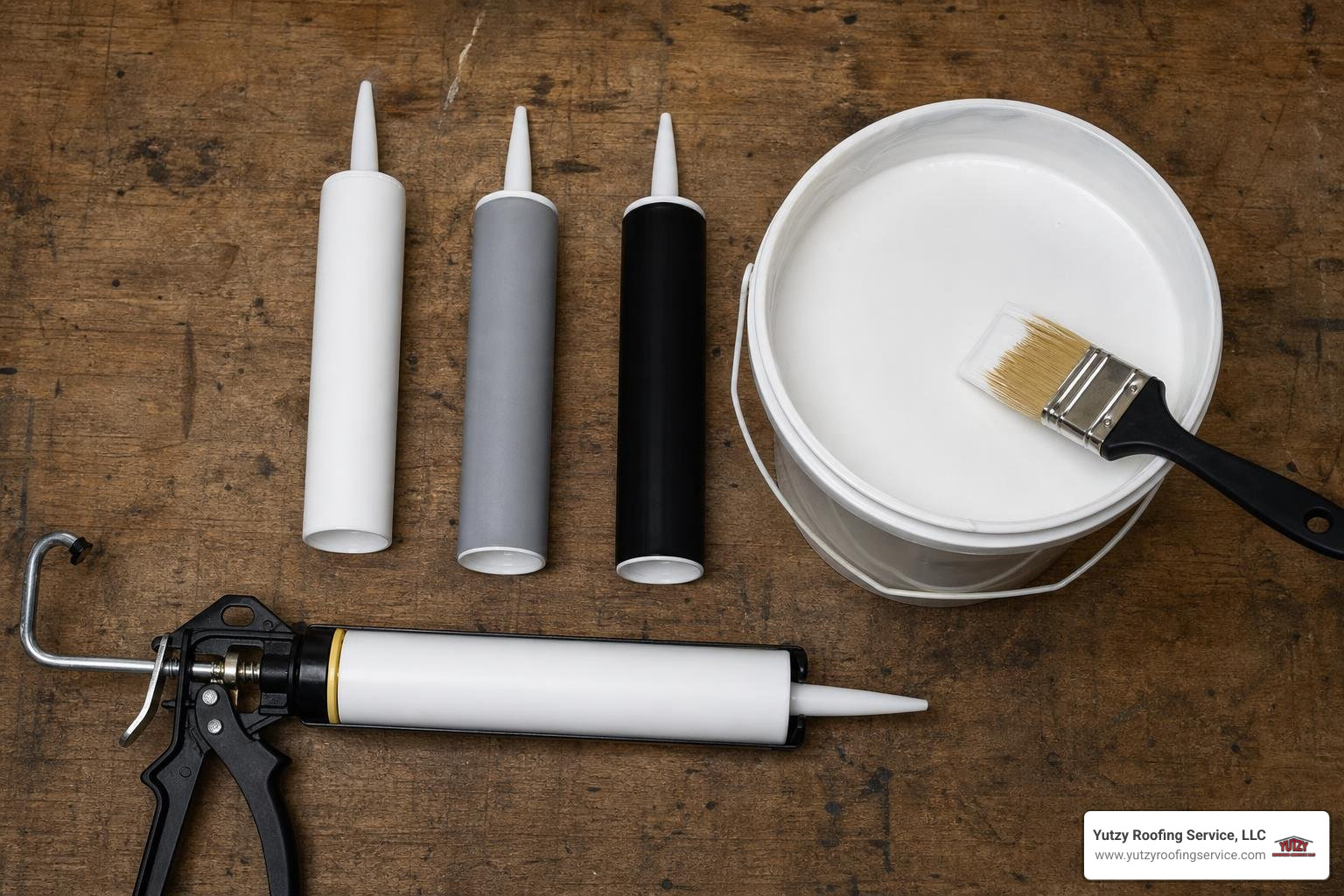
Selecting the right commercial-grade product is essential to ensure your repairs last. Commercial metal roof caulks are typically sold in standard 10.1 oz or 10.5 oz cartridges for caulk guns, while larger-scale seam sealers and liquid membranes are sold in 1-gallon or 5-gallon pails for brush or trowel application.
High-Performance Polymer and Elastomeric Sealants
Advanced polymer technology has led to the creation of hybrid sealants that combine the best properties of silicone and polyurethane.
A prime example is Titebond WeatherMaster Metal Roof Sealant. This premium polymer formula offers unbeatable adhesion to Kynar-coated metals, aluminum, galvanized steel, and copper. It provides a joint movement capability of ±50% and can be applied in extreme weather conditions down to 0°F (-18°C).
One critical detail that contractors often overlook is Titebond’s strict “no-tooling, no-smearing” rule. The manufacturer explicitly states that this sealant must be applied strictly in its extruded bead form. Tooling or smearing it with solvents, soaps, or oils can disrupt the polymer’s curing process and compromise its long-term performance.
Liquid-Applied and Brush-On Metal Roof Caulk Solutions
When you have hundreds of linear feet of seams or thousands of fasteners to seal, using a standard caulk gun can be incredibly time-consuming. In these scenarios, liquid-applied, brush-on sealants are far more efficient.
For heavy-duty seam sealing, Henry 295 Metal Seam Sealer is an excellent white, rubber-based, mastic-grade elastomeric sealant. It is specifically designed to seal critical fasteners and lap seams. For joints or laps larger than 1/8 inch, it requires a layer of polyester reinforcement fabric sandwiched between two consecutive coats to prevent the sealant from cracking under thermal movement. Due to high VOC levels, this product has regional restrictions and cannot be sold in Southern California — though it is perfectly compliant for use on commercial properties here in Wisconsin and Minnesota.
Another highly popular option is Liquid Rubber MetalSafe Sealant. This elastomeric liquid coating contains built-in rust inhibitors, allowing it to be applied directly over lightly rusted areas without a separate primer step once the surface is cleaned. It goes on brown (allowing the applicator to easily see coverage) and dries to a bold, protective black finish.
How to Prepare and Apply Caulk to Metal Roof Seams and Fasteners
Even the highest-quality sealant will fail prematurely if the surface preparation is rushed. Proper adhesion requires a clean, stable substrate.
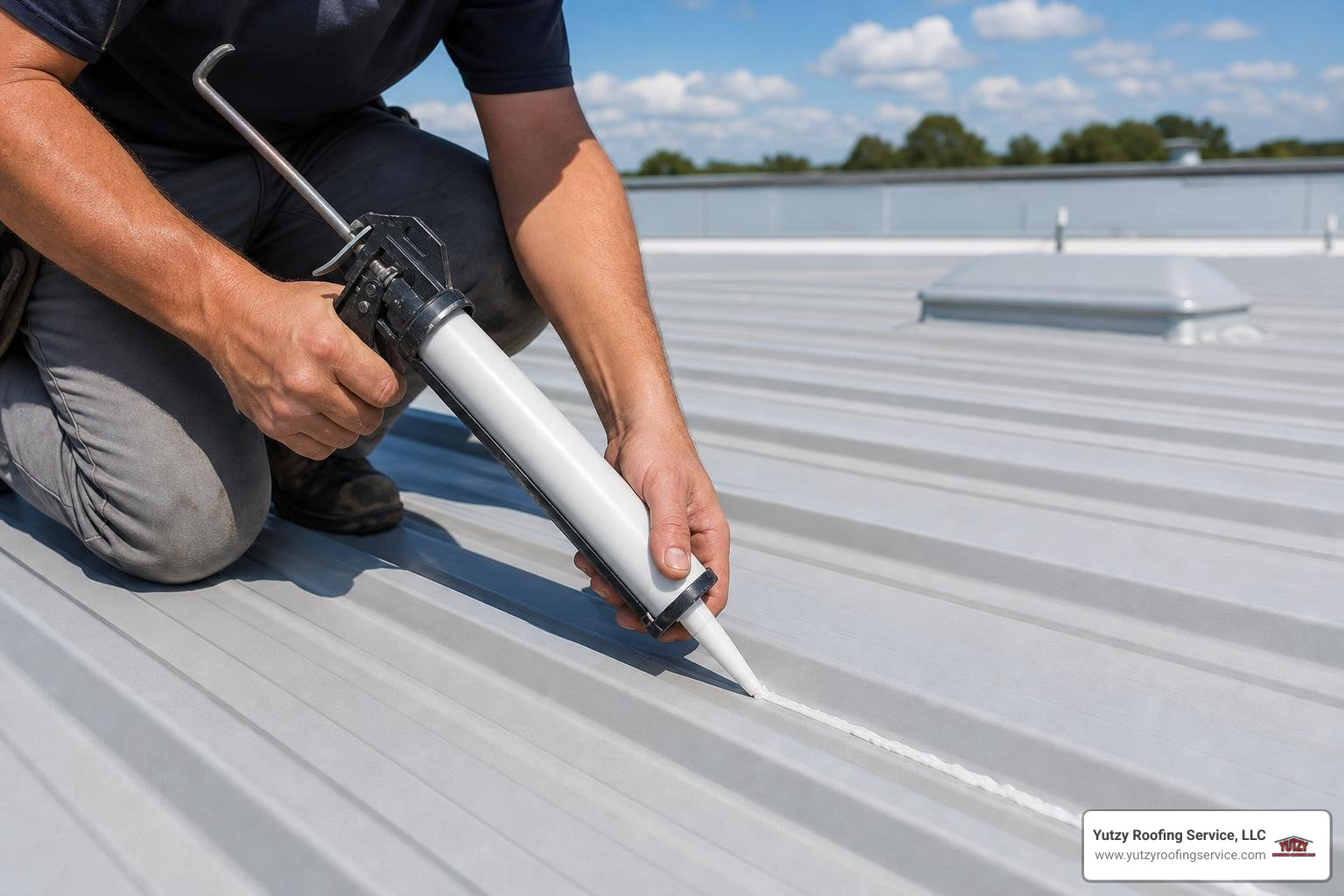
Before you begin applying any caulk, you must first locate the source of the water intrusion. If you are tracking down a tricky drip, consult our guide on how to identify a metal roof leak and our complete metal roof leak repair guide.
Surface Preparation and Dealing with Rust
The golden rule of roofing repairs is that sealant will not adhere to dirt, grease, loose rust, or failing old caulk.
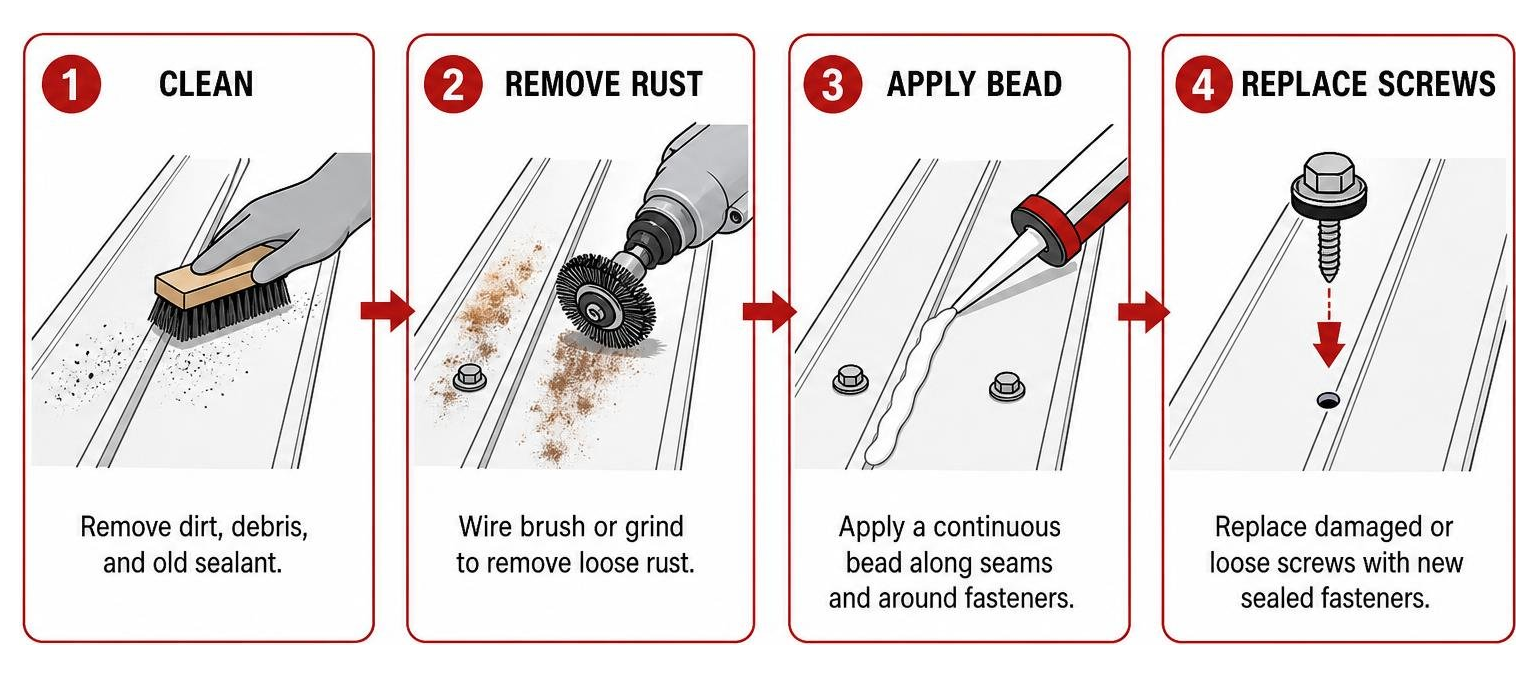
- Remove Old Sealant: Use a scraper or utility knife to cut away any old, cracked, or failing caulk.
- Wire Brush Rust: For rusted areas, use a wire brush or an angle grinder with a wire wheel to knock off heavy scale and loose rust. Light, tightly bonded surface rust can remain if you are using a rust-inhibiting sealant like MetalSafe.
- Pressure Wash: Thoroughly pressure wash the area to remove dirt, pollen, and chalky residue.
- Degrease: Use a specialized cleaner to cut through any industrial oils, grease, moss, or lichen.
- Dry: Allow the roof to dry completely (unless using a specialty wet-surface silicone).
Step-by-Step Application for Seams, Flashings, and Vents
When applying liquid caulk from a cartridge, cut the tip on a slight slant to match the width of the seam (typically a 1/4-inch to 3/8-inch bead is ideal). Puncture the inner foil seal thoroughly.
When sealing lap seams, force the sealant directly into the joint in a continuous, unbroken bead. If you want perfectly clean lines, you can apply masking tape adjacent to the joint before caulking and peel it off immediately after application while the sealant is still wet.
Fixing “Drunk” Screws and Fasteners
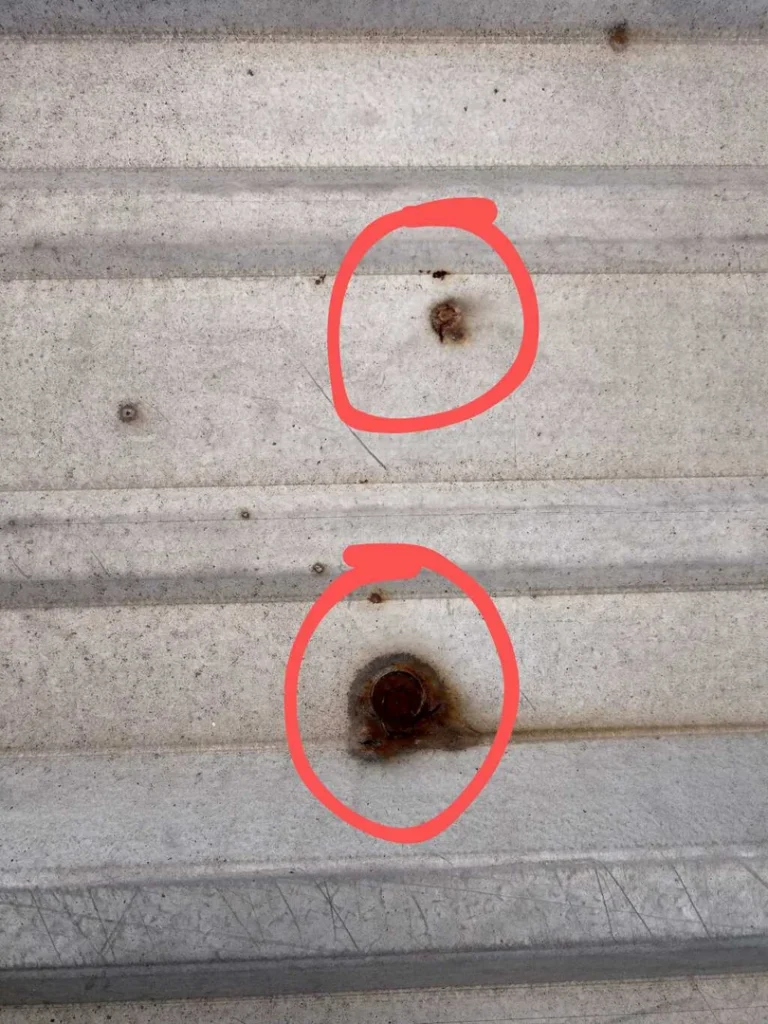
One of the most common failure points on commercial metal roofs is improperly installed fasteners. Over-tightening can destroy the integrated EPDM rubber washers, while crookedly driven screws leave gaps that act as tiny funnels for rainwater.
If you find crooked or stripped fasteners:
- Back the damaged screw out completely.
- Clean the area around the hole.
- Replace it with an oversized “rescue screw” (also known as an over-size screw). These have larger threads and wider washers designed to seal up stripped holes.
- Apply a small dab of high-quality polyurethane or silicone sealant directly into the hole before driving the new screw to ensure a watertight seal underneath the washer assembly.
For flashings, vents, and other penetrations, apply a generous bead of sealant around the base of the penetration where it meets the metal roof panel. Ensure the sealant bridges the gap completely, and use backing material if the gap is wider than 1/4 inch.
Metal Roof Caulk vs. Full Roof Coating Systems
While spot repairs with metal roof caulk are excellent for stopping immediate, localized leaks, they are ultimately temporary band-aids. If your commercial metal roof is reaching the end of its design life and has multiple leaks across its seams and fasteners, chasing them with individual tubes of caulk is a losing battle.
This is where a full roof restoration using a seamless monolithic roof coating system becomes the smarter, more cost-effective choice. Instead of replacing the entire metal roof (which is incredibly expensive and disrupts business operations), we can apply an elastomeric roof coating system over the existing panels.
These systems involve:
- Tightening and sealing all fasteners.
- Reinforcing all seams, joints, and penetrations with heavy-duty seam tape or polyester fabric.
- Applying a seamless, liquid-applied elastomeric base coat and top coat across the entire roof surface.
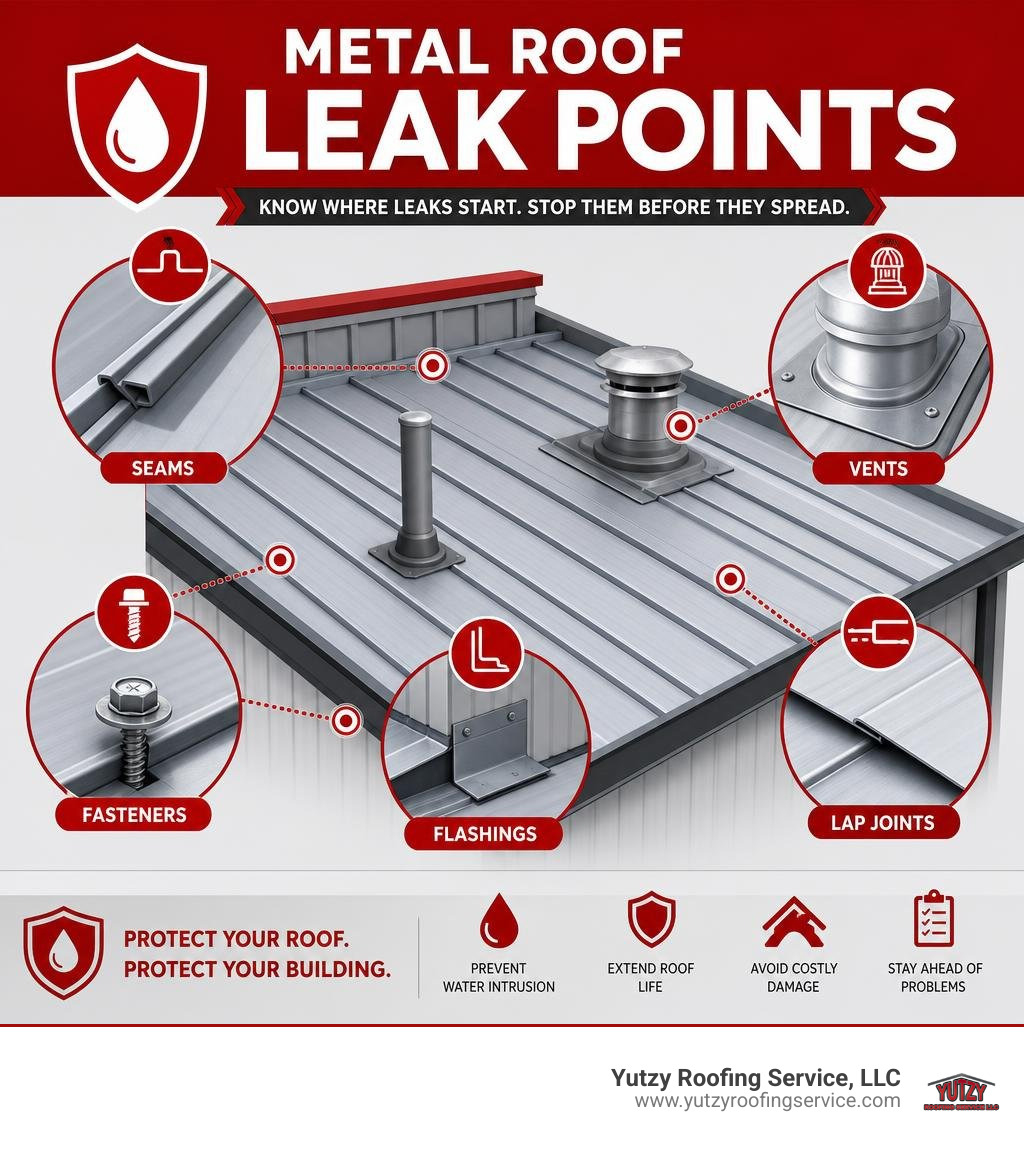
This creates a single, continuous waterproof membrane that completely eliminates the joints and seams where 95% of metal roof leaks occur. Elastomeric coatings are highly reflective (reducing energy costs) and expand and contract easily with the thermal movement of the metal. Best of all, these systems can extend the life of your roof by decades at a fraction of the cost of replacement. Learn more about the metal roof waterproofing benefits for properties in our region.
Frequently Asked Questions About Metal Roof Sealants
How long does metal roof caulk typically last before reapplication?
The lifespan of metal roof caulk depends heavily on the chemistry of the product and its exposure to the elements. High-quality polyurethane and silicone caulks typically last between 10 to 20 years. However, in climates like Wisconsin and Minnesota with extreme temperature swings, we recommend performing routine roof inspections twice a year (spring and fall). Look for signs of degradation such as cracking, peeling, chalking, or loss of elasticity.
What temperature and weather conditions are ideal for applying sealant?
For most standard caulks, the ideal application temperature is between 40°F and 100°F (4°C to 38°C). However, high-performance polymer sealants like Titebond WeatherMaster can be applied in temperatures as low as 0°F (-18°C), and solvent-based rubber sealants can go down to 20°F (-7°C). Avoid applying sealants during active rain or when dew is heavy on the roof, as moisture will severely compromise the adhesion of non-silicone products.
Can you apply new caulk directly over old sealant or rust?
No. Applying new caulk directly over cracked, old sealant or loose rust is a recipe for immediate failure. The new sealant will only adhere to the failing material underneath, which will quickly peel away from the metal. You must scrape away the old caulk and wire brush any heavy rust down to a clean, stable surface before applying new sealant.
Conclusion
A leaking commercial metal roof doesn’t necessarily mean you need a costly replacement. By choosing the right metal roof caulk and applying it with proper surface preparation, you can protect your building and extend the lifespan of your roof.
At Yutzy Roofing Service, LLC, we specialize in commercial metal roof restoration, repairs, and maintenance across Wisconsin and Minnesota — including Marshfield, Madison, Appleton, Wausau, Eau Claire, Fond Du Lac, Green Bay, Mankato, and Rochester. We stand behind our work with non-prorated, renewable warranties of up to 18 years.
If your commercial building’s metal roof is showing signs of age or has persistent leaks, don’t wait for a major storm to cause expensive interior damage. Check out Yutzy Roofing Service’s Metal Roof Sealant Complete Guide or contact our team today to schedule a professional roof assessment!
