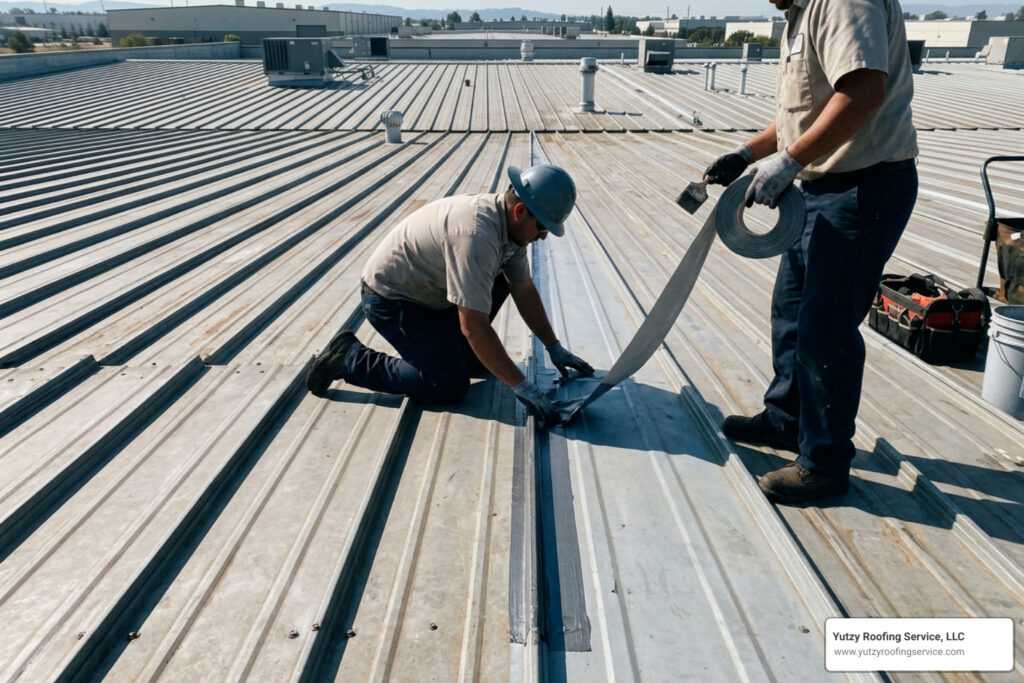
Why Mastic Tape for Metal Roofing Is the First Line of Defense Against Leaks
Mastic tape for metal roofing is a flexible, rubber-based sealant strip used to create watertight seals at panel laps, flashings, and penetrations on metal roofs. Here’s a quick summary of what it does and why it matters:
- What it is: A butyl rubber adhesive tape that bonds metal to metal without curing
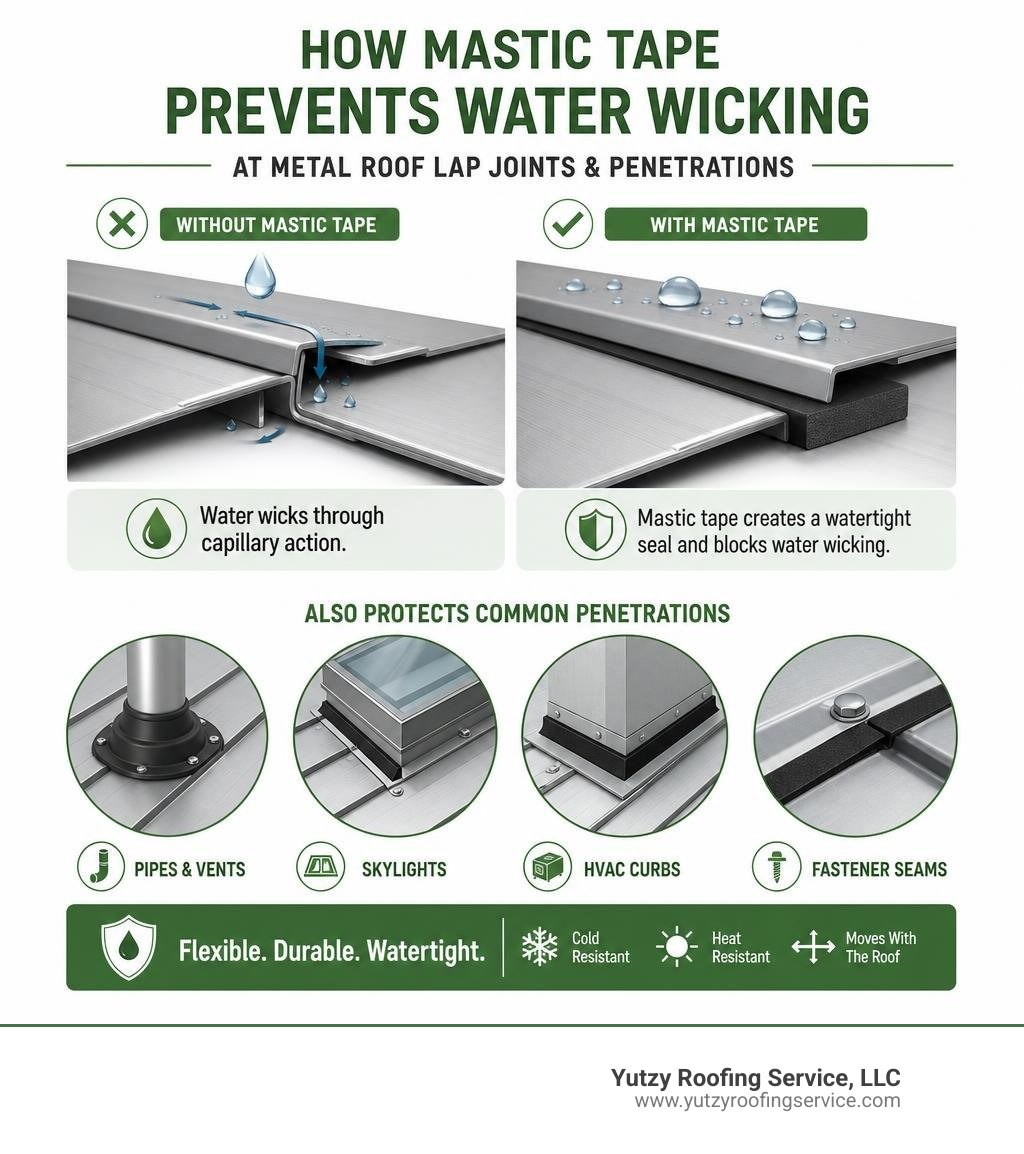
- Where it’s used: Endlaps, sidelaps, pipe flashings, skylights, HVAC curbs, and vents
- Key benefit: Stays flexible from -40°F to 180°F — it won’t crack, harden, or ooze
- Best for: Sealing commercial metal roofs against water wicking, air infiltration, and thermal movement
- Application: Peel-and-stick, no special tools required
Metal roofs are built to last. But even the toughest steel panels can’t stop water on their own.
The real weak points are the seams. Every lap joint, fastener hole, and roof penetration is a place where water can work its way in — especially under the freeze-thaw stress of a Wisconsin winter. A single overtorqued screw or an unsealed endlap can turn into a costly interior leak before you ever notice it on the surface.
That’s where mastic tape earns its place on every commercial roof restoration job.
It’s not a temporary patch. It’s a permanent, pressure-sensitive seal that moves with the roof as it expands and contracts through the seasons — something rigid caulks and liquid sealants simply can’t do.
I’m Josh Yutzy of Yutzy Roofing Service, LLC, and after decades of restoring commercial metal roofs across Wisconsin, I’ve seen how proper mastic tape for metal roofing applications stop leaks that nothing else could fix. In this guide, I’ll walk you through everything you need to know to seal your metal roof right the first time.
What is Mastic Tape for Metal Roofing?
To understand why mastic tape is so effective, we have to look at what it is actually made of. Often referred to interchangeably as butyl tape, mastic tape is a high-performance adhesive sealant extruded into a roll of pre-formed tape.
Unlike traditional adhesive tapes that use a thin layer of glue on a plastic backing, mastic tape is a solid, 100% synthetic rubber compound. Chemically classified as isobutylene, it is formulated without solvent carriers, meaning it has zero volatile organic content (VOCs) and will never shrink or dry out over time.
Because it does not cure or harden, mastic tape offers permanent flexibility. When you press it between two metal panels, it creates an instant, aggressive, non-staining bond. It behaves like a highly tacky, dense putty that conforms to every microscopic imperfection in the metal. For commercial facilities in places like Green Bay, WI, or Rochester, MN, this physical barrier is what stands between your inventory and a sudden rainstorm.
You can learn more about how this material works in the field by reading about Butyl/Sealant Tape for metal roofing applications.
Comparing Mastic Tape for Metal Roofing to Liquid Sealants
When we talk to commercial building owners about sealing their roofs, the first question is usually: “Why can’t we just use a tube of caulk?”
It’s a fair question. Liquid sealants like polyurethane, silicone, or acrylic caulks are cheap and easy to squeeze out of a gun. But on a metal roof, liquid sealants face a massive physical challenge: thermal expansion and contraction.
Metal roofs are dynamic systems. When the summer sun beats down on a warehouse in Madison or Wausau, the metal panels expand. When a sudden thunderstorm cools the roof, or when winter temperatures drop to -30°F, the panels contract. This constant movement puts immense shear stress on any joint.
Liquid sealants cure into a solid state. Over time, the repeated stretching and compressing leads to cohesive separation (the caulk tears down the middle) or adhesive failure (the caulk peels away from the metal). Furthermore, liquid sealants require a specific curing window, during which rain, dew, or dust can ruin the bond.
Mastic tape, on the other hand, never cures. It has an elongation capacity of over 1000%, meaning it can stretch and self-heal indefinitely. When compressed between two panels, it is protected from direct UV exposure, allowing it to maintain its seal for decades.
To see how these options stack up, take a look at our comparison table:
| Feature | Mastic (Butyl) Tape | Liquid Caulk / Polyurethane |
|---|---|---|
| Cure Time | None (Instant Seal) | 24 to 72 Hours |
| Flexibility | Permanent (Over 1000% Elongation) | Decreases over time as it dries |
| Application Consistency | Perfectly uniform thickness | Highly dependent on installer skill |
| Movement Tolerance | Excellent (Self-healing under pressure) | Moderate (Prone to tearing/cracking) |
| Cleanliness | Neat, trimmable, no mess | Messy, prone to oozing and dripping |
| Lifespan | 20+ Years (Protected inside joint) | 3 to 7 Years (Exposed to weather) |
If you want to dive deeper into all your options for protecting your commercial building, check out our Metal Roof Sealant Complete Guide.
Key Specifications of Mastic Tape for Metal Roofing
Not all butyl tapes are created equal. If you walk into a big-box store, you might find cheap putty tapes designed for light RV repairs that will quickly melt or slide off a hot commercial metal roof. Professional-grade commercial roofing requires heavy-duty specifications.
When selecting or verifying mastic tape for your commercial roof, look for these critical physical properties:
- Thickness: Standard metal roofing tape should be between 3/32″ and 1/8″ thick. This thickness ensures that when the metal panels are fastened together, the tape has enough body to fill the gaps created by panel ribs and minor buckling.
- Width: Typical widths range from 3/8″ to 1″ wide. For standard sidelaps, 1/2″ or 3/4″ is the industry standard.
- Tensile and Adhesive Strength: High-quality tapes, such as SM5227 | Tacky Tape, feature a minimum adhesive tensile strength of 20 psi. This ensures that the tape won’t pull away under wind uplift or thermal shifting.
- Elongation: Look for products tested under ASTM C908 that show elongation exceeding 1000%. This guarantees the tape can stretch without tearing.
- Solids Content: Insist on 100% solids, asbestos-free formulations. This ensures the material will not shrink, crack, or release harmful vapors over time.
Key Applications in Commercial Metal Roof Restoration
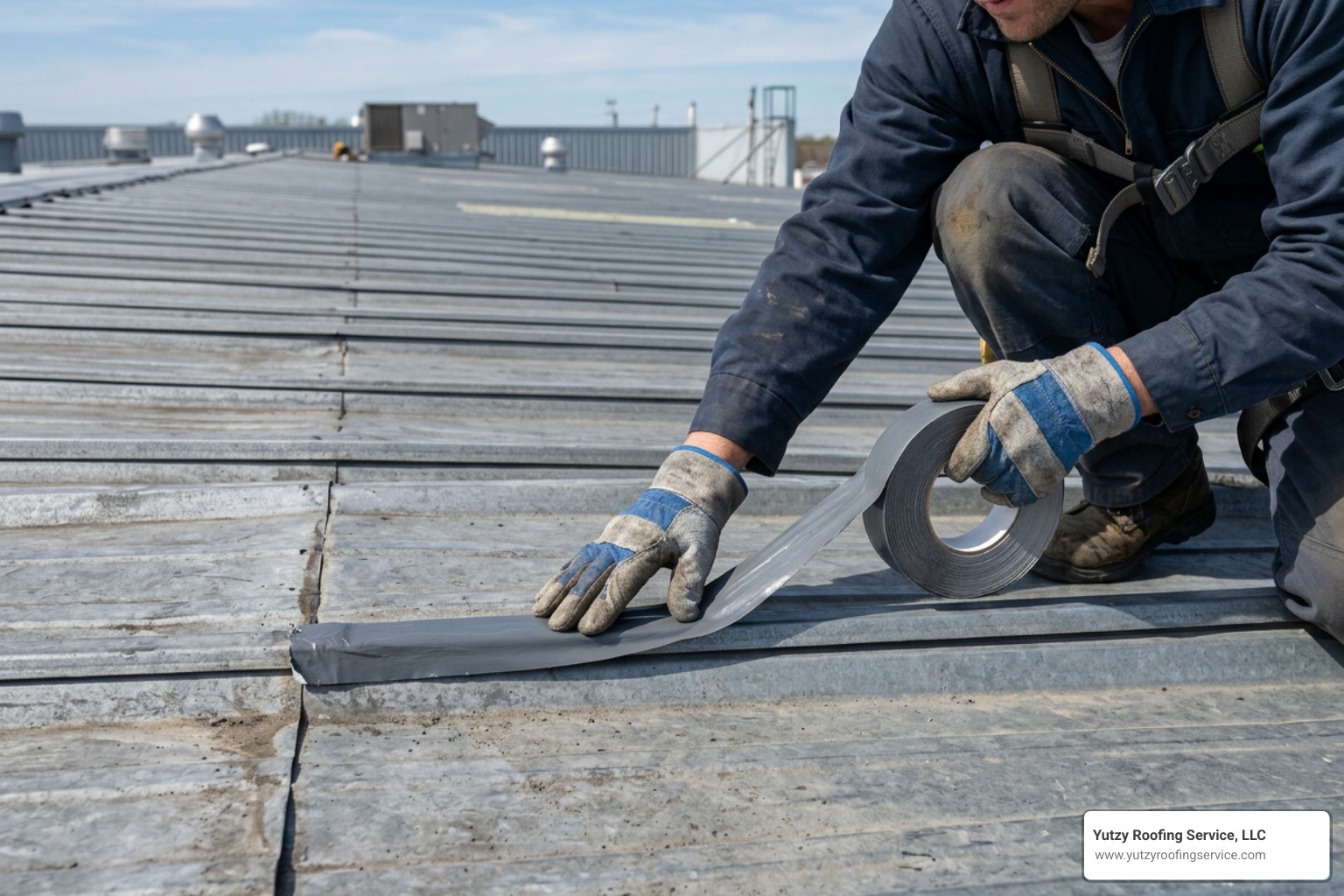
In the commercial roofing world, we rarely install brand-new metal roofs from scratch. Instead, our focus is on extending the life of your existing investment. Through professional commercial roof restoration, we can save building owners thousands of dollars compared to a premature roof replacement.
Mastic tape is a cornerstone of this process. When we perform a Metal Roof Restoration – Extend Your Roof Life, we target every single joint and seam to ensure the system is completely watertight before applying protective elastomeric coatings.
If you are currently dealing with active water intrusion, finding the source is the first step. You can read our practical guide on Drip Drip Drip: How to Identify and Fix a Metal Roof Leak to learn how we trace these issues back to their origin.
Sealing Endlaps and Sidelaps
The most common areas for leaks on a commercial metal roof are the horizontal endlaps (where the bottom of one panel overlaps the top of the panel below it) and the vertical sidelaps (where the panels meet side-by-side).
On low-slope commercial roofs, wind-driven rain can easily push water backward, up and under these overlaps. This process, known as water wicking, is a major cause of structural rust and interior ceiling damage.
Additionally, as the building shifts and settles, the fasteners holding these laps together can back out or strip the metal, widening the gap.
By applying a continuous bead of high-performance tape, like Mastix Butyl Tape – Marco Industries – Great Performance & Easy Installation, directly inside the lap joint before securing the fasteners, you create an impenetrable barrier. The tape seals around the shank of every screw as it penetrates the metal, ensuring that even if a fastener backs out slightly over time, water still cannot pass through the hole.
Flashing, Curbs, and Penetrations
Commercial roofs are rarely flat, unbroken expanses of metal. They are interrupted by HVAC units, skylights, exhaust vents, plumbing stacks, and expansion joints. Every single one of these penetrations requires flashing to transition from the vertical surface of the curb back to the horizontal metal deck.
These transition zones are prime targets for leaks, especially during heavy downpours or winter snow melts. If you’ve ever walked into your facility after a storm to find a puddle beneath an exhaust fan, you know exactly how frustrating this can be.
To prevent this, we use mastic tape to seal the metal flanges of roof curbs and pipe jacks directly to the roof panels. The tape acts as a gasket beneath the metal-to-metal connection, blocking water from seeping under the flashing.
If your facility is currently suffering from these issues, you might find our guide on This Is What to Do If Your Metal Roof Leaks in Heavy Rain helpful for taking immediate damage-control steps.
Performance Under Extreme Weather and Temperatures
Here in the Upper Midwest — from our home base in Marshfield, WI, to our service areas in Appleton, Eau Claire, and Mankato, MN — commercial roofs must survive some of the most brutal weather in the country.
In July, metal roof surface temperatures can easily soar past 150°F. In January, those same panels can drop well below -20°F. This extreme temperature swing is why cheap sealants fail within a season or two.
Professional-grade mastic tape is specifically engineered to handle these harsh environments:
- Service Temperature Range: Quality butyl tape maintains its elasticity and adhesive bond across a wide service temperature range of -40°F to +180°F (and up to 200°F for premium formulations like SM5227). It will not become brittle or crack in deep winter, nor will it melt, sag, or ooze out of the joints during the peak of summer.
- UV and Weather Resistance: Because the tape is typically sandwiched between metal panels or covered by flashing, it is shielded from direct sunlight. However, even in exposed areas, high-quality butyl rubber resists degradation from UV radiation, ozone, and acid rain.
- Freeze-Thaw Durability: Water expands when it freezes. If water gets into a microscopic crack in a liquid sealant, the next freeze-thaw cycle will widen that crack until the seal fails. Because mastic tape is completely hydrophobic and self-healing, it prevents water from entering the joint in the first place, stopping freeze-thaw damage before it starts.
Using materials rated for these conditions is a key part of protecting your facility’s bottom line. For a deeper look at how long-term roof preservation saves money, read about The Business Benefits Maintenance of a Commercial Metal Roof.
You can also review the formal engineering data sheets, such as the SM7100 CONSTRUCTION testing documentation, to see how these materials perform under strict laboratory conditions.
Step-by-Step Application Guide for Commercial Roofers

Even the best mastic tape on the market will fail if it is applied incorrectly. At Yutzy Roofing Service, LLC, we follow a strict installation protocol to ensure every seal we create lasts for the long haul.
If you are managing a maintenance crew or looking to oversee a restoration project on your facility, here is the professional step-by-step process for applying mastic tape:
Step 1: Surface Preparation (The Most Critical Step)
Mastic tape requires direct contact with clean, bare metal to form a permanent bond.
- Use a wire brush or scraper to remove any loose rust, old caulk, or peeling paint.
- Wipe the area down thoroughly with a solvent like acetone or isopropyl alcohol to remove any residual grease, dust, or roll-forming oils left over from manufacturing.
- Crucial Tip: The surface must be completely dry. Never apply mastic tape over dew, frost, or standing water.
Step 2: Unrolling and Positioning
- Keep the paper release liner on the tape as you unroll it.
- Lay the tape down along the joint, positioning it on the dry, secure side of where your fasteners will go (usually about 1/2″ to 1″ from the edge of the panel).
- Press down firmly along the entire length of the paper backing with your fingers or a small rubber seam roller. This initial pressure activates the adhesive bond.
Step 3: Removing the Liner and Joining
- Peel back the paper release liner slowly, taking care not to pull the tape off the metal.
- If you need to transition or turn a corner, butt-join the ends of the tape together. Do not overlap them, as this can create a thick bump that prevents the metal panels from laying flat.
- Carefully position the overlapping metal panel or flashing directly over the exposed tape.
Step 4: Fastening and Final Compression
- Secure the joint using appropriate commercial roofing screws with neoprene washers.
- As you tighten the fasteners, the pressure will compress the mastic tape, forcing it to flow into the threads of the screws and seal any microscopic gaps.
- Pro Tip: Avoid overtorquing the screws. Overtightening can strip the metal deck or crack the rubber washers, creating a new path for leaks.
To keep your roof in top shape and avoid common installation errors, take a look at our guide on The Dos and Don’ts of Metal Roof Maintenance.
For projects requiring specialized self-adhesive flashing membranes, you can also review the application instructions for Sikalastic®-100 SA Tape | Additional Roofing Products.
Frequently Asked Questions about Metal Roof Sealing
Can you use mastic tape on standing seam metal roofs?
Yes, but with some specific guidelines. Standing seam metal roofs are designed to allow the panels to slide back and forth during thermal expansion. Because of this, you should never apply mastic tape along the vertical standing seams themselves, as this can lock the panels in place and cause buckling.
However, mastic tape is absolutely required on standing seam roofs at the endlaps (where panels overlap horizontally), around roof curbs, and beneath skylights or pipe flashings. In these areas, the tape provides the necessary watertight gasket without interfering with the roof’s thermal movement.
If you are dealing with a leaking standing seam roof in Wisconsin, you can learn more about our local repair capabilities by visiting Metal Roof Leak Repair Services in Oshkosh WI.
How long does butyl tape last on a commercial roof?
When applied correctly and compressed within a metal-to-metal joint, high-quality butyl tape can easily last 20 to 25 years — often outlasting the metal fasteners themselves.
Because it is protected from direct UV rays inside the seam, it does not suffer from the rapid solar degradation that destroys liquid caulks. Over decades, it will remain sticky and flexible, continuing to seal out water even as the building settles.
Integrating this long-lasting tape into a comprehensive restoration project is one of the smartest moves a building owner can make. For more details on this process, read Metal Roof Restoration – What Is It, What Are the Benefits.
What is the best temperature to apply mastic tape?
For the best results, mastic tape should be applied when ambient temperatures are between 40°F and 110°F.
In extremely cold weather, the tape can lose some of its initial “tack,” making it harder to stick to the metal. Furthermore, cold metal is highly prone to microscopic condensation or frost, which will ruin the adhesive bond.
If you must apply tape in cold weather, ensure the metal is thoroughly dried with a clean cloth and solvent, and keep the tape rolls in a heated space (like a truck cab) until right before application.
For standard retail specifications and temperature ratings, you can check out the 50 ft. Butyl Sealant Tape Roof Accessory in Gray – The Home Depot product page.
Conclusion
When it comes to protecting your commercial facility, there is no room for compromise. A small leak over an office, warehouse, or production floor can lead to damaged equipment, ruined inventory, and costly downtime.
Using high-performance mastic tape for metal roofing is one of the simplest, most effective ways to ensure your metal roof remains completely watertight, no matter what the Wisconsin and Minnesota weather throws at it.
At Yutzy Roofing Service, LLC, we specialize in helping commercial property owners extend the life of their roofs through professional restoration, maintenance, and leak repair. We back our work with up to 18-year non-prorated renewable warranties, giving you total peace of mind.
Whether your building is in Madison, Wausau, Appleton, or Mankato, our team is ready to help. If you want to learn more about how to keep your facility dry, or if you’re ready to schedule a professional roof inspection, check out our comprehensive Metal Roof Sealant Complete Guide or contact us directly today!
