
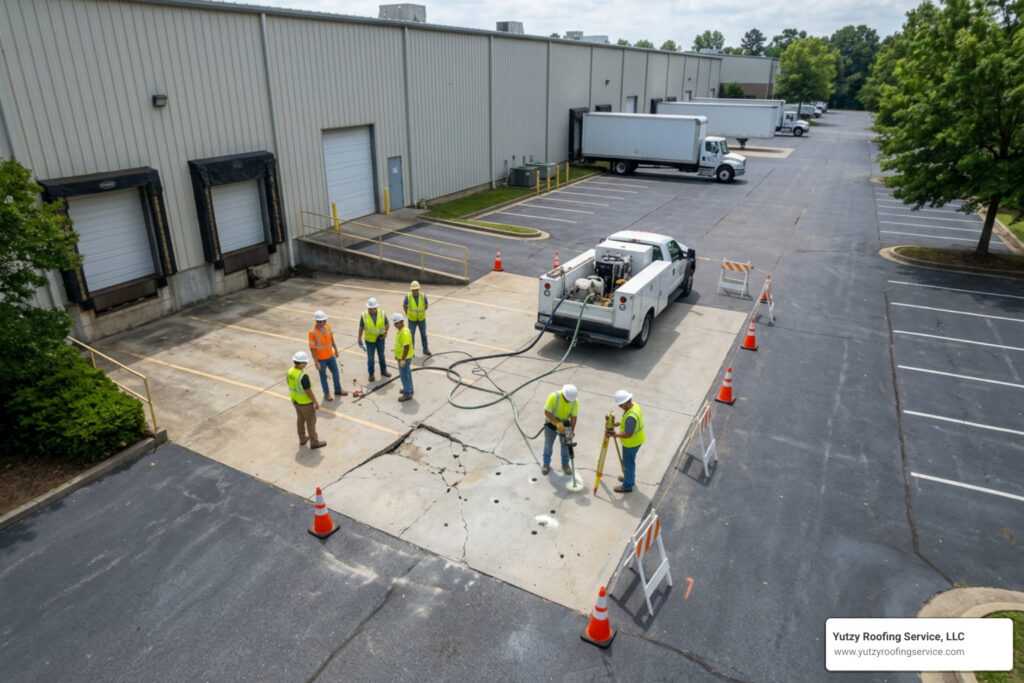
When Your Concrete Slab Starts Sinking, Here’s What Actually Works
Concrete foam spray is one of the fastest, most effective ways to lift sunken slabs, fill voids, and stop trip hazards before they become liability problems.
Quick answer — best concrete foam spray products by use case:
| Use Case | Best Product |
|---|---|
| Small gaps and cracks | Loctite Tite Foam Gaps & Cracks |
| Post and pole installation | Fast 2K Fence Post Mix |
| Commercial slab lifting | HandiFoam Concrete Lift |
| Wall cavity insulation | DAP Wall & Cavity Foam |
That sunken loading dock apron or cracked parking lot slab might look like a minor annoyance. But left alone, settlement gets worse — and fast. Water erosion, freeze-thaw cycles (a very real problem in Wisconsin winters), and poor soil compaction all eat away at the ground beneath your concrete. The slab drops. Gaps form. Someone trips. Now you have a real problem.
The good news? Modern polyurethane foam products can lift and stabilize concrete in minutes — without tearing anything out. Professional concrete leveling can even save up to 70% compared to full slab replacement.
But not every foam product is right for every job. Canned spray foam from a hardware store is not the same as a high-density polyurethane system engineered to carry thousands of pounds per square foot.
This guide breaks down exactly which products work, where, and how to use them safely.
I’m Josh Yutzy, and while my team at Yutzy Roofing Service specializes in commercial roofing across Wisconsin, we work closely with concrete foam spray systems in the context of roof deck stabilization and exterior surface repair. In nearly 30 years of commercial work, I’ve seen how the right foam product protects a building’s structure — and how the wrong one makes things worse.
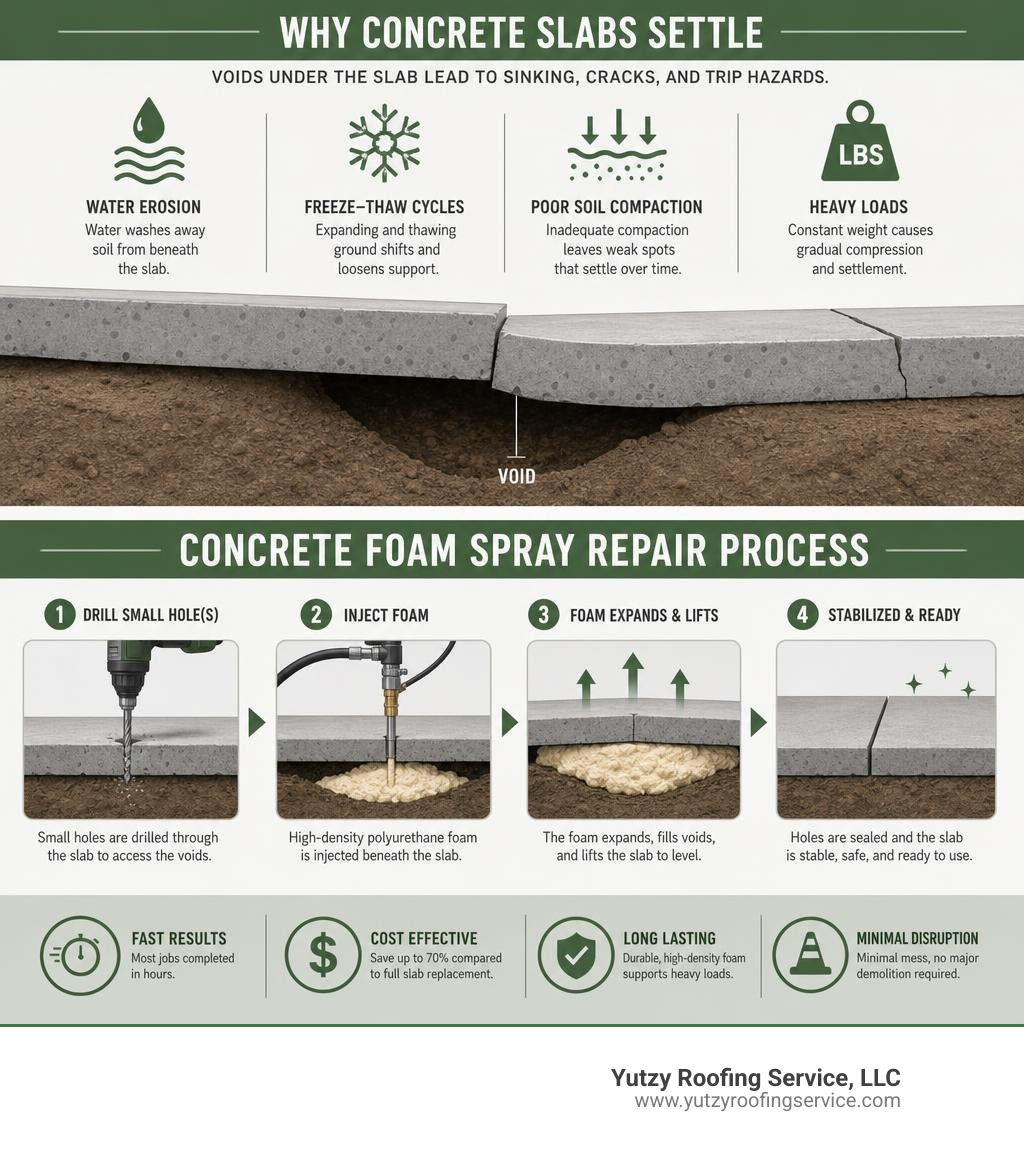
Essential concrete foam spray terms:
What is Concrete Foam Spray and How Does It Work?
At its core, concrete foam spray is a high-density polyurethane foam. It starts as two separate liquid components—usually referred to as an “A-side” (isocyanate) and a “B-side” (polyol). When these liquids mix at the tip of an injection gun, a chemical reaction occurs. The mixture rapidly expands, turning from a liquid stream into a dense, closed-cell foam structure.
In commercial slab repair and void filling, this expansion is the secret weapon. As the foam expands under a concrete slab, it flows into the path of least resistance, filling empty spaces, compacting weak subgrade soils, and eventually exerting enough upward pressure to lift heavy concrete slabs back to their original grade.
When comparing these systems, pay close attention to two key technical metrics:
- Free Rise Density: This is the density of the foam when allowed to expand without restriction. For heavy-duty concrete lifting, you want a free rise density of around 2.8 to 3.1 lbs/ft³. This ensures the foam has enough body to support massive loads.
- Compressive Strength: This measures how much weight the cured foam can support before compressing. High-quality lifting foams boast compressive strengths of 27 to 35 psi (pounds per square inch). That translates to a load-bearing capacity of over 5,000 lbs per square foot!
While we regularly use similar polyurethane chemistry for commercial roof restorations to seal and insulate, slab lifting requires a much higher density. To learn more about how we utilize these high-performance materials on roof structures, check out our guide on Polyurethane Foam Spray: Is It Right for Your Roof.
Polyurethane Foam vs. Traditional Mudjacking
For decades, the standard method for lifting sunken concrete was mudjacking. This process involves drilling large, 2-inch holes into the concrete and pumping in a heavy “slurry” made of water, soil, sand, and portland cement.
While mudjacking works, it has several major drawbacks compared to modern concrete foam spray injection:
- Weight: Mudjacking slurry is incredibly heavy, weighing up to 100–120 lbs per cubic foot. Injecting this heavy material on top of already failing, unstable subgrade soil often causes further settlement down the road. High-density polyurethane foam, by contrast, weighs only about 3 to 4 lbs per cubic foot. It adds virtually no weight to the soil while providing superior load support.
- Precision: Slurry is difficult to control and requires massive pressure to move. This can cause the concrete slab to crack or lift unevenly. Polyurethane foam expands uniformly and cures within minutes, allowing technicians to make micro-adjustments for a perfectly level finish.
- Drill Hole Size: Mudjacking requires large, unsightly holes that must be patched. Polyurethane injection only requires small, nickel-sized holes (about 5/8 of an inch), leaving a much cleaner finish.
- Water Resistance: Mudjacking slurry can erode if water runs beneath the slab. Polyurethane foam is hydrophobic (water-resistant) and will not wash away, even in heavy rain or high water tables.
Types of Concrete Foam Spray and Their Uses
Different applications require different foam structures. Using the wrong foam type can lead to structural failure or wasted material.
| Foam Type | Density (lbs/ft³) | Compressive Strength | Best Use Case |
|---|---|---|---|
| High-Density Closed-Cell Foam | 2.8 – 3.2 | 30 – 35+ psi | Lifting heavy commercial concrete slabs, parking lots, warehouse floors |
| Medium-Density Closed-Cell Foam | 1.7 – 2.2 | 24 – 27 psi | Void filling, rim joist sealing, foundation insulation, precast form sealing |
| One-Component Gap Fillers | < 1.5 | Low (Non-Structural) | Sealing small cracks, gaps, and keeping out pests or draft air |
| Two-Component Post/Pole Foams | 2.5 – 3.0 | Moderate | Backfilling utility poles, fence posts, and signposts |
For commercial applications in Wisconsin, professional contractors rely on high-density closed-cell foams to handle the harsh freeze-thaw cycles that push slabs out of alignment.
Top Concrete Foam Spray Products Reviewed
Choosing the right concrete foam spray depends entirely on the scope of your project. Here is a review of the top-performing products available as of June 2026.

Best for Post Installation: Fast 2K Fence Post Mix
If you are setting utility poles, security fences, or signposts around a commercial property, traditional concrete bags are heavy, messy, and take 24 to 48 hours to fully cure. Fast 2K Fence Post Mix has revolutionized this process.
- Performance & Popularity: This product is incredibly popular for quick installations, boasting over 1,986 customer reviews and 800+ purchases in the past month alone.
- How it Works: It is a two-component polyurethane system packaged in a single, convenient bag. You simply roll the bag to break the inner seal, mix the two liquids by shaking the bag for 30 seconds, and pour it directly into the post hole.
- Key Strengths: It expands to fill the entire void between the post and the soil, curing to a load-bearing state in just 15 minutes. It is completely waterproof, which protects wooden or metal posts from rotting or rusting underground.
- Limitations: It is strictly designed for post setting and void backfilling around poles. It does not have the flat-surface expansion control needed to lift flat concrete slabs.
Best for Small Gaps and Cracks: Loctite Tite Foam
When you aren’t trying to lift a 10-ton concrete slab, but instead need to seal gaps, joint transitions, or cracks in a foundation wall, a high-quality canned foam is your best bet. Loctite Tite Foam is the industry gold standard for small-scale sealing.
- Performance & Popularity: The market demand for this product is massive. Loctite Tite Foam Gaps & Cracks has over 19,661 customer reviews and 8K+ purchases in the past month, while the Big Gaps version has 9,079 reviews and over 6K purchases in the past month.
- Key Strengths: Unlike cheap, brittle canned foams that degrade and crumble over time, Loctite Tite Foam is formulated to be highly flexible. It expands to fill irregular gaps, provides a high R-value insulation barrier, and stands up to the natural shifting and expansion of concrete surfaces without cracking.
- Limitations: This is a non-structural sealant. Do not attempt to use it to lift slabs or support heavy structural loads, as it will compress under weight.
Best for Commercial Slab Lifting: HandiFoam Concrete Foam Spray
For heavy-duty, professional structural lifting and void filling, we highly recommend the HandiFoam® Concrete Lift system.
- Product Overview: Engineered specifically to lift sunken slabs, fill deep voids, and stabilize concrete, this low-pressure spray polyurethane foam is a top choice for commercial contractors. You can learn more about its technical specs directly on the HandiFoam® Concrete Lift Low-Pressure Spray Polyurethane Foam (SPF) – HandiFoam® product page.
- Key Specs:
- Free Rise Density: 3.10 lbs/ft³ (50 kg/m³)
- Tack-Free Time: 30 to 60 seconds
- Fully Cured: 1 hour
- Structure: 95% closed-cell content, ensuring maximum water resistance.
- Environmental Compliance: It is formulated with next-generation HFO blowing agents, giving it a very low Global Warming Potential (GWP) and ensuring compliance with strict environmental regulations.
- When to Use: This system is perfect for leveling uneven warehouse floors, stabilizing loading docks, and filling large voids under parking lots. It minimizes downtime, allowing traffic to return to the concrete within an hour of application.
How to Apply Concrete Foam Spray Safely and Effectively
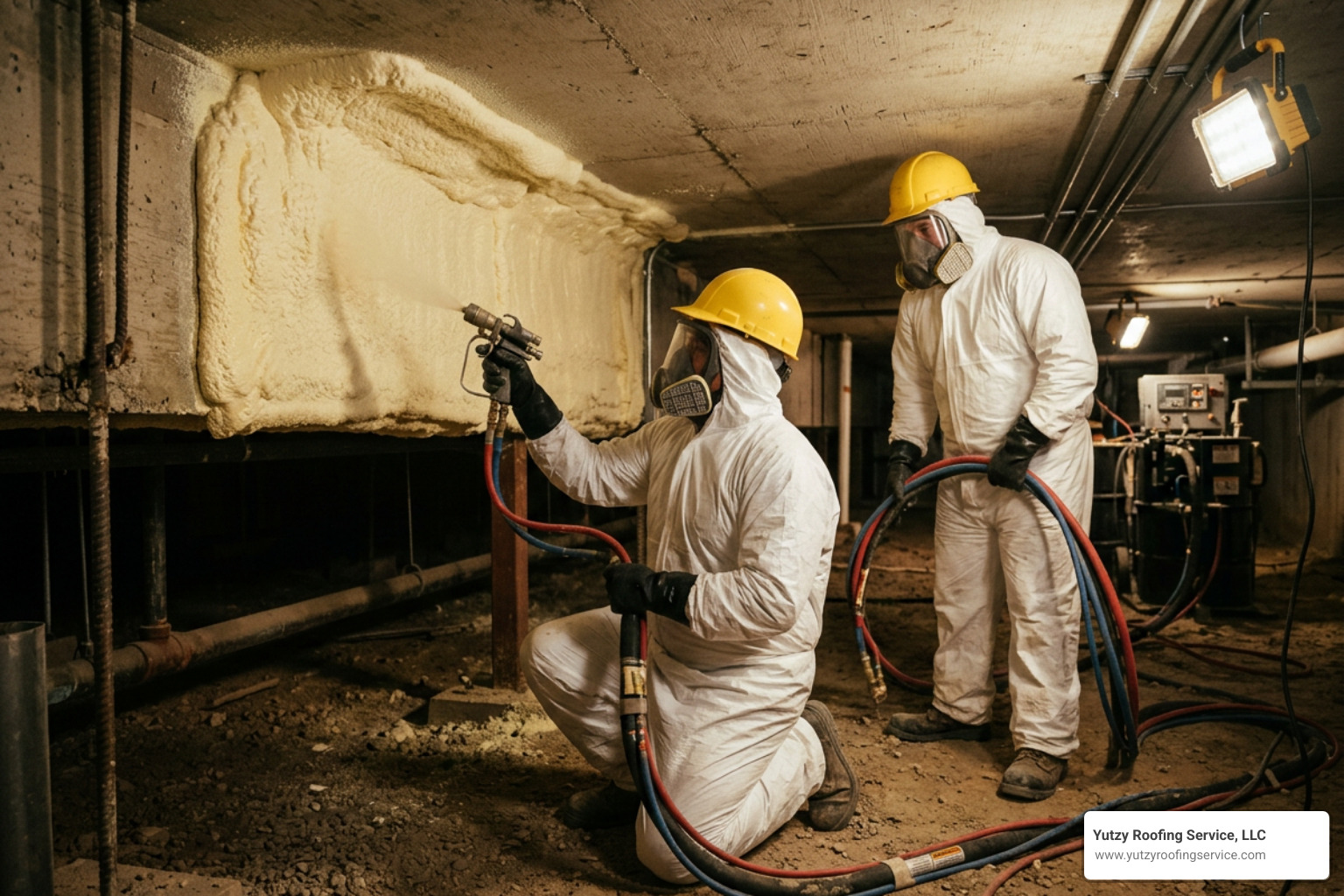
Whether you are using a portable kit or hiring a professional team, applying concrete foam spray requires careful preparation, the right safety gear, and a strict step-by-step process.
Step-by-Step Application and Surface Preparation
To achieve a clean, permanent lift or fill, follow these steps:
- Inspect and Plan: Locate any underground utilities, conduits, or pipes before drilling. Mark out your injection grid. For slab lifting, holes are typically spaced 3 to 4 feet apart in a grid pattern.
- Drill the Injection Holes: Using a rotary hammer drill, drill holes through the concrete slab. For professional foams like HandiFoam, a 5/8-inch drill bit is standard.
- Clean the Voids: Blow out the drilled holes with compressed air to remove concrete dust and loose debris. If the concrete surface is extremely smooth, roughening the inside of the injection port can improve foam adhesion.
- Check Moisture and Temperature: Polyurethane foam adheres best to clean, dry surfaces. Ensure the substrate temperature is within the manufacturer’s recommended range (typically above 60°F for optimal expansion). If you are working in cooler weather, refer to resources like the UPC 2.0 technical guidelines for cold-weather priming.
- Inject the Foam: Insert the injection nozzle securely into the first hole. Inject the foam in short, controlled bursts (2 to 5 seconds at a time). Allow the foam to expand and monitor the slab. You will see the slab begin to rise within a minute.
- Patch the Holes: Once the slab is level and the foam has set, trim any excess foam that squeezed out of the holes. Fill the injection holes with a high-strength concrete patch, such as Sika Sikacryl Ready-Mix Concrete Patch or Red Devil Pre-Mixed Concrete Patch.
Important Safety Note: Always wear personal protective equipment (PPE) during application. This includes safety goggles, long sleeves, nitrile gloves, and a respirator with organic vapor cartridges if working in confined spaces. Uncured polyurethane is incredibly sticky and can cause skin and respiratory irritation.
Curing Times and Durability Factors
One of the greatest advantages of polyurethane foam is its rapid cure time:
- Tack-Free Time: Most professional lifting foams, such as HandiFoam Concrete Lift, become tack-free in just 30 to 60 seconds.
- Cuttable/Trimmable: You can slice away excess foam within 2 to 5 minutes.
- Full Cure: The foam achieves its full structural compressive strength in 1 hour.
Once cured, high-density closed-cell foam is highly durable. Because it is chemically inert, it will not decompose, rot, or leach chemicals into the surrounding soil.
However, UV degradation is its primary weakness. Polyurethane foam must be protected from direct sunlight. If any foam is left exposed to outdoor sunlight (such as around the edges of a loading dock), it must be painted, coated, or covered to prevent UV rays from breaking down the foam structure over time.
Frequently Asked Questions about Concrete Foam Spray
Understanding the limits of your materials is key to a successful project. For a deeper look at the performance of polyurethane systems in commercial settings, see our detailed guide on The Pros and Cons of SPF Roofing for Commercial Buildings Explained.
Will canned spray foam lift concrete?
No, canned retail spray foam will not lift concrete slabs. While it is technically possible for canned foam to expand in a confined space, retail products like standard window and door foam do not have the density or compressive strength required to lift and support heavy structural loads. Attempting to use canned foam for slab lifting will result in the foam collapsing under the weight of the concrete, leading to uneven lifting, slab cracking, and a wasted mess. For slab lifting, you must use a dedicated, high-density, two-component polyurethane system.
Does spray foam stick to concrete?
Yes, closed-cell polyurethane spray foam sticks incredibly well to concrete. In fact, it is known as one of the stickiest substances on earth! However, for proper adhesion, the concrete surface must be clean, dry, and free of dust, grease, oil, or standing water. If you are applying foam to very smooth concrete, lightly roughening the surface or applying a thin “skim layer” first can dramatically improve the bond.
Is concrete foam leveling a permanent fix?
Yes, the foam itself is a permanent fix, but it does not fix the underlying soil or drainage issues. Cured high-density polyurethane foam will last for the lifetime of the concrete. It will not rot, compress, or wash away.
However, if the original settlement was caused by water erosion (such as a broken downspout washing away soil) or poor drainage, you must fix those root causes. If water continues to wash away the soil around or under the foam, the adjacent ground will continue to sink. Always pair concrete lifting with proactive maintenance, like redirecting downspouts and sealing concrete joints.
Conclusion
When a commercial concrete slab begins to sink, ignoring the problem only leads to larger liability risks and more expensive repairs down the road. Concrete foam spray offers a fast, clean, and highly cost-effective alternative to tearing out and replacing concrete, saving you up to 70% in repair costs.
At Yutzy Roofing Service, we are proud to serve commercial property owners throughout Wisconsin—including Madison, Appleton, Wausau, Marshfield, Eau Claire, Fond Du Lac, and Green Bay—as well as Mankato and Rochester, Minnesota. Our team specializes in high-performance commercial roofing restorations, spray foam coatings, and long-term building envelope protection. We stand behind our work with an industry-leading, up to 18-year non-prorated renewable warranty.
If you are ready to protect your commercial building from the roof down, explore how our advanced spray foam systems can benefit your facility. Read our comprehensive guide on Spray Foam Roofing: What Is It and How Can It Benefit You, or contact us today to schedule a professional consultation!
