Is Your Commercial Flat Roof Due for a Restore — or a Full Replacement?
If you’re weighing options for a commercial flat roof restore, here’s the short answer:
- Restore if your roof deck is structurally sound and wet insulation covers less than ~25% of the total area
- Repair if damage is small and localized (a few seams, one puncture)
- Replace if the deck is compromised, moisture is widespread, or the system has reached end of life
Most roofs qualify for restoration. Up to 70% of commercial roofs evaluated with proper diagnostic tools do not need a full tear-off.
Wisconsin commercial buildings take a beating. Brutal freeze-thaw cycles crack seams. Summer UV degrades membranes. Standing water after spring thaws finds every weak point. The result? A roof that leaks, drives up energy bills, and puts your business operations at risk.
The default advice from many contractors is to tear it off and start over. But that’s often the most expensive option — not the only one.
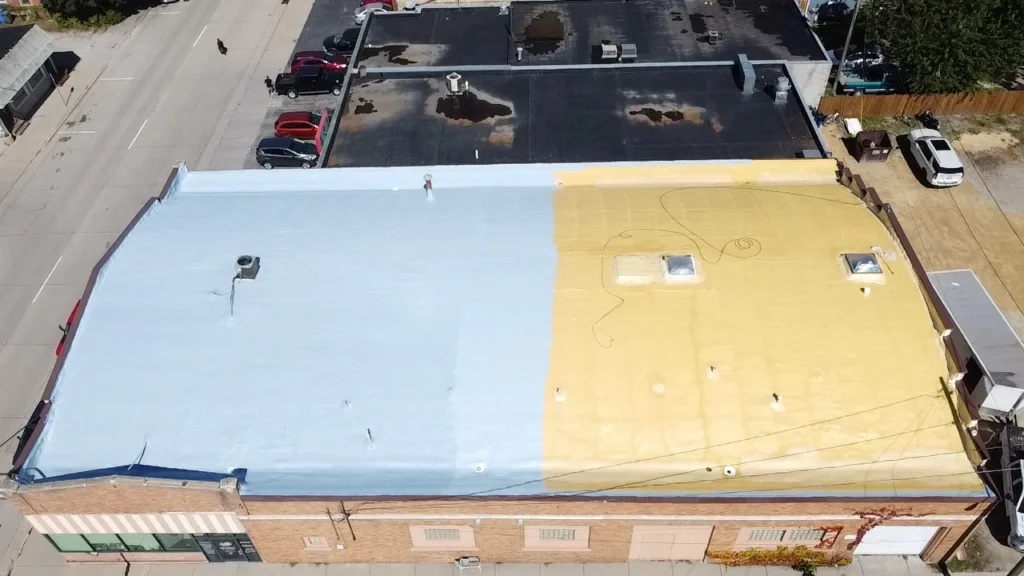
A fluid-applied restoration can cost 50% to 70% less than a full tear-off and replacement. It adds decades of service life. And in most cases, it can be done in one to three days with zero disruption to your building operations.
I’m Josh Yutzy, and my family has been handling commercial flat roof restore projects across Wisconsin, Missouri, and Kansas since 1995. We’ve seen how the right diagnostic approach — before any recommendation is made — separates a smart investment from an unnecessary one.
When to Choose a Commercial Flat Roof Restore Over Replacement
Making the right decision for your commercial building in 2026 shouldn’t be based on guesswork. It should be built on data. Far too many facility managers in places like Madison, WI or Appleton, WI are told they need a complete tear-off when their roof is actually an excellent candidate for a high-performance restoration.
To help you visualize the differences, let’s break down how these options compare side-by-side:
| Feature/Metric | Localized Repair | Commercial Flat Roof Restore | Full Tear-Off & Replacement |
|---|---|---|---|
| Typical Cost | $200 – $2,000 (per incident) | $3 – $7 per sq. ft. | $12 – $22 per sq. ft. |
| Average Lifespan | Temporary fix (months to years) | 10 to 20+ years (renewable) | 15 to 30 years |
| Business Disruption | None | Extremely low (no odor, fast cure) | High (noise, debris, open deck) |
| Landfill Waste | Zero | Zero | High (tons of old membrane/insulation) |
| Tax Treatment | Immediate expense | Immediate Section 179 deduction | 39-year capital depreciation |
| Installation Time | Hours | 1 to 3 days | 1 to 3 weeks |
Understanding the difference between repairing, retrofitting, and replacing is the first step toward smart asset management. A basic repair is perfect for fixing a single puncture or a loose flashing seam. If you want to dive deeper into the mechanics of localized fixes, check out our guide on Flat Roof Leak Repair: How Does It Work?.
However, if you find yourself constantly patching the same roof, you are likely wasting money. When minor issues become chronic, you need a long-term strategy. For a comprehensive look at this decision-making process, read our expert analysis on Commercial Roof Repair or Replacement: What’s the Best Choice?.
How a Commercial Flat Roof Restore Saves Money
The financial math behind a commercial flat roof restore is incredibly compelling. First, there are the direct day-one savings. Because we do not have to pay for extensive labor to tear off the existing roof, rent multiple industrial dumpsters, or pay heavy landfill disposal fees, we can pass those savings directly to you. A fluid-applied silicone or acrylic system typically costs 50% to 70% less than a traditional replacement. On a 50,000-square-foot facility, that can translate to saving $200,000 to $450,000.
Second, the IRS looks very favorably on roof restoration. Under Section 179 of the tax code, a fluid-applied restoration is generally classified as “maintenance” or a “repair” rather than a capital improvement. This means you can often deduct the entire cost of the project in the very first year, rather than depreciating it over a painful 39-year schedule. For general information about depreciation and Section 179 rules, see IRS Publication 946. As always, we recommend consulting your CPA to confirm how this applies to your specific tax situation.
Finally, you save money on your monthly utility bills. Applying a highly reflective “cool roof” coating can lower your roof’s surface temperature by up to 50 degrees during the hot summer months, reducing your building’s cooling costs by 25% to 35%.
Diagnostic Methods to Qualify Your Roof
We don’t just walk onto a roof, look around, and tell you to coat it. A successful restoration requires a rigorous, data-driven diagnostic process. If a contractor tries to sell you a roof coating without performing these three diagnostic steps, run the other way:
- Infrared Thermal Imaging: We perform non-destructive thermal scans (often at night or just after sunset) to detect temperature differences across your roof. Saturated insulation holds heat longer than dry insulation. This allows us to map out the exact locations of subsurface moisture with pinpoint accuracy.
- Core Sampling: We take physical core cuts through the roofing membrane down to the deck. This allows us to verify the exact assembly of your roof, check the condition of the structural deck (looking for rust in metal or rot in wood), and confirm whether the insulation is dry.
- Moisture Surveys & Structural Validation: If we find that less than 25% of the insulation board is wet, we can simply cut out and replace those specific wet sections, patch them, and proceed with the restoration. If the wet areas exceed 25% to 30%, or if the structural deck itself is compromised, then a full replacement becomes necessary.
For more details on how we evaluate flat roofs and identify hidden vulnerabilities, read our comprehensive Flat Commercial Roof Repair Guide.
Compatible Substrates and Coating Technologies
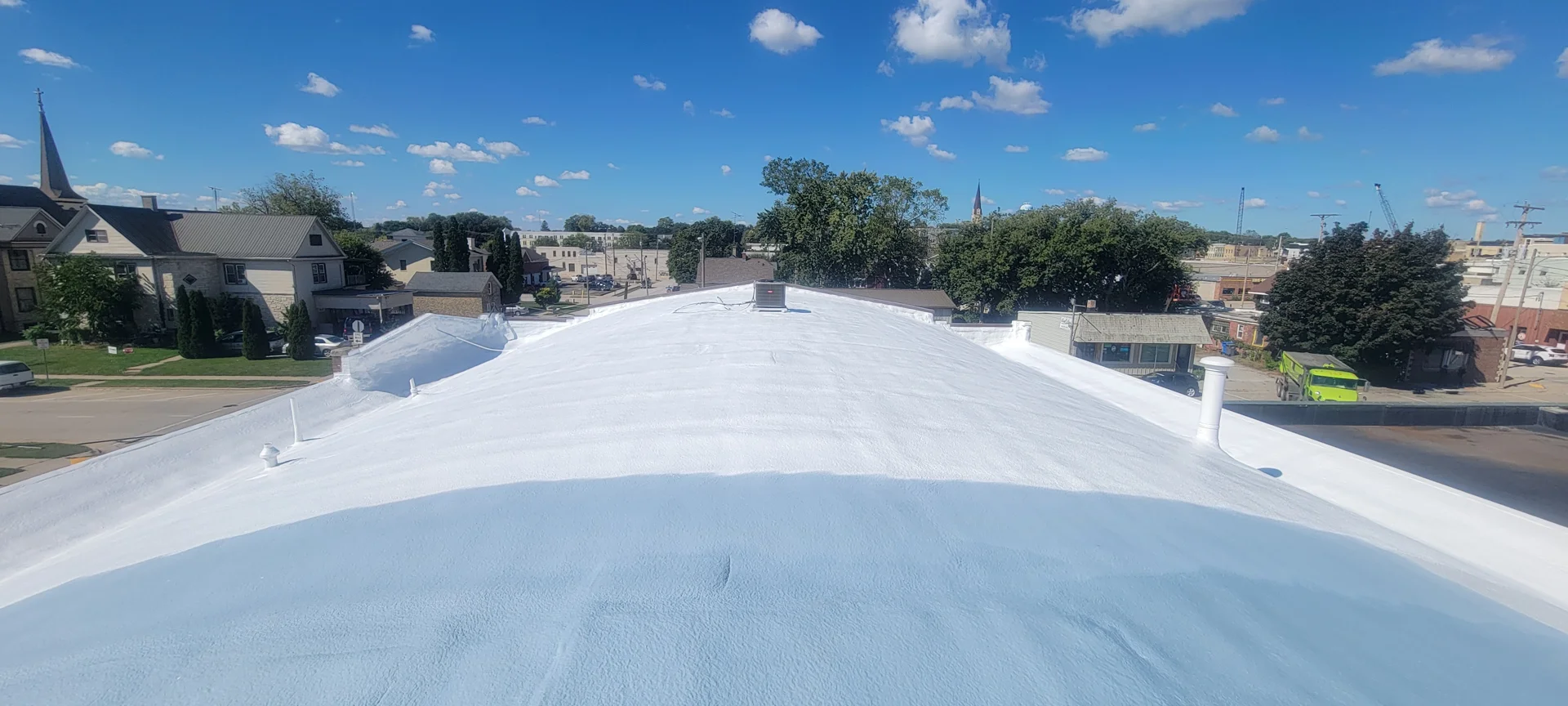
One of the greatest advantages of modern fluid-applied systems is their versatility. Whether your building is located in Eau Claire, WI or Mankato, MN, we can restore a wide variety of existing flat roof systems.
To learn more about what is currently protecting your building, take a look at our guide to the Top Flat Roof Material Types You Should Know About: A Closer Look. Here is how we approach the most common commercial substrates:
- EPDM (Rubber): EPDM is highly durable but degrades predictably through shrinkage, brittle flashings, and seam failures. Applying a silicone restoration system eliminates these seam vulnerabilities entirely. Because dark EPDM has a solar reflectance of only 6% to 10%, converting it to a white silicone system (with 80% to 90% reflectance) dramatically slashes your cooling bills.
- TPO and PVC (Single-Ply): These thermoplastic membranes are popular, but over time, UV exposure and thermal expansion cause them to crack and fail at the welded seams. We can apply high-performance coatings directly over clean, primed TPO or PVC to encapsulate the entire surface.
- Modified Bitumen and Built-Up Roofs (BUR): Multi-ply asphalt systems are robust but prone to cracking, blistering, and gravel loss. We can clean the substrate, secure loose gravel, and apply a thick elastomeric membrane to stop leaks permanently.
- Metal Roofs: Low-slope metal roofs suffer from rust, backed-out fasteners, and seam movement. We treat the rust, seal every fastener and seam with specialized heavy-duty mastics, and apply an elastomeric topcoat to fully encapsulate the metal.
Fluid-Applied Coating Chemistries (Silicone, Acrylic, and Urethane)
Choosing the right chemistry is critical for a long-lasting restoration. We do not believe in a “one-size-fits-all” product placement; instead, we select the material that matches your roof’s slope, drainage, and usage.
- Silicone Coatings: Silicone is the gold standard for flat roofs because it is completely unaffected by ponding water. Unlike other chemistries, silicone will not degrade or wash away even if water sits on it indefinitely. It offers outstanding UV resistance and remains highly flexible in frigid Wisconsin winters.
- Acrylic Membranes: Acrylic coatings are highly cost-effective and easy to apply. They offer excellent reflectivity and work wonderfully on roofs with positive drainage (no standing water). However, they should not be used on roofs prone to long-term ponding water.
- Urethane Systems: Urethane coatings are incredibly tough and impact-resistant. They are ideal for roofs that receive heavy foot traffic or are located near HVAC units where service technicians walk frequently. They offer excellent chemical resistance and durability.
If you want to understand the science behind how these coatings keep water out of your building, read The Waterproof Truth About Commercial Flat Roof Coating.
Step-by-Step: How to Commercial Flat Roof Restore Successfully
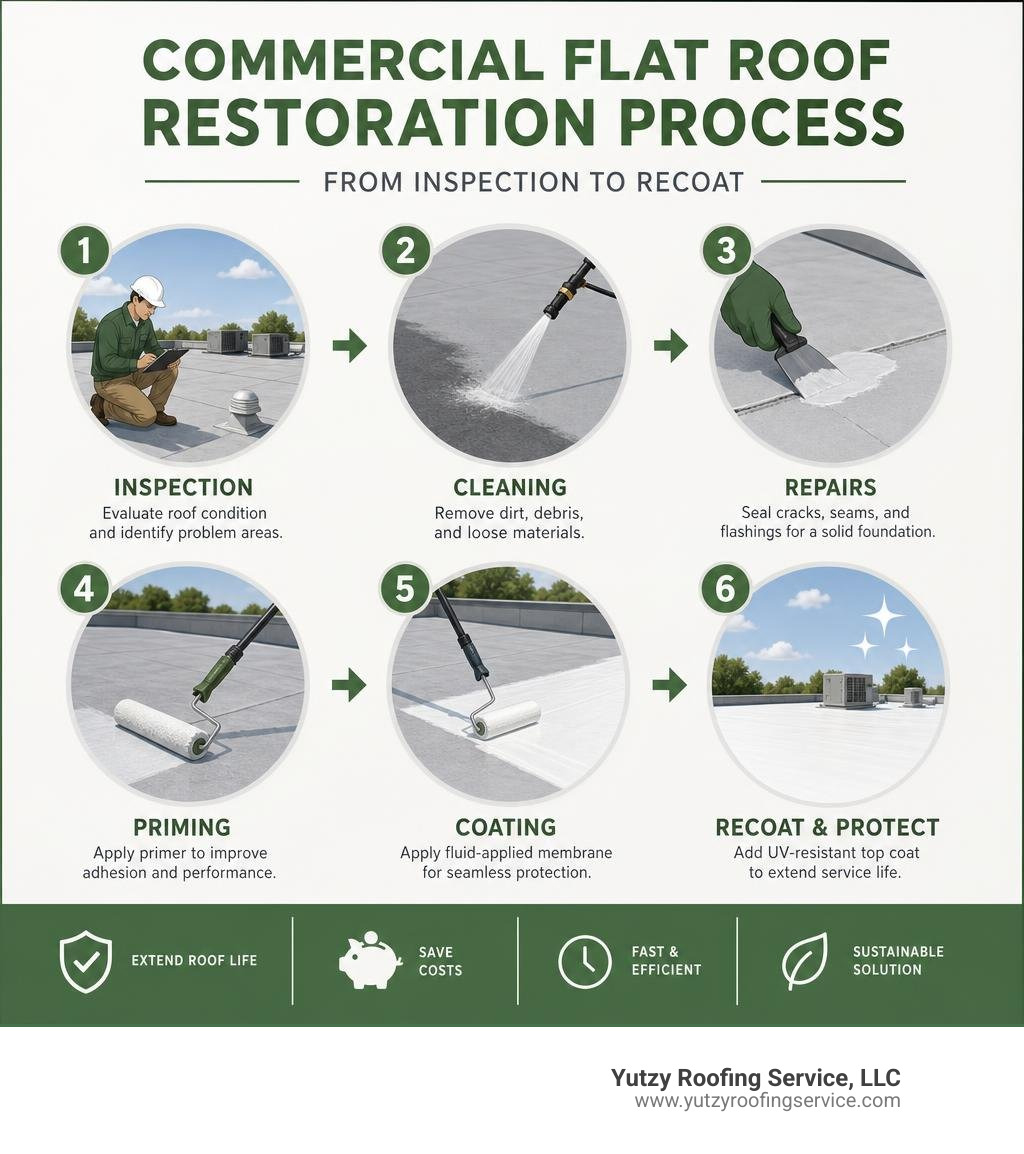
A roof coating is only as good as the preparation work underneath it. We follow a strict five-step protocol to ensure every restoration project is flawless:
- Surface Preparation: We pressure-wash the entire roof surface to remove dirt, grease, mold, and loose debris. Any remaining contaminants will ruin the adhesion of the new coating.
- Adhesion Testing: Before applying the main coating, we perform standardized adhesion tests on different areas of the roof to guarantee the coating bonds permanently to your specific substrate.
- Seam and Penetration Reinforcement: Over 90% of roof leaks occur at the seams, flashings, or penetrations. We apply heavy-duty, fiber-reinforced mastics or fabric-embedded liquid membranes to reinforce every single seam, pipe boot, curb, and perimeter flashing.
- Base Coat and Top Coat Application: We apply the liquid membrane in a uniform, multi-directional application to achieve the manufacturer-specified dry film thickness (typically between 20 to 40 mils).
- Quality Assurance & Warranty Handoff: Once cured, we inspect the entire roof to ensure there are no pinholes or thin spots, followed by a final inspection to issue your manufacturer-backed warranty.
Long-Term Performance, Warranties, and Risk Mitigation

Investing in a commercial flat roof restore isn’t just about stopping active leaks today; it is about protecting your real estate portfolio and managing risk for the next twenty years. When we complete a fluid-applied restoration, we aren’t just giving you a temporary band-aid. We are providing a seamless, monolithic barrier that performs just like a brand-new membrane.
How does this impact your building’s long-term value? For starters, a restored roof is far easier to maintain. Because there are no seams to lift or tear, the risk of sudden, catastrophic water damage is virtually eliminated. This makes your building much more attractive to future buyers or tenants and keeps your insurance carriers happy.
If you are wondering how this fits into the overall lifecycle of your building, take a look at our detailed breakdown of How Long Does a Flat Roof Last?.
Furthermore, we back our work with industry-leading warranties. At Yutzy Roofing Service, LLC, we offer up to 18-year non-prorated renewable warranties. Because these warranties are manufacturer-backed, your protection is secure. And unlike traditional roof warranties that lose value every year, our non-prorated warranties provide 100% coverage for labor and materials for the entire duration of the term.
Environmental Benefits of Restoration
As business owners and facility managers, we all want to reduce our environmental footprint. Traditional roof tear-offs are incredibly wasteful. Millions of tons of old EPDM, TPO, and asphalt shingles are dumped into local landfills every year.
By choosing to restore your roof, you utilize your existing, structurally sound roof as the substrate. This means:
- Zero landfill waste from your project.
- Reduced carbon footprint by avoiding the manufacturing and transportation of massive amounts of new membrane.
- Massive energy savings from the high reflectivity of white “cool roof” coatings, which keep your building cooler and lower urban heat island effects.
To explore more ways a well-maintained flat roof can benefit your business and the environment, read about the 7 Major Benefits of Flat Roofs for Commercial Buildings.
Frequently Asked Questions About Commercial Flat Roof Restoration
How long does a restored commercial flat roof last?
A professionally restored commercial flat roof will easily last 10 to 20 years depending on the thickness of the coating applied. The best part? At the end of the warranty period, the system does not need to be torn off. As long as the underlying structure remains dry, we can simply clean the surface and apply a new topcoat to extend the warranty for another 10 to 15 years.
To keep your system performing perfectly between recoats, we highly recommend establishing a preventative maintenance plan. You can learn more about how to protect your investment in The Ultimate Guide to Flat Roof Coating Experts and Maintenance Plans.
Can you restore a metal commercial flat roof?
Yes, absolutely! Low-slope metal roofs are outstanding candidates for restoration. Over time, metal roofs develop rust, fasteners back out due to thermal movement, and seams begin to separate.
Our restoration process treats existing rust with rust-inhibiting primers, tightens and seals every single fastener with specialized elastomeric caps, reinforces all seams with fabric-embedded mastics, and encapsulates the entire roof in a highly durable, weather-resistant topcoat. This stops leaks and prevents rust from returning.
Does roof restoration qualify for tax deductions?
Yes. In almost all cases, the IRS classifies fluid-applied roof restoration as a repair and maintenance expense rather than a capital improvement. Under Section 179, this allows you to write off the entire cost of the project in the tax year it was completed, rather than depreciating it over 39 years. Be sure to consult your CPA to maximize these tax savings for your business.
Conclusion
A failing flat roof doesn’t have to mean a stressful, multi-million dollar replacement project. By utilizing advanced diagnostics like thermal imaging and core sampling, we can help you determine if a commercial flat roof restore is the right choice for your building. You will save money, avoid business disruption, lower your energy bills, and enjoy incredible tax benefits.
At Yutzy Roofing Service, LLC, we are proud to serve commercial property owners throughout Wisconsin and Minnesota, including Marshfield, WI, Fond du Lac, WI, Green Bay, WI, Wausau, WI, and Mankato, MN. We stand behind our work with our premier, renewable warranties designed to give you total peace of mind.
Ready to find out if your commercial flat roof qualifies for a money-saving restoration? Contact us today to schedule a professional, no-obligation roof assessment. And if your building features an older, specialized roofing system, don’t miss our specialized guide on How to Maintain a Tar and Gravel Roof.
