
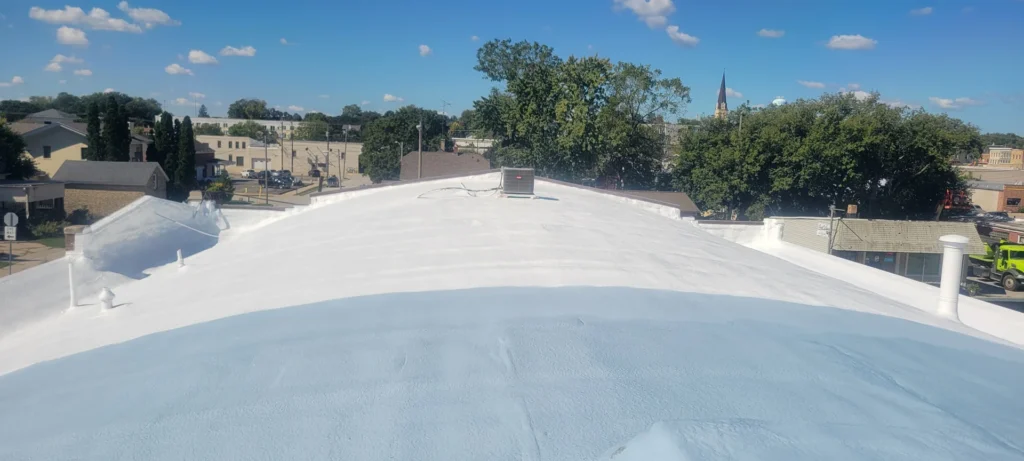
Why a Leaky Roof Deck Can Cost You Far More Than You Think
A water proof roof deck is one of the most critical investments you can make as a commercial property owner — especially in a climate like Wisconsin’s, where freeze-thaw cycles, heavy snow loads, and summer heat hit your building year after year.
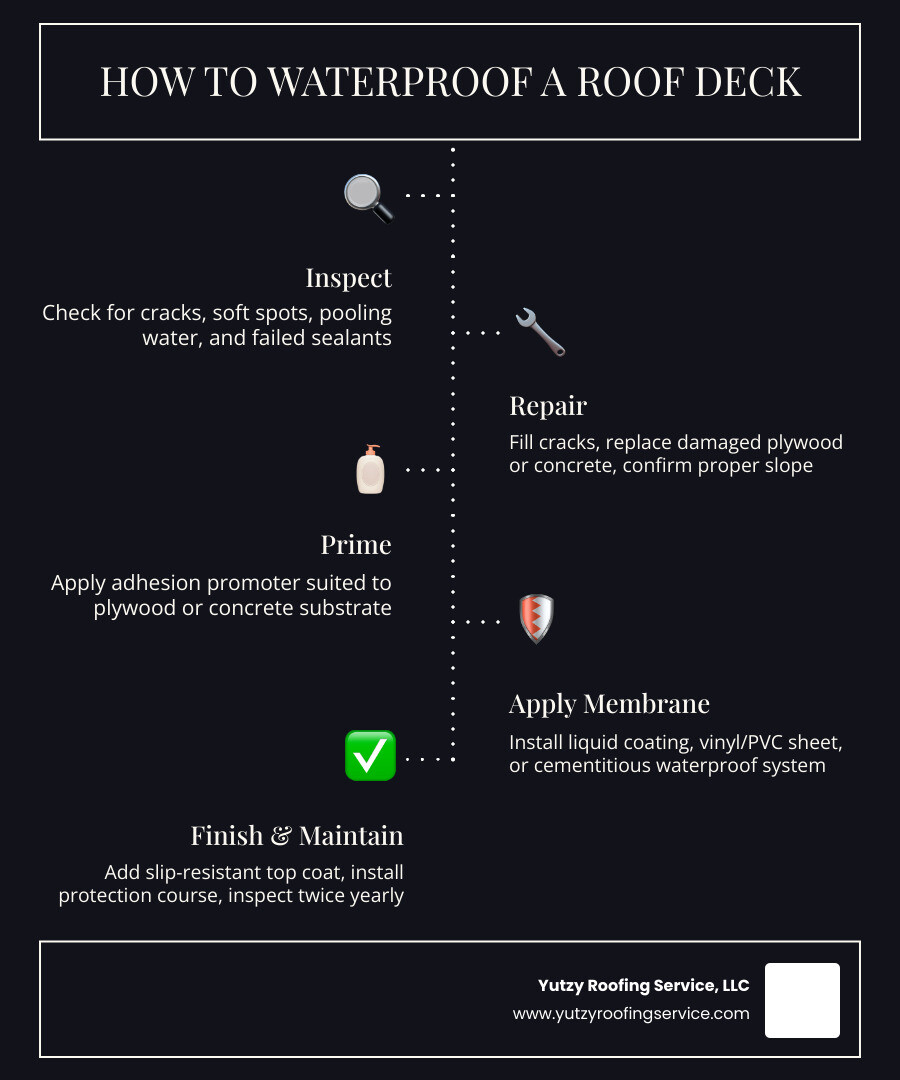
Here’s how to waterproof a roof deck (quick overview):
- Inspect the deck surface for cracks, soft spots, pooling water, and failed sealant
- Repair the substrate — fill cracks, replace damaged plywood or concrete sections, confirm proper slope
- Prime the surface with an adhesion promoter suited to your substrate (plywood or concrete)
- Apply a waterproof membrane — liquid-applied coating, vinyl/PVC sheet, or cementitious system
- Reinforce seams, edges, drains, and transitions with mesh or flashing tape
- Finish with a slip-resistant top coat or install a protection course if adding pavers or tile
- Inspect twice a year and reapply coatings every 2–3 years as needed
Flat and low-slope roof decks are fundamentally different from pitched roofs. Water doesn’t run off quickly — it sits. And when water sits on an unprotected surface over an occupied space, it finds every crack, every unsealed joint, and every weak spot in the substrate. The result is structural damage, mold, and costly interior repairs.
Unlike sloped roofs that shed water with shingles, a flat roof deck needs a completely waterproof barrier — not just water resistance. Without it, plywood substrates can rot and concrete can spall, often before the damage is even visible from inside the building.
I’m Josh Yutzy, and at Yutzy Roofing Service we’ve been sealing and restoring commercial roofs across Wisconsin, Missouri, and Kansas since 1995 — including many water proof roof deck projects over occupied living and working spaces. In the sections below, I’ll walk you through every method, material, and step you need to make the right call for your property.
Why a Water Proof Roof Deck Requires a Different Approach
A roof deck has to do two jobs at once: keep water out and hold up to foot traffic. That is very different from a standard roof, where the surface is mainly designed to shed water and resist weather.
On a flat or low-slope deck, rainwater, melting snow, and ice can remain on the surface longer. That means more exposure to ponding, more stress on seams, and more chances for water to work into tiny cracks. In Wisconsin cities like Madison, Appleton, Green Bay, Wausau, Eau Claire, Fond du Lac, and Marshfield, freeze-thaw cycles make that even tougher. Water sneaks in, freezes, expands, and suddenly a hairline defect becomes a leak path.
That is why a true waterproof barrier matters more than a merely water-resistant surface. If you want a broader overview of system types, our guide to different roof waterproofing methods is a helpful companion.

Understanding the Barrier vs. Shedding Principle
Think of shingles like fish scales: they overlap and shed water downhill. They work great on steep roofs because gravity does most of the work.
A roof deck is different. It needs a continuous barrier. That means:
- Sealed seams
- Watertight transitions at walls and doors
- Protected drains and scuppers
- Reinforced corners and penetrations
- A membrane or coating that stays flexible as the structure moves
This is the barrier principle. Instead of encouraging water to leave quickly and hoping nothing gets underneath, we create a surface that water cannot pass through in the first place.
That is also why underlayment alone is not enough for a walking deck. Underlayment is part of a roofing system, but a pedestrian roof deck needs a finished waterproof layer on top. For background, see why roofs need water-resistant underlayment.
Code Compliance and Fire Safety
If your deck is installed over occupied space, code and fire performance become major factors, not optional upgrades.
Depending on the assembly and occupancy type, you may need:
- A Class A roof covering
- A one-hour fire-resistance-rated assembly
- Tested compliance with IBC or IRC provisions
- Documentation from ICC-ES, Intertek, or similar third-party evaluators
This comes up often on multifamily and mixed-use buildings, where the deck surface is directly above tenant or office space. Some deck systems are specifically tested to provide Class A performance, and some are approved as part of one-hour assemblies when installed exactly as specified. One example is the Deck Flex W.M. ICC-Approved Class A Walking Deck System (ESR-3672), which includes published evaluation data for code-driven projects.
Bottom line: if the deck is over conditioned or occupied space, waterproofing decisions should be made with both leak prevention and code compliance in mind.
Top Waterproofing Systems for Rooftop Decks
There is no single best system for every deck. The right choice depends on the substrate, traffic level, finish expectations, fire requirements, and maintenance goals.
Here is a simple comparison:
| System type | Best for | Walkability | Aesthetics | Typical maintenance | Relative cost |
|---|---|---|---|---|---|
| Liquid-applied coatings | Simpler resurfacing, seamless waterproofing | Good with traffic-rated topcoat | Moderate to good | Recoat often every 2-3 years depending on exposure | Low to moderate |
| Reinforced vinyl or PVC membranes | Decks needing waterproofing and finished walking surface in one | Very good | Good | Low | Moderate |
| Sheet membranes under finishes | Decks with pavers, overlays, or protected assemblies | Not usually exposed as final walking surface | Hidden under finish | Low if protected | Moderate to high |
| Cementitious/composite systems | High-traffic decks, code-sensitive assemblies | Very good | Very good | Low to moderate | Moderate to high |
Liquid-Applied Coatings for a Water Proof Roof Deck
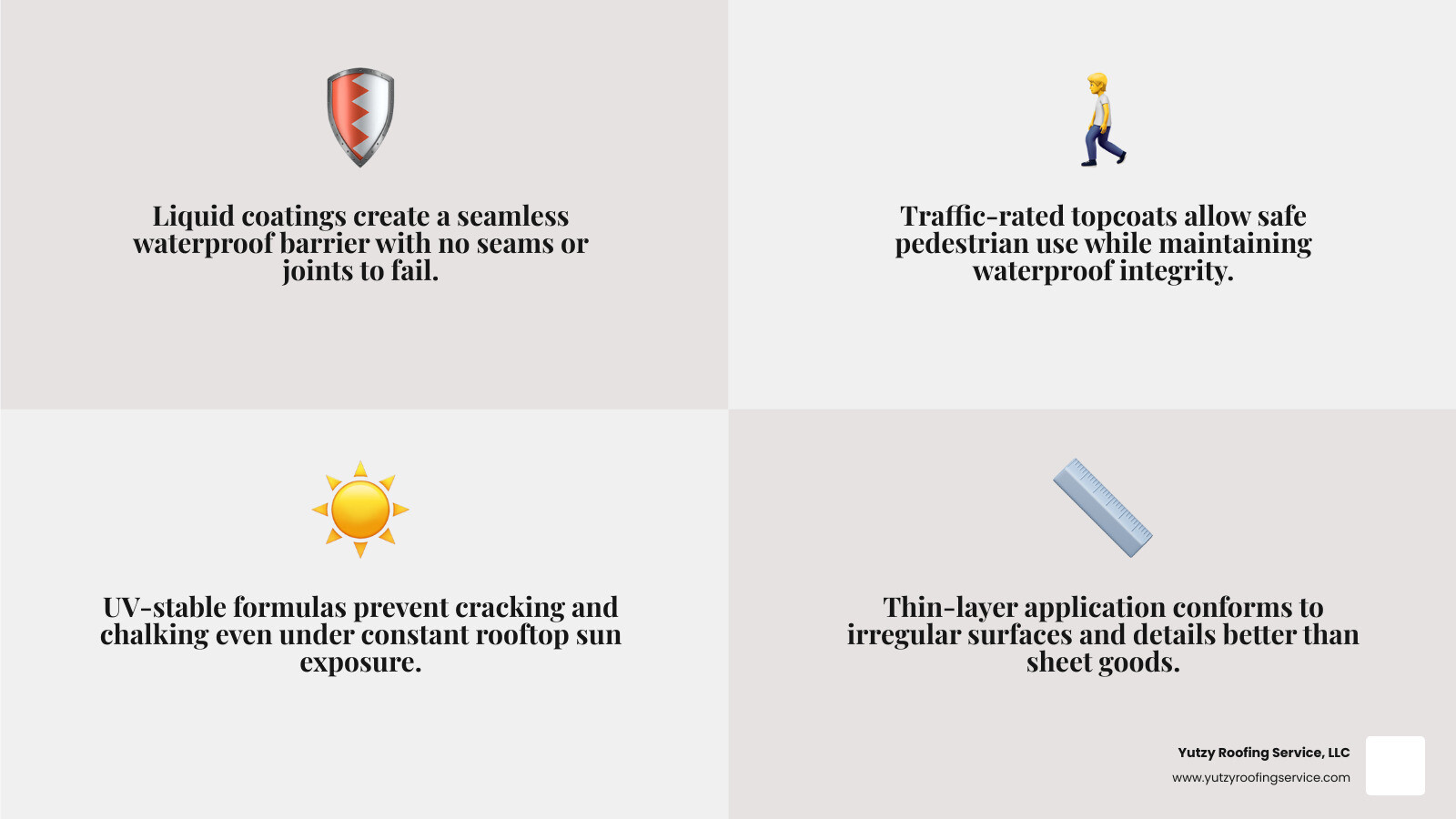
Liquid-applied systems are popular because they create a seamless membrane. They are rolled, brushed, or sprayed onto the prepared surface and usually include:
- Primer
- Base coat
- Reinforcing fabric or mesh at details
- Intermediate coat
- Slip-resistant top coat
Their biggest strengths are flexibility and easy detailing around drains, corners, and penetrations. They can also provide slip resistance and, in some cases, ADA-friendly texture when properly installed. Some traffic-bearing coating systems are specifically marketed for balconies and rooftop decks.
Their biggest weakness is that not every roof coating is meant for foot traffic. A coating that works on a commercial roof may not be the right choice for a deck where people actually walk. We see this confusion a lot. Roof coating and traffic coating are cousins, not twins.
Another important point: liquid-applied systems usually need more maintenance than membrane-based systems. Research commonly points to reapplication every 2 to 3 years depending on weather exposure and use. For a deeper look at coating benefits, see 7 surprising advantages of roof coatings and sealants.
Reinforced Vinyl and Sheet Membranes
Vinyl and PVC-style deck membranes are designed to do something very useful: act as both the waterproof layer and the pedestrian surface in one application.
That gives them several advantages:
- Clean finished look
- Good walkability
- Strong seam performance when welded or properly seamed
- Less need for a separate finish layer
- Long service life, often 10 to 20 years or more with proper care
This category is especially attractive when the deck is over occupied space and you want a single integrated system instead of a membrane plus another walking surface. Some vinyl systems are tested to meet code requirements as both a roofing membrane and walking deck finish.
Still, details matter. Seams, terminations, perimeter edges, and wall tie-ins have to be installed precisely. Poor detail work can ruin a good membrane. Our article on commercial flat roof coating truth explains why product selection must match actual use conditions.
Cementitious and Composite Systems
Cementitious and composite deck systems are common when durability, fire rating, and a decorative traffic-bearing finish all matter.
These systems often include:
- Prepared plywood or concrete substrate
- Metal lath or fiberglass reinforcement
- Polymer cement base layers
- Resin or elastomeric waterproofing layers
- Textured finish coat
- Decorative sealer or stain
They can be excellent for multifamily decks, commercial balconies, and rooftop common areas because they offer strong wear resistance and a more solid underfoot feel. Some systems have published strengths around 6,000 psi compressive performance and have Class A or one-hour ratings when installed over approved assemblies.
Examples include the Pli-Dek Standard System for plywood and the Con-Dek Standard System for concrete. These systems are more installation-sensitive than a simple coating, but they can be a very good fit where code, durability, and appearance all matter.
Essential Preparation: Slope, Drainage, and Substrates
Most roof deck failures do not begin with the top coat. They begin below it.
If the slope is wrong, drains are poorly placed, joints are moving, or the substrate is damp and unstable, the nicest waterproofing product in the world is just an expensive bandage.
Achieving Proper Drainage
Good drainage is not glamorous, but neither is explaining interior leaks to tenants.
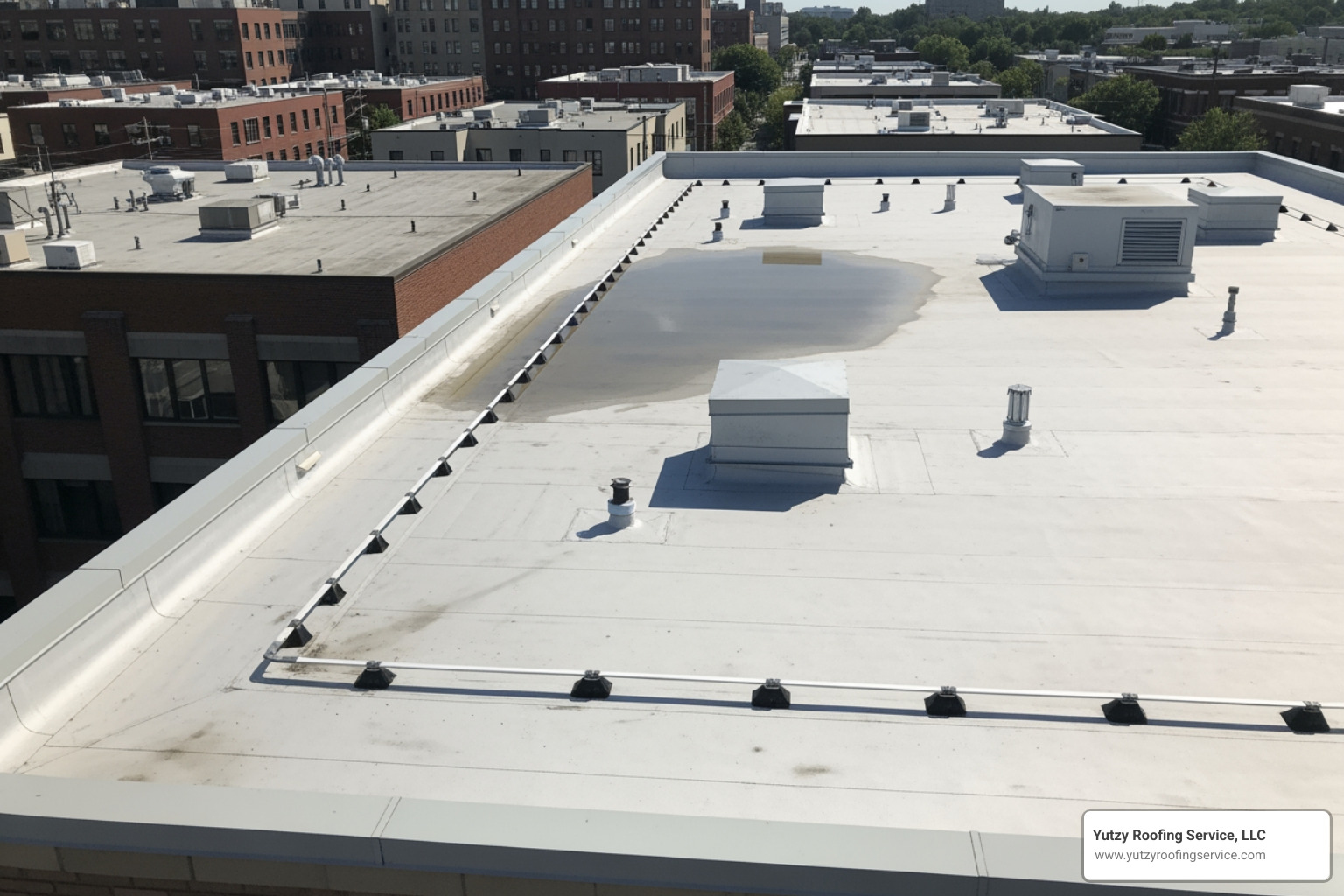
As a rule, the deck needs positive slope to drains, scuppers, or edges. A common target is 1/4 inch per foot, though actual design requirements depend on the assembly and project documents. The goal is simple: minimize standing water.
Key drainage best practices include:
- Slope from the start, not as an afterthought
- Keep drains at low points
- Use overflow protection where required
- Avoid dead corners where water can stagnate
- Maintain clear scuppers, gutters, and internal drains
If water ponds for long periods, the membrane stays under constant stress. Add ice, snow, and Wisconsin winters, and failure accelerates. Proper drainage is just as important on coated systems as it is on single-ply or metal assemblies. Related reading: the importance of metal roof waterproofing in Madison WI.
Substrate Repair and Priming
Waterproofing has to bond to something solid. That means the substrate must be structurally sound, clean, dry, and properly prepared.
For plywood decks, check:
- Exterior-grade panel requirements
- Proper thickness
- Blocked joints or joints over framing
- No rot, swelling, or delamination
- Secure fastening with no movement
For concrete decks, check:
- Cure condition
- Moisture vapor issues
- Cracks and spalls
- Surface contamination
- Need for etching, grinding, or moisture-mitigating primer
Cracks and joints often need special treatment before waterproofing begins. Some systems require reinforcing strips over cracks and transitions. Others call for approved joint fillers only. Primers and adhesion promoters are equally important, especially on dense concrete or aged surfaces. If you want to learn more about sealants and prep chemistry, our metal roof sealant guide covers many of the same bonding principles.
Step-by-Step Guide to Sealing Your Roof Deck
Here is the general professional workflow we follow when evaluating a deck waterproofing project.
Inspect the entire deck Look for soft spots, cracked coatings, failed seams, ponding, loose flashing, wall separation, and clogged drains.
Confirm slope and drainage If the deck does not drain, sealing alone will not solve the problem. We address drainage before installing a new waterproofing layer.
Repair the substrate Replace damaged plywood, patch spalled concrete, stabilize joints, and reinforce weak transitions.
Clean and dry the surface Remove dirt, dust, old failing material, oils, and debris. Adhesion hates contamination.
Install or repair flashing Tie the system into walls, doors, thresholds, curbs, drains, and edges. Waterproofing fails at details first.
Prime the substrate Use the manufacturer-approved primer for the exact substrate and weather conditions.
Apply the waterproofing system This may be a liquid membrane, reinforced sheet membrane, or composite assembly.
Reinforce all critical areas Seams, corners, drains, and changes in plane need extra attention.
Add the final walking surface or protective layer This may be a textured top coat, a membrane finish layer, or a protection course beneath pavers.
Inspect and document A final punch list, cure confirmation, and maintenance plan help protect the investment.
Professional Application of a Water Proof Roof Deck
The exact sequence depends on the system, but most professional installations follow a layered approach.
A liquid traffic-bearing system may include:
- Primer
- Base coat
- Reinforcing mesh at seams and joints
- Intermediate waterproof coat
- Textured wear coat
- UV-stable top coat
A cementitious system may include:
- Metal lath
- Polymer cement base
- Fiberglass mat
- Resin
- Texture coat
- Color sealer
A sheet membrane assembly may include:
- Surface preparation compound
- Self-adhered or cold-applied membrane
- Overlapped seams
- Rolling for full contact
- Flood testing where specified
- Drainage/protection layer before overburden
Some systems have very specific technical requirements. For example, the BITUTHENE® Deck System Data Sheet calls for 2-inch overlaps, immediate rolling with a 75-pound roller, and a 24-hour flood test with a 2-inch head of water before protection layers are added.
The lesson is simple: waterproofing is not just “paint it and hope.” Cure windows, layer thickness, reinforcement, weather limits, and detail treatment all matter. Our guide to the best Conklin coatings explains why the system approach always beats product-only thinking.
Installing Finishes Over Membranes
Yes, you can install tile, pavers, or other finishes over some waterproof membranes, but only if the assembly is designed for it.
Best practices include:
- Use a protection course over vulnerable membranes
- Prefer floating pavers or pedestal systems when possible
- Avoid directly bonding rigid finishes to membranes not approved for that use
- Preserve drainage paths beneath pavers
- Follow the membrane manufacturer’s warranty rules exactly
Protected membrane assemblies often perform better long term because the waterproofing layer is shielded from UV, foot traffic, and furniture abrasion. This is especially important for decks over occupied commercial space.
For concrete decks or plaza-style assemblies, protected sheet systems can work very well. Products such as BITUTHENE® Deck System Data Sheet are intended for covered horizontal waterproofing with a drainage or protection layer above. By contrast, exposed walking membranes are meant to be the finish surface and should not be buried unless the manufacturer allows it.
Maintenance and Long-Term Protection
A good roof deck system is not install-and-forget. It is more like a truck than a paperweight. Give it basic care, and it keeps working.
We recommend:
- Inspecting at least twice a year, ideally spring and fall
- Checking after major storms and snow events
- Clearing drains, scuppers, and debris regularly
- Looking for cracks, punctures, blisters, loose edges, or worn topcoat
- Repairing small defects before they become major leaks
For liquid-applied deck coatings, reapplication is often needed every 2 to 3 years depending on traffic and weather exposure. For reinforced vinyl, sheet, or cementitious systems, service life can reach 10 to 20 years or more with proper maintenance and timely repairs.
Warranties also matter. A strong warranty is only useful if the system was installed correctly and maintained. We always tell clients to look for:
- Clear warranty terms
- Approved installation methods
- Third-party tested assemblies
- Contractor experience with the exact system
- Inspection records and repair history
If your deck is already showing recurring problems, it may be time for more than a patch. Our article on why you might need a roof remodel more than you realize can help you think through that decision.
Frequently Asked Questions about Roof Deck Sealing
Can you walk on a waterproof roof coating?
Sometimes, yes. Sometimes, absolutely not.
A general roof coating is not automatically a walking-deck system. If the product is rated for pedestrian traffic and includes a slip-resistant finish, then it may be suitable for routine foot traffic. Some systems include embedded texture or granules and may even support ADA-oriented walking surfaces when installed as specified.
But if the coating is only designed for weatherproofing, regular walking can wear it out quickly. Always match the product to the traffic level.
How long does a waterproof deck membrane last?
It depends on the material and maintenance.
- Liquid traffic coatings often need refresh coats every 2 to 3 years
- Vinyl or reinforced membranes can often last 10 to 20 years or more
- Cementitious/composite systems can also deliver long service life when maintained
- Protected sheet membranes under pavers or overlays may last longer because they are shielded from UV and abuse
Sun exposure, freeze-thaw cycles, standing water, and foot traffic all affect lifespan. So does installation quality. A premium product installed poorly is still a leak waiting for a holiday weekend.
What is the best waterproofing for a deck over a living space?
For decks over occupied space, we usually prioritize five things:
- Fully waterproof barrier performance
- Reliable detailing at walls, drains, and thresholds
- Traffic-rated surface or approved protection layer
- Required fire classification or one-hour assembly
- Proven testing and manufacturer documentation
In many cases, the best options are reinforced vinyl membranes, tested cementitious/composite systems, or protected sheet membrane assemblies under pavers. The right answer depends on whether the substrate is plywood or concrete, whether the surface will remain exposed, and what code requirements apply to the building.
Conclusion
A successful water proof roof deck is never just about the top layer. It is about the whole assembly: slope, drainage, substrate, details, membrane, finish, and maintenance plan.
At Yutzy Roofing Service, LLC, we help commercial property owners across Marshfield, Appleton, Eau Claire, Fond du Lac, Green Bay, Madison, Wausau, Rochester, Mankato, and surrounding Wisconsin and Minnesota service areas evaluate low-slope deck and roof waterproofing with long-term performance in mind. Our commercial restoration focus, maintenance experience, and up to 18-year non-prorated renewable warranty options give owners a practical path to fewer leaks and more peace of mind.
If you are comparing systems or trying to decide whether your deck needs coating, membrane replacement, or a larger rebuild, start with our guide to The Different Types of Roof Waterproofing Methods Explained. Then contact us to assess your deck before a small leak turns into a very expensive skylight in the wrong place.
