What Does an EPDM Roof Actually Cost in 2026?
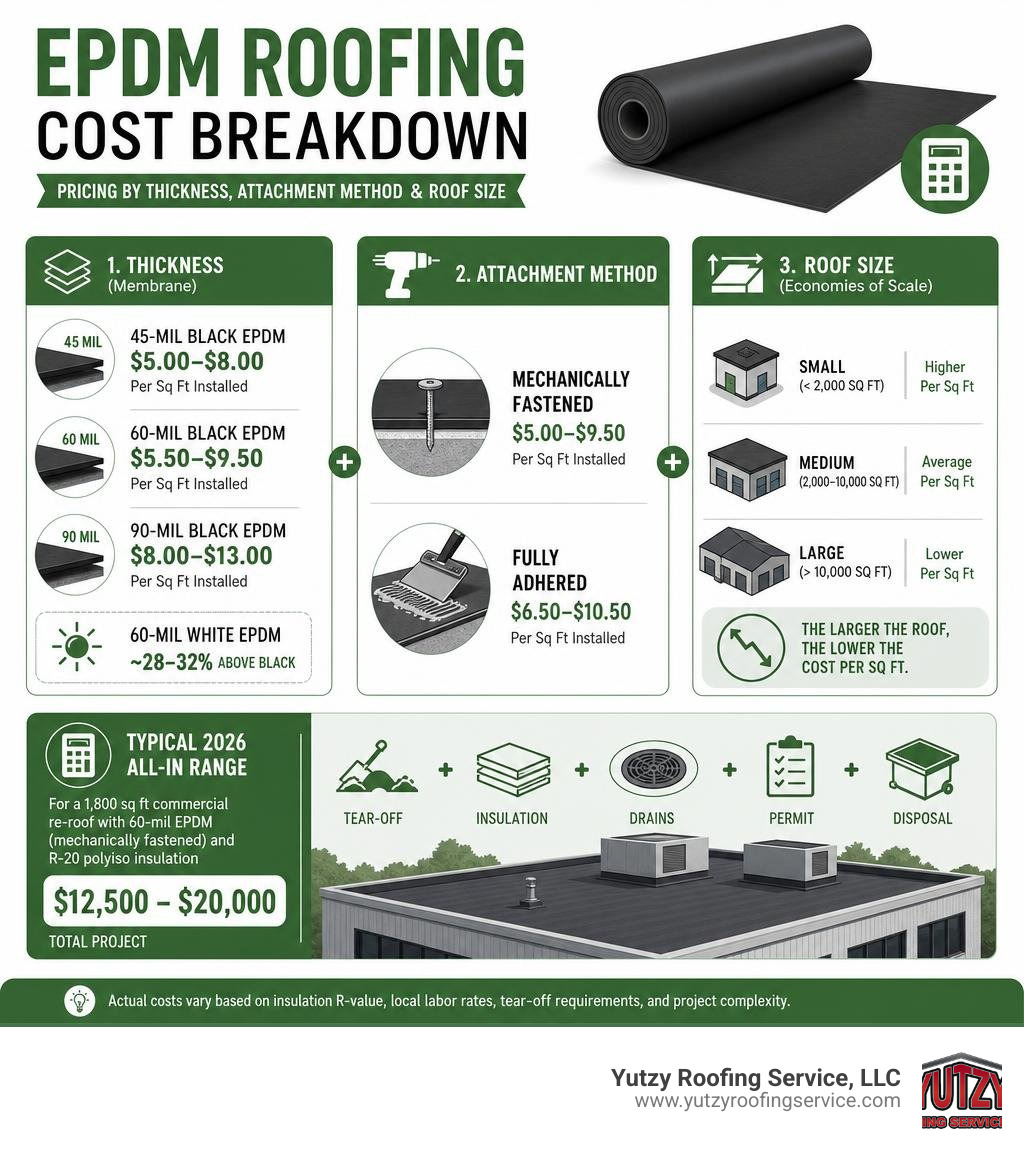
Using an EPDM roofing cost calculator is the fastest way to estimate what your commercial flat roof project will run before you call a single contractor. Here are the key 2026 benchmarks to know right away:
| Membrane | Attachment | Installed Cost (US) |
|---|---|---|
| 45-mil black EPDM | Mechanically fastened | $5.00–$8.00/sq ft |
| 60-mil black EPDM | Mechanically fastened | $5.50–$9.50/sq ft |
| 60-mil black EPDM | Fully adhered | $6.50–$10.50/sq ft |
| 90-mil black EPDM | Fully adhered | $8.00–$13.00/sq ft |
| 60-mil white EPDM | Mechanically fastened | ~28–32% above black |
For a typical commercial re-roof, a 1,800 sq ft building with 60-mil mechanically fastened EPDM and R-20 polyiso insulation runs roughly $12,500 to $20,000 all-in in 2026 — including tear-off, insulation, drains, permit, and disposal.
Those numbers shift based on your roof size, insulation requirements, local labor rates, and whether you need a full tear-off. That’s exactly what this guide walks through.
EPDM (ethylene propylene diene monomer) has been the dominant flat roofing membrane in North America since the 1960s — with over 3 billion square feet installed. It holds up well against Wisconsin’s brutal freeze-thaw cycles, handles extreme temperatures from -40°F to 300°F, and typically lasts 25 to 40 years with proper maintenance. For commercial property owners dealing with leaks or aging membranes, it remains one of the most cost-effective solutions available.
But “cost-effective” only means something when you know your actual numbers. That’s where a solid cost calculator — and understanding what drives the price — makes all the difference.
I’m Josh Yutzy of Yutzy Roofing Service, LLC, and after nearly 30 years installing and restoring commercial EPDM roofs across Wisconsin, Missouri, and Kansas, I’ve put together this guide to give you the same line-item clarity an EPDM roofing cost calculator provides — without the guesswork. Let’s break it all down.
Epdm roofing cost calculator terminology:
How to Use an EPDM Roofing Cost Calculator for Commercial Properties
When you are assessing a commercial property—whether it is a warehouse in Eau Claire, a retail building in Appleton, or an office complex in Madison—estimating the budget accurately prevents painful surprises. An online epdm roofing cost calculator simplifies this process by translating raw building dimensions into realistic financial estimates.
To get a highly accurate estimate from an online tool like the EPDM Roof Cost Calculator (2026), you need to gather three primary pieces of information:
- Total Roof Square Footage: This is the actual flat surface area of the roof. For commercial buildings, you can often find this in your building’s original architectural blueprints or by taking a quick measurement of the building footprint.
- The Waste Factor: Flat roofs are rarely perfect rectangles without penetrations. You must account for a waste margin of 10% to 15% to cover overlaps at the seams, parapet wall flashings, and cuts around HVAC units.
- Membrane Specifications: You must decide on the thickness (45, 60, or 90 mil) and the attachment method, as these selections act as price multipliers within the calculator’s algorithm.
Once you input these details, the calculator processes the raw material costs and provides a baseline. However, to truly understand your project’s scope, it helps to understand the math behind the screen.
Manual Formulas vs. an Online EPDM Roofing Cost Calculator
While an online calculator provides an instant estimate, calculating your costs manually helps you understand how different components impact your budget.
To estimate the raw materials required for a commercial roof, we use specific coverage formulas:
- Membrane Sheets: If your commercial roof is 10,000 square feet, you do not just order 10,000 square feet of rubber. Adding a 12% waste and seam overlap factor means you actually need to purchase 11,200 square feet of membrane.
- Bonding Adhesive: Standard EPDM bonding adhesive covers approximately 60 square feet per gallon (or 300 square feet per 5-gallon pail). For our 11,200 square-foot requirement, you will need approximately 187 gallons of adhesive.
- Seam Tape and Primers: Seam tape typically comes in 100-foot rolls, with primer covering roughly 25 square feet per pint.
By calculating these line items, you can see the tangible financial benefits of choosing EPDM. When considering the benefits of installing EPDM rubber roofing on your business, you will find that its lower material cost per square foot compared to PVC or TPO makes it an incredibly economical choice for large commercial footprints.
Estimating Regional Labor Rates with an EPDM Roofing Cost Calculator
The physical materials are only one part of the equation; labor is where regional location heavily influences the final price. In 2026, the median labor rate for commercial EPDM installation ranges from $2.50 to $4.50 per square foot.
In our primary service areas—including Marshfield, Green Bay, Wausau, and Mankato—labor costs are influenced by several local factors:
- Building Height and Access: A single-story warehouse in Fond Du Lac is much faster and safer to roof than a three-story office building in downtown Madison. High-rise structures require cranes, material hoists, and extensive safety rigging, which can increase labor costs by 15% to 30%.
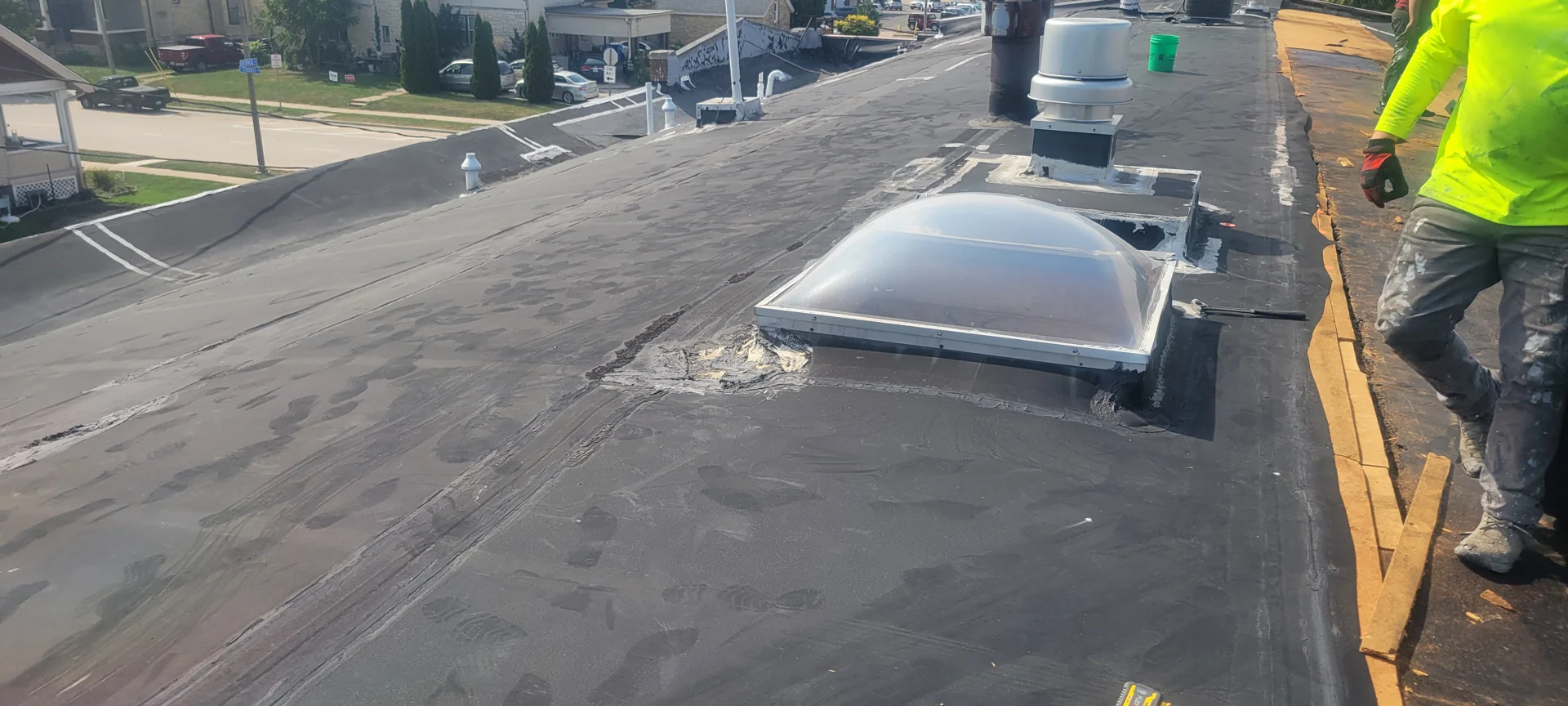
- Roof Complexity: A wide-open flat roof with zero penetrations can be laid down rapidly. If our crews have to flash around twenty separate commercial HVAC units, skylights, and plumbing vents, the installation time—and therefore the labor cost—increases.
- Local Compliance: Commercial roofing in Wisconsin and Minnesota must adhere to strict winter safety standards and wind-uplift regulations, requiring experienced, certified crews who command higher wages but deliver leak-free results.
Key Factors That Influence EPDM Installation Costs
Every commercial roof has its own unique set of challenges. When we inspect a commercial property to prepare a bid, we look at several critical cost drivers that go beyond basic square footage.
- Roof Size: Larger roofs benefit from economies of scale. The cost per square foot for a 50,000-square-foot industrial facility in Rochester, MN, will be significantly lower than that of a 1,500-square-foot commercial storefront in Wausau.
- Accessibility: If our trucks can park right next to the building and load materials directly onto the roof deck, labor costs stay low. If we have to navigate tight alleyways, overhead power lines, or protect delicate landscaping, the logistics will add to the budget.
- Tear-Off Scope: If your existing roof is saturated with water or has multiple layers of old roofing, it must be completely removed. A clean deck is essential for a successful EPDM installation.
Insulation and Drainage Requirements
You cannot lay EPDM directly onto a bare wood or metal deck without insulation. To comply with modern energy codes in Wisconsin and Minnesota (IECC Climate Zones 5 and 6), commercial buildings require high-performing insulation.
- Polyisocyanurate (Polyiso) Boards: This is the industry standard. To meet the code-required R-25 to R-30 thermal resistance, you generally need two layers of 2.5-inch or 3-inch rigid polyiso boards. This continuous insulation adds $2.40 to $3.50 per square foot to your project cost.
- Tapered Insulation Systems: If your flat roof does not have a built-in slope, water will pool. Standing water is the enemy of any roof membrane. We design and install tapered polyiso systems (usually a 1/4-inch slope per foot) to direct water toward your drains. While tapered insulation adds to the upfront cost, it is crucial for long-term durability.
Understanding how to keep your EPDM roof happy and healthy starts with proper insulation and drainage design. Eliminating ponding water prevents premature seam degradation and protects your building’s structural integrity.
Tear-Off, Disposal, and Permits
When replacing an old roof, the demolition phase carries its own set of costs that must be factored into your budget:
- Tear-Off Labor: Removing one layer of old membrane typically costs $1.40 to $1.85 per square foot. If there are multiple layers of asphalt, coal tar pitch, or saturated insulation, that price can climb above $2.50 per square foot.
- Disposal and Skip Hire: Commercial waste disposal fees vary by municipality. Renting large roll-off containers and paying landfill tipping fees generally adds $150 to $400 per ton of debris.
- Building Permits and Local Codes: Commercial building permits in cities like Green Bay, Madison, or Mankato usually range from $150 to $500 depending on the overall project value. Additionally, local codes may require wind-uplift testing documentation or specific fire-rated barriers.
Comparing EPDM Thicknesses and Attachment Methods
Your choice of EPDM thickness and how it is secured to your building will have a major impact on both the upfront cost and the overall lifespan of your roof.
| Specification | 45-Mil Membrane | 60-Mil Membrane | 90-Mil Membrane |
|---|---|---|---|
| Primary Use | Light commercial / Budget | Standard commercial | Heavy-duty commercial |
| Average Lifespan | 15–20 Years | 25–30 Years | 30–40+ Years |
| Puncture Resistance | Moderate | High | Extremely High |
| Material Cost Factor | Baseline | +15% to 20% | +35% to 45% |
Membrane Thickness: 45 Mil vs. 60 Mil vs. 90 Mil
EPDM membranes are measured in “mils” (one-thousandth of an inch):
- 45 Mil (1.14 mm): This is the thinnest option. While it is the most economical upfront, we rarely recommend it for commercial buildings in our region. It is more susceptible to punctures from hail, dropped tools, or maintenance traffic.
- 60 Mil (1.52 mm): The industry standard. It offers the ideal balance of cost, durability, and puncture resistance. A 60-mil EPDM roof easily handles Wisconsin’s heavy snow loads and thermal expansion.
- 90 Mil (2.29 mm): The premium choice. If your commercial roof has heavy foot traffic, frequent HVAC maintenance, or is located in an area prone to severe hail, 90-mil rubber is worth the investment. It provides superior puncture resistance and can extend your roof’s lifespan past 40 years.
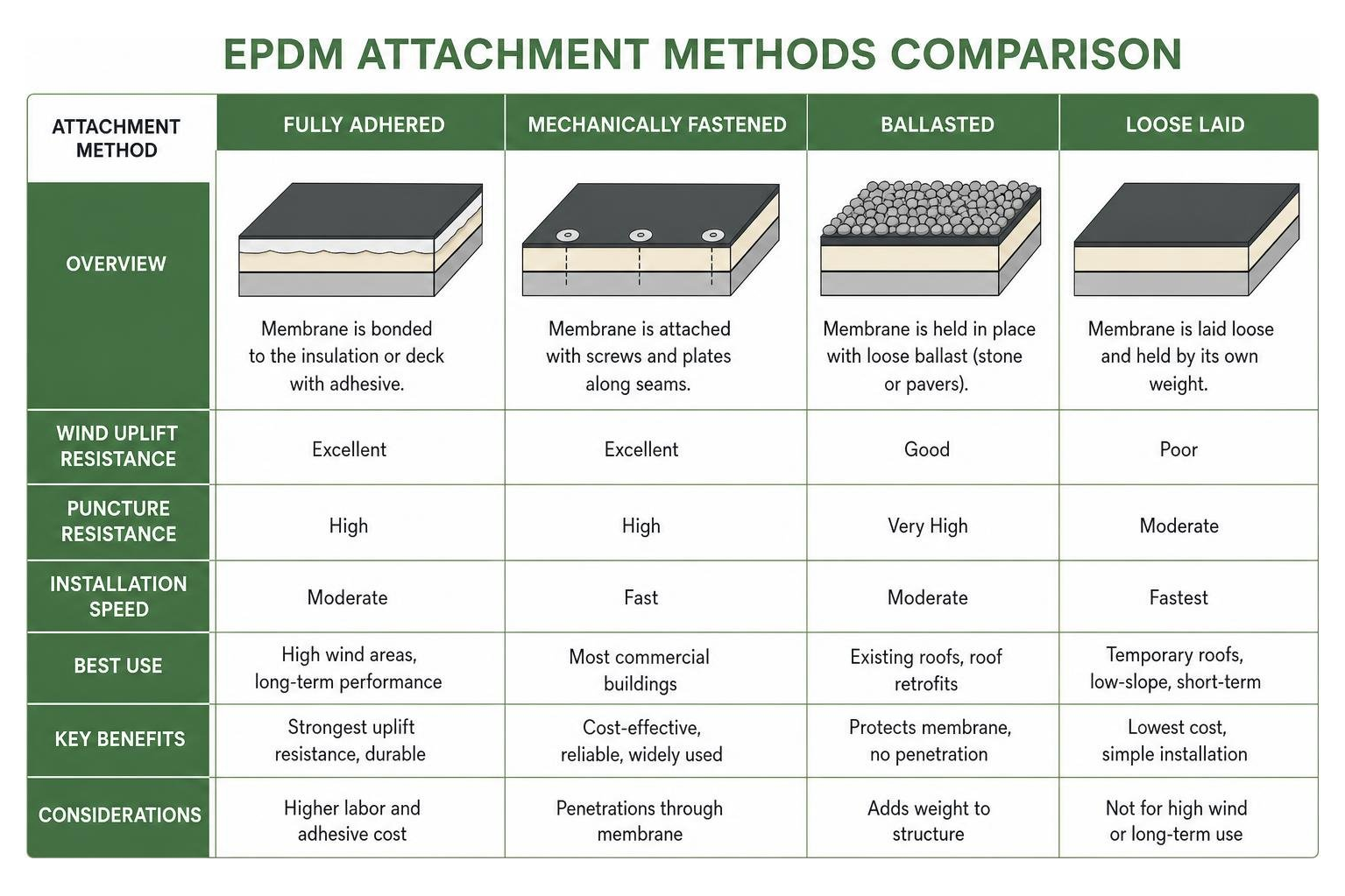
Attachment Methods: Fully Adhered, Mechanically Fastened, and Ballasted
How the rubber is secured to the roof deck affects both wind resistance and installation speed:
- Fully Adhered: The membrane is glued down across 100% of the substrate using strong bonding adhesives. This method offers the best wind-uplift resistance and a smooth, clean appearance. It is highly recommended for commercial buildings in windy, open areas. It adds about 10% to 20% to the labor and material cost.
- Mechanically Fastened: The membrane is secured using heavy-duty screws and plates along the seams, which are then sealed with splice tape. This is a fast, cost-effective method, but the membrane can flutter in high winds, which puts stress on the fasteners over time.
- Ballasted: The EPDM is laid loose over the insulation and held down by a heavy layer of river stone ballast or concrete pavers. This is the least expensive installation method, but it adds immense weight to the structure. The building must be structurally engineered to handle the load, and finding leaks under stones can be incredibly difficult.
If you have an existing EPDM roof that is starting to show its age, you might not need a costly tear-off. Opting for EPDM restorations with a high-performance fluid-applied coating can restore your roof to watertight condition at a fraction of the cost of a full replacement.
Frequently Asked Questions About EPDM Roofing Costs
How much does an EPDM roof cost per square foot in 2026?
In 2026, a fully installed commercial EPDM roof generally costs between $5.50 and $10.50 per square foot. If you are dealing with a straightforward re-cover project over an existing, dry roof deck, costs will lean toward the lower end. If your project requires a full tear-off of multiple wet layers, structural deck repairs, and a tapered polyiso insulation system, the price will naturally land on the higher end of the spectrum. You can run customized estimates using a Rubber Roof Cost Calculator to see how different parameters affect the final price.
How long does an EPDM roof last?
A professionally installed 60-mil EPDM roof typically lasts 25 to 30 years, while a heavy-duty 90-mil membrane can easily last 35 to 40+ years.
Unlike other single-ply membranes that degrade quickly under intense UV exposure, EPDM is exceptionally stable. When the membrane eventually begins to show signs of weathering, you do not necessarily have to pay for a full replacement. Applying a professional restoration coating can add another 10 to 18 years of warranted life to your existing roof.
Does white EPDM cost more than black EPDM?
Yes, white EPDM carries a 28% to 32% material price premium over standard black EPDM. This is due to the titanium dioxide cap layer and specialized manufacturing processes required to make the rubber reflective.
However, white EPDM reflects up to 80% of solar radiation, which can reduce your building’s summer cooling costs by up to 30%. In cooling-dominated southern climates, white EPDM pays for itself quickly. In our colder northern climate zones (like Wisconsin and Minnesota), black EPDM is often preferred because it absorbs heat during our long, freezing winters, helping to melt snow and reduce heating demands.

Conclusion
Investing in a commercial roof is a major decision that impacts your business’s bottom line for decades. While using an epdm roofing cost calculator provides a helpful starting point, nothing replaces a professional, on-site physical inspection.
At Yutzy Roofing Service, LLC, we specialize in helping commercial property owners throughout Wisconsin and Minnesota—from Madison and Appleton to Wausau, Marshfield, and Mankato—make smart, cost-effective roofing decisions. We do not believe in one-size-fits-all solutions. If your EPDM roof is leaking or showing its age, a full tear-off might not be your only option.
We offer premium rubber roofing repair and restoration services that can rebuild and reinforce your existing EPDM membrane. Our fluid-applied restoration coatings seal every seam, eliminate leaks, and come with an industry-leading, up to 18-year non-prorated renewable warranty.
Ready to get an accurate, honest assessment of your commercial roof? Contact us today to schedule a professional inspection and receive a detailed, customized estimate for your property.
