Why a Metal Roof Sealant Restoration Expert Matters for Commercial Buildings
A metal roof sealant restoration expert helps commercial property owners stop leaks, protect aging panels, and extend roof service life without an unnecessary tear-off. The right contractor evaluates the roof’s condition, repairs vulnerable seams and penetrations, treats corrosion correctly, and applies a compatible waterproof coating system.
For Wisconsin facilities, this matters. Repeated freeze-thaw cycles, summer heat, standing water, loose fasteners, and failing seam materials can create small openings that turn into costly interior damage. A professional restoration focuses on preserving a sound existing roof while building a flexible barrier against water and thermal movement.
| What an expert should assess | Why it matters |
|---|---|
| Seams, fasteners, vents, and rooftop equipment | These are common water-entry points |
| Rust, loose coating, and surface contamination | Coatings need a clean, stable surface to bond |
| Drainage and ponding water | Standing water can shorten coating performance |
| Weather, humidity, and dew point | Poor application conditions can cause coating failure |
I am Josh Yutzy of Yutzy Roofing Service, LLC, a family roofing business serving Wisconsin since 1995, with experience delivering durable repair and restoration systems backed by labor and material warranties. As a metal roof sealant restoration expert, I will walk through what a sound restoration requires, starting with how to spot the warning signs before minor roof issues grow.
Key terms for metal roof sealant restoration expert:
Understanding Metal Roof Sealants and When Restoration Is Needed
Commercial metal roof panels are engineered to last for decades, but the joints, fasteners, and flashing details that hold them together are not invincible. Over time, sunlight, severe midwestern winter storms, and continuous thermal expansion weaken the factory seals. That is where a continuous waterproof membrane comes into play. By converting an assembly of individual metal panels into a seamless barrier, specialized elastomeric sealants prevent moisture intrusion while improving solar reflectivity.
Understanding how high-performance coatings function is the first step toward preserving commercial building assets. You can explore our metal roof sealant complete guide for deep technical breakdowns, or reference our troubleshooting tips on drip drip drip how to identify and fix a metal roof leak when active moisture is detected inside your facility.
Identifying Signs Your Commercial Roof Needs a Metal Roof Sealant Restoration Expert
Metal roof panels naturally expand and contract as ambient temperatures shift. In regions like Madison, Appleton, or Green Bay, winter temperatures drop well below freezing while bright summer sunlight heats metal surfaces significantly. This ongoing movement creates intense thermal fatigue, causing screws to back out and factory butyl tape to dried out, crack, or slip out of position.
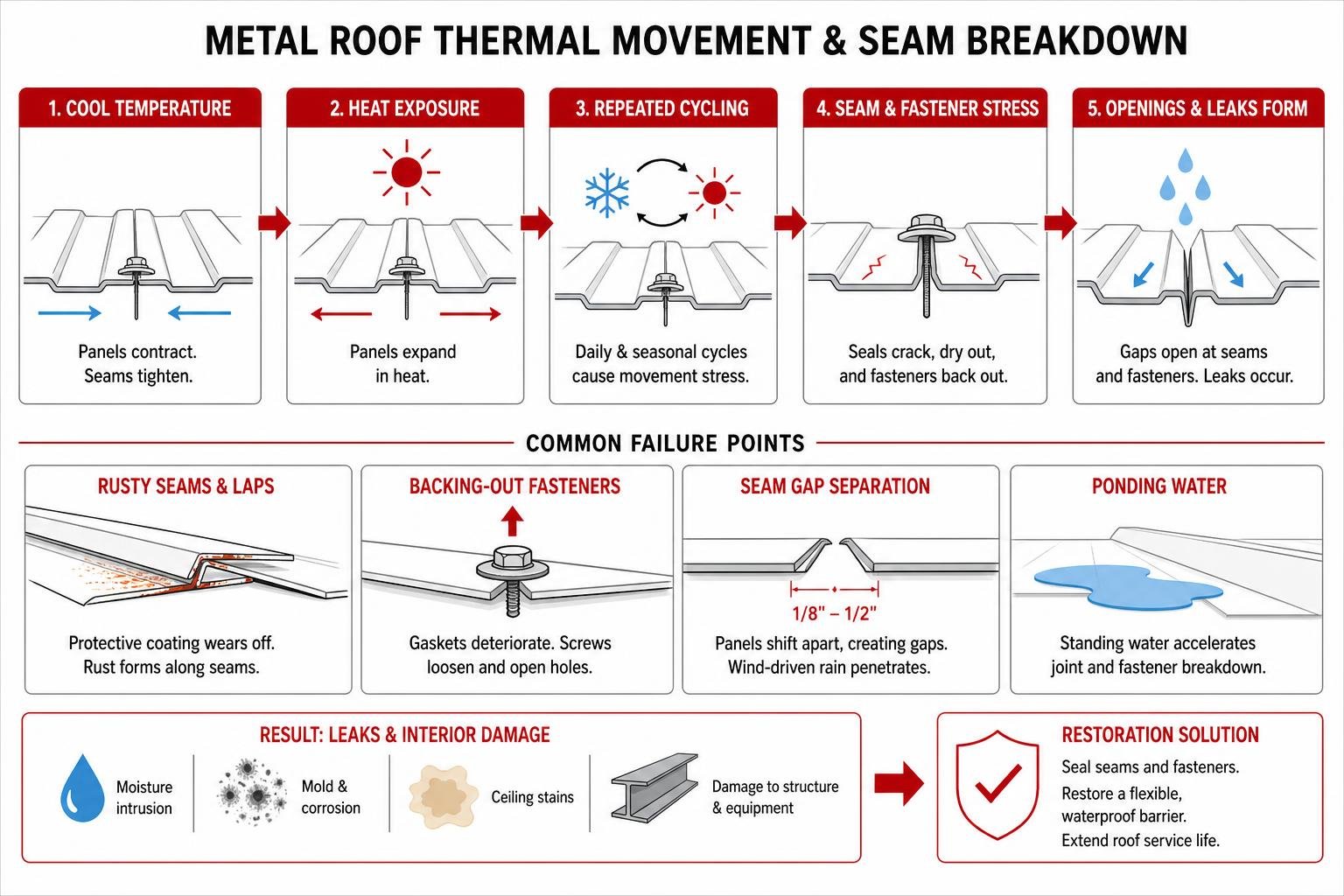
When we perform site assessments, we look closely for these distinct warning signs:
- Rusty Seams and Laps: Surface rust emerging along panel overlaps indicates that protective factory galvanized or Galvalume coatings have worn away.
- Backing-Out Fasteners: Fastener gaskets deteriorate under UV exposure, and thermal cycling unscrews them over time, creating open holes directly into the substrate.
- Seam Gap Separation: Panels shift apart slightly, opening up 1/8-inch to 1/2-inch voids where wind-driven rain easily penetrates.
- Ponding Water: Structural deflection or blocked gutters allow standing water to accumulate, accelerating joint degradation.
- Flashing and Penetration Failure: Deteriorated sealant around HVAC curbs, skylights, and plumbing vents allows water to travel along structural purlins before dripping onto inventory or equipment.
Comparing Metal Roof Restoration to Structural Roof Replacement
Many commercial facility managers assume that widespread seam leaks or localized surface rust require a complete, disruptive roof tear-off. However, full replacement is rarely necessary if the underlying structural deck and steel purlins remain structurally sound. Reviewing a complete guide to metal roof restoration reveals how elastomeric liquid membranes offer a smarter, more economic alternative.
Choosing restoration over complete replacement offers distinct operational advantages:
- Cost-Effective Waterproofing: Restoration typically costs a fraction of total replacement expense because labor demands are lower and existing metal panels remain in place.
- Zero Operational Downtime: Commercial operations inside manufacturing plants, warehouses, or retail spaces proceed without interruption. There is no open building envelope exposed to the weather.
- Landfill Waste Reduction: Restoring existing metal avoids dumping tons of steel panels and insulation into local Wisconsin landfills.
- Renewable Lifespan: Once a restored roof reaches the end of its coating cycle years later, a simple refresher coat reinstates protection without starting from scratch.
Types of Sealants Used by a Metal Roof Sealant Restoration Expert
Not all roofing sealants perform equally on industrial metal roofs. Using generic hardware store caulks or rigid asphaltic mastics on flexible metal seams is a recipe for quick failure because rigid materials cannot flex when steel panels expand. A true metal roof sealant restoration expert relies on high-build elastomeric systems designed for extreme elongation and adhesion.
Products like Metal Roof Sealant – Durable, Waterproof Protection – Liquid Rubber demonstrate how modern liquid rubbers and high-solid sealants bond directly to metal while incorporating active rust inhibitors.
Evaluating Elastomeric, Acrylic, and Silicone Coatings
Choosing the correct chemical chemistry depends on roof slope, localized moisture exposure, cure speed requirements, and budget. Here is how professional-grade chemistries compare:
- Acrylic Coatings and Hybrids: Highly cost-effective water-based systems offering superior UV protection, high solar reflectance, and easy clean-up. They cure as water evaporates (typically requiring 6 to 8 hours between coats) and perform exceptionally well on roofs with positive drainage.
- Silicone Coatings: Moisture-cure polymers that excel in high-moisture environments. Silicone resists standing water without breaking down and features fast cure times (often 2 to 4 hours between coats). However, silicone can attract airborne dirt over time and requires specific silicone-based products for future touch-ups.
- Polyurethane Sealants: Heavy-duty caulking compounds used primarily for detail work, filling panel gaps, and sealing fastener heads due to high tensile strength and tear resistance.
| Property | Acrylic Hybrid Sealants | Silicone Roof Coatings | Polyurethane Sealants / Caulks |
|---|---|---|---|
| Cure Mechanism | Water Evaporation | Moisture Cure | Chemical / Moisture Cure |
| Dry Time Between Coats | 6 to 8 Hours | 2 to 4 Hours | 12 to 24 Hours |
| Ponding Water Resistance | Moderate | Exceptional | High |
| Elongation / Flexibility | Excellent (300%+ ) | Superior (400%+ ) | High (250%+ ) |
| UV Resistance | High Reflected Protection | Excellent Long-Term | Moderate (Requires Topcoat) |
| Primary Application | Full Roof Membrane | Low-Slope / Water-Prone Areas | Seam Filling & Penetration Joints |
For deeper technical comparisons on chemistry selection, consult the ultimate guide to metal roof sealants according to the pros.
Applying Sealants Directly Over Rust and Corrosion
Rust never sleeps, but light surface corrosion does not mean a commercial roof must be scrapped. When addressing corroded panels, we utilize chemistries engineered with built-in rust inhibitors or apply dedicated water-based rust converters.
The surface passivization process works systematically:
- Heavy Scale Removal: Loose scale and flaking rust are mechanically removed using wire brushes or high-pressure water blasting.
- Chemical Neutralization: A rust converter or specialized water-based rust primer is applied over remaining tight rust, chemically transforming iron oxide into an inert chemical barrier.
- Direct-to-Metal Protection: Specialized rubberized sealants go on smooth (often appearing brown during application) and cure into a continuous, impenetrable protective layer that seals out air and moisture—the two essential ingredients required for rust to form.
Surface Preparation and Weather Requirements for Restoration

A high-performance coating is only as good as the preparation underneath it. Even the most advanced silicone or acrylic sealant will peel if applied over grease, chalking paint, or industrial grime.
Surface Profile Preparation and Washing
Before opening a single bucket of coating, our field crews clean and prep the metal substrate:
- Pressure Washing: Washing the roof surface at 2,500 to 3,000 PSI strips away loose paint, chalking residue, dirt, and pollution.
- Degreasing: Areas around kitchen exhausts or industrial machinery vents receive specialized biodegradable roof cleaners to dissolve oil films that block adhesion.
- Bond Strength Testing: We perform cross-hatch adhesion tape tests on questionable existing coatings to ensure the surface profile will support new material without delaminating.
Environmental Timing and Weather Conditions for Coating
Weather dictates restoration success. Manufacturer specifications, such as the Liquid Rubber_Metal Roofs Application Guide 2026, outline strict environmental parameters that must be strictly followed:
- Temperature Range: Air and surface temperatures must remain between 50°F and 86°F (10°C to 30°C) during application and initial curing.
- Humidity Threshold: Relative humidity must be below 80% to allow proper solvent or water release.
- Dew Point Margin: The metal deck temperature must be at least 5°F above the ambient dew point. Cold metal draws condensation from humid air, creating an invisible layer of water that guarantees coating failure.
- Cure Window: There must be no rain, heavy dew, or freezing temperatures forecast within 24 hours after application.
Essential Safety Precautions During Roof Restoration
Commercial roofs present inherent fall risks, requiring strict adherence to occupational safety standards:
- Fall Protection Systems: Full-body harnesses, shock-absorbing lanyards, and certified tie-off points (such as mobile fall anchors or heavy-duty purlin clamps) are non-negotiable.
- Non-Slip Footwear: Technicians wear soft rubber-soled footwear designed to grip steep or slick metal panels safely.
- Personal Protective Equipment (PPE): Safety glasses, chemical-resistant gloves, and respirators are mandatory when handling industrial primers, cleaners, or solvent-borne liquids.
Step-by-Step Restoration Application and Material Coverage
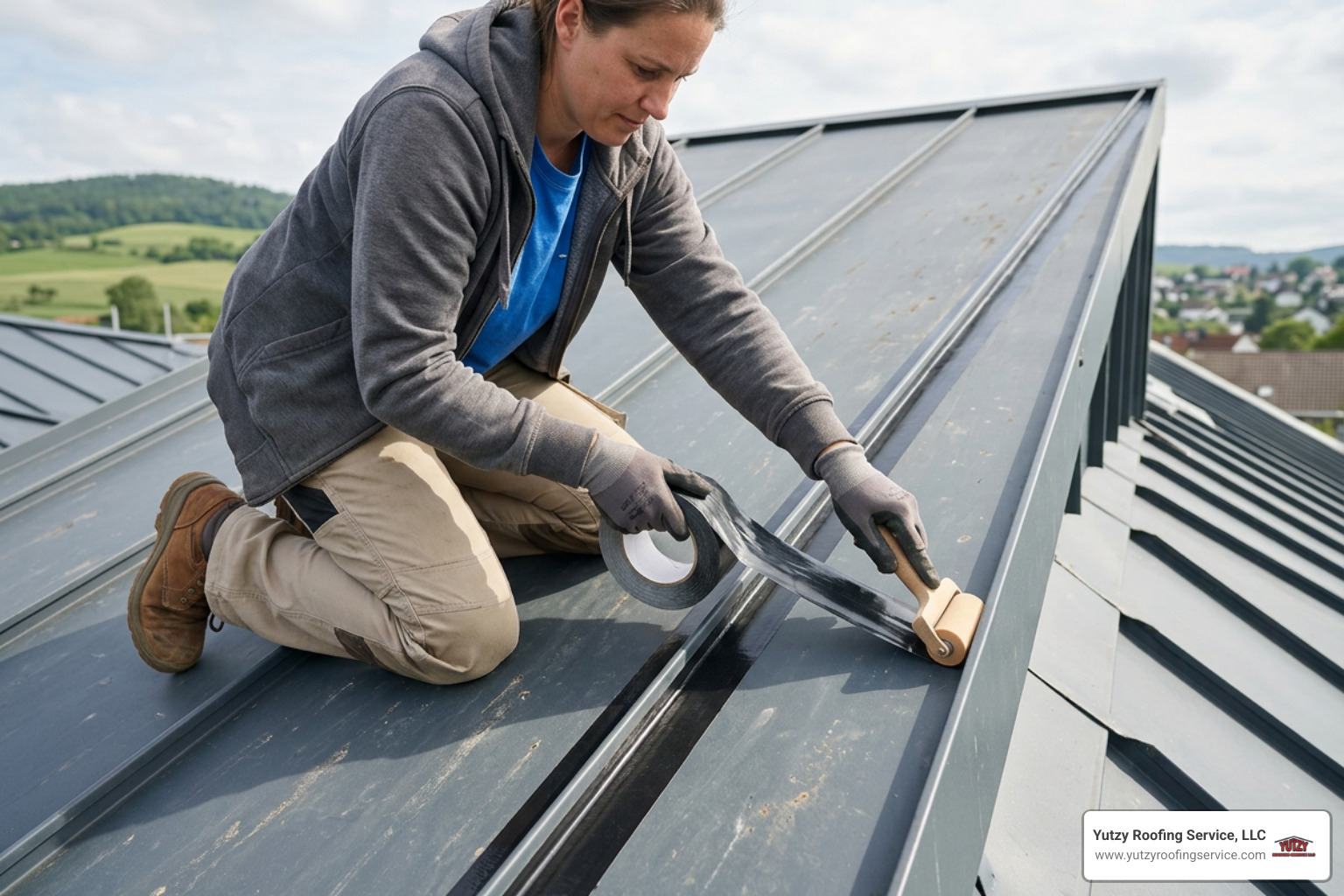
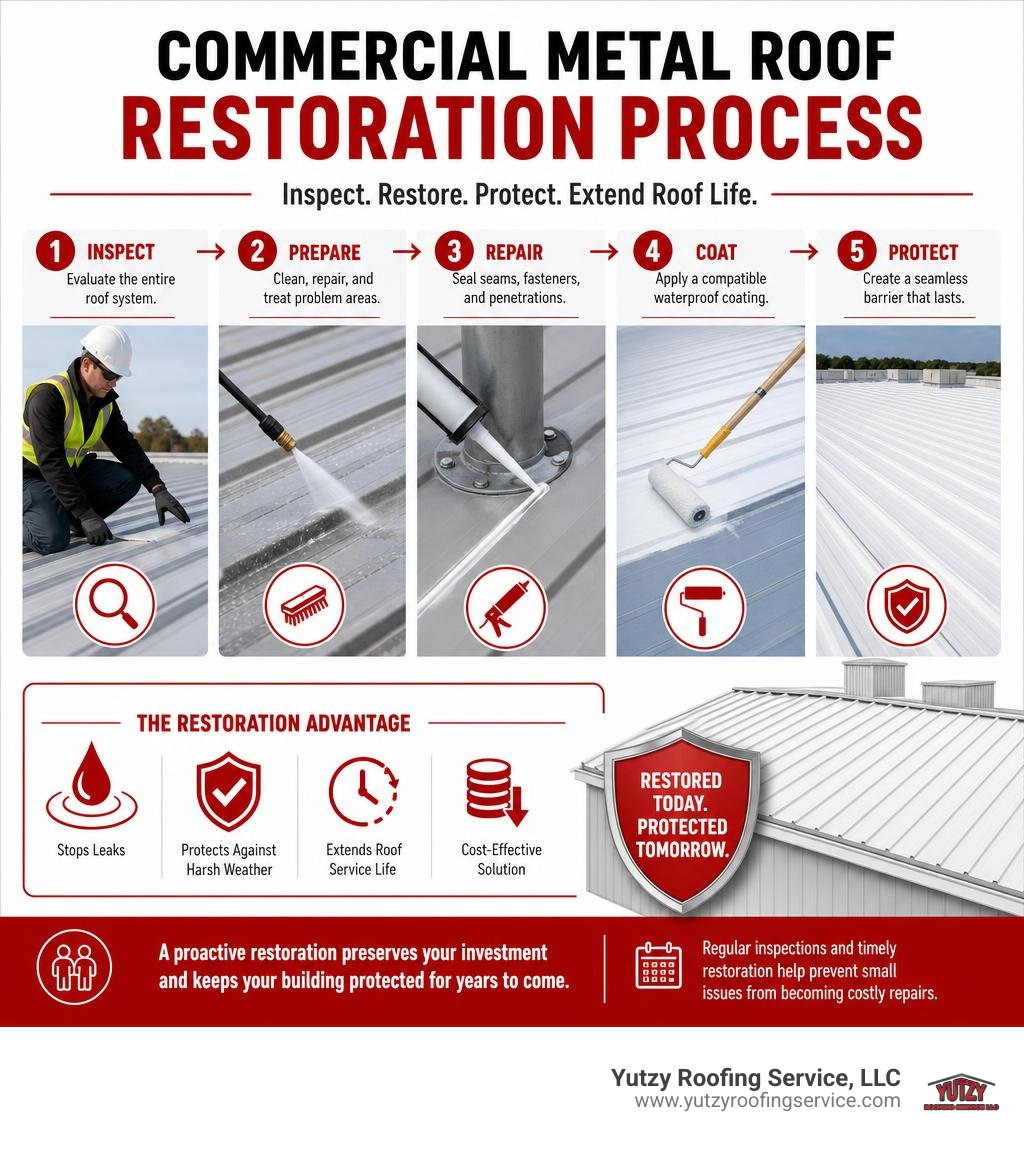
Restoring a commercial metal roof demands step-by-step precision. Skipping steps or applying material too thinly leads to early failure.
Steps Followed by a Metal Roof Sealant Restoration Expert
When our crews restore a metal building, we follow field-tested strategies outlined in our guide on metal roof restoration strategies that experts love:
- Fastener Replacement and Tightening: Every structural screw is inspected. Stripped or backing-out fasteners are removed and replaced with oversized, weather-resistant screws fitted with fresh EPDM washers.
- Joint Caulking and Seam Reinforcement: Gaps and voids between 1/8 inch and 1/2 inch are filled using heavy-bodied elastomeric caulk.
- The Three-Course Seam Repair: All longitudinal and horizontal panel laps receive a heavy layer of liquid sealant, followed immediately by high-tensile geo-textile fabric embedded into the wet material, and finished with a second saturating coat of sealant. Alternatively, self-adhesive butyl seam tape is applied smooth without air pockets.
- Detail Priming: Flashing around rooftop units, stack pipes, and gutter lines receives targeted priming and fabric reinforcement.
- Base Coat Application: The primary protective liquid coat is applied uniformly using professional airless spray equipment or heavy-nap rollers.
- Alternating Topcoat Finish: Once the base coat dries (typically 6 to 8 hours for acrylics or 2 to 4 hours for silicones), the final topcoat is applied in an alternating direction (perpendicular to the base coat). This criss-cross technique eliminates micro-pinholes and ensures uniform membrane thickness. The final pass always runs parallel to roof slope to facilitate smooth water runoff.
Calculating Product Coverage and Common Mistakes to Avoid
A common mistake made by inexperienced contractors is confusing coat count with total material volume. Coverage ratings specified by manufacturers reflect the total volume needed across all combined coats to achieve the required dry film thickness (DFT).
For instance:
- An acrylic restoration system may require 5 gallons per 150 sq. ft. spread over two coats to achieve a durable waterproof shield.
- High-solids silicone might require 4 gallons per 200 sq. ft. total volume.
- A standard 1/4-inch bead of elastomeric adhesive caulk yields approximately 24 linear feet per cartridge.
Avoid these costly mistakes during restoration:
- Skipping Primers: Trying to apply water-based acrylics over unprimed, heavily corroded metal leads to flash rusting and adhesive release.
- Ignoring Dew Points: Coating late in the afternoon when ambient temperatures drop near the dew point causes trapped moisture and blistering.
- Applying Over Loose Scale: Sealant stuck to loose rust flakes will simply peel off when the rust flakes detach.
- Unsealed Fasteners: Spraying a thin coating over raised screw heads without pre-treating them individually leaves weak points that fail under thermal movement.
Long-Term Maintenance and Inspection Schedules
A newly restored metal roof is an investment that yields significant dividends when supported by simple preventive care. Implementing a structured maintenance plan extends protective service life and keeps renewable manufacturer warranties fully valid. Learn more about maximizing roof longevity in our guide on how to metal roof restoration extend your roof life.
We recommend facility managers establish a semi-annual survey schedule:
- Spring Checkup (Post-Winter): Inspect panels after ice snow melt to identify any impact damage from falling ice, snow-slide movement, or loose flashings.
- Autumn Checkup (Pre-Winter): Clear all perimeter gutters, internal drains, and scuppers of leaves, twigs, and airborne debris to prevent standing water during winter freeze cycles.
- Post-Storm Inspections: Walk the roof following severe hail, heavy windstorms, or rooftop HVAC servicing to check for dropped tools, punctures, or physical membrane tears.
- 5-Year Refresher Application: Applying a thin refresher topcoat every 5 to 10 years recharges UV protection and keeps the seamless system operating indefinitely.
Frequently Asked Questions About Metal Roof Restoration
How long does metal roof sealant typically last on commercial roofs?
A professionally installed elastomeric or silicone restoration system lasts anywhere from 10 to 18+ years, depending on the coating chemistry, dry film thickness, and weather exposure. High-solids silicone membranes offer exceptional UV and ponding water resistance. Furthermore, because restoration coatings are renewable, applying a light refresher coat at the end of the warranty period extends protective service life for another decade or more without requiring structural tear-offs.
Can metal roof sealant be applied over active rust?
Yes, provided surface preparation rules are strictly enforced. Heavy, flaking rust scale must be mechanically removed with wire brushes or pressure washers. Once flaking rust is gone, a specialized water-based rust primer or converter is applied to chemically stabilize iron oxides. Once primed, high-build elastomeric coatings with built-in rust inhibitors can be safely applied directly over the prepared substrate, cutting off water and air to stop further corrosion.
What is the 3-course method in seam sealing?
The 3-course method is a high-strength joint-reinforcement technique used by restoration professionals. It consists of:
- First Course: Applying a generous coat of liquid elastomeric sealant over the seam or joint.
- Second Course: Immediately embedding a tough, flexible strip of geo-textile polyester fabric into the wet sealant, smoothing out all wrinkles and air bubbles.
- Third Course: Applying a second layer of liquid sealant over the top, fully saturating the fabric mesh. This creates a flexible, fabric-reinforced bridge capable of handling extreme structural movement across panel laps.
Conclusion
Protecting your commercial facility from weather intrusion does not require high-cost structural replacement or disruptive construction noise. By partnering with a proven metal roof sealant restoration expert, building owners across Wisconsin—from Marshfield and Wausau to Eau Claire, Fond Du Lac, Mankato, and Rochester—can seal active leaks, eliminate panel rust, and dramatically lower indoor cooling costs with solar-reflective membranes.
At Yutzy Roofing Service, LLC, we bring decades of hands-on expertise to commercial roofing restoration. We back our craftsmanship with up to 18-year non-prorated renewable warranties, giving facility managers ultimate peace of mind.
Ready to restore your building’s roof? Explore our comprehensive metal roof sealant complete guide or contact our expert team today to schedule your commercial roof evaluation!
