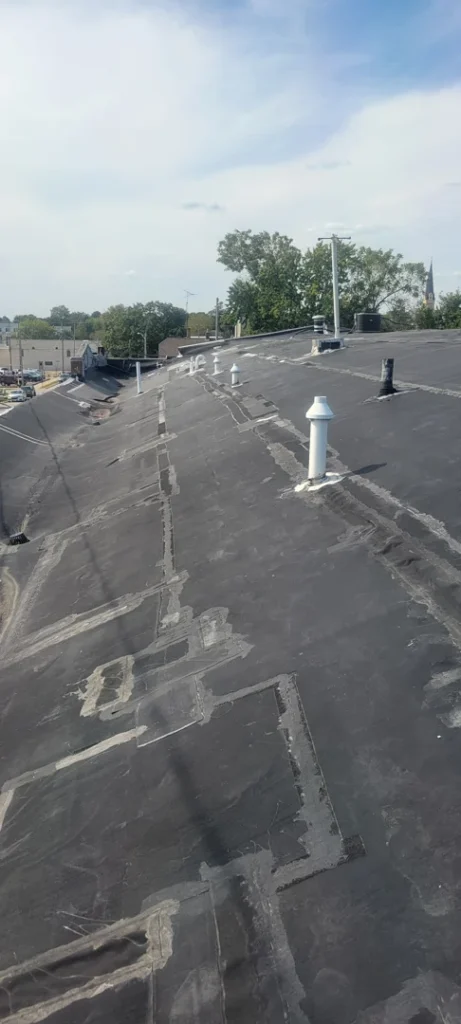
Why Bitumen Sheet Waterproofing Dominates Commercial Flat Roofing
Bitumen sheet waterproofing is a proven method of protecting flat roofs and below-grade structures using polymer-modified bitumen membranes rolled onto a prepared surface. Here’s a quick summary of what it is and why it matters:
- What it is: Pre-formed sheets made from bitumen (a thick, sticky petroleum derivative) reinforced with polyester or fiberglass, applied by torch, adhesive, or self-adhesion
- Where it’s used: Flat commercial roofs, basement walls, retaining walls, foundations, and below-grade structures
- Main types: Torch-on (APP or SBS modified), self-adhesive, and wet-applied membranes
- Why it works: Creates a seamless, highly durable waterproof barrier with excellent resistance to water pressure, temperature swings, and physical stress
- Market share: Bitumen technology holds roughly 60% of the flat roof market worldwide — and over 80% in some countries
That kind of dominance doesn’t happen by accident. Bitumen membranes have earned their place through decades of reliable performance across climates and building types.
For Wisconsin commercial property owners, that reliability is especially important. Harsh freeze-thaw cycles, heavy snow loads, and summer heat put real stress on a roof. A membrane system that can flex in the cold and resist heat flow is not a luxury — it’s a necessity.
I’m Josh Yutzy, and our team at Yutzy Roofing Service has been installing and repairing bitumen sheet waterproofing systems across Wisconsin, Missouri, and Kansas since 1995. In the sections below, I’ll walk you through everything you need to know to make the right call for your building.
Simple bitumen sheet waterproofing word guide:
The Essentials of Bitumen Sheet Waterproofing
To understand why bitumen sheet waterproofing is such a powerhouse in the commercial building sector, we have to look at the material itself.
Bitumen is a highly viscous, black, sticky form of petroleum. Historically, raw bitumen was used in simple, unmodified layers. However, modern construction relies on polymer-modified bituminous membranes. By blending raw bitumen with specific synthetic polymers, manufacturers create a material with incredible viscoelastic and thermoplastic properties.
What does that mean in plain English?
- Viscoelastic behavior: The sheet behaves like an elastic solid under rapid loads (rebounding when walked on) but can flow and adapt like a thick liquid under sustained, long-term pressures. This prevents cracking and splitting.
- Thermoplastic properties: It softens when heated, allowing installers to fuse seams together perfectly, and solidifies as it cools to form a monolithic, watertight shield.
This unique combination makes modified bitumen highly impervious to water and vapor transmission. When applied correctly, it prevents water from finding a path into your structural deck. If you are exploring how this fits into the broader picture of commercial roof protection, take a look at The Different Types of Roof Waterproofing Methods Explained to see how sheet systems stack up against other historical and modern methods.
Selecting the Right Bitumen Sheet Waterproofing for Commercial Roofs
When dealing with flat commercial roofs, water ponding is an inevitable challenge. Unlike sloped residential roofs that shed water immediately, flat commercial structures must withstand standing water for days at a time. This is where high-quality bitumen sheet waterproofing becomes your building’s primary line of defense.
During a commercial roof renovation or a new construction project, choosing the right grade and thickness of the membrane is critical. High-performance membranes like Sika® BituSeal T-130 SG | Sheet Membranes offer excellent tensile strength and low-temperature flexibility, making them ideal for the harsh, fluctuating climates of the Upper Midwest.
Furthermore, a membrane is only as good as the system beneath it. Incorporating a high-quality underlayment ensures that condensation and minor leaks do not rot the structural deck from the inside out. For a deeper dive into why this layer is so critical, read more about Why Your Roof Needs Water-Resistant Underlayment.
Below-Grade Applications of Bitumen Sheet Waterproofing
Waterproofing doesn’t stop at the roofline. In fact, some of the most punishing hydrostatic pressures occur below ground level. Foundation walls, retaining walls, and commercial basements are constantly subjected to ground water, wet soil, and lateral soil pressures.
For below-grade structures, sheet-applied systems act as a tough, positive-side barrier. This means the membrane is applied to the exterior face of the concrete, blocking water before it can ever penetrate the foundation. High-durability options such as Sheet-Applied Waterproofing – W. R. Meadows are designed specifically to withstand backfill impact, soil chemistry, and continuous water immersion without degrading.
In municipal and commercial structures—like those we service in Appleton, Green Bay, and Madison—below-grade waterproofing keeps valuable storage, mechanical rooms, and structural concrete dry and free from structural concrete degradation.
Typical System Build-Up and Installation Methods
A reliable bitumen sheet waterproofing system is not just a single layer of material unrolled onto concrete. It is a carefully engineered assembly where each layer plays a specific role.
To achieve a long-lasting seal, we must prepare and layer the system correctly. You can read about the fundamentals of preparing your structural surface in our guide on The Best Methods for Sealing Your Roof Deck.
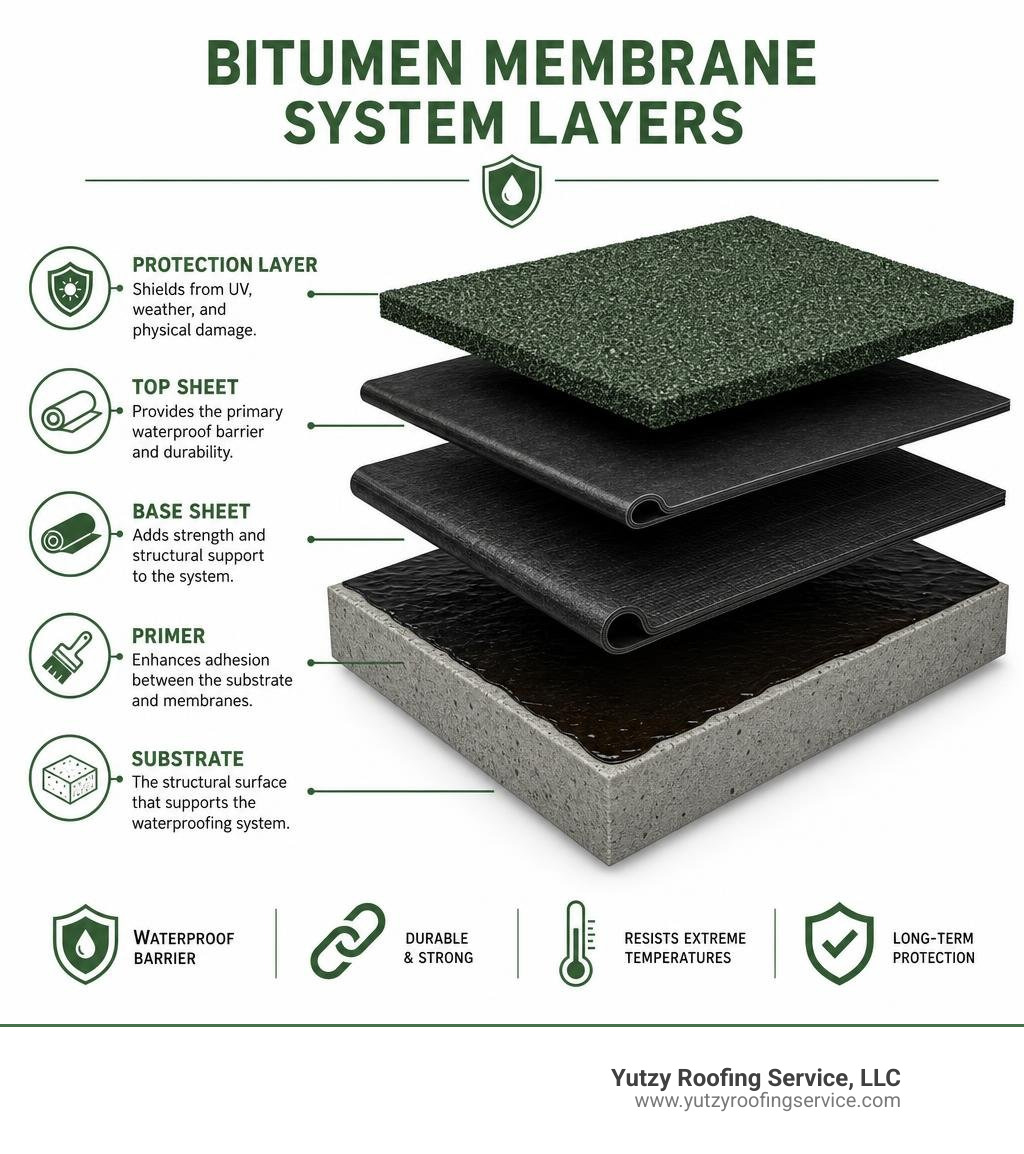
Here is how a typical high-performance bituminous sheet system is built from the bottom up:
- Structural Substrate: Typically a poured concrete deck, lightweight insulating concrete, or heavy-duty wood decking. It must be clean, smooth, and free of sharp protrusions.
- Bitumen Primer: A solvent- or water-based primer applied to seal concrete pores and ensure maximum adhesion of the membrane.
- Base Sheet: The first waterproof layer, which can be mechanically fastened, self-adhered, or hot-mopped.
- Reinforcement Layer (built into the sheet): Tough non-woven polyester or fiberglass mats embedded within the bitumen sheets to provide dimensional stability and tear resistance.
- Cap Sheet (Top Layer): The final exposed layer, often coated with mineral granules or a protective film to resist UV radiation and foot traffic.
- Protection Board / Drainage Mat: For below-grade applications, a tough board (like Bituboard) is installed over the membrane to protect it from stone impacts during soil backfilling.
Key Types of Bituminous Membranes and Their Applications
Not all commercial projects are created equal, which is why manufacturers have developed several distinct types of bituminous membranes. Depending on your building’s location, structural design, and local safety codes, you will need to choose between torch-on, self-adhesive, wet-applied, or hybrid systems.
To help you visualize the primary differences between the two most common commercial options, we’ve put together this quick comparison table:
| Feature | Torch-On Membranes | Self-Adhesive Membranes |
|---|---|---|
| Application Method | Propane torch (open flame) | Peel-and-stick release film |
| Substrate Temperature | Highly adaptable (can apply in colder temps) | Requires warmer conditions (usually >40°F) |
| Safety Considerations | Requires open-flame safety permits | Fire-safe; ideal for active buildings |
| Seam Strength | Excellent (thermal fusion of bitumen) | Strong (requires weighted rolling and pressure) |
| Key Use Cases | Large flat roofs, heavy commercial decks | Flame-restricted zones, indoor areas, subways |
Torch-On Bituminous Membranes
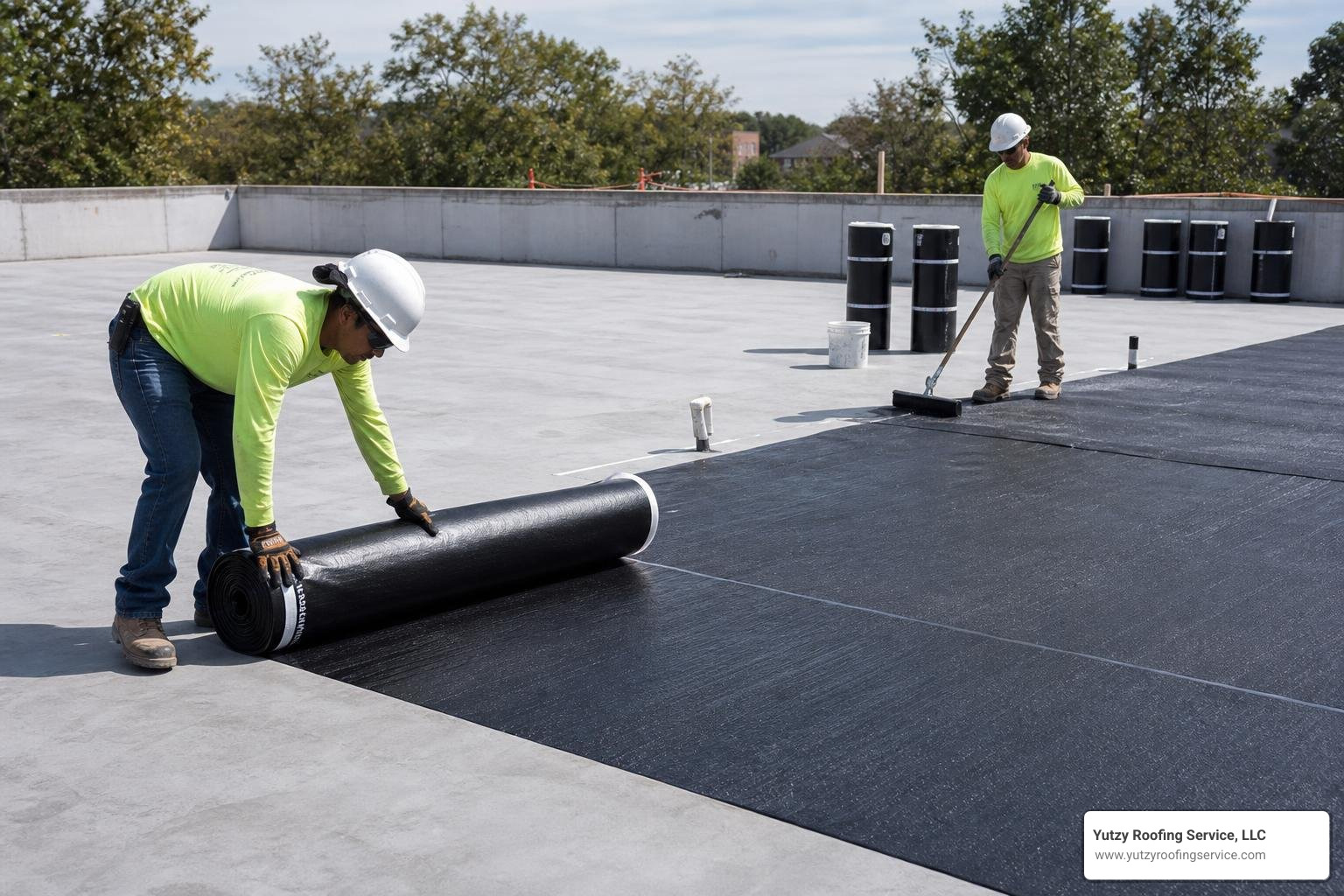
Torch-on systems represent the traditional gold standard of the commercial roofing industry. During installation, a professional technician uses a propane gas torch to melt the bottom thermofusible film of the roll as it is unrolled. This molten bitumen fuses directly to the primed substrate and creates an incredibly strong, welded seam at the overlaps.
An excellent example of this class of material is Bituplus E 4270 SBS Modified Bituminous Waterproofing Membrane – Henkel Polybit – POLYBIT . This heavy-duty, 4mm thick elastomeric membrane uses SBS polymers to maintain high flexibility even when temperatures drop well below freezing, ensuring that the welded seams do not split under building movement.
Self-Adhesive Bituminous Membranes
While torch-on membranes are incredibly tough, they are not always practical. Many commercial facilities—such as active hospitals, schools, or chemical plants—have strict “no open flame” policies. In these environments, self-adhesive bituminous membranes are the perfect alternative.
These sheets feature a highly sticky, polymer-modified bitumen compound on the underside, protected by a peel-off release film. Once unrolled and aligned, the film is pulled away, and the sheet is pressed down using a heavy steel roller to activate the bond.
For projects requiring high dimensional stability without the heat, products like CANSHIELDTM SA300 Modified Bitumen Membrane from China manufacturer – Canlon offer an excellent flame-free solution for underground subways, tunnels, and indoor wet areas. Similarly, Bitustick XLR fibre reinforced self-adhesive bituminous waterproofing membrane- Henkel Polybit – POLYBIT features a tough glass fiber carrier that provides exceptional resistance to tearing and puncture while maintaining a simple, cold-applied installation process.
Specialty and Hybrid Membranes
As material science has advanced, manufacturers have engineered specialty and hybrid membranes to solve specific jobsite challenges. Hybrid membranes combine different polymer modifications—such as an APP-modified top layer for superior UV and heat resistance, paired with an SBS-modified bottom layer for unmatched cold flexibility and adhesion.
Additionally, some wet-applied bituminous sheet systems are designed to be laid directly over damp, fresh concrete, drastically reducing construction schedules by eliminating the standard 28-day concrete cure time. If you are looking for a reliable, multi-use plastomeric option, the SikaShield® P25 PE SA 4 mm | Bituminous Sheet Membrane is a high-performance, polyester-reinforced sheet that delivers outstanding durability in both roofing and below-grade tanking applications.
Comparing Plastomeric (APP) and Elastomeric (SBS) Performance
If you dive into the technical specifications of modified bitumen, you will constantly see two acronyms: APP and SBS. These represent the two primary polymer modifiers used to alter raw asphalt. Choosing the wrong one for your regional climate can lead to premature system failure.
If you are trying to decide which system fits your building’s specific environmental threats, check out our guide on how to Don’t Let the Rain Win with These Top Waterproofing Solutions. You can also browse our curated articles under Tag: Roof Membranes for more comparisons.
Plastomeric APP Modified Bitumen
APP stands for Atactic Polypropylene, a plastic polymer. Adding APP to bitumen raises its melting point significantly, giving the sheet excellent thermal stability.
- Key Characteristics: High UV resistance, stiffer walking surface, and a high softening point (often around 150°C / 300°F).
- Best Climates: Hot, tropical, or southern regions where intense sun and high temperatures dominate.
- Application: Almost always torch-applied, as the APP compound requires higher heat to melt and flow properly.
While APP performs beautifully in southern heat, it can become brittle in extreme cold, making it less ideal as an exposed roofing layer in northern climates.
Elastomeric SBS Modified Bitumen
SBS stands for Styrene-Butadiene-Styrene, a synthetic rubber polymer. Blending SBS into bitumen gives the sheet a rubberized quality with incredible elasticity.
- Key Characteristics: High elongation (some formulations can stretch up to six times their original length and fully recover), excellent self-healing properties for minor punctures, and outstanding cold flexibility (often remaining functional down to -10°F or lower).
- Best Climates: Northern regions that experience severe winter freezes, heavy snow loads, and rapid freeze-thaw cycles.
- Application: Can be torch-applied, hot-mopped, or installed as a self-adhesive sheet.
For commercial properties in Wisconsin, Minnesota, and northern Illinois, SBS is almost always the preferred choice. It easily tolerates the thermal shock of a fast-moving winter storm without cracking. To learn more about how these systems perform locally, take a look at the historical success of SBS Modified Bitumen Roofing Systems Installed in Wisconsin .
Frequently Asked Questions About Bituminous Membranes
Commercial building owners and facility managers often have practical questions when comparing sheet systems to other options on the market. Here are the answers to the most common queries we receive.
For a deeper look at how coatings and membranes interact over time, you can also read The Waterproof Truth About Commercial Flat Roof Coating.
Can bituminous membranes be applied on fresh concrete?
Generally, traditional torch-on and self-adhesive bituminous membranes require concrete to be fully cured (typically a minimum of 28 days) and dry, with a moisture content of 4% or less. Applying standard sheets over wet concrete traps vapor, leading to massive blistering, adhesion failure, and structural wood rot.
However, specialty wet-applied bituminous sheet systems (such as SikaShield W) are specifically engineered with active chemical adhesives that bond directly to damp concrete or green concrete, allowing construction to proceed without costly delays.
What is the typical lifespan and maintenance of these systems?
A professionally installed, multi-ply bitumen sheet waterproofing system can easily last 20 to 30 years or more. To maximize this lifespan, we recommend:
- Bi-Annual Inspections: Checking seams, flashings, and drains every spring and fall.
- UV Protection: Ensuring the mineral granule surfacing or reflective roof coatings remain intact.
- Prompt Repairs: Sealing any localized punctures or edge lifting before water can migrate.
If your older modified bitumen system is starting to show its age but is still structurally sound, applying a reflective liquid roof coating can add decades of life at a fraction of the cost of a full replacement. You can explore these options under our Tag: Roof Coatings archive.
How do bituminous membranes compare to liquid-applied membranes?
Both systems are excellent, but they serve different structural needs:
- Bituminous Sheets: Offer guaranteed, factory-controlled thickness (you know exactly how many millimeters of protection you have across the entire roof) and high puncture resistance. However, they require seams, which are potential failure points if installed poorly.
- Liquid-Applied Membranes: Create a completely seamless, monolithic coating that conforms perfectly to highly complex geometries, pipes, and structural penetrations. However, they require meticulous on-site application to achieve the correct wet-film thickness.
For many large commercial flat roofs, a hybrid approach—using tough bituminous sheets for the main field and liquid-applied details around complex pipe penetrations—provides the ultimate waterproofing solution. Read more about these membrane comparisons under Tag: Roof Membrane.
Conclusion
Protecting your commercial building from water infiltration requires a system that is tough, flexible, and proven to last. Bitumen sheet waterproofing has earned its massive global market share because it simply works. Whether you are sealing a flat commercial roof in Wausau, protecting a deep foundation in Madison, or restoring an older flat roof in Appleton, modified bitumen provides a thick, reliable shield against the elements.
At Yutzy Roofing Service, LLC, we specialize in high-performance commercial roofing restorations, spray foam coatings, and long-term maintenance. We stand behind our workmanship with an up to 18-year non-prorated, renewable warranty, giving you complete peace of mind that your assets will stay dry year after year.
Don’t wait for the next heavy storm to test your roof’s limits. Contact our expert team today at our Marshfield, WI headquarters or any of our local service branches to schedule a comprehensive professional roof inspection.
To continue learning about your options, browse our complete guide on The Different Types of Roof Waterproofing Methods Explained.

