Understanding Chemistries: Best Roofing Caulk for Metal Roof Options
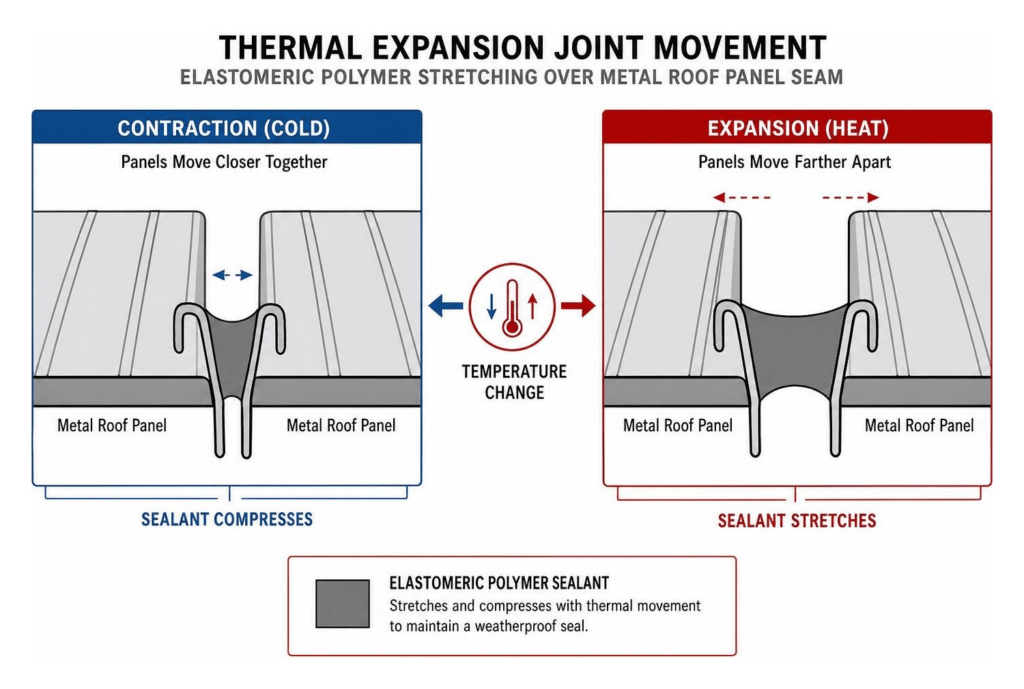
Choosing the best roofing caulk for metal roof projects comes down to chemistry. Metal roofing panels endure extreme thermal expansion and contraction. On a clear summer day in Wisconsin, metal surface temperatures can climb past 140°F, only to drop below zero in winter. If a sealant lacks joint movement capacity, it will split or peel away from the substrate.
| Sealant Chemistry | Primary Application | Joint Movement | Temperature Tolerance | UV Resistance | Substrate Adhesion | Paintable |
|---|---|---|---|---|---|---|
| Advanced Polymer | Kynar coated metal, general trim, flashings | ±50% | -75°F to 212°F | Excellent | Superior (No primer) | Yes (after 1 hr) |
| 100% Silicone | Pipe boots, high-temp penetrations | High | -40°F to 350°F | Exceptional | Good | No (Translucent) |
| Polyurethane | Exposed seams, expansion joints | Moderate | -40°F to 180°F | Fair to Good | High | Yes |
| Butyl Tape / Caulk | Concealed panel overlaps, Z-closures | Non-curing | -40°F to 200°F | Low (Degrades in UV) | High | No |
Different formulations behave uniquely when bonded to aluminum, galvanized steel, copper, or Kynar finishes. To learn more about selecting the right chemical base, read our article on choosing the best caulk for metal roofs.
Advanced Polymer and Silicone Roofing Caulk for Metal Roof Sealing
Advanced elastomeric polymers have revolutionized commercial metal roof maintenance. Products such as Titebond WeatherMaster Metal Roof Sealant offer 99% solids content and an impressive ±50% joint movement capability. This flexibility allows the caulk to stretch and compress alongside metal panels without tearing. Polymer formulas adhere directly to difficult surfaces like Kynar coated metal, steel, aluminum, and copper without requiring a primer.
Silicone options are also widely used on commercial roofs. Oxime-cured silicone sealant provides incredible UV resistance and handles extreme temperature swings from -40°F to 350°F. Silicone is ideal for weatherproofing round pipe boots and HVAC curb penetrations exposed to intense sunlight. However, standard silicone cannot be painted, and clear/translucent varieties typically offer lower joint movement tolerances (±25%). For an in-depth review of product specifications, check out our complete metal roof sealant guide.
Polyurethane and Butyl Roofing Caulk for Metal Roof Applications
Polyurethane seam sealers provide strong initial adhesion and high tensile strength. They can be painted to match existing panels and work well on vertical wall transitions and trim. However, polyurethane degrades faster under continuous ultraviolet radiation compared to advanced polymers, making regular inspection critical.
Butyl-based products serve a completely different purpose. Available as gunnable caulk or double-sided tape, butyl is a non-curing compound designed strictly for concealed lap joints. Research shows non-curing butyl tape retains its cohesive strength for over 35 years when sandwiched inside hidden panel overlaps. Because UV light breaks butyl down, it must never be applied topically. For full details on tape applications, refer to our guide on mastic tape for metal roofing or browse standard commercial options at Home Depot commercial roof sealants.
Surface Preparation and Proper Application Guidelines
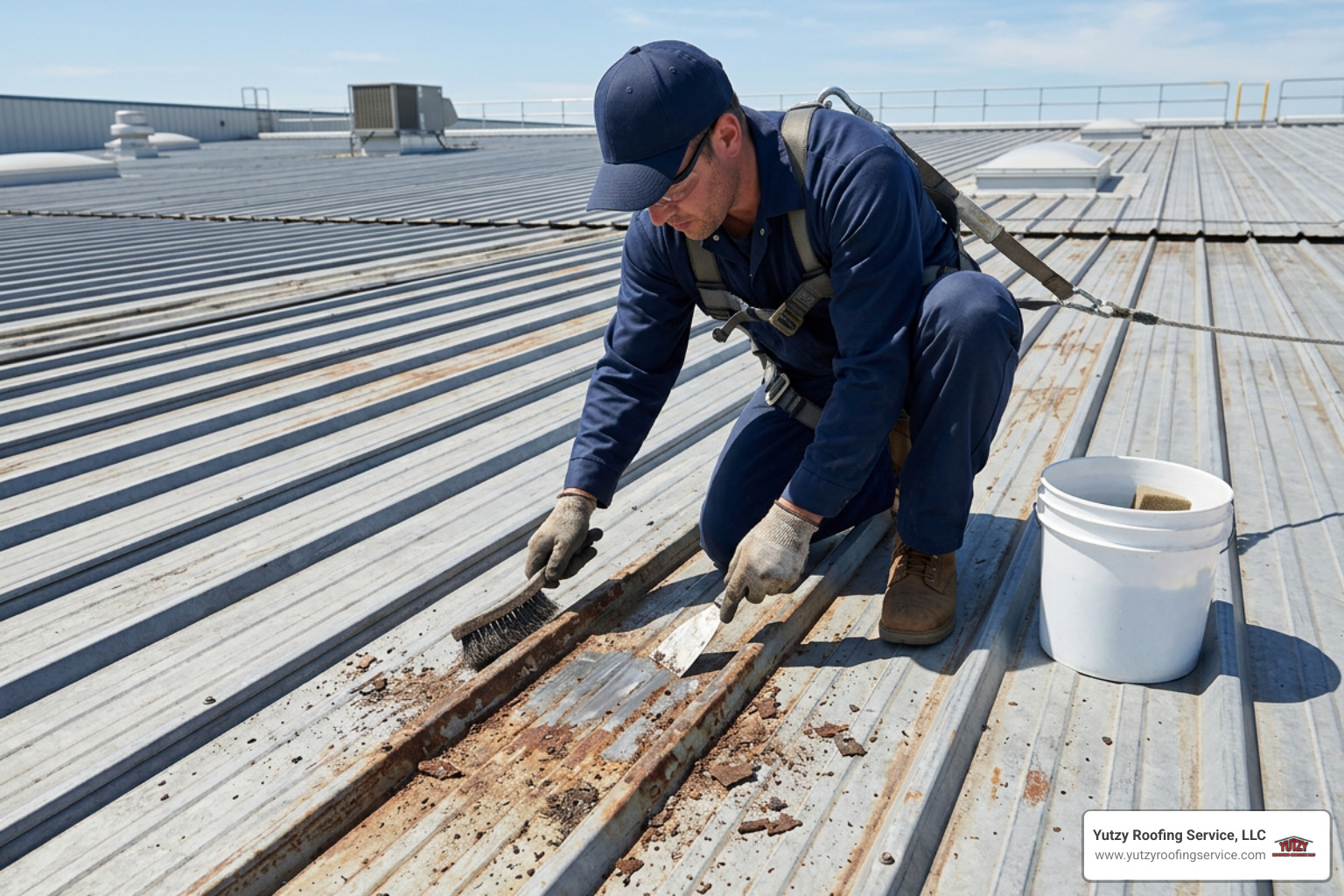
Even the highest-grade roofing caulk for metal roof repairs will fail if applied over dirt, rust, or old degraded sealant. Surface preparation is 90% of a successful, leak-free installation.
- Clean Thoroughly: Remove dust, loose paint, and dirt using wire brushes, scraper tools, or industrial degreasers.
- Eliminate Rust: Scrub surface rust down to clean metal. Coat raw copper or severe oxidation to prevent premature bond failure.
- Remove Old Sealant: Cut away failed urethane or silicone. Fresh caulk cannot form a reliable bond over loose, chalky remnants.
- Ensure Dry Substrates: While some advanced polymers can adhere to damp surfaces, dry surfaces yield maximum long-term adhesion.
To review proper maintenance standards, consult the dos and donts of metal roof maintenance.
When applying premium polymer sealant, extrude a continuous bead directly into the joint. Do not tool, smear, or spread the bead flat with a spatula, wet finger, or solvent rag. Smearing thins the material, weakening its elastomeric properties and joint movement rating.
Polymer caulks feature a 10-15 minute tooling window, achieve tack-free status in 20-30 minutes, and complete a full cure within 24 to 48 hours. Always verify application instructions on the official WeatherMaster metal roof sealant page.
Repairing Loose Fasteners, Panel Seams, and Penetrations

Loose or backing-out fasteners are the primary source of leaks on metal roofs. Over time, panel movement enlarges screw holes and destroys original EPDM rubber washers.
To repair damaged fastener points:
- Back out the damaged, crooked, or stripped screw.
- Inject a dab of high-grade polymer caulk directly into the open screw hole.
- Install an oversized “rescue screw” (typically #14 diameter instead of standard #10 or #12) featuring a larger EPDM rubber washer.
- If the underlying metal hole is severely torn, add a stainless steel fender washer combined with a fresh rubber washer over the hole before driving the screw home. Do not over-torque, which splits the washer.
For panel end-laps and pipe boots, inject caulk directly into the overlap seam before inserting fasteners. Learn more about locating structural leaks in our guide to metal roof leak repair and explore step-by-step diagnostic strategies in how to identify and fix a metal roof leak.
Color Selection, Coverage Rates, and Cost Considerations
Matching your sealant color to your metal building aesthetic prevents unsightly streaks across the roofline. Advanced polymer sealants come in up to 13 factory-matched colors — including white, gray, black, bronze, and green — as well as clear translucent formulations. White and colored polymer caulks can be painted with water-based acrylic paint just 1 hour after application. Translucent silicone or polymer options are non-paintable. If you plan to refinish your building, review our guide on how to paint a metal roof.
A standard 10.1 fl oz tube yields approximately:
- 116 linear feet with a 1/8″ bead
- 53 linear feet with a 3/16″ bead
- 29 linear feet with a 1/4″ bead
- 13 linear feet with a 3/8″ bead
Prices for commercial-grade metal roof caulk range from $6 to $12 per tube for standard polymer formulas, up to $28 per tube for specialized high-temp bonding sealants.
Common Caulking Mistakes That Cause Commercial Roof Leaks

Commercial roof leaks frequently occur due to installation errors rather than material defects. Understanding these critical mistakes protects your building from premature failures:
- Applying in Severe Weather: While advanced polymers can be gunned in temperatures down to 0°F, applying sealant over frost, ice, or active snow prevents adequate bonding.
- Over-Tooling and Solvent Wiping: Tooling thins the bead, while wiping with mineral spirits or alcohol disrupts the curing chemistry.
- Polycarbonate Stress Cracking: Never apply translucent sealants or solvent-releasing caulks to polycarbonate skylight panels, as solvents cause stress cracking.
- Using Non-Curing Tape Topically: Installing non-curing butyl tape on exposed joints causes rapid UV degradation and dirt accumulation.
For additional compliance tips, read our guide to metal roof caulk practices. Building owners in southern Wisconsin should also review the importance of metal roof waterproofing in Madison, WI.
Frequently Asked Questions
Can I use standard clear silicone caulk on a commercial metal roof?
No. Standard off-the-shelf clear silicone caulk lacks the joint movement capability (±50%) required for long commercial metal roof panels. Standard clear formulas also tend to break down under continuous UV rays and can cause corrosion on unpainted metal substrates. Always use a specialized oxime-cured silicone or advanced elastomeric polymer caulk rated for metal roofs.
How do I fix a stripped or crooked metal roof screw hole?
Back out the damaged fastener, clear away debris, and inject a small amount of polymer roof sealant into the hole. Then, drive an oversized rescue screw (such as a #14 screw with a 5/8″ or 3/4″ EPDM washer) into the original hole. For severely enlarged openings, stack a stainless steel fender washer over a new neoprene washer before securing the fastener.
How long does high-grade metal roof caulk last compared to the roof?
High-grade polymer or silicone metal roof caulk lasts between 10 and 20 years, whereas metal roof panels can last 40 to 60 years. Because sealants age faster than metal, routine inspections should be performed every few years to touch up aging joints before water enters the facility.
Conclusion
Mastering the selection and application of roofing caulk for metal roof systems is essential for maintaining a watertight commercial facility. Using superior polymer or oxime-cured silicone chemistries, properly preparing metal substrates, and applying un-tooled continuous beads ensures your roof withstands Wisconsin’s demanding climate.
When spot caulking is no longer enough to manage aging seams and back-out fasteners, a comprehensive restoration is the smartest choice. At Yutzy Roofing Service, LLC, we specialize in commercial metal roof restoration and fluid-applied seamless elastomeric coatings that eliminate leaks across your entire roof. Our installations are backed by an up to 18-year non-prorated renewable warranty, giving you lasting peace of mind.
Explore our metal roof restoration options or review our complete metal roof sealant guide. Contact Yutzy Roofing Service today to schedule a professional roof evaluation for your building in Madison, Appleton, Wausau, Green Bay, or surrounding Wisconsin and Minnesota communities!
