
How Thermal Imaging Helps Find Hidden Roof Moisture
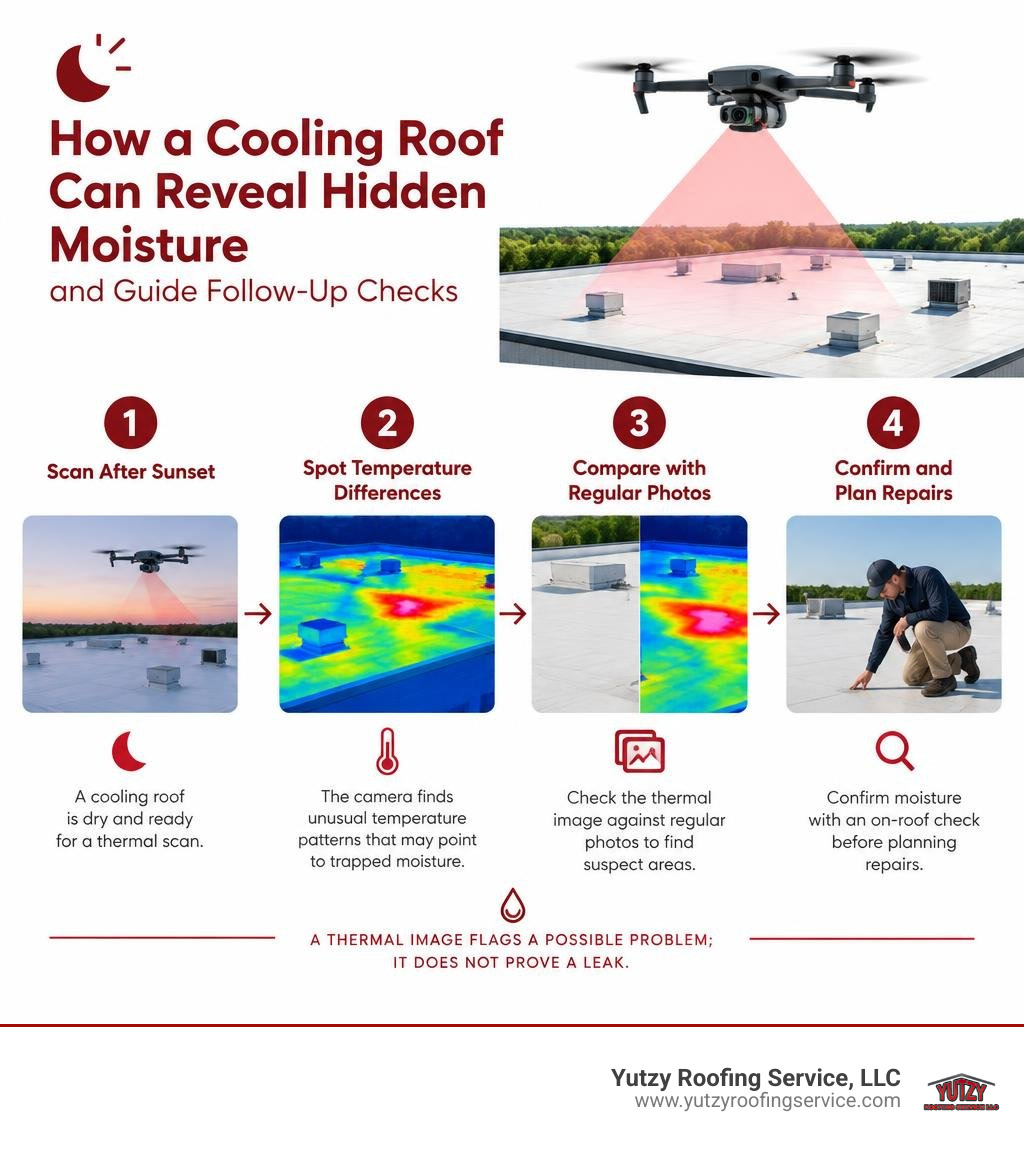
Thermal imaging roof leak detection uses a camera to find temperature patterns that may point to trapped moisture. For a commercial roof, the best starting point is often a scan after sunset, when the roof surface is dry and cooling. Compare any unusual areas with regular photos, then confirm moisture with an on-roof check before planning repairs. A thermal image flags a possible problem; it does not prove a leak.
This approach can help property managers focus follow-up work on suspect areas without opening large sections of the roof. The U.S. Department of Energy notes that infrared thermography is a proven method for detecting moisture trapped within flat roofing systems.
I’m Josh Yutzy of Yutzy Roofing Service, LLC, a family-owned roofing company with Wisconsin roots dating to 1995. I bring that roofing background to this guide on thermal imaging roof leak detection, starting with what the camera can and cannot show.
Thermal imaging roof leak detection further reading:
The Science and Workflow of Thermal Imaging Roof Leak Detection
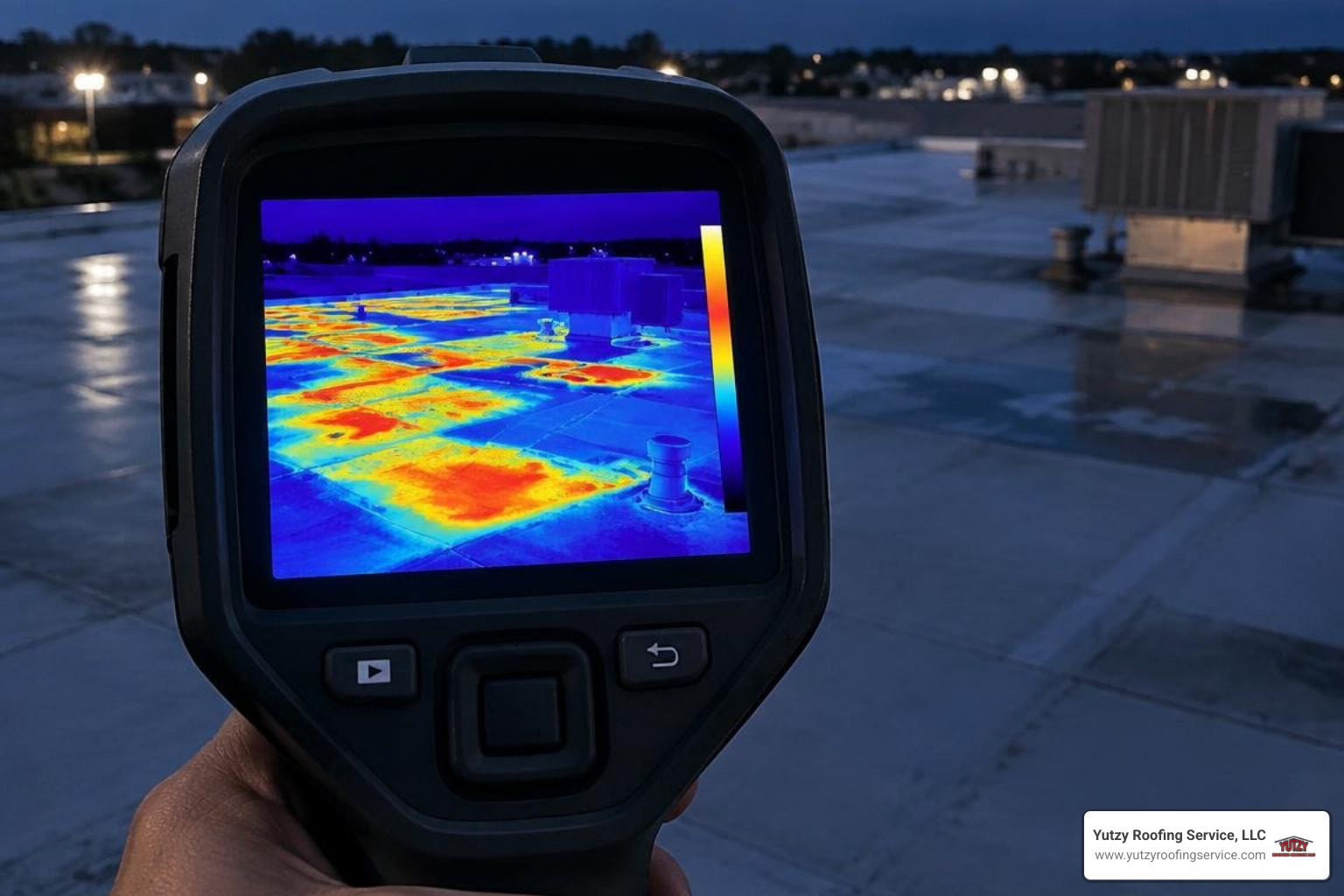
Since the 1970s, infrared thermography has been used for inspecting flat and low-slope roofs to check for subsurface moisture entrapment. The physical principle behind it is thermal capacitance.
Water has a specific heat capacity roughly five times higher than typical commercial roofing materials like polyisocyanurate insulation, EPDM rubber, or TPO membranes. During a warm day, the entire roof assembly absorbs solar radiation. When the sun sets, dry insulation sheds heat rapidly into the night sky. In contrast, water-saturated insulation holds onto that thermal energy far longer.
This creates a distinct temperature lag. When we fly an aerial survey with calibrated radiometric sensors, the camera registers these radiating heat signatures. Instead of making blind cuts across thousands of square feet, we use infrared imaging to spot anomalies and integrate them into our complete roof inspection checklist for verification.
How Thermal Imaging Roof Leak Detection Works and Measures Temperature Differentials
Modern high-resolution radiometric thermal cameras can detect temperature differences as tiny as 0.1°C. By measuring infrared radiation across the roof membrane, the software assigns color palettes to surface temperatures, mapping out thermal anomalies.
To interpret what the camera sees, we evaluate the temperature differential ($\Delta T$) between suspect zones and adjacent dry reference sections:
- 3–5°C Delta: Typically points to light moisture intrusion or damp insulation along early seam breaches.
- 5–8°C Delta: Indicates moderate saturation where moisture has begun spreading horizontally through insulation boards.
- Above 8°C Delta: Signals heavy water accumulation, severe wet insulation, or hidden water pockets trapped between membrane plies.
A typical thermal crossover window produces a delta of three to five degrees Celsius between dry and wet insulation, creating a clear visual boundary for diagnostic review.
Best Timing and Drone Equipment for Infrared Moisture Scans
Timing is the single most critical variable in an accurate infrared moisture survey. Inspections should take place during the evening thermal crossover window—roughly one to two hours after sunset. At this stage, the sun’s surface glare has cleared, dry roof substrates have cooled, and wet insulation continues to radiate stored daytime heat.
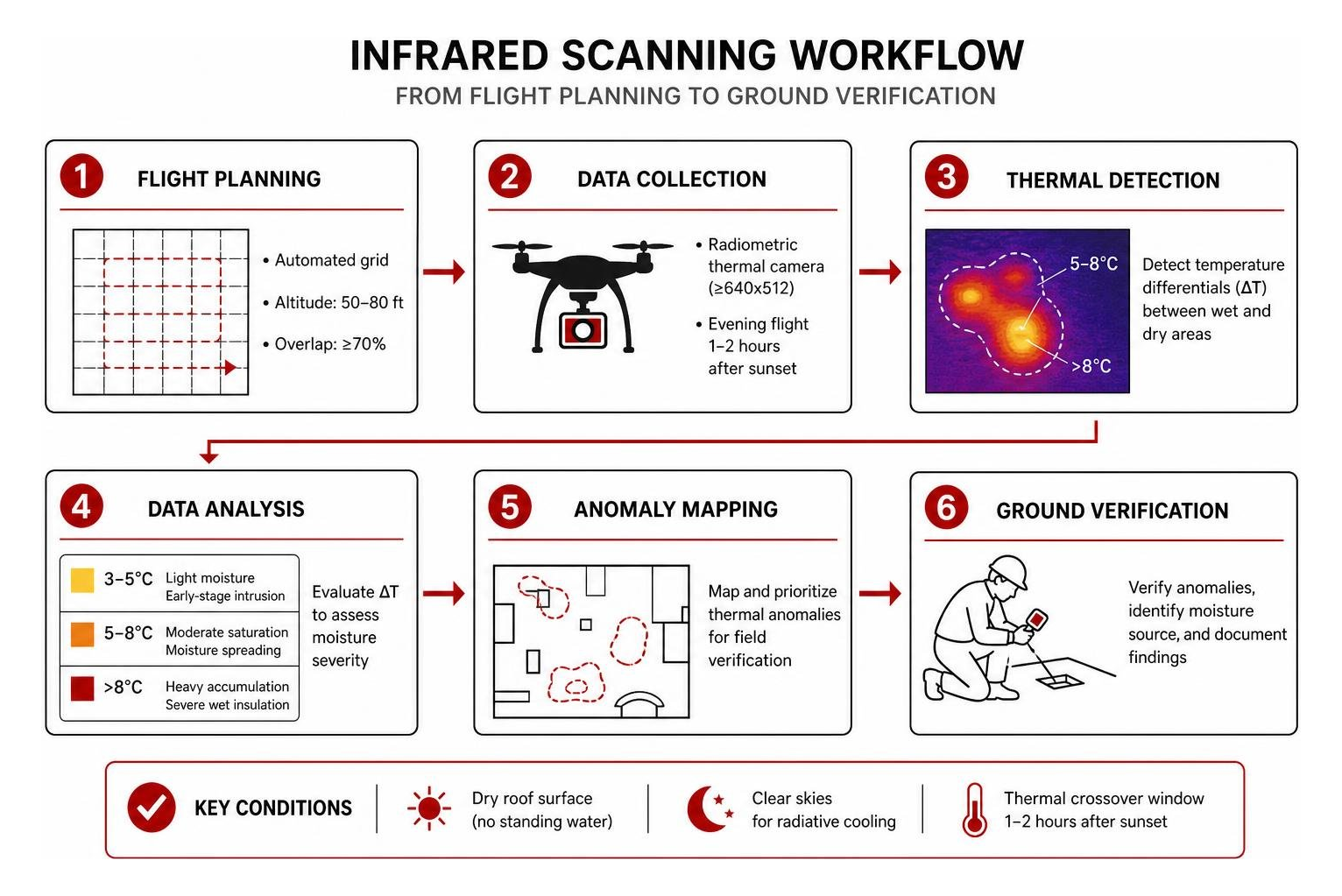
For aerial data collection, we deploy commercial drones equipped with radiometric sensors featuring at least 640×512 thermal resolution. Flight paths are planned in automated grids at altitudes between 50 and 80 feet, maintaining a minimum 70 percent image overlap. This provides high spatial clarity; a 640×512 sensor at 50 feet can easily detect moisture patches as small as 12 by 12 inches, provided there is at least a two-degree Celsius differential.
Weather conditions must be stable:
- Dry roof surface (standing surface rainwater hides internal temperature signatures)
- Clear skies for optimal radiative cooling
- Low wind speeds (under 10 mph) to prevent convective wind cooling from washing out thermal contrast
Operating under these conditions prevents common false positives caused by surface reflections, HVAC exhausts, or differing surface material emissivities.
Subsurface Damage and Membrane Failures Identified by Thermal Scans
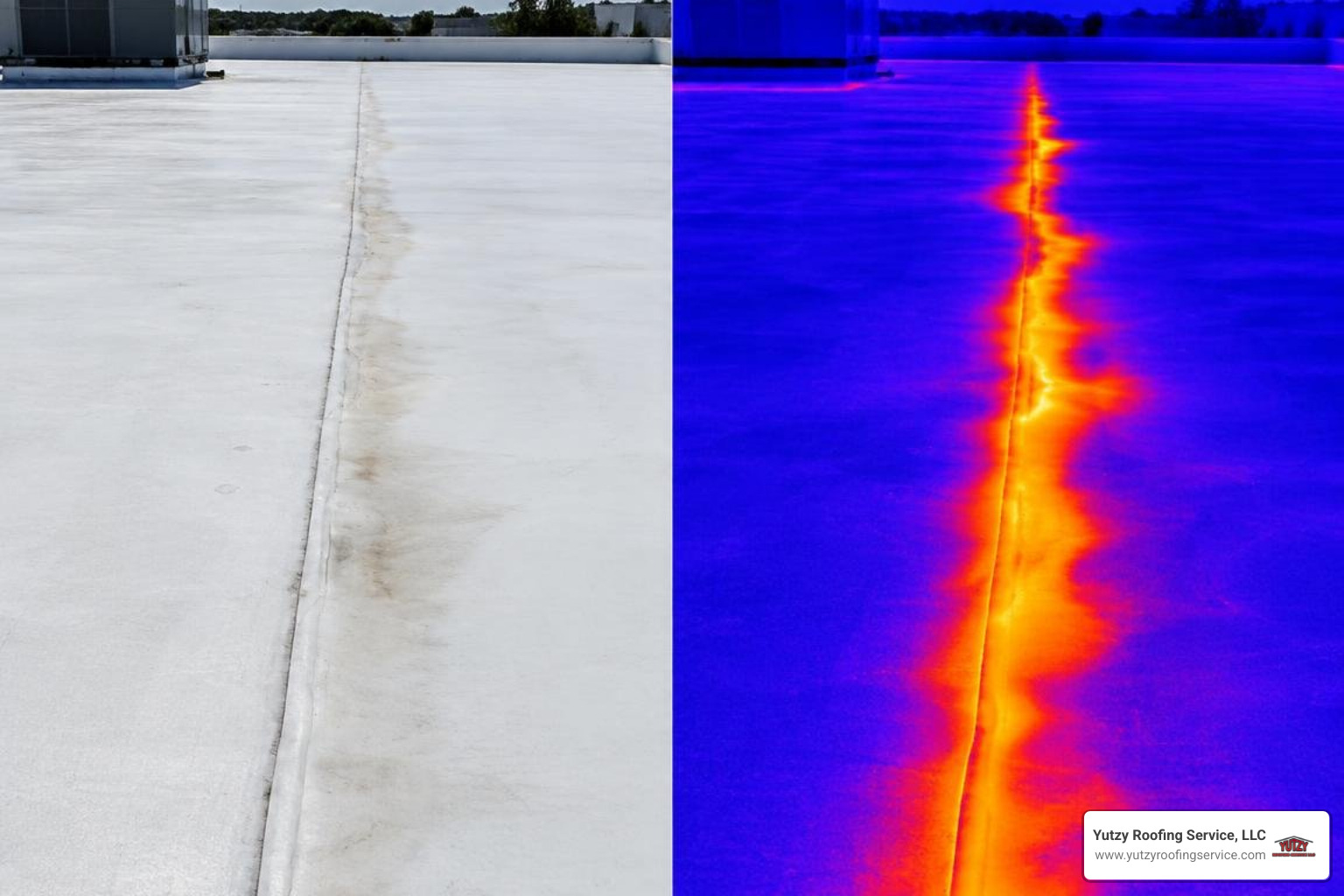
Infrared scans locate moisture entry points and internal saturation across commercial roofing systems long before water penetrates the interior decking. When using physical diagnostic tools, probing for problems works best when guided by thermal mapping.
Thermal imaging excels at identifying:
- Membrane Seam and Puncture Breaches: Detecting water tracking beneath TPO, PVC, and EPDM sheet seams.
- Subsurface Wet Insulation: Defining the exact perimeter of saturated polyiso or perlite board insulation without destructive testing.
- Parapet Wall & Flashing Failures: Capturing vertical wall moisture intrusion and deteriorated counter-flashing around rooftop curbs.
- Sub-Membrane Water Entrapment: Distinguishing between benign surface puddles that have already evaporated and trapped liquid beneath the top layer.
Maximizing ROI and Maintenance with Infrared Technology
Thermal inspections detect leaks at least 60 days earlier than visual inspections on average. Catching water intrusion at the insulation level prevents structural deterioration, interior inventory damage, and costly emergency shutdowns.
A single undetected roof leak that causes interior water damage, equipment failure, and deck corrosion can cost $10,000 to $50,000 or more to remediate. Replacing damaged commercial roofs can run as much as $8 to $10 per square foot. Identifying moisture early keeps capital expenditure budgets predictable and manageable.
| Inspection Metric | Traditional Visual Walkthrough | Aerial Thermal Infrared Scan |
|---|---|---|
| Inspection Speed | 2–3 hours per 10,000 sq ft | 20–30 minutes per 10,000 sq ft |
| Moisture Detection | Detects surface flaws / active ceiling drips | Maps hidden subsurface moisture entrapment |
| Surface Coverage | Spot checks and visual estimation | 100% radiometric mapping |
| Safety Risk | High (extended foot traffic near edges) | Low (conducted via aerial drone) |
| Actionable Precision | Broad estimation of affected areas | Pinpointed square footage of wet insulation |
Regular diagnostics are essential. If you are assessing your building’s condition, ask yourself when was the last time you had a commercial roof inspection?
Traditional Visual Inspections vs. Thermal Imaging Roof Leak Detection
Visual inspections remain necessary, but relying solely on surface walkthroughs leaves major diagnostic gaps. Membrane surfaces often look completely intact while holding hundreds of gallons of water in the underlying insulation.
Dual-modality inspections solve this problem by pairing thermal infrared data with high-resolution visual (RGB) images taken from the exact same aerial perspective. An anomaly appearing warm on the thermal camera can immediately be checked against the RGB optical frame to determine whether it is an HVAC thermal exhaust, a patch of gravel, or subsurface moisture.
Property managers who inspect their commercial portfolio regularly reduce annual roof repair spend by 40 to 60 percent. Instead of paying for premature, complete roof tear-offs, facility teams can execute surgical, targeted repairs.
Developing an Actionable Moisture Remediation and Maintenance Plan
Thermal mapping turns subjective leak tracking into an objective, data-backed remediation plan. Once an aerial survey highlights potential moisture retention, we conduct non-destructive moisture meter checks or take minimal core samples to verify the presence of water.
For commercial flat roofs across Wisconsin and southeastern Minnesota—including facilities in Madison, Appleton, Green Bay, Wausau, and Rochester—having geotagged radiometric documentation makes insurance claims, warranty validations, and repair scopes straightforward.
Once wet insulation is removed and replaced, we restore the roof using fluid-applied membrane systems or targeted restorations. To understand how we address these underlying issues and seal your building envelope, explore our process for flat roof leak repair.
Quarterly or bi-annual thermal imaging provides the defensible documentation commercial property managers need to maximize roof lifespans and stop leaks before they disrupt operations.
