
What to Do When You Find Leakage on the Ceiling
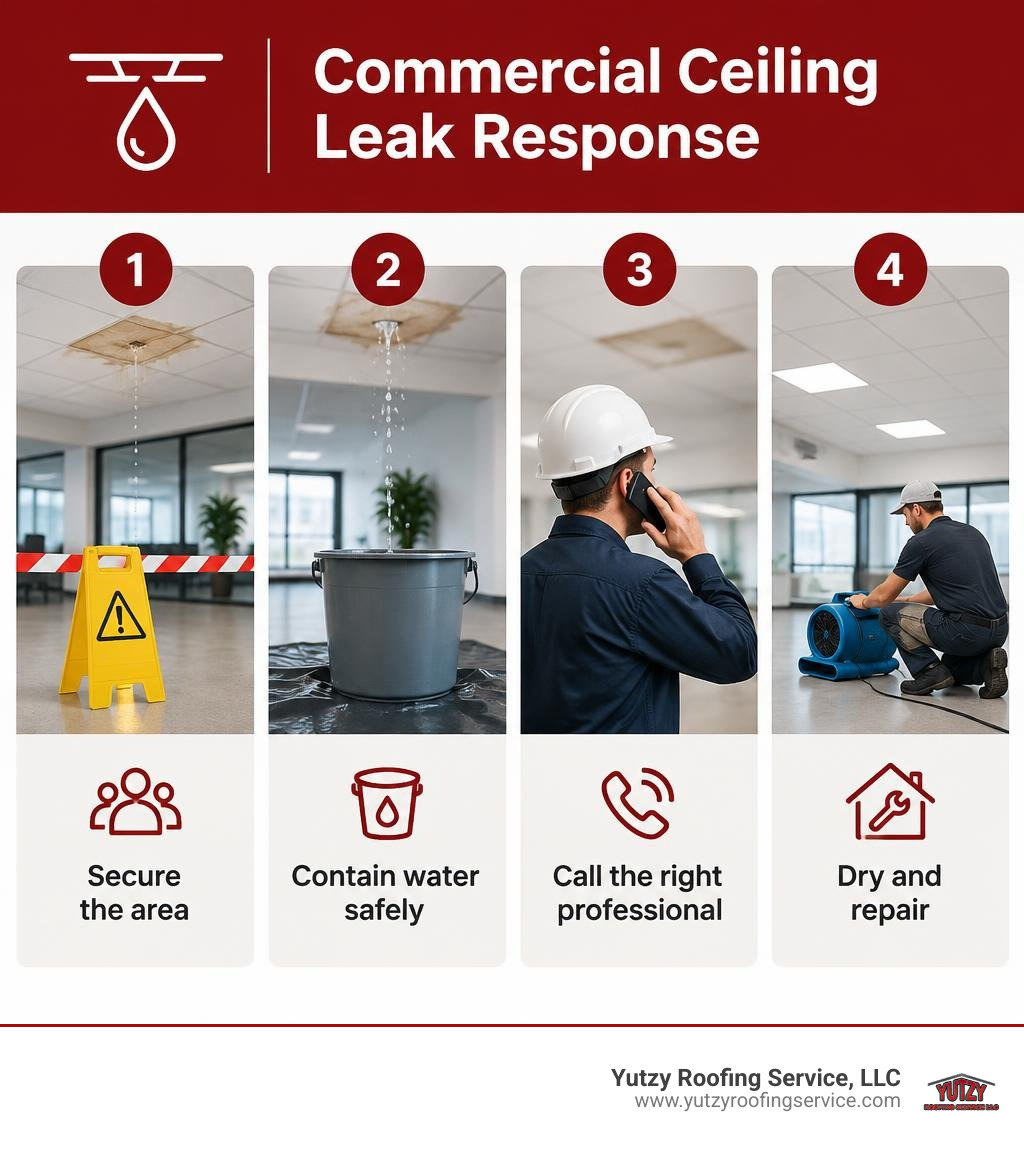
If you find leakage on the ceiling in a commercial building, keep people away from wet or sagging ceiling panels. Protect equipment and contain drips only if you can do so safely. If water is near lights or wiring, have qualified staff shut off power to the affected area. Then call a roofer if the leak follows rain or snowmelt, or a plumber if it appears tied to a pipe or fixture.
Do not wait to fix the source: wet drywall can weaken, and mold can begin growing within 24 to 48 hours. Once the leak is stopped, have the damaged area checked and dried before ceiling repairs begin.
I’m Josh Yutzy of Yutzy Roofing Service, a family roofing business serving Wisconsin since 1995. I draw on our commercial roofing experience to help owners respond to leakage on the ceiling before it disrupts their work.
Leakage on the ceiling terms explained:
How to Diagnose and Manage Leakage on the Ceiling
Discovering overhead water intrusion inside a commercial property threatens business continuity, tenant safety, and structural integrity. Water obeys gravity and follows the path of least resistance, often traveling extensive horizontal distances across deck flutes, structural steel, or electrical conduit before pooling. Consequently, surface discoloration or dripping drywall rarely sits directly beneath the actual breach.
Facility managers must balance rapid interim containment with rigorous diagnostic evaluations. Addressing ceiling moisture involves adhering to federal environmental standards, such as the Moisture Control Guidance for Building Design, Construction and Maintenance established by the EPA, to prevent airborne fungal contamination and preserve structural capacity.
Immediate Emergency Containment When Leakage on the Ceiling Occurs
Emergency containment prevents widespread operational disruption and costly equipment loss while professional contractors mobilize. If active water causes drywall or acoustical panels to sag or blister, the trapped weight presents a sudden collapse hazard.
- Relieve Hydraulic Pressure: Carefully pierce the center of a water-swollen drywall blister using a screwdriver or awl to guide water downward in a controlled stream rather than risking an uncontrolled ceiling blowout.
- Deploy Commercial Drip Diverters: Rather than relying on simple buckets that quickly overflow or splash onto work surfaces, hang heavy-duty vinyl drip diverters secured to ceiling joists with bungee cords. These funnels route intrusive water directly into dedicated floor drains or storage drums via drainage hoses.
- Isolate Electrical Infrastructure: Water traversing ceiling assemblies can compromise lighting grids, junction boxes, and supply lines. Submerged wiring left energized or wet for over 24 hours often requires complete replacement; cut circuit breakers feeding the wet zone immediately.
- Mitigate Biological Hazards: Water left standing starts a ticking clock. Mold colony establishment can begin in as little as 24 to 48 hours under humid indoor conditions, necessitating rapid extraction and air movement.
Tracing the Root Cause of Leakage on the Ceiling
Once overhead drips are stabilized, pinpointing the true origin requires specialized diagnostic instrumentation. Commercial leak detection relies on non-destructive technology rather than speculative drywall demolition.
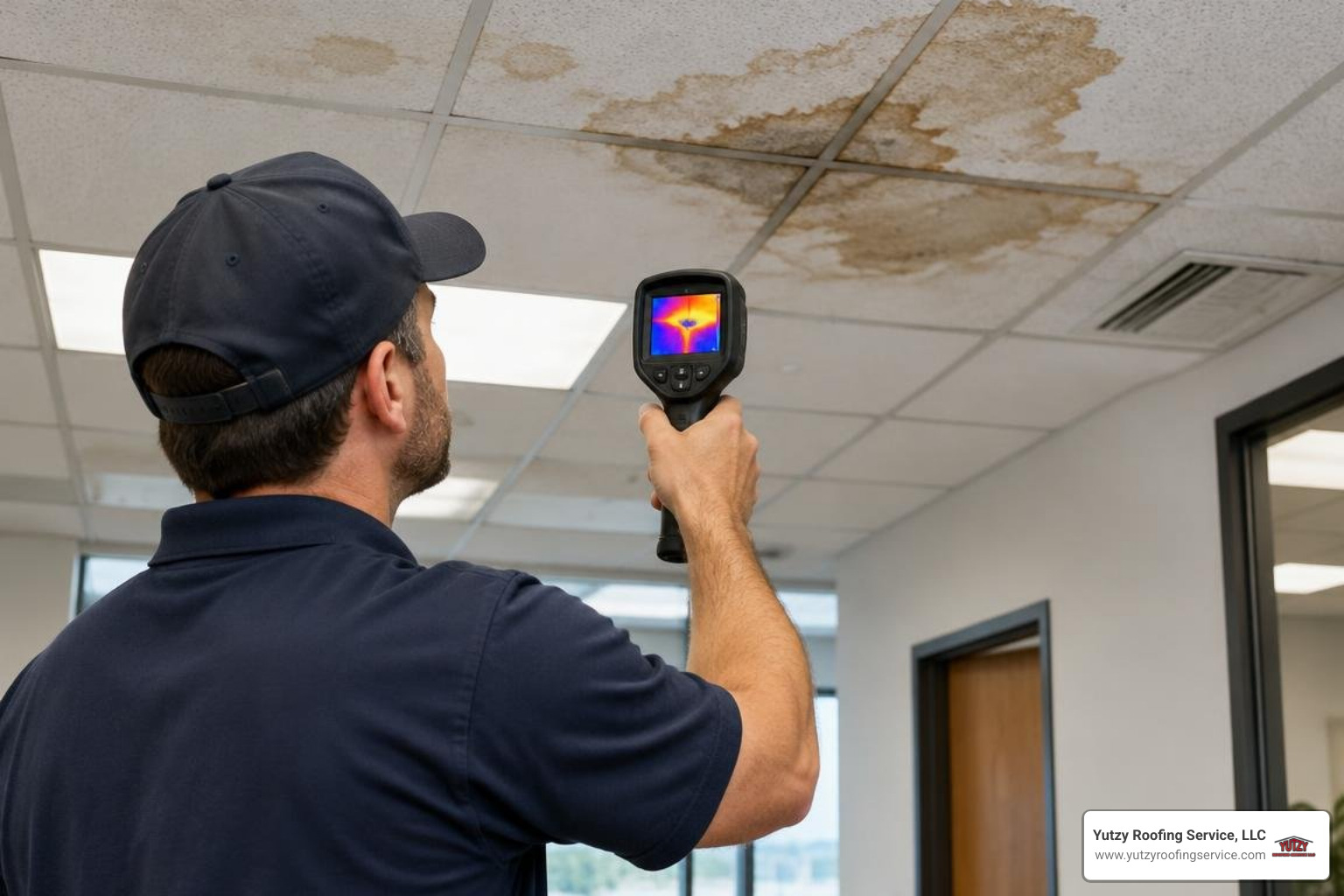
Trained commercial roofing professionals deploy infrared thermography to map hidden moisture plumes trapped inside ceiling assemblies and roof insulation boards. Because wet insulation retains thermal energy differently than dry substrate, thermal imaging clearly outlines water channels. Acoustic listening devices and high-frequency electronic leak detectors further evaluate pressurized supply piping, fire suppression loops, and roof membrane seam integrity.
When tracing exterior intrusion, contractors look past the interior stain to locate compromised roof features. Factors such as cracked expansion joint flashings, separated parapet seams, degraded vent boots, or mechanical curb failures allow water to enter the building envelope. Utilizing systematic techniques for locating elusive commercial roof leaks ensures every entry point along the water path is accurately identified and sealed.
Roof Failure vs. HVAC Condensation in Commercial Buildings
Facility managers frequently misdiagnose ceiling moisture by mistaking mechanical condensation for roof breaches, or vice versa. Uninsulated air ducts running through warm roof plenums generate substantial condensation during humid Wisconsin summers, manifesting as sweating ceiling tiles or rusted supply grilles.
Conversely, a true roof membrane failure allows bulk precipitation into the building envelope, saturating thermal insulation boards and producing brownish rings across drywall assemblies. Employing a systematic commercial leak diagnosis eliminates guesswork, determining whether mechanical ventilation adjustments or roofing interventions are required.
Why Commercial Facilities Require Professional Roof Restoration and Prevention
Attempting makeshift patches or delaying commercial roof restoration compounds facility risks rapidly. Unchecked water migration weakens interior drywall, destabilizes roof decking, and invites health liabilities into commercial working environments.
The Dangers of Inadequate Repairs on Building Framing
Superficial cosmetic repairs that simply cover up stained ceiling drywall leave active moisture trapped within upper roof assemblies. Wood framing begins to degrade at sustained moisture levels above about 19%, sparking hidden dry rot and load-bearing failures. Similarly, steel deck assemblies suffer accelerated oxidation when exposed to moisture trapped within wet insulation cores.
The economic fallout of deferred action is severe. A minor roof breach requiring modest repair can quickly escalate into extensive structural remediation and asset loss if ignored. If you notice signs of water ingress, identifying deep commercial roof damage early prevents structural decay, protects interior air quality, and preserves commercial property values across Madison, Appleton, and Wausau facilities.
Long-Term Protection with Commercial Membrane Coatings
At Yutzy Roofing Service, we deliver comprehensive commercial roofing restoration designed to stop recurring ceiling leaks permanently. Rather than performing disruptive and expensive complete tear-offs, our engineered fluid-applied systems renew and fortify your existing roof envelope.
- Seamless Spray Foam Roofing: Delivers monolithic insulation and waterproofing, eliminating mechanical fasteners and leak-prone seams entirely.
- Commercial Metal Roof Restoration: Seals fastener penetrations, reinforces standing seams, and applies elastomeric topcoats to prevent rust and expansion leaks.
- EPDM & Single-Ply Membrane Restoration: Repairs cracked rubber, reinforces perimeter flashings, and encapsulates weathered single-ply membranes with reflective coatings.
- Industry-Leading Warranties: We back our commercial restoration systems with up to an 18-year non-prorated renewable warranty, ensuring long-term financial security.
When your facility exhibits signs of moisture intrusion, turn to proven commercial roofing specialists to secure the entire envelope. You can schedule professional roof leak restoration to protect building ceilings with our experienced commercial team today.
