
Which Flat Roof Types Fit Commercial Buildings?
The main flat roof types are TPO, EPDM, PVC, modified bitumen, and built-up roofing (BUR). TPO is a strong choice when heat reflection matters. EPDM stays flexible through temperature swings, while PVC suits roofs exposed to grease or chemicals. Modified bitumen and BUR offer layered protection, but they are heavier systems. The right choice depends on your building’s drainage, roof traffic, climate, and budget.
I’m Josh Yutzy of Yutzy Roofing Service, LLC. From my family’s roofing work in Wisconsin since 1995, I’ll compare these flat roof types and the upkeep that helps them last.
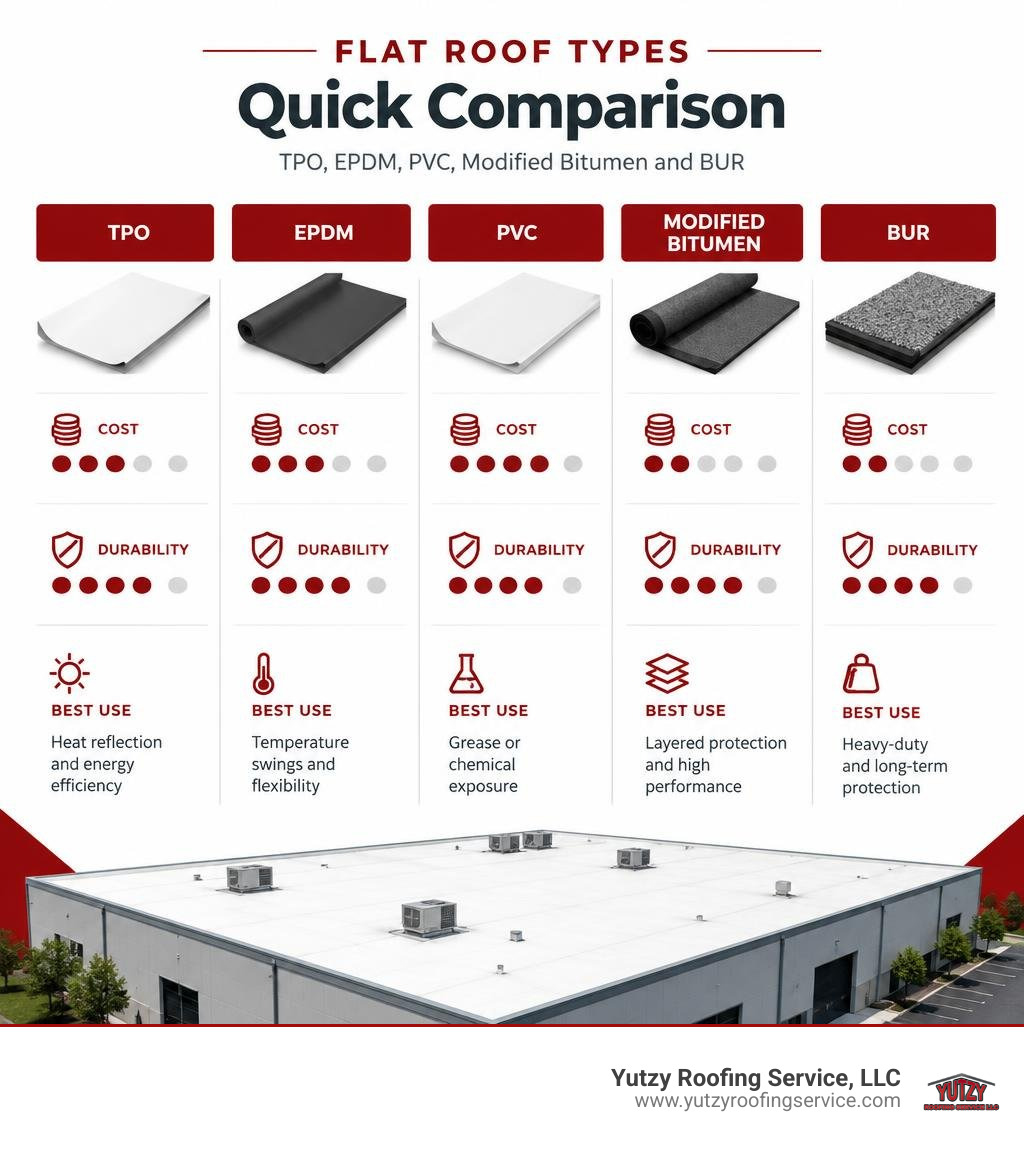
Simple guide to flat roof types terms:
Understanding Commercial Low-Slope Roof Engineering

Commercial flat roofs are rarely level. In modern construction, they are engineered as low-slope systems with a minimum pitch—typically a 1/4-inch rise per horizontal foot (a slope of 1:48). This slight incline prevents water from pooling like a giant rooftop swimming pool and directs rain or melting snow toward designated outlets.
There are many benefits of flat roofs for commercial buildings, including easy equipment staging and maximum usable interior space below. To manage moisture, flat roofs rely on primary internal drains, perimeter scupper outlets, and secondary overflows.
Engineers generally design these assemblies in two primary thermal profiles:
- Warm Roof Design: Insulation boards (typically rigid polyisocyanurate) are placed directly above the structural deck, beneath the waterproof membrane. This keeps the roof deck at interior building temperatures and eliminates the need for complex interstitial ventilation.
- Cold Roof Design: Insulation sits beneath the structural deck, requiring dedicated airflow channels between the insulation layer and the decking to prevent trapped condensation.
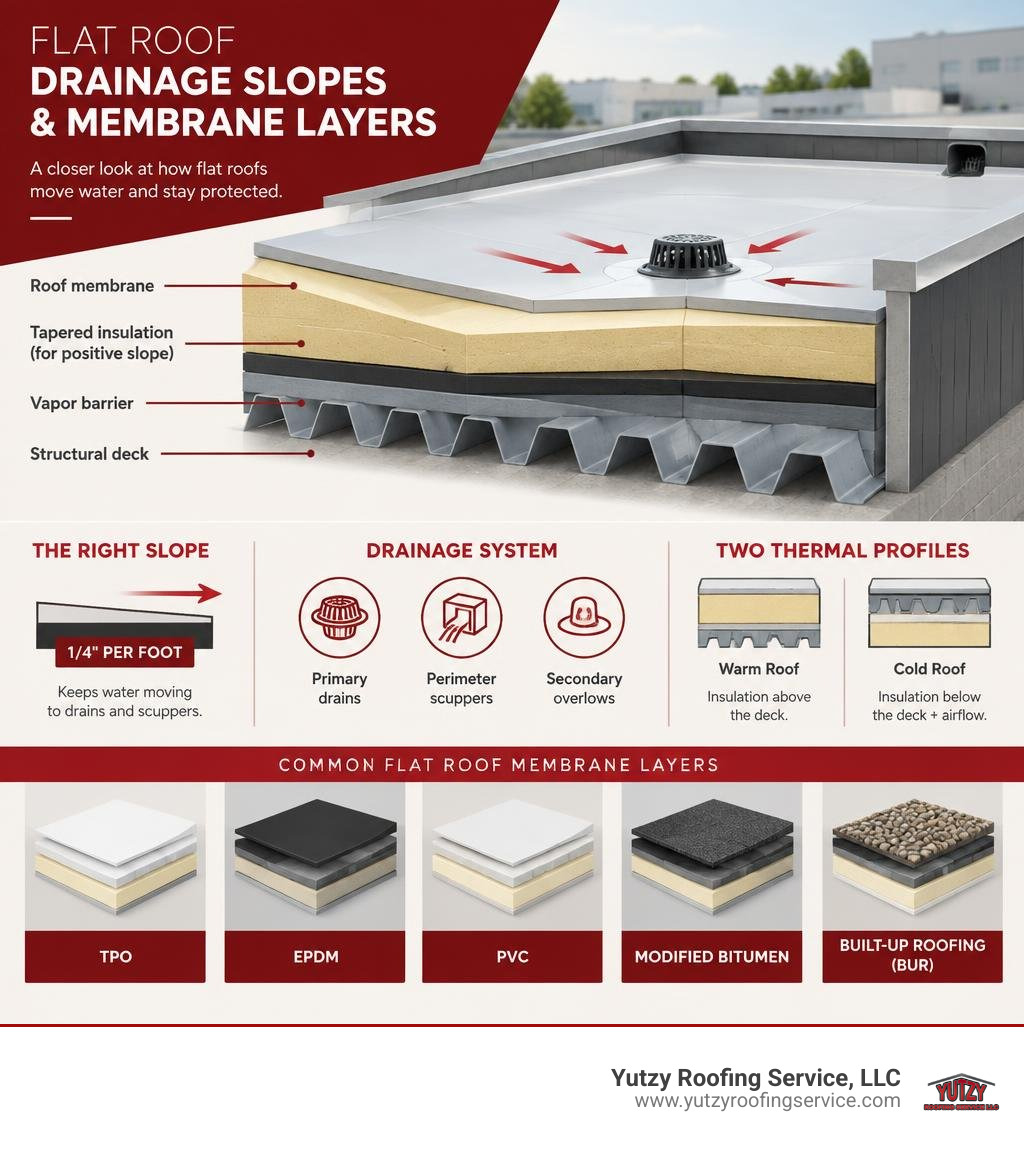
Tapered polyiso insulation boards are often cut at specific angles to create artificial slopes on completely flat decks. This positive slope channels water directly into drains, extending the service life of every component installed above it.
Comprehensive Comparison of Modern Flat Roof Types
Selecting from different flat roof material types requires balancing upfront budget constraints, anticipated foot traffic, chemical exposures, and regional weather conditions.
According to National Roofing Contractors Association (NRCA) surveys, single-ply systems dominate commercial applications. TPO leads the single-ply market at roughly 60%, EPDM accounts for about 20%, and PVC holds approximately 10%. Multi-ply asphaltic systems such as modified bitumen and built-up roofing make up the remaining share of low-slope assemblies. Understanding the broader landscape of roof membranes for low-slope roofs allows facility managers to choose the best performance profile for their facility.
| Flat Roof System | Installed Cost (Sq. Ft.) | Expected Lifespan | Primary Strengths | Common ASTM Standard |
|---|---|---|---|---|
| TPO | $7 – $12 | 20 – 30 years | High solar reflectivity, hot-air welded seams | ASTM D6878 |
| EPDM | $5 – $9 | 25 – 30+ years | Superior freeze-thaw flexibility, puncture resistance | ASTM D4637 |
| PVC | $9 – $15 | 25 – 30 years | Chemical, oil, animal fat, and fire resistance | ASTM D4434 |
| Modified Bitumen | $6 – $11 | 15 – 25 years | Multi-layer redundancy, tear resistance | ASTM D6162 / D6163 |
| Built-Up (BUR) | $5 – $10 | 20 – 30+ years | Heavy foot-traffic tolerance, exceptional puncture strength | ASTM D2178 |
| SPF + Coating | $6 – $12 | 20 – 50+ years | Seamless monolithic insulation, renewable lifecycle | ASTM D7425 / C1029 |
Single-Ply Flat Roof Types: TPO, PVC, and EPDM

Single-ply membranes consist of flexible sheets of synthetic polymers installed in a single, waterproof layer.
- TPO (Thermoplastic Polyolefin): TPO is the most widely installed single-ply material. Manufactured in thicknesses ranging from 45 mil to 80 mil (with 60 mil serving as the commercial standard), TPO features heat-welded seams that fuse into a monolithic joint. Its bright white surface delivers high solar reflectance, reducing rooftop surface temperatures significantly during summer heat waves.
- PVC (Polyvinyl Chloride): PVC is a premium thermoplastic membrane engineered for harsh environments. Because of its plasticized formulation, PVC resists rooftop chemical exposure, jet fuel, and animal fats. It is the premier choice for food processing facilities, manufacturing plants, and restaurants with rooftop grease exhaust vents.
- EPDM (Ethylene Propylene Diene Monomer): Often called synthetic rubber, EPDM has protected low-slope buildings since the 1960s. Formulated with carbon black for UV stability, EPDM sheets (typically 45 or 60 mil) offer unmatched elasticity in extreme cold. Systems can be mechanically fastened, fully adhered with industrial adhesives, or ballasted with smooth river stone.
Multi-Ply and Asphaltic Flat Roof Types: BUR and Modified Bitumen
Asphaltic assemblies use alternating plies of reinforcing fabric and bitumen for redundant waterproofing.
- Built-Up Roofing (BUR): BUR has protected facilities for over a century. It consists of multiple layers (typically 3 to 5 plies) of asphalt felts laminated together with hot coal tar pitch or asphalt, topped with an aggregate gravel layer. While heavy, BUR is exceptionally resilient against heavy foot traffic, hail, and mechanical impacts.
- Modified Bitumen: An evolution of BUR, modified bitumen incorporates asphalt modified with synthetic rubbers (SBS, or Styrene-Butadiene-Styrene) for cold-weather flexibility or plastic polymers (APP, or Atactic Polypropylene) for heat resistance. Installed via torch-down techniques, cold-applied adhesives, or self-adhering cap sheets, it provides multi-layer strength with simpler installation logistics. Understanding how long a flat roof lasts often comes down to tracking the ply count and UV exposure on these asphalt cap sheets.
Fluid-Applied Systems and Spray Polyurethane Foam
For facilities seeking seamless barriers without traditional tear-offs, fluid-applied systems and Spray Polyurethane Foam (SPF) deliver advanced waterproofing.
SPF is applied as a two-component liquid that expands into a rigid, closed-cell foam layer directly over an approved substrate. It provides continuous, gap-free thermal insulation with high R-value performance. Because SPF degrades under ultraviolet radiation, it must be protected by a weather-resistant topcoat.
Applying an elastomeric commercial flat roof coating—such as high-solids silicone or acrylic—creates a seamless protective skin. These coatings encapsulate tricky penetrations, scuppers, and flashings without vulnerable seams. Best of all, fluid-applied systems can be recoated every 10 to 18 years, creating an indefinitely renewable roof lifecycle without filling local landfills.
Strategic Material Selection and Long-Term Maintenance
Choosing the best flat roof assembly requires evaluating structural capacity, local climate conditions, environmental exposures, and long-term operating costs.
Climate Compatibility and Energy Performance Factors
Regional weather patterns dictate material longevity. In regions characterized by extreme winter freeze-thaw cycles—such as Wisconsin and Minnesota—membrane flexibility is critical. EPDM and SBS-modified bitumen excel at sub-zero temperatures because they expand and contract without cracking.
Conversely, facilities prioritizing cooling energy savings benefit from membranes with a high Solar Reflectance Index (SRI), such as white TPO or silicone-coated roofs. Reflective cool roof membranes can lower ambient surface temperatures by up to 50°F, reducing building HVAC energy demand by 15% to 25% during warm months.
Membrane assemblies must also meet regional wind-uplift codes, such as UL 580 and UL 1897 standards, ensuring that fasteners and perimeter flashings withstand severe storm events.
Cost Analysis, Installation, and Contractor Selection
Commercial flat roof replacement costs generally range between $4 and $15 per square foot, depending on the membrane type, insulation thickness, and roof height. Labor represents 40% to 70% of total project expenditure, while old membrane removal and disposal can add $1 to $5 per square foot.
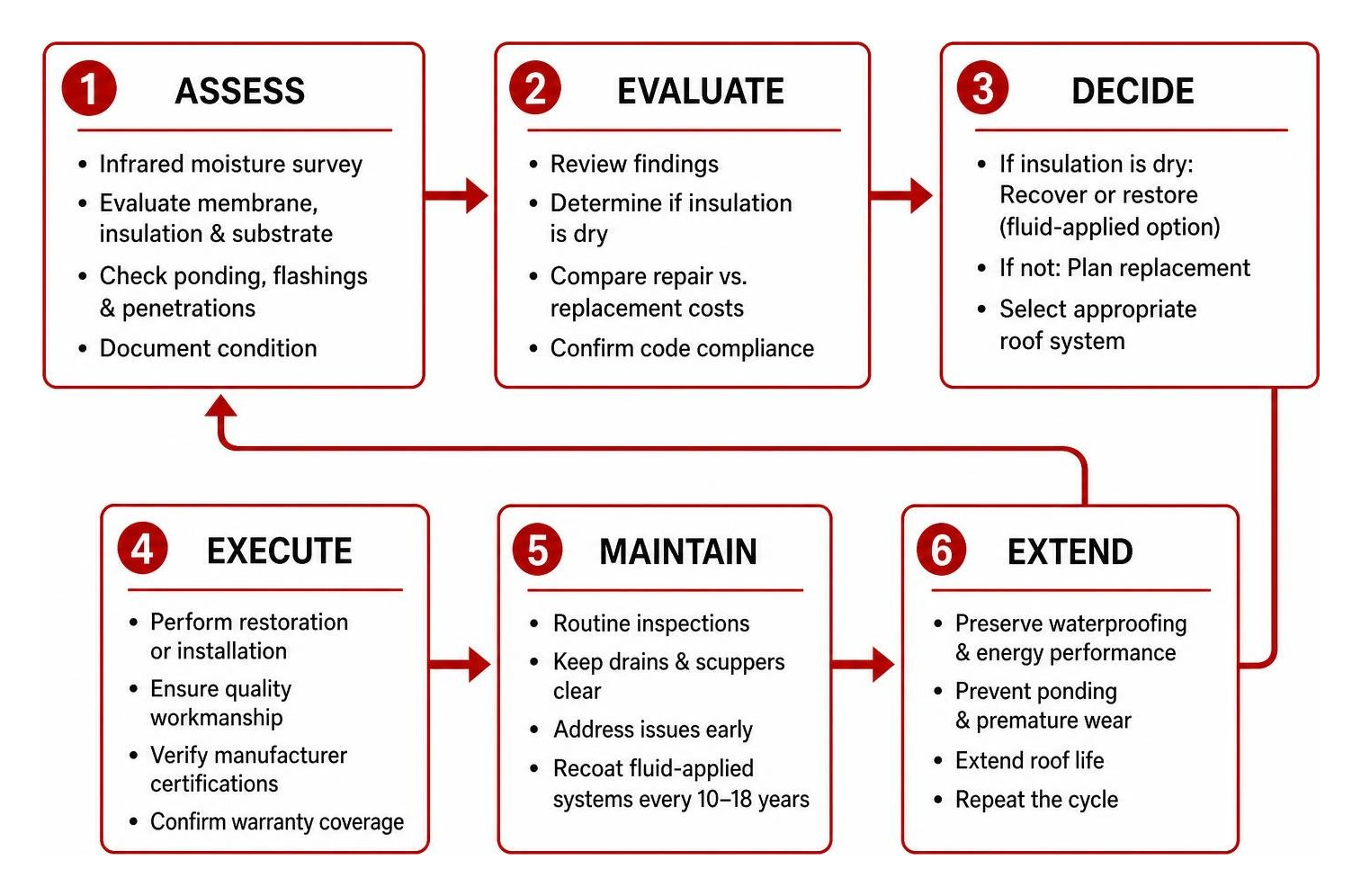
Before undertaking a costly full tear-off, building owners should commission an infrared moisture survey. If insulation boards remain dry, the International Building Code (IBC) often allows an existing system to receive a roof recover or fluid-applied restoration, cutting installation expenses in half.
Always verify that your roofing partner holds manufacturer certifications, full commercial liability insurance, and clear non-prorated warranty coverage.
Preventive Maintenance, Ponding Prevention, and Restorations
Even the most durable roofing systems fail prematurely if basic upkeep is neglected. Ponding water—defined as standing water that remains on a roof for more than 48 hours after precipitation—accelerates UV degradation, stresses structural decking, and invalidates many standard manufacturer warranties.
We recommend implementing a bi-annual preventive maintenance checklist:
- Clear Drainage Pathways: Remove leaves, sediment, and debris from all internal drains, conductor heads, and scuppers.
- Inspect Penetrations and Seams: Check HVAC curbs, pipes, and wall flashings for splits, unbonded laps, or cracking sealant. Applying a high-grade waterproof sealant for flat roofs prevents minor separations from turning into active leaks.
- Monitor Membrane Integrity: Inspect high-traffic walkways for punctures, fastener back-outs, or mechanical gouges.
- Plan Restorations Early: Facility managers can restore a commercial flat roof with elastomeric coatings before widespread membrane failure occurs, securing up to 18 years of renewable warranty protection.
By investing in professional flat roof maintenance services, property owners in Marshfield, Madison, Appleton, Green Bay, Wausau, Eau Claire, Fond Du Lac, Rochester, and Mankato can maximize their capital investment. To explore tailored restorations, coating systems, and maintenance plans for your industrial or commercial facility, connect with our team at Yutzy Roofing Service today.
